
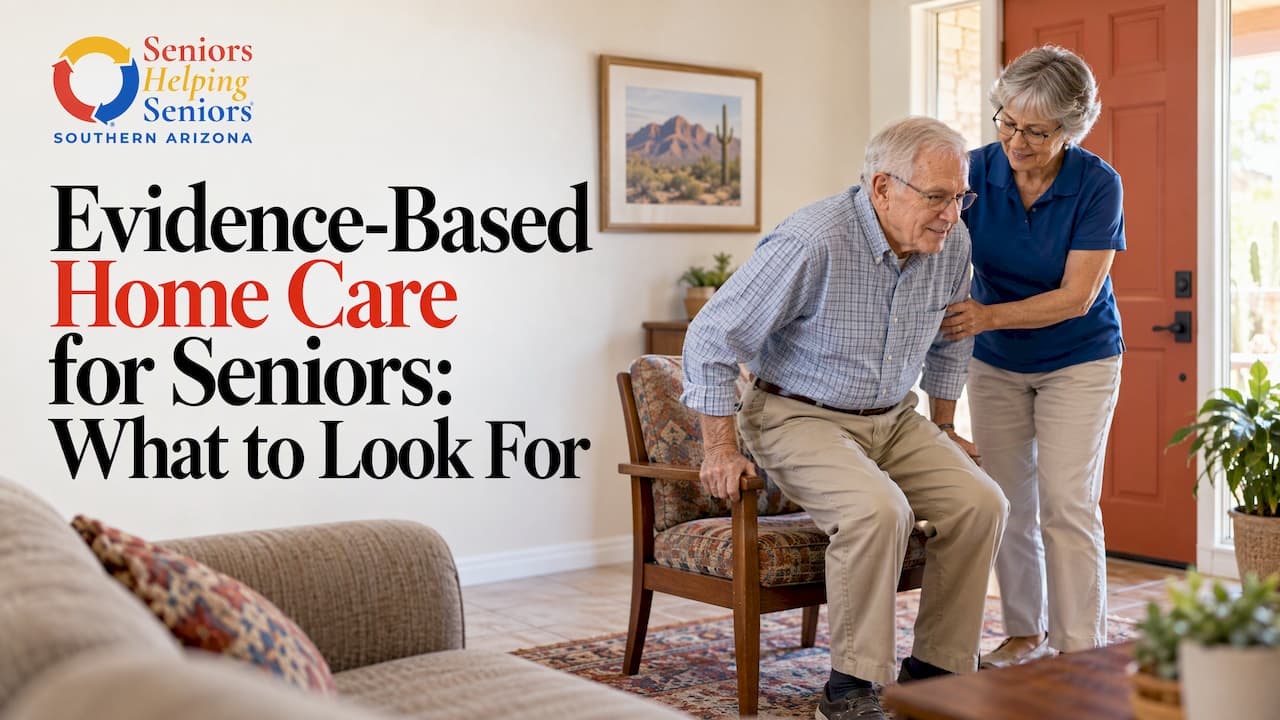
Evidence-based home care means the help your loved one receives at home is built on practices that research has linked to better safety, independence and well-being, and is shaped around the person's own goals. It is not a brand name or a single program. It is a way of planning care: define the problem, set a goal with the senior, choose practices with support behind them, and check that they are actually being followed. Here is what that looks like in a Tucson living room, and how to ask for it.
Key Takeaways
- Evidence-based home care starts with the person's goals, then picks practices that research supports, such as fall-risk reduction, home modification, exercise and consistent caregivers.
- A 2023 JAMA report says removing home hazards like clutter, poor lighting and stairs without railings can cut falls by 26% in older adults, and by 38% in those at higher risk.
- Consistent, reliable and respectful caregivers are central to client satisfaction, so who shows up matters as much as what they do.
- You can check a plan yourself: ask for a written care plan, the goal behind each task, and how the provider will notice if something changes.
- Non-medical home care works best alongside, not instead of, your doctor's guidance, especially with dementia, Parkinson's or heart conditions.
Table of Contents
- What evidence-based home care actually means
- How it differs from home health care
- Practices with research behind them
- What research links to better outcomes
- Why the caregiver matters as much as the method
- Companionship is part of care, not a luxury
- How to tell whether a care plan is person-centered and safe
- Working with family and health professionals
- What veterans and their families should know
- Our perspective
- Care built around your family
- FAQ
- Sources
What evidence-based home care actually means
The phrase sounds clinical, but the idea is simple. Instead of doing things the way they have always been done, a good provider asks what problem needs solving, what outcome would make life better, and which approaches have been tested and found helpful.
That order matters. A practice guide on evidence-based home care describes standardized care plans as a way to carry research into daily routines in enough detail that the help is delivered the way it was meant to be. In plain terms, a good plan is written down, specific, and repeatable from one visit to the next.
For older adults, researchers often use the term home and community-based services. A 2024 systematic review, with a literature search through December 7, 2023, found a range of approaches in U.S. studies: nonpharmacological dementia care, physical rehabilitation, self-directed home care and interdisciplinary care coordination. Those are very different services, which is why "evidence-based" is only useful when you ask: evidence for what, and for whom?
How it differs from home health care
Families often mix up two things that sound alike.
Home health care is medical. It is ordered by a doctor and delivered by licensed professionals such as nurses and physical, occupational or speech therapists.
Non-medical home care is everyday support: companionship, help with bathing and dressing, meals, light housekeeping, rides to appointments, medication reminders and respite for family caregivers. This is the kind of care we provide at Seniors Helping Seniors® Tucson.
Both can follow evidence. A nurse follows clinical protocols. A companion caregiver follows a care plan built around fall prevention, nutrition, activity and connection. The two often work side by side, and the best results come when everyone knows what the others are doing.
Practices with research behind them
You do not need to read a stack of journals. A handful of practices come up again and again, and they are the ones worth asking about.
Reducing fall risk at home
Falls are the area with the clearest research. A 2021 network meta-analysis found that a combination of home modification, assistive technology, quality improvement, orthostatic hypotension management and basic falls risk assessment was associated with fewer people falling. The 2023 JAMA report mentioned above puts a number on the simplest piece: minimizing clutter, poor lighting and stairs without railings can reduce the rate of falls by 26% in older people, and by 38% in those at higher risk.

This is practical, not high-tech. A caregiver who walks the home with you, moves the loose rug, brightens the hallway and notices that the bathroom has no grab bar is doing evidence-based work. Our room-by-room home safety checklist walks through exactly that, and our caregiver-first fall prevention plan explains a three-step approach families can start this week.
Tucson has its own wrinkles. Many homes have steps at the entry, desert gravel yards, patios with uneven pavers and, in the foothills, sloped driveways. If you live on a hillside, our piece on fall prevention in Catalina Foothills houses covers the specifics.
Staying strong with exercise
Home-based exercise has solid support. A 2025 academic review of home healthcare services notes that digital home-based exercise programs can enhance lower-body strength and improve quality of life and balance for older adults. You do not need a screen to benefit from the principle: regular, supervised, safe movement at home helps.
If your parent finds it hard to get out, start small. These 10 to 20 minute chair exercises are designed so a caregiver can guide them safely. For a closer look at moves that train steadiness, this guide to balance training for seniors is a good companion read.
Reablement: doing things again, not just having them done
The same 2025 review reports that reablement and restorative homecare, when led by occupational therapists, significantly improve activities of daily living, mobility and overall quality of life. The idea is to help a person regain skills, not simply take over tasks.
A companion caregiver is not a therapist, and we do not claim to be. But the mindset carries over. When someone is recovering from a hospital stay, a good caregiver encourages them to do what they safely can, stands close, and follows the therapist's plan. That is the thinking behind our Return Home Transitional Care.
Technology with a person behind it
Wearable alerts and sensors can help, and the falls research includes assistive technology as part of effective combinations. But a device cannot notice that Dad skipped lunch or seems unusually quiet. We wrote about why wearables need caregiver backup for exactly that reason.
What research links to better outcomes
When researchers look across home care studies, the same outcomes appear. The 2025 review associates evidence-based home care with reduced hospital readmissions, fewer nursing home admissions, improved medication adherence and higher client satisfaction. It also describes home-based medical care, which combines primary and palliative care, as a model documented to reduce hospitalizations, emergency room visits and long-term care admissions.
The 2024 systematic review adds that studies most often measure hospital admissions or readmissions, mortality and function, while the people consulted for the review pointed to quality of life and person-centered outcomes as just as important. That second point is worth holding onto. A care plan can look good on paper and still miss what matters to your mother: sitting on the patio in the morning, getting to church, cooking her own eggs.
The research also shows that the field is still growing, and that more work is needed on how home care serves specific groups, including ethnic, racial and sexual minorities. For families, that is a reason to talk openly with a provider about culture, language, faith and routines, and to expect the plan to reflect them. Tucson is a bilingual, multicultural community, and care should be too.
Why the caregiver matters as much as the method
Here is a finding that surprises people who expect research to be all about techniques. A 2023 scoping review of satisfaction and quality in home-based services identified consistent, reliable and respectful care providers as central drivers of client satisfaction.
In other words, the same trusted face, arriving when promised, treating your parent with respect, is part of the quality. It is not a nice extra.
This is why we match caregivers and clients by temperament, interests and life experience. Our caregivers are mature adults, many of them seniors themselves, who live in the communities they serve. A retired teacher may click with a former librarian. A man who spent his career in the Air Force may feel at ease with a caregiver who understands that rhythm. We think shared experience builds the kind of trust that lets someone accept help with a bath or a pill organizer without feeling diminished. That is our approach, and it is designed around what clients and families tell us matters.
Companionship is part of care, not a luxury
Loneliness does not show up on a medication list, but it shapes how a person eats, moves and sleeps. Support for emotional well-being belongs in the care plan alongside bathing and meals.
In practice, that can mean a morning walk, a game of cards, a drive to the farmers market, help writing to a grandchild, or simply someone who listens to the same story with interest the fifth time. Our guide to keeping seniors independent at home lays out eight low-friction steps where companion care fits in.
How to tell whether a care plan is person-centered and safe
The Centers for Medicare & Medicaid Services define person-centered planning for home and community-based services as a facilitated, individual-directed approach that coordinates services around the person's own aspirations, preferences, values and needs, as described in the 2024 systematic review. The review also argues that providers should monitor fidelity to the recipient's stated goals and verify that evidence-based practices are followed. An expert panel convened by the Institute for Healthcare Improvement similarly names self-determination and person-centered care as fundamental to care in the home, according to this safety report.
That gives you a clear way to evaluate any provider. Ask these questions at the first conversation.
- What are my parent's goals? A good provider asks before proposing tasks. "Stay in my own home" and "get to my granddaughter's games" lead to different plans.
- Is the plan in writing? You should see what will be done, how often, and why. Our five steps for person-centered in-home care shows what a good plan includes.
- Is there a home safety review? Look for a walk-through that covers lighting, clutter, rugs, stairs, bathrooms and entryways.
- Who will come, and will it be the same person? Consistency is tied to satisfaction in the research. Ask how matching works and what happens when a caregiver is out.
- How are changes noticed and shared? A new bruise, a skipped meal or increased confusion should reach the family, and when appropriate the doctor.
- How are caregivers vetted and insured? You should get a plain answer, in writing if you want it.
- How easy is it to adjust? Needs shift after a hospital stay or a bad week. Ask about minimums, notice periods and contracts before you sign anything.
A provider that welcomes these questions is usually one that has thought about them. One that treats them as an annoyance is telling you something.
Working with family and health professionals
Home care is rarely a solo act. A systematic review of home and community care models describes case management as a collaborative process of assessment, planning, facilitation and advocacy, and cautions that it does not automatically produce coordinated care. The same review suggests that combining models, such as case management, integrated care and consumer-directed services, may maximize clinical and quality-of-life outcomes for frail older people.
For families, the lesson is to make coordination someone's actual job. Decide who talks to the doctor, who keeps the medication list, and who gets the call if something changes. Give the caregiver the doctor's instructions, such as diet limits, activity guidance or warning signs, so the daily routine follows them.
This matters most with specialized conditions. For dementia, Parkinson's or heart failure, the daily routine, the environment and the caregiver's approach all affect how the person feels, while diagnosis and treatment stay with the medical team. Our family care plan for heart failure home care is an example of how a matched caregiver can support a physician's plan with daily observation and encouragement. Personal care deserves the same thought: see our guide to safer, dignified toileting at home for family caregivers.
What veterans and their families should know
Many Tucson families include a veteran, and some do not realize that benefits for in-home help may exist. Eligibility and coverage depend on the veteran's service history, health status and the program, so the right first step is to contact the U.S. Department of Veterans Affairs or an accredited veterans service officer, who can explain current options and help with applications. Ask them what home and community-based services the VA can cover in your situation.
Meanwhile, the person-centered questions above apply just as well. Veterans often value routine, directness and a caregiver who understands that experience. We offer veteran care and can talk through how our hourly, flexible schedules could fill gaps that other programs leave open.
Our perspective
We have sat at a lot of kitchen tables in Tucson, and the question families ask us is rarely about research. It is: "Will my mom be safe, and will she still feel like herself?" Evidence-based care is how we answer both.
To us, it means we do not guess. We look at the home for the things that cause falls. We build a plan around what the senior says matters. We keep the caregiver consistent, because trust is part of care. And we tell the family what we see, so the doctor, the family and the caregiver are all working from the same page.
We also believe in the peer relationship. Our caregivers are mature adults, often seniors themselves, who understand what it means to want your independence. When a caregiver and a client share a background, a love of gardening, or a memory of the same neighborhood, help feels like friendship. That is the kind of care we would want for our own parents.
Our approach is built to support dignity, flexibility and safety: no minimums, no long-term contracts, and vetted, insured caregivers who live in your community.
Cameron
Care built around your family
If you are weighing options for a parent, spouse or yourself, we can start with a conversation about goals, routines and the home. Our caregivers provide companion care, personal care, transportation and errands, light housekeeping and meals, medication reminders, dementia and Alzheimer's support, Parkinson's support, and respite and overnight care. We serve Tucson, Corona de Tucson, Tucson Estates, Green Valley and Sierra Vista.
See all of our in-home care services, learn about Return Home Transitional Care after a hospital stay, or read about in-home senior care in Green Valley. You can also reach us any time through our website.
FAQ
Is evidence-based home care the same as home health care?
No. Home health care is medical care ordered by a doctor and delivered by licensed clinicians. Evidence-based home care is a way of planning and delivering support, medical or non-medical, around practices that research supports. Non-medical care such as companionship, personal care and fall-risk reduction can follow that approach too.
What is the most useful thing a caregiver can do to prevent falls?
A home safety review is a strong start. The 2023 JAMA report linked reducing hazards such as clutter, poor lighting and stairs without railings to a 26% lower rate of falls, and 38% for people at higher risk. After that, regular safe movement, steady footwear and a doctor's review of medications and blood pressure are worth discussing.
How do I know a provider is person-centered?
Look for questions about your parent's goals before any talk of schedules, a written plan that reflects them, and the same caregiver visiting consistently. Research on home-based services ties consistent, reliable and respectful caregivers to higher satisfaction. Ask how the provider will notice and report changes.
Can home care help someone with dementia or Parkinson's?
Yes, as a supportive layer alongside medical care. A matched caregiver can provide steady routines, safe surroundings, companionship and observation that helps the family and the doctor. Treatment decisions stay with your physician, and it helps to share their guidance with the caregiver.
Do I have to sign a long-term contract?
With us, no. We offer flexible scheduling with no minimums or long-term contracts. Whichever provider you consider, ask about minimum hours, notice periods and cancellation terms before starting.
Sources
- Evidence-based standardized care plans for home care
- Home and Community-Based Services: A Systematic Review (2024)
- Interventions for preventing falls and fall-related injuries (2021 network meta-analysis)
- JAMA: Systematic Review: What Works to Prevent Falls for Older Adults (2023)
- Home Healthcare Services and Interventions for Older Adults (2025)
- Examining Satisfaction and Quality in Home- and Community-Based Services (2023)
- A systematic review of different models of home and community care
- No Place Like Home: Advancing the Safety of Care in the Home (2018)