
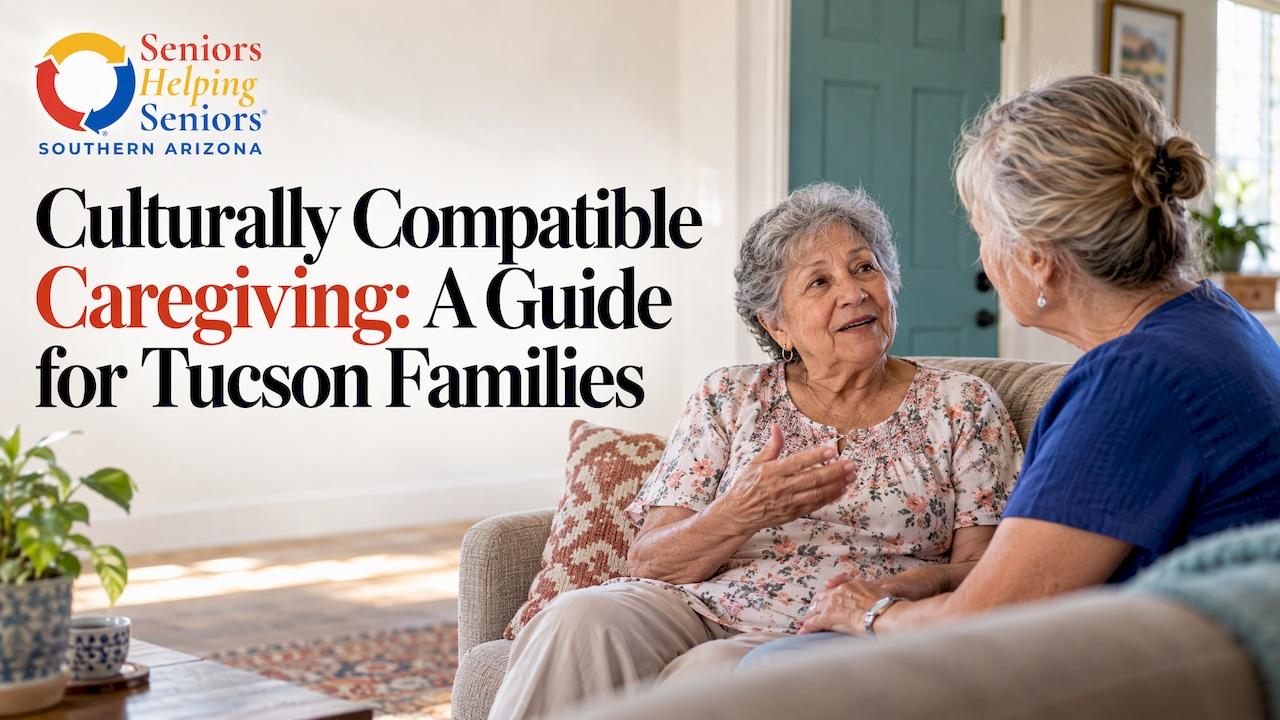
Culturally compatible caregiving means that the person helping you at home respects how you live, what you believe and how you like things done, and learns those things from you instead of guessing. It is care shaped around one person's background, language, faith, food, family roles and daily habits. The strongest version pairs that respect with a caregiver who shares real life experience with you, which is why we match our senior caregivers to the seniors they serve.
This guide is for older adults, families and veterans in the Tucson area who are choosing in-home help. It explains what the term covers, what the research says, how to tell a caregiver what matters to you, and what to ask before you sign anything.
Key Takeaways
- Culturally compatible care is individualized care that respects a person's beliefs and preferences without stereotyping. Researchers describe it as care free of prejudice and bias.
- Culture can shape communication, family roles, decisions and beliefs about health, so the safest approach is to ask the person and not assume.
- Translation alone is not enough. A 2024 scoping review says culturally adapted support must reflect values and social context too.
- A written plan that says who does what, when and how keeps everyone on the same page and keeps the older adult in charge.
- We match caregivers and clients by shared life experience, with flexible scheduling and no minimums or long-term contracts.
Table of Contents
- What culturally compatible caregiving really means
- How culture shapes the way care is received
- Why it matters when care happens at home
- Questions to ask a caregiver in the first visit
- Putting preferences into a plan that everyone follows
- Veterans and culturally compatible care
- Why matching on life experience makes a difference
- Perspective from our team
- How we can help in Tucson and southern Arizona
- A simple checklist for choosing culturally compatible care
- FAQ
- Sources
What culturally compatible caregiving really means
The phrase sounds technical, but the idea is simple. Every person has a way of living that comes from where they grew up, what they believe, who raised them and what they have been through. Good care fits into that life. It does not ask the person to fit into the caregiver's routine.
An academic article on care for older adults defines this as individualized, patient-centered care that respects the cultural influences on a person's behavior, attitudes, preferences and health-care decisions. The same article is just as firm about what it is not: care without prejudice, stereotyping or bias.
That last point matters. Culture is not a checklist you apply to a person based on their last name or accent. Two women who both grew up in Tucson, both worship at the same church and both speak Spanish at home can want completely different things at breakfast, at bath time and when it comes to who makes decisions. Compatibility starts with the individual.

Culture is more than language or ethnicity
In everyday care, culture shows up in small, practical places:
- How a person likes to be addressed, as Mr., Mrs., by first name, or by a family title.
- Which foods are comfortable, which are avoided, and who traditionally cooks.
- Whether a bath, dressing or toileting help feels acceptable from a man, a woman or only a family member.
- Prayer, holidays, music and quiet times that anchor the week.
- Military service, a first career or a long marriage, which shape how people see themselves.
That last item is why veterans often do well with a caregiver who understands service life. Military culture has its own humor, routines and sense of duty.
How culture shapes the way care is received
A caregiver toolkit from the Presbyterian Church (USA) explains that culture may influence verbal and nonverbal communication, family and gender roles, decision-making and beliefs about health and illness. It warns that eye contact, touch, how men and women interact, answering only yes or no, and expectations about the eldest child can all vary from person to person.
The toolkit's advice is the one we would give any family: learn the individual's expectations rather than assuming them.
Who decides, and who helps
Family roles can be strong, and they are not the same in every home. A 2023 review of home and community-based services reports that younger women may be expected to provide care in Hispanic families, while the oldest son and his wife may be expected to do so in Asian families. It also describes familism, a deep commitment and loyalty to family, and notes that Asian caregivers may feel the pull of filial piety, the idea that adult children owe care and respect to their parents.
Those are patterns, not rules. In Tucson, where about 22% of Pima County residents were 65 or older in 2023, families come from many backgrounds. The point of knowing the patterns is to ask better questions: Who in the family usually helps? Who speaks for you at the doctor's office? What would feel like a loss of dignity?
Trust is built through respect
Stanford Geriatrics' guidance on Filipino American elders shows how trust can work. It describes that group as often more open with providers seen as respectful and accommodating, while a family member may speak for the elder if the provider is not yet part of the trusted circle. The guidance is specific to that community and should not be applied to everyone, but the lesson travels: people open up when they feel respected, and a caregiver who has not earned that yet will hear less about what is really needed.
Why it matters when care happens at home
In a hospital, staff rotate and routines belong to the institution. At home, the caregiver is a guest in the most personal space a person has. Kitchen habits, religious objects, family photos and the way the day unfolds are all in plain view.

A 2019 U.S. study of 158 caregivers of Chinese- and Spanish-speaking patients with limited English found that 90% performed at least three caregiving roles after hospital discharge, such as helping at home, making medical decisions, handling forms and talking with clinicians. The same study found that only 12% of patients reported access to a professional interpreter when discharge instructions were given, and that 40% of caregivers reported moderate or high stress. When communication breaks down at the moment someone comes home, families carry the weight.
The American Psychological Association notes that culturally relevant interventions and bilingual or bicultural staff are likely to increase service use among diverse caregivers. In plain terms: families are more willing to accept help when the help feels like it understands them.
What the research does and does not promise
A 2024 review of culturally adapted support for Latino dementia caregivers concluded that adapted programs can increase the support available and reduce inequities. It also stresses that Spanish translation is necessary but not sufficient. Adaptation should reflect cultural values and social context, and be shaped by caregivers and community members themselves. That is a useful standard for any family evaluating a provider: look past the brochure language and see how the caregiver actually engages with your life.
Questions to ask a caregiver in the first visit
A good first conversation is not an interview of the older adult. It is a chance to set up the relationship. Toolkit guidance recommends keeping communication simple, using an interpreter when needed, backing up speech with pictures or writing, and asking rather than inferring. Here are questions that put that advice to work:
About daily life. What does a good day look like for you? What time do you like to wake up and eat? Which meals are comfort foods, and which are never served?
About personal care. Is there anything about bathing, dressing or toileting that would make you uncomfortable? Would you prefer a caregiver of a particular gender for those tasks?
About family. Who do you want involved in decisions? Who should we call first if something changes? Is there someone who should not be contacted?
About faith and tradition. Are there prayers, holidays, fasting days or customs the household observes? Is there a time of day when you want quiet?
About communication. What language do you think and feel in? Do you prefer written notes, pictures or a conversation? How do you like to be addressed?
About history. Where did you work? Did you serve in the military? What are you proud of? Those answers often tell a caregiver more than a medical form.
Write the answers down. They become the backbone of the care plan, and they let a new or substitute caregiver start with respect instead of guesswork. Our guide to home care questions every family should ask first covers the practical side as well.
Putting preferences into a plan that everyone follows
Cultural compatibility only works if it lives in the plan and not in someone's memory. Miami University's Scripps Gerontology Center describes the best arrangement as one that takes everyone's needs, strengths, preferences and limitations into account and spells out who does what, when, where and how. The same guide treats the person receiving care as an active care partner, not a passive recipient.
Hold a family conversation
The guide supports structured family meetings in which each person shares perceptions, preferences, strengths and limits, and the group builds a shared plan. A few tips for making that conversation work:
- Start with the older adult. Ask what they want before anyone else speaks.
- Define family broadly. The 2023 review recommends involving relevant family members while recognizing that family can include friends, neighbors and others.
- Name the disagreements kindly. If a daughter expects to do the bathing and her mother would rather have someone else, it is better to say so than to let resentment build.
- Write the plan down, with names and times.
- Revisit it after a few weeks. Needs and comfort levels change.
Schedules are a big part of this. If your family wants help around prayer times, a grandchild's visit or a weekly card game, build the week around those. Our caregiver schedule planning guide walks through how to do it.
Keep independence at the center
Respect for culture and respect for independence go together. A family's expectations, however loving, should not override what the older adult says. When a conflict comes up, return to the person's own words: What do you want here? A caregiver who listens first and supports the family's role second helps everyone stay steady.
Veterans and culturally compatible care
Many veterans in southern Arizona want help at home but do not want to feel like a patient. The VA's 2023 policy brief says home and community-based services can offer flexible, individualized long-term support that preserves autonomy and helps with daily activities such as eating, bathing, dressing, toileting and mobility.
Research on VA home-based primary care adds that home visits reveal medical and social complexity that clinics miss and help meet practical needs that are often nonmedical. A caregiver who sits in the living room and listens learns what a clinic cannot see.
For veterans, the practical questions are the same as for anyone: What routines matter? What is hard to talk about? Who should be called? A caregiver who understands the rhythms of service life, or who simply has years of life experience of their own, can often get to the real answers sooner. Families should also talk with their VA care team about benefits that may apply to their situation.
Why matching on life experience makes a difference
Most approaches to cultural competence train a caregiver to be aware, informed and open. Those are essential: the 2015 academic framework describes a process of desire, awareness, knowledge, skills, collaboration and encounter. We believe the encounter itself, the daily human meeting between two people, is where compatibility is won or lost.
That is why our caregivers are mature adults, often seniors themselves, and why we match them with clients based on shared life experience. A caregiver who has raised a family, buried a spouse, worked a long career or lived through the same decades often understands without a long explanation. That shared ground makes it easier for a client to say, "This is how I like it," and be heard.
Perspective from our team
We have always believed that care begins with the question, "Who are you?" before it gets to, "What do you need?" A list of tasks can be done by anyone. A good day for a senior depends on whether the person in the room understands the way that senior lives, and respects it.
That is why Seniors Helping Seniors® Tucson is built around caregivers who are seniors themselves. They bring their own decades of experience, and we match them with clients who share some of that life story. Shared history opens conversation, eases loneliness and turns a service into a relationship.
Culture is not a category we assign to anyone. It is what each person tells us about their home, their family, their faith and their habits. Our job is to listen, write it down and make sure every caregiver who walks through the door honors it. Families choose us because they want dignity and personal attention for someone they love, and they want flexibility without minimums or long-term contracts.
If you are weighing your options, start by telling us what matters most to the person who will receive care. We will build from there.
Cameron
How we can help in Tucson and southern Arizona
We provide in-home care across Tucson, Corona de Tucson, Tucson Estates, Green Valley and Sierra Vista. Our caregivers are vetted, insured and live in the communities they serve, and care is coordinated locally. Scheduling is flexible, with no minimums or long-term contracts.
Our full list of services includes companion care, personal care, transportation and errands, light housekeeping and meals, medication reminders, respite and overnight care, and specialized support for dementia and Alzheimer's and for Parkinson's. We also offer veteran care and Return Home Transitional Care for the weeks after a hospital stay.
If loneliness is the biggest concern, start with companion care. If memory loss is changing how your parent communicates, our dementia care page explains how we support clients and families. If you are heading home from the hospital, see Return Home Transitional Care. To talk through your family's preferences, you can reach us through our home page.
A simple checklist for choosing culturally compatible care
When you speak with any home care provider, listen for these things:
- They ask about the older adult's history, routines and preferences before talking about tasks.
- They explain how caregivers are matched to clients, and on what basis.
- They record your preferences in writing and share them with every caregiver on the schedule.
- They involve the person receiving care in decisions, not only the family.
- They let you adjust the schedule as needs change.
For dementia, specific conditions and the weeks after a hospital stay, the same principle holds: the person's identity does not disappear because their needs change. Our guides to Parkinson's care at home and companion care at home show how that looks in practice.
FAQ
What is culturally compatible caregiving?
It is care that fits an older adult's own background, beliefs, language, family roles and daily preferences. Researchers describe it as individualized care that avoids prejudice, stereotyping and bias. In practice, the caregiver asks, listens and adapts.
Does it only matter for people who speak another language?
No. Language is one part, and interpreters are important when needed. A 2024 review found that translation alone is not enough without attention to values and social context. Faith, food, family roles, military service and life history all shape what feels respectful.
How do I tell a caregiver what my parent prefers?
Start with your parent's own words, then write down the answers: how they like to be addressed, their routines, foods, faith practices and who should be involved in decisions. Share the notes with every caregiver. Keep your communication simple and revisit the plan after a few weeks.
What if family members disagree about the care?
Hold a structured family meeting where each person shares preferences and limits, beginning with the older adult. Miami University's guide recommends building a shared plan that spells out who does what, when, where and how.
Do you match caregivers to clients?
Yes. Our caregivers are mature adults, often seniors themselves, and we match them with clients for compatibility and shared life experience. Tell us about your loved one's routines and history so we can build from there.
Sources
- Providing Culturally Congruent Health Care to Older Adults
- Cultural Diversity and Caregiving, Care Partner Toolkit
- Literature Review of Home- and Community-Based Services for Diverse Caregivers
- Cultural Values, Stanford Geriatrics
- Caregiving for Older Adults with Limited English Proficiency
- A Scoping Review on Culturally Adapted Support for Latino Dementia Caregivers
- Variations for practice with culturally diverse groups, American Psychological Association
- Guide for Professionals, Miami University Scripps Gerontology Center
- Policy Brief: Home and Community-Based Services, U.S. Department of Veterans Affairs
- "Eyes in the Home": Addressing Social Complexity in VA Home-Based Primary Care
- Tucson Then and Now: What Has Changed Over 75 Years