
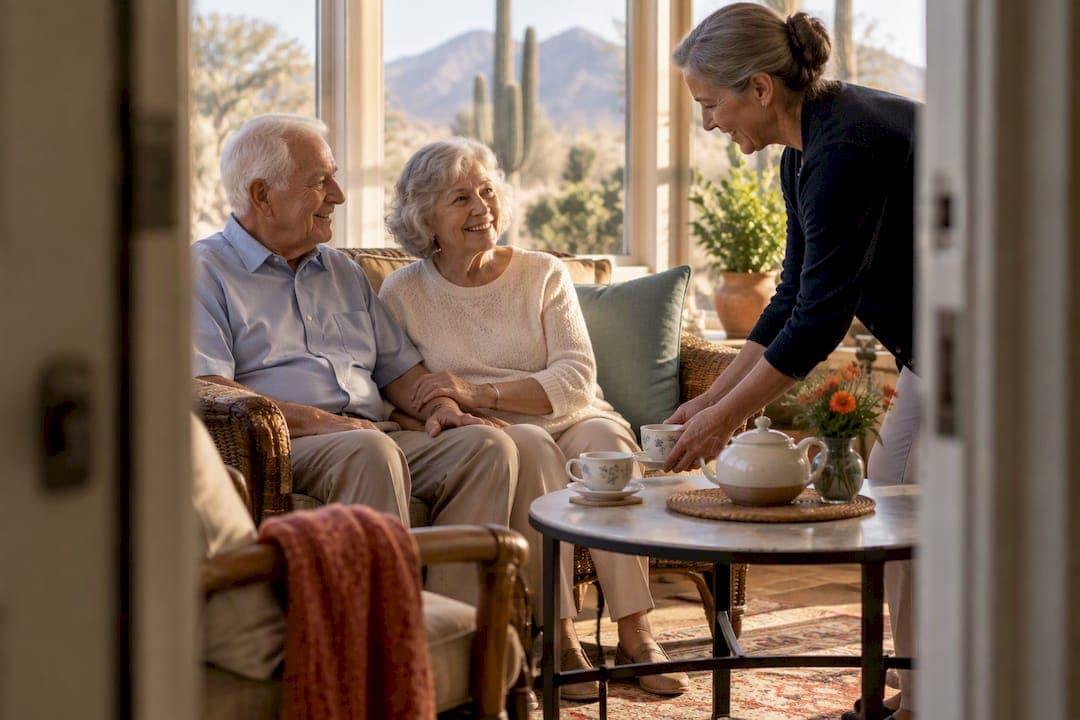
Most elderly couples can stay together, even as health needs grow, when families combine home-based supports, paid help like companion or personal care, safety upgrades, and a clear funding plan. That's the practical path for care for elderly couples who want to avoid separation. Start with three moves this week: a home safety check, a call to your local Eldercare Locator, and a short trial run of paid in-home help before committing to anything bigger.
TL;DR:
- Most elderly couples can remain together by utilizing a mix of safety upgrades, in-home paid help, and clear funding plans before crises occur.
- Medicare only covers skilled medical services for homebound patients, not daily custodial care like bathing or companionship, which families must budget for privately or through Medicaid.
- Structuring a written, rotating care plan with designated tasks and involving both spouses prevents caregiver burnout and maintains couple connection.
- Assisted living and memory care communities vary widely in policies for couples, especially regarding shared rooms and care divergence, so written policies should be verified upfront.
- Hiring mature, experienced caregivers who share life backgrounds can improve trust, reduce resistance to outside help, and support couples staying at home longer.
Table of Contents
- Understanding Your Care Options: Home Care, Home Health, and Facility Choices
- How to Structure In-Home Care So Both Partners Stay Connected
- What Assisted Living and Memory Care Mean for Couples Who Want to Stay Together
- What Medicare Actually Pays For, and How to Budget the Rest
- Building a Care Team Without Burning Out the Healthy Spouse
- Fall Prevention: The Safety Work That Prevents Sudden Separation
- Companion Care Tactics That Preserve Dignity
- Why Keeping Couples Together Should Be the Default Goal, Not the Exception
- How Seniors Helping Seniors® Tucson Helps Couples Stay Home Longer
- Sources
- FAQ
Understanding Your Care Options: Home Care, Home Health, and Facility Choices
Families often use "home care" and "home health" interchangeably, and that mix-up causes real financial surprises. Home care is custodial: help with bathing, dressing, meal prep, and companionship. It's paid out of pocket in most cases. Home health is different. It means physician-ordered skilled services, like nursing or physical therapy, delivered to someone who is homebound, and Medicare covers it only when eligibility and homebound requirements are met. Confusing the two leads people to assume Medicare will pay for daily help with a spouse's showers. It won't.
For couples specifically, the setting decision usually comes down to how much daily support each partner needs and whether that gap is widening.
- Hourly companion or personal care: A caregiver comes for set blocks, a few hours a day or a few days a week. Good fit when one or both partners are mostly independent but need help with specific tasks.
- Live-in care: One caregiver stays overnight, providing continuity and reducing the disruption of shift changes. Better for couples where nighttime supervision or overnight incidents (falls, wandering, incontinence) are a growing concern.
- Assisted living: A move out of the home into a facility with built-in staffing, meals, and activities. Worth considering when home modifications and paid help can no longer cover the gap safely.
- Memory care: A specialized assisted living tier for dementia, with secured units and trained staff.
- Adult day programs: Daytime supervision and activities outside the home, often used to give a spouse caregiver a predictable break without full relocation.
The trade-off is almost always privacy versus staffing reliability. Home settings protect a couple's routines and personal space, but a single missed caregiver shift can leave a spouse scrambling. Facilities offer staffing backup, but shared living and facility schedules replace decades of private routine.
How to Structure In-Home Care So Both Partners Stay Connected
The biggest risk in home-based care for couples isn't the medical need. It's the healthier spouse quietly becoming the only caregiver, working around the clock until burnout forces a crisis decision. A written plan prevents that slide.
- Build a joint care plan with named owners. List every recurring task, medications, meals, bathing, mobility help, and assign who does it and when. If the healthier spouse currently owns all of it, that's the item to fix first.
- Rotate the caregiving load. Bring in a paid caregiver for specific shifts, even just a few hours, so the healthier spouse gets guaranteed personal time instead of stolen moments between tasks.
- Use companion visits to protect couple time. A caregiver who handles chores or supervision during the visit frees the couple to spend time together as partners, not as patient and aide.
- Plan sleeping arrangements deliberately. If one partner needs overnight repositioning or has a fall risk, consider a hospital bed in the shared room, a bedside commode, or, when medically necessary, temporary separate rooms with a clear plan to reunite once the acute need passes.
- Revisit the plan monthly. Needs shift faster than families expect. What worked in January can quietly fail by April if nobody's tracking it.
Pro Tip: Write the care plan on a single shared document, even a printed sheet on the fridge, and update it together as a couple whenever possible. Involving the spouse who needs less help in decisions about their partner's care keeps them from feeling sidelined in their own home.
What Assisted Living and Memory Care Mean for Couples Who Want to Stay Together
Not every community handles couples the same way, and the differences matter more than most families realize before touring.
Double-occupancy policies vary widely. Some communities let couples share a standard room at a lower combined rate; others require separate units even for spouses, which roughly doubles the cost. Transfer policies matter too: if one partner's needs escalate, some facilities move that person to a higher level of care within the same building, while others require relocation to a different property entirely, breaking up the couple.
Memory care raises a distinct problem. Dementia rarely progresses in both partners at the same pace. A community that can't "reunify" a couple once one partner needs secured memory care and the other doesn't create exactly the separation most families are trying to avoid.
Before signing anything, ask admissions directly:
- Can we share a room, and does that change the daily rate?
- If one of us needs a higher level of care, do we move within this building or to a different location?
- What happens if only one partner develops dementia, does the other lose their spot in that unit?
- How do you handle a couple where care needs diverge significantly?
- What's your policy if one partner is hospitalized, do you hold the room?
Get these answers in writing. Verbal assurances from a tour guide rarely match what's in the admissions contract.
What Medicare Actually Pays For, and How to Budget the Rest
Here's the misconception that trips up more families than any other: Medicare does not pay for long-term custodial care, the daily bathing, dressing, meal prep, and supervision that most couples actually need. Medicare's home health benefit covers physician-ordered skilled services, nursing, physical therapy, wound care, for patients who are homebound, and only while those skilled services are actively needed.
That gap between what people assume Medicare covers and what it actually covers is where care plans fall apart financially.
Fewer than 1 in 10 homes are set up to support aging safely without modification, according to the Administration for Community Living's Profile of Older Americans, even though 88% of older adults say staying in their own home matters to them. Budgeting for both care and home modifications up front avoids a scramble later.
Practical next steps, in order:
- Call your regional Area Agency on Aging through the Eldercare Locator to ask about local subsidized programs and eligibility screening.
- Check your state's Medicaid rules. Coverage for home and community-based services varies significantly by state, and waiting lists exist in many places, so apply early even if you're not sure you'll qualify.
- Pull out any long-term care insurance policy and read the elimination period and daily benefit cap before you need it, not after.
- Get a written private-pay estimate from a local home care provider for both partners' needs combined, since two-person care often costs less per hour than two separate single-person arrangements.
Building a Care Team Without Burning Out the Healthy Spouse
Every family caregiving situation eventually hits the same wall: one person can't sustain everything alone indefinitely. Caregiver burnout is one of the leading drivers of premature nursing home placement, which means the very thing families do to keep a couple together, the healthier spouse doing it all, often backfires.
- Decide agency versus private hire early. Agencies handle background checks, insurance, payroll taxes, and backup staffing when a caregiver calls in sick. Private hires can cost less per hour, but the family becomes the employer, responsible for payroll taxes, workers' comp exposure, and finding a replacement on short notice. A family guide to hiring privately walks through those obligations in detail.
- Screen thoroughly regardless of path. Background checks, verified references, a paid trial visit, and a written list of duties protect everyone, including the caregiver.
- Build in respite from day one, not after a crisis. Respite care gives the primary caregiving spouse scheduled relief, whether that's a few hours a week or an overnight stay.
- Consider a geriatric care manager for complex cases. They coordinate medical, legal, and daily-care logistics, which matters most when the couple's needs are diverging quickly.
Fall Prevention: The Safety Work That Prevents Sudden Separation
A single fall is often the event that forces a rushed decision to separate a couple, one partner to the hospital, then to a facility, while the other stays home alone. Prevention work now avoids that scramble later.
About 27.5% of older adults report at least one fall each year, and the CDC's STEADI program outlines the interventions that meaningfully cut that risk.
- Improve lighting in hallways, bathrooms, and stairwells; add night-lights near the bed and bathroom path.
- Clear rugs, cords, and clutter from walkways.
- Install grab bars in the shower and near the toilet, and add a shower seat if standing is unsteady.
- Use non-slip mats in the tub and on bathroom floors.
- Add secure handrails on both sides of any stairs.
Beyond the house itself, ask a doctor for a STEADI-based fall risk screening, a medication review (some combinations increase dizziness), a vision check, and a physical or occupational therapy referral if either partner's balance or strength has declined. Any fall, even a minor one, should trigger an immediate reassessment of the whole care plan, not a wait-and-see approach.
Companion Care Tactics That Preserve Dignity
Small, consistent choices matter more than grand gestures. Matching a caregiver to a client by shared life experience, not just skill checklist, tends to build faster trust and better companionship outcomes. Starting with a short trial visit, then a structured feedback conversation, reduces resistance when a proud spouse initially refuses outside help. And a simple, repeated ritual, the same caregiver, same 30 to 60 minute visit, same time each week, measurably reduces isolation and can delay the need for heavier daily care.

Why Keeping Couples Together Should Be the Default Goal, Not the Exception

Families carry a particular kind of guilt around this decision, guilt over hiring help, guilt over even considering separate care levels, guilt over not doing it all themselves. That guilt is understandable, but it's not a useful compass. The couples who stay together longest aren't the ones who refused outside help the longest. They're the ones who brought in support early enough that nobody hit a breaking point.
The stepwise approach in this guide, safety first, then layered support, then funding clarity, then a real care team, isn't a consolation prize for families who "couldn't do it alone." It's the actual strategy that works. Waiting for a crisis to force the decision almost always produces a worse outcome than planning for it. Start earlier than feels necessary. It's easier to scale help up gradually than to make an emergency placement decision at 2 a.m. in an ER waiting room.
— Cameron
How Seniors Helping Seniors® Tucson Helps Couples Stay Home Longer
Tucsonshs takes a different approach than the standard hourly aide model: caregivers are mature adults, often seniors themselves, matched with clients for shared life experience rather than a generic skills checklist. For a couple trying to stay together at home, that matters. A caregiver closer in age and outlook tends to build rapport faster, and that trust is exactly what reduces resistance to accepting help in the first place.

Tucsonshs offers the full range of companion care, personal care, respite and overnight care, medication reminders, and dementia support that this guide has walked through, with flexible scheduling and no long-term contracts required. If one partner is coming home after a hospital stay and needs a short burst of intensified support, the Return Home Transitional Care service is built for exactly that window. Getting started is simple: request an assessment, schedule a short trial visit to see how the match feels, and adjust the plan from there. If you're in Southern Arizona, reach out to discuss what a first visit could look like for your family.
This article is general information, not a substitute for advice from a qualified doctor. Consult a qualified healthcare professional about your own circumstances before acting on anything here.
Sources
- Home health services coverage — Medicare
- Eldercare Locator — Administration for Community Living
- Taking care of yourself: tips for caregivers — National Institute on Aging
- STEADI — CDC fall prevention initiative
FAQ
What is the 40/70 rule for aging and caregiving?
Families should start talking early about future care wishes, and by the time parents reach older age, those conversations should turn into concrete planning. It's a guideline for timing, not a formal medical standard, but it captures a real pattern: families who plan early avoid crisis-driven decisions later.
Do dementia patients do better at home or in a nursing home?
It depends on the stage and severity of the dementia, plus how much support the home environment can provide. Many people in early to moderate stages do better at home with layered support and safety modifications, while advanced or behaviorally complex dementia often needs the staffing and secured environment a memory care facility provides.
How do you stay sane while caring for an elderly parent or spouse?
Build a care team early instead of carrying the load alone. Caregiver burnout is a leading cause of premature institutionalization, so scheduled respite, even a few hours a week, protects both the caregiver and the relationship long term.
Does Medicare pay for elder care at home?
Medicare pays for skilled home health services, like nursing or physical therapy, when a physician orders them and the patient is homebound, but it does not cover custodial care such as bathing, dressing, or companionship. Families typically cover custodial care through private pay, long-term care insurance, or state Medicaid programs.
What does care for elderly couples typically cost?
Costs vary widely based on hours needed, location, and whether care is hourly or live-in, and two-person care in the same home often runs less per hour than two separate single-person arrangements. Tucsonshs does not publish flat rates online; current pricing is available by requesting an assessment through its services page.