

Dementia isn't one disease. It's an umbrella term for a decline in memory, thinking, or reasoning severe enough to interfere with daily life, and it can come from several different diseases in the brain. The five major types are:
- Alzheimer's disease — the most common, marked by gradual memory loss
- Vascular dementia — caused by reduced blood flow to the brain, often after strokes
- Lewy body dementia — brings hallucinations, movement symptoms, and alertness that fluctuates
- Frontotemporal dementia — hits behavior, personality, or language before memory
- Mixed dementia — two or more of the above happening at once
The rest of this guide breaks down how these types differ in symptoms, causes, typical age of onset, and what a diagnosis actually changes about care.
Key Takeaways
Correctly identifying which of the major dementia types a person has determines which medications are safe, which risks to plan for, and how fast the disease is likely to progress.
| Point | Details |
|---|---|
| Five major types | Alzheimer's, vascular, Lewy body, frontotemporal, and mixed dementia cover most diagnoses. |
| Alzheimer's is most common | It accounts for 60% to 80% of dementia cases and usually starts with memory loss. |
| Lewy body needs medication caution | Antipsychotics can trigger dangerous reactions in people with Lewy body dementia. |
| FTD often strikes younger | Behavior or language changes in someone's 40s or 50s can signal frontotemporal dementia, not memory loss. |
| In-home care fills the gap | Tucsonshs provides dementia-aware companionship, medication reminders, and respite for families adjusting to a diagnosis. |
Table of Contents
- Why the Type of Dementia You're Dealing With Matters
- Major Dementia Types: Symptoms, Causes, and Age of Onset
- Rarer Causes of Dementia Worth Knowing About
- How Do Doctors Tell Dementia Types Apart?
- Treatment Differences Between Dementia Types
- Which Types of Dementia Progress Fastest?
- What Should Families Do After a Dementia Diagnosis?
- What Working With Dementia Families Has Taught Us
- How In-Home Care Supports Families Managing Dementia
- Frequently Asked Questions
- Sources
Why the Type of Dementia You're Dealing With Matters
Getting the diagnosis right changes what happens next. It affects which medications are safe, what risks to watch for at home, and how fast you need to move on planning.
A few concrete examples of what shifts based on type:
- Medication choice — cholinesterase inhibitors help some types more than others
- Safety risks — hallucinations and falls are more common in some types than others
- Treatable causes — a handful of dementia-like conditions can improve with treatment
- Vascular risk control — blood pressure and cholesterol management can slow one type's progression
Pro Tip: If a doctor ever suggests an antipsychotic medication for agitation or hallucinations, ask specifically whether Lewy body dementia has been ruled out first. People with Lewy body dementia can have severe, even dangerous, reactions to these drugs.
Major Dementia Types: Symptoms, Causes, and Age of Onset
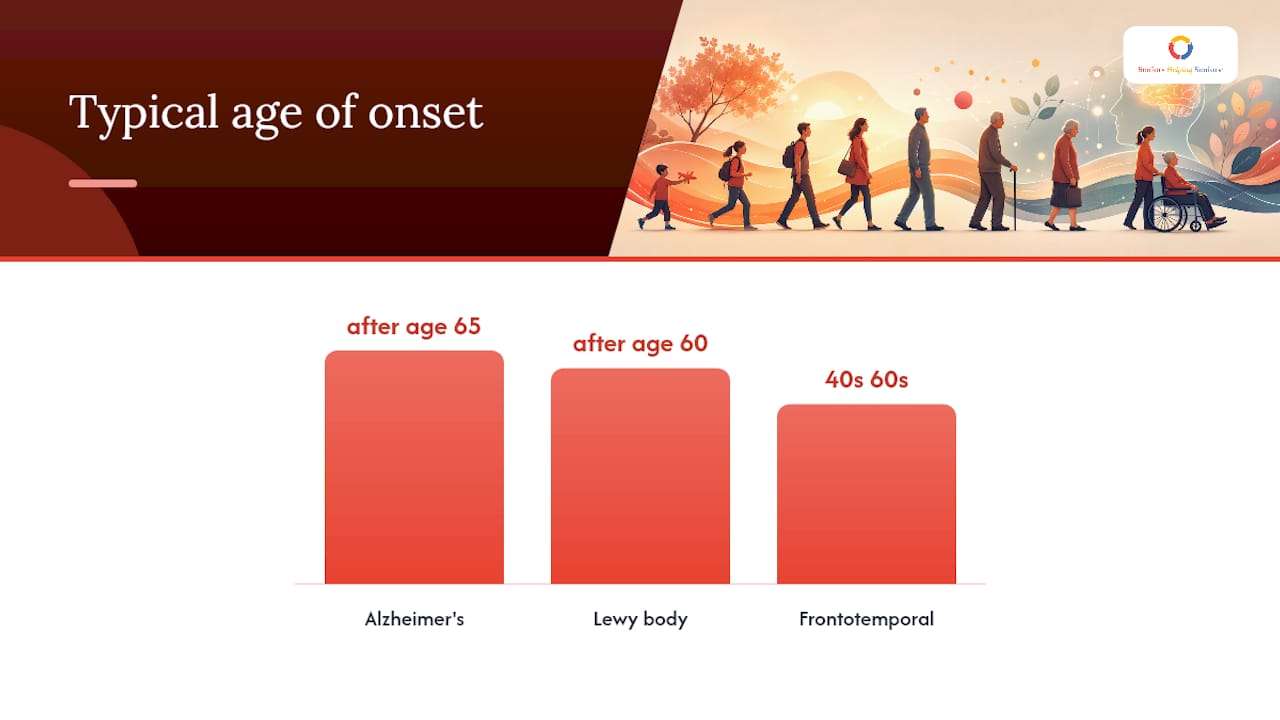
Alzheimer's disease shows up first as short-term memory loss, usually after age 65, though early-onset cases happen in a person's 40s or 50s. It's the most common type of dementia, accounting for 60% to 80% of cases. Underneath, it's driven by amyloid plaques and tau tangles that disrupt communication between brain cells, according to the National Institute on Aging.
Watch for:
- Repeating questions or losing track of recent conversations
- Getting lost in familiar places
- Trouble managing finances or following multi-step tasks
- Word-finding difficulty that worsens over time
Vascular dementia typically appears after a stroke or a series of small, often unnoticed strokes, and it tends to progress in a stepwise pattern rather than a smooth decline. Onset often follows cardiovascular events, so it skews toward people with a history of stroke, high blood pressure, or diabetes. The cause is disrupted blood flow starving brain tissue of oxygen.
Watch for:
- Sudden drops in thinking ability tied to a specific event
- Slowed processing speed and difficulty planning
- Problems with attention and organization more than memory
- Physical symptoms like weakness on one side or unsteady gait
Lewy body dementia is driven by abnormal deposits of a protein called alpha-synuclein, and it commonly causes fluctuating alertness, visual hallucinations, and Parkinsonism alongside cognitive decline. It usually develops after age 60.
Watch for:
- Detailed visual hallucinations, often of people or animals
- Alertness and attention that swing dramatically hour to hour
- Slowed movement, tremor, or rigid muscles
- Acting out dreams during sleep, sometimes years before other symptoms
Frontotemporal dementia (FTD) is different from the others because it often strikes people in their 40s and 50s, well before typical retirement age. It attacks the frontal and temporal lobes, and depending on the subtype, it produces early changes in behavior, personality, or language rather than memory.
Watch for:
- Loss of social filters, impulsivity, or apathy
- Difficulty finding words or understanding speech
- Repetitive or compulsive behaviors
- Memory that stays relatively intact early on, which throws families off the scent
Mixed dementia means more than one of the above is happening in the same brain, most often Alzheimer's changes layered with vascular damage. It's common and often explains why some people follow a course that doesn't fit neatly into one category.
Rarer Causes of Dementia Worth Knowing About
A handful of less common conditions cause dementia symptoms, and some behave very differently from the five major types:
- Creutzfeldt-Jakob disease (CJD) — a prion disease that progresses over weeks to months; considered a medical emergency
- Normal-pressure hydrocephalus — caused by fluid buildup in the brain; often improves with treatment, including shunt surgery
- Posterior cortical atrophy — affects vision-processing regions before memory
- Huntington's disease — an inherited condition combining movement, psychiatric, and cognitive symptoms
- Alcohol-related dementia — tied to long-term heavy drinking and thiamine deficiency
If decline reaches an advanced stage in under a year, clinicians treat that as a rapidly progressive dementia and move quickly to rule out CJD and other urgent causes. Mixed pathology is common enough that even a confident diagnosis sometimes needs revisiting as symptoms evolve.
How Do Doctors Tell Dementia Types Apart?
A detailed history from the patient and a family member, paired with cognitive testing, is usually the starting point. Dementia is a syndrome, not a single disease, so the workup is built to narrow down which one it is.
- History and collateral report. The doctor asks about symptom onset, pattern, and daily function, often interviewing a spouse or adult child directly.
- Cognitive screening or neuropsychological testing. Standardized tests measure memory, language, attention, and executive function.
- Brain imaging (MRI or CT). This checks for stroke damage, shrinkage patterns, or structural causes like hydrocephalus.
- Blood tests. These rule out treatable causes like thyroid problems or vitamin deficiencies.
- Specialized imaging or biomarkers when needed. FDG-PET, amyloid or tau PET scans, and cerebrospinal fluid biomarkers get used when the picture is unclear or a specialist wants confirmation before starting specific treatments.
Treatment Differences Between Dementia Types
Management centers on cause-specific treatment where one exists, plus symptom control, safety planning, and risk-factor management for everyone.
- Alzheimer's disease — cholinesterase inhibitors or memantine may slow symptom progression
- Vascular dementia — controlling blood pressure, cholesterol, and blood sugar can slow further decline
- Lewy body dementia — requires extreme caution with antipsychotic medications, which can trigger severe reactions; specific dementia medications may still help
- Frontotemporal dementia — behavioral strategies and speech therapy (for language-variant FTD) matter more than memory-focused drugs
- Mixed dementia — usually needs a combined approach addressing each contributing pathology
Across every type, nonpharmacologic care carries real weight: predictable routines, a safe and familiar environment, and caregiver training on how to de-escalate confusion or agitation. A resource like this family guide to memory preservation walks through practical techniques for building those routines at home.
Which Types of Dementia Progress Fastest?
Frontotemporal dementia and CJD tend to move faster than Alzheimer's disease, while many Lewy body and typical Alzheimer's cases progress more gradually, though every case varies.
- Progression speed depends heavily on subtype, age at onset, and overall health
- Mixed pathology can accelerate decline compared to a single disease acting alone
- Exceptions run in both directions, so individual prognosis always needs a clinician's input
One clinical study found median survival from initial clinic presentation was about 3.0 years for frontotemporal dementia versus 5.7 years for Alzheimer's disease.
What Should Families Do After a Dementia Diagnosis?
Start with the right specialists, then move quickly into safety and planning conversations.
- See a primary care doctor first, then a neurologist or geriatrician for a fuller workup if symptoms are unclear.
- Bring a written symptom timeline and a full medication list to appointments; a family member's observations matter as much as the patient's.
- Ask directly about medication safety, especially before starting antipsychotics if hallucinations are involved.
- Run a home safety check: remove fall hazards, secure medications, and address stove or driving risks.
- Get a driving assessment if there's any concern about reaction time or judgment.
- Start legal and financial planning early, while the person can still participate in decisions.
- Look into caregiver support and respite options before burnout sets in. In-home care can provide immediate daily supervision and companionship while the family sorts out longer-term plans.
What Working With Dementia Families Has Taught Us
Supporting people through memory loss day to day teaches you something textbooks don't: the diagnosis matters less to daily life than the routine built around it. A safe home, a familiar face, and steady companionship do more for someone's mood on a Tuesday afternoon than any label on a chart. If a loved one is showing signs of memory or behavior change, a proper assessment is worth pursuing sooner rather than later.
How In-Home Care Supports Families Managing Dementia
Tucsonshs pairs families with caregivers who are themselves mature adults, matched for compatibility and trained to support people living with memory loss. That match matters. A caregiver closer in age and life experience to the client tends to build trust faster than a rotating cast of unfamiliar aides.

Day to day, that support looks like medication reminders so doses don't get missed, consistent routines that reduce confusion and agitation, real companionship instead of isolation, and scheduled respite so family caregivers get a break before burnout hits. For a family juggling a new diagnosis and a dozen open questions, having one reliable person show up on schedule is worth more than another app or checklist. If you're trying to figure out the right level of support for a parent or spouse, request an in-home care assessment to talk through options.
Frequently Asked Questions
What's the difference between Alzheimer's and dementia? Dementia is the umbrella term for a syndrome of cognitive decline; Alzheimer's disease is the specific, most common cause of that syndrome.
What are the early signs of dementia? Early signs vary by type but often include memory lapses, word-finding trouble, getting lost in familiar places, or noticeable personality and judgment changes.
What are the stages of dementia? Most dementias progress through mild, moderate, and severe stages, though the pace and specific symptoms at each stage differ significantly by type.
Can dementia be caused by something treatable? Yes. Conditions like normal-pressure hydrocephalus and certain vitamin deficiencies or thyroid problems can cause dementia-like symptoms that improve with treatment.
Which type of dementia progresses the fastest? Frontotemporal dementia and rapidly progressive dementias like CJD tend to move faster than typical Alzheimer's disease, though individual cases vary widely.
This article is general information, not a substitute for advice from a qualified doctor. Consult a qualified healthcare professional about your own circumstances before acting on anything here.
Sources
- About Dementia | Alzheimer's Disease and Dementia | CDC
- Infographic: Understanding Different Types of Dementia (NIA/NIH)
- Frontotemporal dementia progresses to death faster than Alzheimer disease | Neurology (PubMed entry)
- Mixed dementia often involves multiple brain pathologies (PMC review)
- Types of dementia (NINDS)