
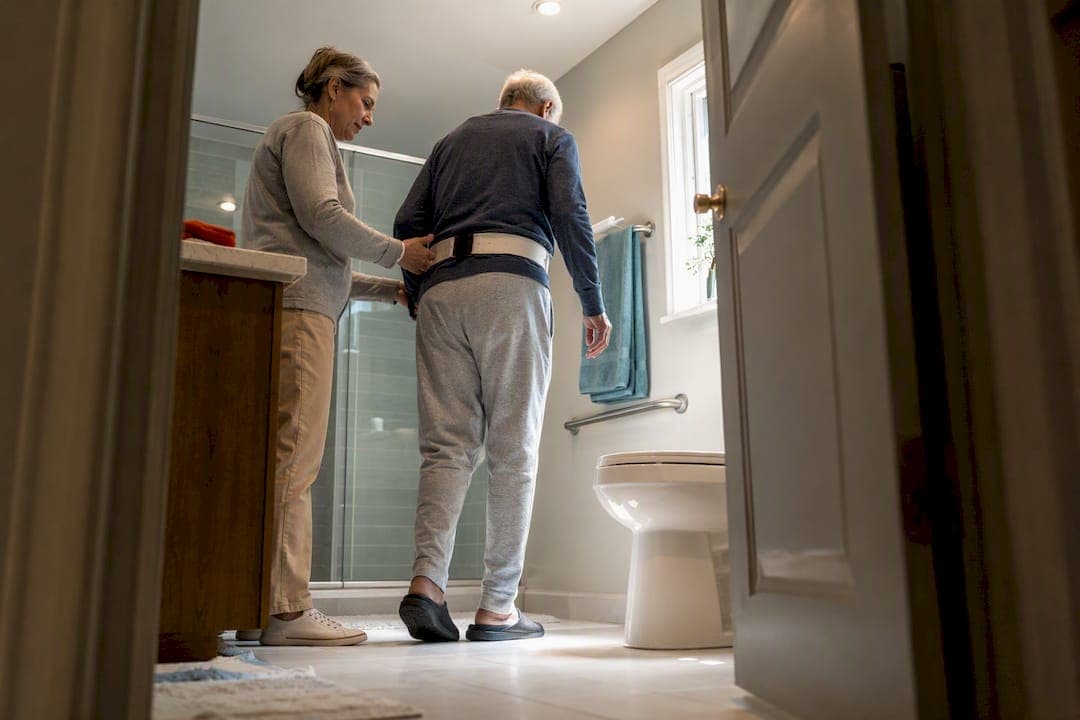
Before you touch anyone during a toileting emergency, check one thing: can they bear weight on both legs and follow a simple instruction? If not, don't attempt a manual pivot transfer. Use grab bars, a raised seat, or a bedside commode instead, and call for backup if the setup feels unsafe. Clear the path, gather supplies first, and use calm, adult language throughout.
TL;DR:
- Manual transfers are unsafe if the person cannot bear weight or follow simple instructions; in such cases, mechanical aids or professional help should be used.
- Bathroom modifications like grab bars, raised seats, and improved lighting significantly reduce fall risk, especially for those with mobility or vision issues.
- Caregivers should prioritize judgment and pattern tracking over equipment alone, stopping transfers immediately if safety or dignity is compromised.
- Proper in-home assessments and professional support can tailor toileting solutions and prevent injuries more effectively than generic equipment suggestions.
- Maintaining dignity through respectful communication and hygiene practices fosters cooperation, reduces embarrassment, and supports better health outcomes.
Table of Contents
- What Are the Best Toileting Assistance Methods at Home?
- How Do You Safely Transfer Someone to the Toilet?
- Which Bathroom Changes Actually Reduce Fall Risk?
- How Do You Preserve Dignity During Toileting Care?
- Building a Toileting Schedule That Actually Reduces Accidents
- When Should You Call in a Professional?
- A Caregiver's View From the Field
- What This Guide Gets Right That Others Skip
- Getting Hands-On Help With Toileting Assistance at Home
- Sources
What Are the Best Toileting Assistance Methods at Home?
Toileting assistance at home isn't one task. It's a set of different methods, and picking the wrong one for someone's mobility or cognition is how falls happen. The goal is matching the method to the person in front of you, not defaulting to whatever worked last year.
Standard toilet with support. This works for people who can still stand, pivot, and sit with minimal help. Add a grab bar and a raised seat before assuming someone "just needs a hand." Don't let them grab your neck or shoulders for balance. That's how caregivers get pulled off balance too.
Raised toilet seat or seat riser. Ideal for anyone with hip or knee limitations who can still transfer independently but struggles with the last few inches of sitting or standing. Skip this if the person has severe balance issues. A taller seat without arm support can actually increase fall risk on the way down.
Bedside commode. The right call when the bathroom is too far, too cluttered, or reached too slowly at night. Position it on a non-slip surface, never on carpet or a loose mat, and empty it promptly for hygiene and odor control.
Bedpan and urinal. These are for people who cannot transfer at all, even with assistance. Always warm a metal bedpan before use, protect skin from prolonged pressure, and offer privacy the same way you would for a bathroom visit.
Ostomy and catheter care. This is where family caregivers should draw a firm line. Appliance changes, catheter maintenance, and stoma care call for training from a home health nurse. Attempting these without instruction risks infection and skin injury.
- Toilet with grab bars: for independent or near-independent movers
- Raised seat: for joint pain without balance risks
- Commode: for reduced mobility or nighttime needs
- Bedpan/urinal: for bed-bound individuals
- Catheter/ostomy: hand off to a trained nurse
How Do You Safely Transfer Someone to the Toilet?
Weight-bearing status decides everything. If the person cannot reliably support their own weight on both legs and follow verbal cues, a manual transfer is not appropriate. Mechanical aids such as sit-to-stand lifts or sliding boards exist for exactly this situation, and using one isn't giving up. It's preventing an injury that sidelines both of you.
When a manual transfer is appropriate, follow this sequence:
- Position the wheelchair or walker at a slight angle to the toilet, brakes locked.
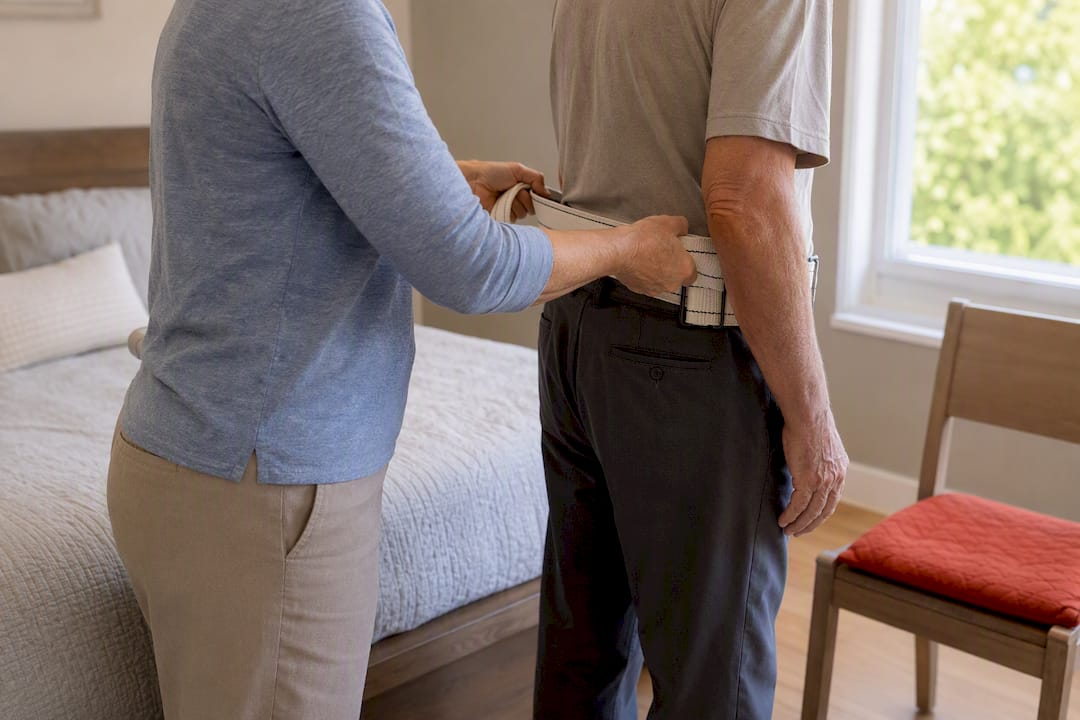
- Put a gait belt around the person's waist, not their arms.
- Count together ("one, two, three, stand") so the movement is coordinated, not sudden.
- Guide from the hips using the gait belt, letting them do as much of the standing as they can.
- Pivot slowly, watching their feet, and lower them onto the seat with control, not a drop.
- Stay close until they're steady and balanced before stepping back.
Never pull someone up by the arms or wrists. Caregiver back and shoulder injuries frequently trace back to exactly this habit, along with bending at the waist instead of the knees during a lift. Keep your feet shoulder width apart and your back straight, and let your legs do the work.
If at any point the person's knees buckle, they stop following instructions, or they seem dizzier than usual, stop the transfer and ease them back down or to the floor safely. That's not a failure. It's the correct call, and it's the exact moment to switch to a mechanical lift for future transfers.
Pro Tip: Practice the gait-belt grip on a good day, when there's no urgency and no fall risk. Muscle memory built during a calm moment is what actually holds up during a rushed 2 a.m. bathroom trip.
Which Bathroom Changes Actually Reduce Fall Risk?
Bathroom modifications matter more than most families realize, and the evidence on this is specific: grab bars, raised seats, and improved lighting measurably reduce fall risk for people with mobility or vision limitations. These aren't luxury upgrades. They're the difference between an independent bathroom trip and a 2 a.m. emergency.
- Install grab bars near the toilet and inside the shower, anchored to studs, not just drywall.
- Add a raised toilet seat with armrests for anyone who struggles to sit or stand fully upright.
- Use a high-contrast seat color against the floor and bowl, which helps people with low vision or dementia locate the toilet faster, especially at night.
- Put motion-activated night lights inside the bathroom and along the hallway path.
- Remove or tape down bath mats and rugs; loose flooring is a leading, preventable trip hazard.
- Consider a bidet attachment or bidet seat, which cuts down on reaching and twisting during cleanup and often improves hygiene outcomes on its own.
- Use adaptive clothing with velcro or magnetic closures and a long-handled wiping aid for anyone with limited reach.
A recent review mapped 163 categories of assistive toileting products across more than 1,500 product-to-problem matches, which tells you how varied the right equipment can be from one person to the next. That variety is exactly why an occupational therapist visit is worth requesting. Many home health plans and Medicare Advantage programs cover an OT home safety assessment, and it often surfaces equipment needs a family wouldn't have thought to ask about.
How Do You Preserve Dignity During Toileting Care?
Adult, matter-of-fact language changes the entire experience for someone who needs help with something this personal. Say what you're doing before you do it. Ask permission before touching. Step outside the door if it's safe to do so, staying within earshot.
- Use the person's own words for needing the bathroom rather than a childlike substitute; respectful phrasing reduces embarrassment and improves cooperation.
- Clean front to back for anyone assisted with wiping, which limits bacterial spread and infection risk.
- Pat skin dry rather than rub, and apply a barrier cream if skin looks irritated or reddened.
- Hand them the washcloth or wipe if they can manage part of the task themselves.
Pro Tip: Let them hold and use the washcloth on their lower legs even if you're doing the rest. Guiding rather than fully taking over keeps muscles and confidence engaged, and it slows functional decline more than most families expect.
Building a Toileting Schedule That Actually Reduces Accidents
Guesswork causes more accidents than incontinence itself. A logged pattern, tracked for even a week, tells you far more than instinct does.
- Write down every bathroom trip and every accident for five to seven days, noting the time.
- Look for patterns, like needing the bathroom 30 minutes after meals or first thing in the morning.
- Build a prompted schedule around those windows, offering the bathroom rather than waiting to be asked.
- Choose containment products by activity level and skin sensitivity, not just absorbency rating, and size them properly to prevent leaks and pressure points.
- Plan nighttime separately: a commode beside the bed or a motion-sensor path light often prevents the accidents that happen on the walk to the bathroom, not in the act itself.
- Revisit the log monthly. Patterns shift as mobility, medication, or cognition changes.
This kind of tracking also gives a doctor or continence nurse something concrete to work from if behavioral strategies stop being enough on their own.
When Should You Call in a Professional?
Some signs mean it's time to stop managing alone and bring in outside help.
- Burning urination, cloudy or strong-smelling urine, or sudden confusion can signal a urinary tract infection and need a same-week doctor visit.
- Redness, blistering, or an open area on the skin near the tailbone or hips signals pressure sore risk and needs prompt medical attention.
- A near-fall or actual fall during a transfer means it's time to stop manual transfers and bring in an occupational therapist or arrange a lift.
- Repeated accidents despite a consistent schedule may call for a continence specialist rather than more caregiver effort.
Document the date, time, and specifics of any fall or skin change. That record speeds up referrals to home health aides or an occupational therapist considerably, since clinicians can act on specifics faster than on "it's been getting harder."
A Caregiver's View From the Field
[brand_signal]
Most families reach out after a scare, not before one. A parent slips reaching for a towel bar that wasn't rated to hold weight, or a spouse tries to catch a fall and pulls a shoulder doing it. The pattern repeats often enough that it's predictable: the equipment gets bought after the injury, not before it.
What tends to work better is treating toileting help as a skill, not an emergency response. Caregivers who practice gait-belt positioning on a calm afternoon handle the 2 a.m. version of that same task with far less panic. Families who log bathroom timing for a week almost always find a pattern they didn't expect, and that pattern is what turns a chaotic day into a manageable routine.
[author_bio]
What This Guide Gets Right That Others Skip
Most caregiving articles hand you a shopping list and call it a day: buy a raised seat, buy a commode, done. That advice isn't wrong, but it skips the part that actually prevents injuries, which is the judgment call about whether a manual transfer should happen at all.
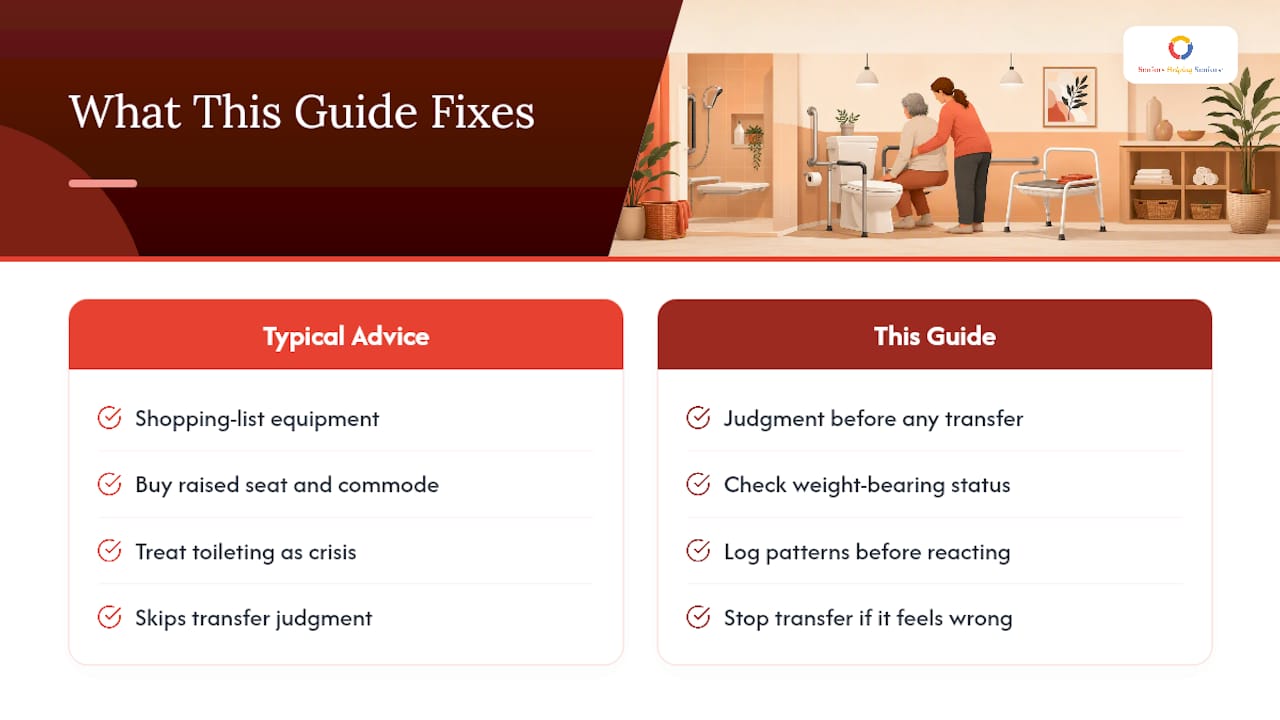
The overlooked piece is this: dignity and safety aren't competing priorities, they're the same decision made well. A caregiver who checks weight-bearing status before pulling someone up isn't being clinical at the expense of kindness. They're protecting the person's independence for another six months instead of causing a fall that ends it.
If you take one thing from this guide, make it the habit of logging patterns before reacting to accidents, and the discipline of stopping a transfer the moment it feels wrong. Equipment matters, but judgment is what actually keeps people safe and out of the hospital. The families who do best treat toileting help as a skill worth practicing on a calm day, not a crisis to manage on a bad one.
— Cameron
Getting Hands-On Help With Toileting Assistance at Home
Reading a guide gets you through the next transfer. It doesn't get you through every 2 a.m. bathroom trip for the next two years. That's where a trained, matched caregiver changes the math for a family that's stretched thin. In-home care providers often match your loved one with a caregiver who approaches toileting help with patience and proper body mechanics, not rushed or clinical detachment.

Assessments start with a conversation about mobility level, current equipment, and how much support is actually needed day to day, whether that's occasional help after a shower or full personal care support. Visits are scheduled flexibly, so families aren't locked into more care than they need. If you are weighing whether a lift, a commode, or extra help is the safer next step, request an in-home care assessment to get a plan built around your specific situation rather than a generic checklist.
This article is general information, not a substitute for advice from a qualified doctor. Consult a qualified healthcare professional about your own circumstances before acting on anything here.
Sources
- How family caregivers can assist with personal hygiene — AARP
- Restroom support — AARP Foundation Paid4Care
- Assistive technology products for toilet-use — mapping review (2025)