

Senior-to-senior care is a nonmedical, peer caregiving model where older adults provide companionship, personal support, and daily living assistance to other older adults. If this sounds like the right fit, your next step is simple: check whether the care needed is nonmedical, then contact your local Area Agency on Aging or call Seniors Helping Seniors Tucson to schedule a trial visit.
The National Institute on Aging recommends reaching out to local resources early, before a care situation becomes a crisis. Medicare sets strict eligibility rules for home health, and most peer caregiving falls outside that coverage. Knowing that upfront saves time and prevents surprises.
Table of Contents
- What does senior-to-senior peer care actually mean?
- What are the real benefits and risks of peer caregiving?
- How does payment usually work for peer care in the U.S.?
- How do you find and evaluate peer caregivers?
- Is Seniors Helping Seniors a legitimate model?
- Where can family caregivers find respite and support?
- Key Takeaways
- Why the peer-care model deserves more credit than it gets
- Seniors Helping Seniors Tucson: local peer care you can try first
- Authoritative sources and where to verify facts
What does senior-to-senior peer care actually mean?
Peer caregiving, often called senior-to-senior care, pairs an active older adult caregiver with a senior who needs nonmedical support at home. The caregiver is typically retired or semi-retired, brings lived experience with aging, and is matched to the client based on shared interests, background, or personality. That matching element is what separates this model from a generic home aide placement.
It is not home health care. Medicare-covered home health requires a physician's order, homebound status, and a skilled clinical need such as wound care or physical therapy. Peer care covers the everyday layer below that threshold.
| Care type | Who provides it | Typical coverage | Scope |
|---|---|---|---|
| Peer (senior-to-senior) care | Active older adult caregiver | Usually private pay | Nonmedical: companionship, ADLs, errands |
| Medicare home health | Certified skilled clinicians | Medicare (with strict eligibility) | Skilled nursing, PT/OT, speech therapy |
| Unpaid family caregiving | Family members | None | Variable; often full-spectrum |
Typical peer-care services include:
- Companionship and conversation
- Help with activities of daily living (dressing, bathing, grooming)
- Meal preparation and grocery shopping
- Light housekeeping and laundry
- Transportation to appointments
- Medication reminders (not administration)
- Memory support and cognitive engagement
Peer caregivers do not provide skilled nursing, wound care, injections, hospice support, or any service requiring a clinical license.
What are the real benefits and risks of peer caregiving?
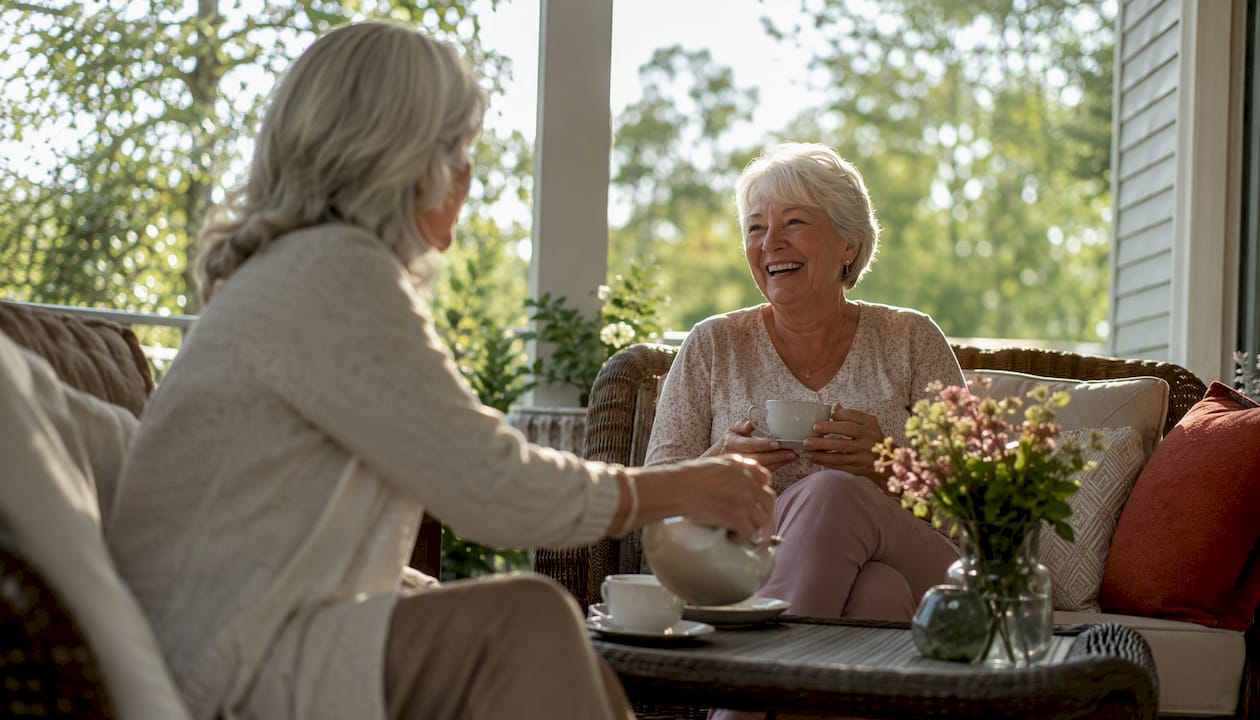
The strongest argument for this model is not cost. It is connection. A caregiver who has navigated their own retirement, health changes, or loss of a spouse brings a kind of empathy that a 25-year-old aide simply cannot replicate. Research consistently links social isolation in older adults to serious health decline, and a peer caregiver addresses that directly.
| Pros | Cons |
|---|---|
| Shared life experience builds genuine rapport | Cannot substitute for skilled nursing or medical care |
| Reduces loneliness and social isolation | Availability varies by franchise location |
| Often lower hourly cost than private-duty nursing | Training standards vary across providers |
| Provides meaningful income for active older adults | Not covered by Medicare for routine nonmedical services |
| Flexible scheduling and task customization | Minimum hour requirements differ by agency |
The risks are manageable with the right screening. The main one families overlook: peer care is not a bridge to medical care. If a senior needs wound management, medication titration, or post-surgical monitoring, peer caregiving is the wrong tool.
Pro Tip: Before hiring any peer caregiver, have the senior's physician or a geriatric care manager assess current and likely near-term clinical needs. If skilled nursing is on the horizon, build that into the care plan now rather than discovering the gap mid-engagement.
How does payment usually work for peer care in the U.S.?
Most peer caregiving is private pay. That is the honest starting point. Medicare covers home health services only when a doctor orders skilled, intermittent care for a homebound patient — typically up to 28 hours per week of combined skilled nursing and aide time. Routine companionship, errands, and personal care do not meet that threshold.
A physician must certify the care plan and a Medicare-certified agency must deliver the services. Peer caregiving agencies are generally not Medicare-certified for this reason.
Other payment options worth exploring:
- State respite programs: — Some states fund short-term respite care for family caregivers through their aging services networks.
Typical hourly rates for peer caregiving run roughly $25–$38 per hour depending on location and franchise, with some sources citing a range closer to $28–$35/hr. Rates vary by market, service type, and minimum-hour requirements.
How do you find and evaluate peer caregivers?
Start with your local Area Agency on Aging or the Eldercare Locator. These free federal resources connect families to vetted local providers, including peer-care agencies, without any sales pressure.
For Tucson families, Seniors Helping Seniors Tucson is a locally operated option with a structured matching and screening process.
Screening checklist for any peer-care provider:
- Criminal background check on every caregiver
- Verified references from prior clients or employers
- Proof of liability insurance
- Vaccination and health screening policies
- Documented caregiver training program
- Compatibility matching process (not just availability matching)
- Written service agreement before care begins
Red flags to watch for:
- Refusal to provide references or background check documentation
- No written service agreement
- Pressure to start immediately without a trial period
- Vague answers about caregiver training or supervision
- No clear process for replacing a caregiver if the match is poor
Questions to ask in an initial interview:
- How do you match caregivers to clients?
- What happens if the assigned caregiver is unavailable?
- What training do your caregivers complete before their first visit?
- Are caregivers employees or independent contractors?
- What is your process if a client's needs change or escalate?
Is Seniors Helping Seniors a legitimate model?
Yes. Seniors Helping Seniors operates as a franchised peer-care brand with individually owned and operated locations across the U.S. Each franchise is independently run, which means service quality, caregiver training depth, and minimum-hour requirements vary by location. That variability is worth asking about directly when you call.
The model's core structure is consistent: all caregivers are older adults themselves, all services are nonmedical, and the matching process prioritizes shared experience and compatibility over pure scheduling availability.
Trust signals to verify with any Seniors Helping Seniors location:
- Background checks completed on all caregivers
- Caregiver training program details (ask specifically what it covers)
- Liability insurance coverage
- Local office contact and supervisor availability
- Process for caregiver replacement if a match does not work
Seniors Helping Seniors Tucson is the local franchise serving the Tucson area. Call the local office directly and ask about their specific caregiver qualifications, training curriculum, and how they handle care escalation when a client's needs change.
Where can family caregivers find respite and support?
Family caregivers provide roughly 89% of in-home help for older adults, and many spend around 22 hours per week on caregiving tasks. Burnout is not a character flaw — it is a predictable outcome of sustained, unsupported caregiving.
The NIA recommends seeking help before you reach a breaking point, not after. Local Area Agencies on Aging, the Family Caregiver Alliance, and the Eldercare Locator all offer free referrals to respite services.
Common respite formats:
- In-home peer respite (a peer caregiver takes over for a few hours or a day)
- Adult day programs (structured daytime activities outside the home)
- Short-term home health for post-acute recovery
- Paid family caregiver programs through Medicaid waivers (state-specific)
How to request respite services:
- Call the Eldercare Locator at 1-800-677-1116 or visit eldercare.acl.gov.
- Ask your local Area Agency on Aging about respite funding and wait times.
- Contact your state Medicaid office to ask about home- and community-based waiver programs.
- If the senior is a veteran, call the VA caregiver support line at 1-855-260-3274.
- Ask your peer-care provider whether they offer scheduled respite blocks.
Caregiver self-care is not optional. Sleep deprivation, social withdrawal, and deferred medical care are common among family caregivers. Using formal supports is how you sustain care over months and years, not just weeks.
Key Takeaways
Peer caregiving is a nonmedical model where older adults care for other older adults — it fills a real gap that Medicare does not cover and that family caregivers cannot always fill alone.
| Point | Details |
|---|---|
| What peer care covers | Nonmedical support: companionship, ADLs, errands, medication reminders — not skilled nursing. |
| Medicare does not cover it | Routine peer caregiving is private pay; Medicare covers only physician-ordered skilled home health. |
| Typical cost range | Hourly rates generally run $25–$38 depending on location and franchise. |
| How to start | Contact your local Area Agency on Aging or Eldercare Locator, then schedule a trial visit before committing. |
| Tucsonshs local option | Seniors Helping Seniors Tucson offers matched, peer-based in-home care in the Tucson area — contact them to ask about caregiver qualifications and schedule a trial. |
Why the peer-care model deserves more credit than it gets
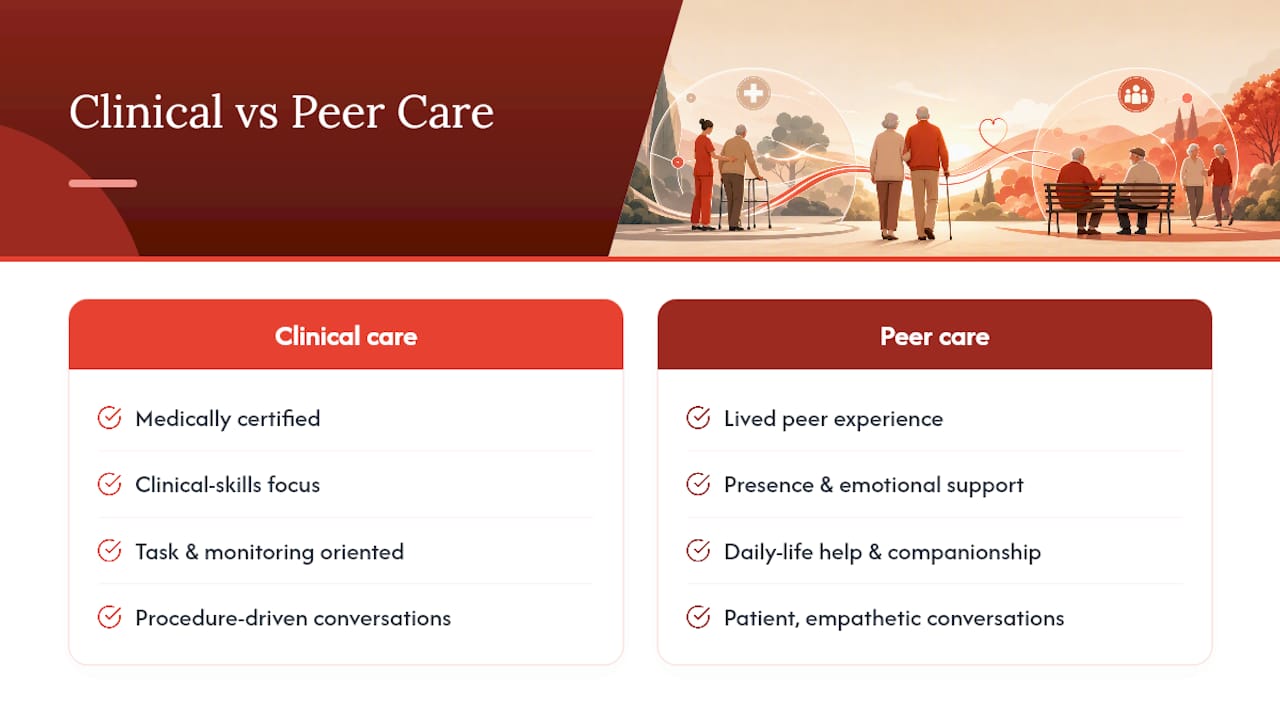
Most conversations about senior care jump straight to clinical credentials. How many certifications does the aide have? Is the agency Medicare-certified? Those questions matter, but they miss something the peer-care model gets right by design: the person sitting with your parent for four hours on a Tuesday afternoon is not just a task-completer. They are a presence.
The conventional wisdom treats nonmedical care as a lesser tier, something you settle for when you cannot afford skilled nursing. That framing is wrong. For the majority of older adults who need help with daily life but are not medically fragile, a peer caregiver who has lived through the same life stage brings something a clinical credential cannot confer. The conversation is different. The patience is different. The understanding of what it feels like to lose a spouse, to slow down, to need help for the first time — that is not in any training manual.
The real risk in peer care is not the model itself. It is using it past its appropriate scope. Families sometimes keep a peer caregiver in place when a senior's needs have shifted to require clinical oversight. Watch for that line and cross it deliberately, not by default.
Seniors Helping Seniors Tucson: local peer care you can try first
Peer caregiving is not a commitment you have to make sight unseen. Tucsonshs offers in-home senior care in Tucson built around the Seniors Helping Seniors model: older adult caregivers, matched by shared experience, providing nonmedical support that actually fits the person receiving it.
The service is primarily private pay. Hourly rates vary, and Medicare does not cover routine nonmedical care. What Tucsonshs does offer is a structured matching process, background-checked caregivers, and the option to start with a trial visit before signing anything long-term. When you call, ask specifically about caregiver qualifications, training details, and how they handle situations where care needs change.
Visit tucsonshs.com or call the Tucson office to check availability and schedule your first visit.
Authoritative sources and where to verify facts
- Caregiving | National Institute on Aging
- Frequently Asked Questions About Caregiving
- Home health services - Medicare
- Medicare and home health care
- Family caregiving for older adults - Merck Manual Professional
- Seniors Helping Seniors Review 2026 | SeniorsList
- Seniors Helping Seniors Review & Pricing in 2026
- Seniors Helping Seniors - FranchiseVerdict
This article provides general information about senior care options in the United States. It is not legal, medical, or financial advice. Confirm current Medicare and Medicaid eligibility rules at Medicare.gov or with a licensed benefits counselor before making care decisions.