

Respite care at home means a trained or volunteer caregiver steps into your home for a few hours, overnight, or even a few days so the primary caregiver can rest, handle personal needs, or simply breathe. According to the National Institute on Aging, respite can last for a short period and can take place in the home, at an adult day center, or in a facility. For most family caregivers who need a short break without uprooting their loved one, in-home respite is the fastest and least disruptive route.
Your three fastest next steps right now:
- Search the ARCH National Respite Locator to find vetted local programs and state coalitions near you.
- Call your local Area Agency on Aging (AAA) via the Eldercare Locator at 1-800-677-1116 for intake, referrals, and funding guidance.
- Contact a trusted local agency such as Seniors Helping Seniors® Tucson for same-area, in-home respite with a caregiver who is also a senior.
Pro Tip: Don't wait until you're running on empty. The NCOA notes that matching respite services to daily tasks works best when you start the process before a crisis, not during one.
Key Takeaways
Respite care at home is short-term, in-home coverage that gives primary caregivers a real break while keeping the care recipient in a familiar, safe environment.
| Point | Details |
|---|---|
| Start with a locator | Use the ARCH National Respite Locator or Eldercare Locator to find vetted local programs fast. |
| Schedule a meet-and-greet first | Introduce the respite caregiver before a full session so the care recipient can adjust gradually. |
| Most in-home respite is private pay | Medicare covers up to five inpatient hospice respite days; Medicaid waivers and VA benefits may cover more. |
| Plan before a crisis | Caregivers who arrange respite early sustain their role longer and handle emergencies with less disruption. |
| Tucsonshs for Tucson families | Seniors Helping Seniors® Tucson offers locally matched, background-checked in-home respite with hourly billing and no long-term contract required upfront. |
Table of Contents
- What is respite care at home, and who does it help?
- Which type of in-home respite care fits your situation?
- How do you find and arrange in-home respite care in the U.S.?
- How much does in-home respite cost, and how do you pay for it?
- Should you hire privately or use an agency, and how do you vet a caregiver?
- How do you prepare for the first respite visit?
- What are the real benefits of respite, and when should you use it?
- How Seniors Helping Seniors® Tucson provides in-home respite
- Who qualifies for respite care programs, and how does the assessment work?
- Legal and safety considerations during respite care
- What most caregivers get wrong about respite
- Seniors Helping Seniors® Tucson: in-home respite care, locally matched
- Authoritative resources for finding and funding respite care
- Sources
What is respite care at home, and who does it help?
In-home respite care is short-term, paid or volunteer coverage provided inside the care recipient's own home so the primary caregiver can step away. The caregiver providing respite handles whatever the primary caregiver normally does: companionship, personal care, medication reminders, meals, or simply sitting with someone who cannot safely be left alone.
Three scenarios where it fits cleanly:
- A spouse caring for a partner with dementia needs four hours every Tuesday to attend a doctor's appointment and run errands without worry.
- An adult child who has been the sole caregiver for a parent recovering from hip surgery needs an overnight break after two weeks of around-the-clock care.
- A primary caregiver who hasn't slept more than four hours in a row for a month needs a weekend of real rest while a trained aide stays with their parent.
In-home respite is distinct from adult day programs (where the care recipient leaves the home for a structured program) and facility-based respite (a short nursing-home or hospice stay). The difference matters: some people with dementia or severe anxiety do far better staying in a familiar environment, which is exactly where in-home respite has an edge.
Pro Tip: Introduce a respite caregiver before you desperately need one. Cleveland Clinic recommends scheduling a meet-and-greet or short trial visit early so the care recipient can adjust to a new face gradually, rather than meeting a stranger on the day you're already overwhelmed.
Which type of in-home respite care fits your situation?
Not all in-home respite looks the same. The right format depends on how long you need, what level of care your loved one requires, and your budget.
A few practical notes on choosing:
- Companion care covers the largest share of respite needs. If your loved one is cognitively impaired but physically stable, a trained companion who can redirect, engage, and supervise is usually enough.
- Personal care aides are the right call when bathing or toileting support is part of the daily routine. An agency hire carries liability coverage the family doesn't have to manage.
- Skilled nursing visits are appropriate when a medical task, such as a catheter change or IV management, falls within the respite window. VITAS Healthcare notes that hospice providers can deliver nursing-level in-home respite when the patient is already on a hospice plan.
- Overnight care is underused. Many caregivers think of respite as daytime-only, but a single night of full sleep can reset a caregiver's capacity more than three short afternoon breaks.
How do you find and arrange in-home respite care in the U.S.?
The fastest, most reliable path runs through three federal or nonprofit resources, then a local agency call.
- Search the ARCH National Respite Locator at Archrespite. Enter your ZIP code to pull up state coalitions, local programs, and volunteer respite networks. ARCH also maintains state-level contacts who can answer eligibility questions.
- Call the Eldercare Locator at 1-800-677-1116 or visit Eldercare. This Administration for Community Living service connects you to your local Area Agency on Aging, which handles intake, program referrals, and sometimes direct funding.
- Check VA caregiver resources if the care recipient is a veteran. The VA Caregiver Support Program offers respite benefits for qualifying veterans and their caregivers; call 1-855-260-3274 or visit caregiver.va.gov.
- Contact a reputable local home-care agency for immediate availability. Ask specifically about respite scheduling, minimum hours, and whether they offer a trial visit.
- Request references and a background check confirmation before any caregiver enters the home. A licensed agency handles this internally; a private hire requires you to run it yourself.
Documentation to have ready before your first call:
- Current medication list with dosages and schedule
- Mobility notes (uses walker, fall risk, transfer assistance needed)
- Behavioral or cognitive notes (sundowning, wandering risk, communication preferences)
- Emergency contacts, including the primary physician
- Insurance cards and any existing care plan documents
Pro Tip: When you're proactively planning rather than responding to a crisis, this senior care planning resource walks through the 24–72 hour decision window and why having a vetted contact already in place changes everything.
How much does in-home respite cost, and how do you pay for it?
Most in-home respite is private pay. That's the honest starting point. Hourly rates for companion care typically run lower than personal care or skilled nursing, and costs vary by region. Tucson-area families will find rates differ from national averages, so ask agencies directly for current pricing.
Funding paths to explore:
- Medicaid waivers. Medicaid administers state-level 1915(c) waivers and Lifespan Respite programs that can cover in-home respite for eligible individuals. Eligibility rules and covered services vary significantly by state, so contact your state Medicaid office or AAA for specifics.
- Medicare hospice benefit. Medicare confirms that Medicare Part A covers up to five consecutive inpatient respite days for hospice-eligible patients. Standard in-home respite outside hospice is generally not covered by Original Medicare.
- VA benefits. Veterans enrolled in VA healthcare may qualify for the Program of Comprehensive Assistance for Family Caregivers (PCAFC), which includes respite hours. Eligibility is tied to the veteran's service-connected disability rating.
- Long-term care insurance. If the care recipient holds a long-term care policy, review the policy's home-care benefit rider. Many policies cover in-home respite once the benefit trigger (typically two or more ADL limitations) is met.
- State Lifespan Respite programs. Funded through the Administration for Community Living, these programs vary by state and sometimes offer direct grants or vouchers to caregivers.
- Grants and local programs. Local nonprofits, faith communities, and disease-specific organizations (Alzheimer's Association chapters, for example) sometimes offer funded respite hours or volunteer programs.
Some families use home equity or proceeds from a property sale to fund longer-term care arrangements. This guide to funding senior care through a home sale explains how families in that situation typically structure the transition.
Pro Tip: Ask every agency you call whether they offer sliding-scale fees, bundled-hour packages, or a reduced-rate first session. Many do, and it's rarely advertised.
Should you hire privately or use an agency, and how do you vet a caregiver?
The core tradeoff is straightforward: an agency handles vetting, supervision, payroll taxes, workers' compensation, and backup coverage when a caregiver calls in sick. A private hire may cost less per hour, but the family becomes the employer, which means running background checks, managing taxes, and carrying liability if something goes wrong.
Vetting checklist for any in-home respite caregiver:
- Criminal background check (state and federal)
- Professional references from prior caregiving roles
- Verification of any claimed credentials (CNA, HHA, CPR/first aid certification)
- TB clearance or current health screening
- Motor vehicle record check if transportation is part of the role
- Proof of liability insurance (agency-provided or personal)
- Confirmation of dementia or memory-care training if applicable
Interview questions worth asking:
- Describe how you handle a care recipient who refuses personal care or becomes agitated.
- What do you do if the person you're caring for falls while I'm away?
- Have you managed medication reminders for someone on multiple prescriptions?
- What would you do if the person had a medical emergency and you couldn't reach me?
- How do you document what happened during a shift?
On the legal side: if you hire privately, the IRS "household employer" rules likely apply, meaning you may owe payroll taxes. A written service agreement, whether with an agency or a private caregiver, protects both parties. It should specify duties, hours, pay rate, cancellation terms, and emergency protocols. An agency caregiver is typically the agency's employee; a private caregiver may be classified as an independent contractor, but that classification has legal limits, and misclassification carries penalties.
How do you prepare for the first respite visit?
The single most important preparation is a short, written care plan and a meet-and-greet before the first full session. Everything else follows from those two things.
- Schedule a meet-and-greet first. Introduce the respite caregiver to your loved one in a low-stakes, short visit. Observe how they interact. Note whether your loved one seems comfortable.
- Write a one-page care summary. Include the daily routine, preferred wake and meal times, mobility aids in use, behavioral triggers to avoid, and favorite activities or topics of conversation.
- Prepare a medication list. Name, dose, time of day, and what each medication is for. Note any medications that must be given with food or that have specific storage requirements.
- Post emergency contacts visibly. Primary physician, nearest family member, poison control (1-800-222-1222), and the local non-emergency line. Include the home address in case the caregiver needs to direct emergency services.
- Note consent and medical decision authority. If you hold healthcare power of attorney, leave a copy accessible. Clarify in writing what the respite caregiver is and is not authorized to decide.
- Start with a short daytime session. A two- to three-hour first visit while you stay nearby (but out of the house) lets you gauge the interaction without full commitment. Ask the caregiver to leave brief written notes on how the visit went.
Pro Tip: After the first visit, ask the caregiver three specific questions: What did your loved one enjoy? Was there any moment of confusion or distress? Is there anything on the care plan that needs updating? Those answers tell you more than a general "it went fine."
What are the real benefits of respite, and when should you use it?
AARP research links regular respite use to lower caregiver distress and measurably better health outcomes. Caregivers who use respite report fewer symptoms of depression and anxiety, and they tend to sustain their caregiving role longer without burning out.
There's also a distinction worth making: true respite means psychological detachment for the primary caregiver, not just task handoff. Sitting in the next room while someone else "helps" doesn't count. The goal is genuine time away, long enough to actually recharge.
When to schedule respite:
- Regular scheduled breaks. Weekly or biweekly respite, even two to three hours, prevents the accumulation of stress that leads to crisis.
- After a hospitalization. The period immediately following a hospital discharge is one of the most demanding for caregivers. Arranging respite during recovery reduces the risk of caregiver collapse at exactly the wrong moment.
- When the caregiver must travel. Overnight or multi-day respite coverage is a practical necessity, not a luxury.
- Emergency coverage. A caregiver who becomes ill or injured needs immediate backup. Having a vetted respite contact already in place is the difference between a manageable gap and a crisis.
Respite also preserves dignity for the care recipient. A caregiver who is rested and not resentful provides better, more patient care. That's not a soft benefit; it's a measurable quality-of-care factor.
How Seniors Helping Seniors® Tucson provides in-home respite
Seniors Helping Seniors® Tucson matches older adults who need care with active, mature caregivers who are often seniors themselves. That peer-to-peer model is what sets the service apart from a standard home-care agency: caregivers bring shared life experience, not just task competence, which tends to reduce the resistance some care recipients show toward younger aides.
For respite specifically, the service covers:
- Companionship and socialization during caregiver absences
- Personal care assistance (bathing, dressing, grooming)
- Medication reminders and meal preparation
- Light housekeeping and transportation
- Dementia and memory-care support
Caregivers are background-checked, trained, and matched to clients based on compatibility and shared experience. The billing model is hourly or by package, and an initial meet-and-greet is part of the standard intake process. Families in Tucson and the Green Valley area can contact Tucsonshs directly to discuss availability, typical costs, and what to expect from a first session.
Trust signals to confirm with any provider you consider: written service agreement, confirmed background checks, caregiver training documentation, liability coverage, and references from current or former clients.
Who qualifies for respite care programs, and how does the assessment work?
Eligibility varies by program type, but most follow a similar pattern.
For Medicaid waiver programs: The care recipient typically must meet the state's functional eligibility criteria, usually defined as needing assistance with two or more Activities of Daily Living (ADLs) such as bathing, dressing, eating, or mobility. Financial eligibility (income and asset limits) also applies and varies by state. The assessment is usually conducted by a state or county caseworker who visits the home and scores functional limitations using a standardized tool.
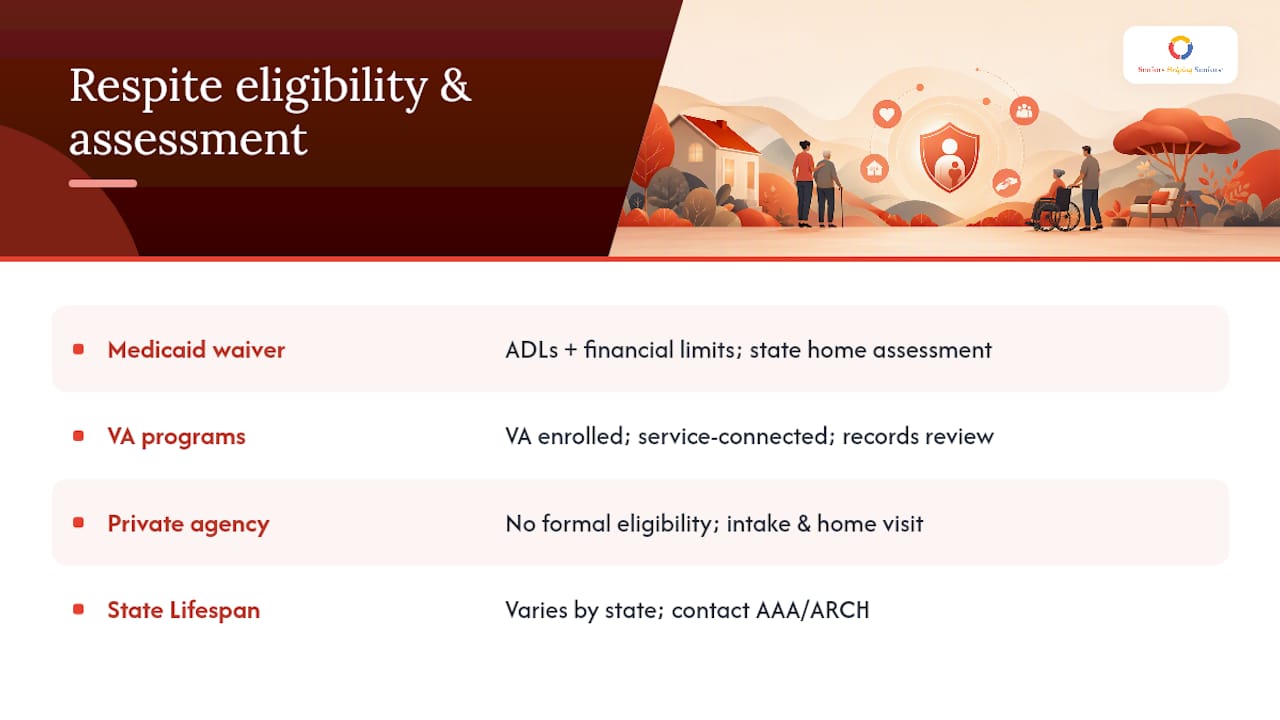
For VA caregiver programs: The veteran must be enrolled in VA healthcare and meet service-connected disability criteria. The PCAFC program requires the veteran to have a serious injury incurred or aggravated in the line of duty on or after September 11, 2001, for the full benefit tier, though the Program of General Caregiver Support Services (PGCSS) is available more broadly.
For private agency or private-pay respite: There is no formal eligibility assessment. The agency conducts an intake call and a home assessment to understand the care recipient's needs and match an appropriate caregiver.
For state Lifespan Respite or grant programs: Eligibility criteria differ by state and funding cycle. Contact your AAA or state respite coalition (findable through ARCH) for current program availability and application requirements.
The assessment process for funded programs typically includes a home visit, a review of medical records or physician documentation, and a caregiver interview. Plan for two to six weeks from application to first service delivery for Medicaid waiver programs; private agency respite can often begin within days.
Legal and safety considerations during respite care
A few legal and safety points that don't get enough attention:
Written consent and medical authority. Before a respite caregiver begins, clarify in writing what they are authorized to do. If the care recipient has a healthcare proxy or power of attorney in place, the respite caregiver should know who holds that authority and how to reach them. The caregiver should never make medical decisions independently.

Emergency protocols. Every respite session needs a written emergency plan: what to do if the care recipient falls, has a seizure, shows signs of stroke, or becomes combative. The caregiver should have the home address written down (not just in a phone), the primary physician's after-hours line, and clear instructions on when to call 911 versus when to call the family first.
Employer liability. If you hire a caregiver privately, you may be liable for injuries that occur in your home during the work period. A homeowner's or renter's insurance policy may not automatically cover a paid household worker. Review your policy and consider a rider. Agency caregivers are covered under the agency's workers' compensation policy.
Medication administration. In most states, non-licensed caregivers can provide medication reminders but cannot administer medications (opening a blister pack, drawing insulin). Know your state's rules and communicate them clearly in the written care plan.
Documentation. Ask the respite caregiver to leave a brief written note after every session covering what was done, how the care recipient responded, and any concerns. That record protects everyone and helps the primary caregiver track changes over time.
What most caregivers get wrong about respite
The most common mistake isn't waiting too long, though that's a close second. It's treating respite as a last resort rather than a scheduled part of the care plan.
Caregivers who use respite reactively, only when they're already at a breaking point, face two compounding problems. First, the care recipient has never met the respite caregiver before, which means resistance, confusion, and a harder transition at the worst possible moment. Second, the caregiver is too depleted to manage that transition well.
The families who handle long-term caregiving most sustainably treat respite the way they treat a car's oil change: scheduled, routine, and not optional. They introduce a respite caregiver early, run a few short trial sessions, and build a working relationship before they need it urgently. When an emergency does come, and in long-term caregiving it always does, they have a vetted person who already knows their loved one's routines, preferences, and triggers.
There's also a guilt factor worth naming directly. Many caregivers feel that using respite means they're not doing enough. AARP's analysis is clear: respite is a core strategy for sustainable caregiving, not a sign of failure. A caregiver who is rested, healthy, and not resentful is a better caregiver. That's the whole point.
Seniors Helping Seniors® Tucson: in-home respite care, locally matched
If you're in Tucson or the Green Valley area and want in-home respite from a caregiver who genuinely understands what your loved one is going through, Seniors Helping Seniors® Tucson is worth a direct conversation. The peer-to-peer model means your loved one is cared for by an active senior who brings real-life experience, not just a checklist.

The intake process starts with a call and an in-home assessment. Have your medication list, care routine, and emergency contacts ready. An initial meet-and-greet is standard before regular scheduling begins, and billing is hourly or by package with no long-term contract required upfront. Costs vary by hours and care level; the team will walk you through current rates during the assessment call.
Contact Tucsonshs to schedule your free in-home assessment and find out how quickly respite care can be arranged for your family.
Authoritative resources for finding and funding respite care
Use these as your starting points for verification, program applications, and locating vetted providers:
- ARCH National Respite Locator: The primary national tool for finding local respite programs, state coalitions, and volunteer networks. Start here.
- National Institute on Aging (NIA/NIH): Authoritative definition of respite care, service settings, and guidance on when and how to use it.
- Eldercare Locator (ACL): Connects you to your local Area Agency on Aging for intake, referrals, and funding program information. Call 1-800-677-1116.
- Medicaid: Official source for state waiver programs and Lifespan Respite funding; check your state's specific eligibility rules here.
- Medicare: Official CMS guidance on the hospice respite benefit and what Medicare does and does not cover for in-home care.
- AARP LTSS Choices: Research-backed analysis of respite outcomes and caregiver burden; useful for understanding why respite matters and how to make the case for it within a family.
- NCOA Caregiver Guide: Practical guidance on matching respite services to daily tasks and planning for both scheduled and emergency respite.
This article is general information, not a substitute for advice from a qualified doctor. Consult a qualified healthcare professional about your own circumstances before acting on anything here.
Sources
- What Is Respite Care? - National Institute on Aging - NIH
- Resources for Caregivers | ARCH National Respite Network & Resource Center
- What Is Respite Care? A Guide for Caregivers | NCOA