
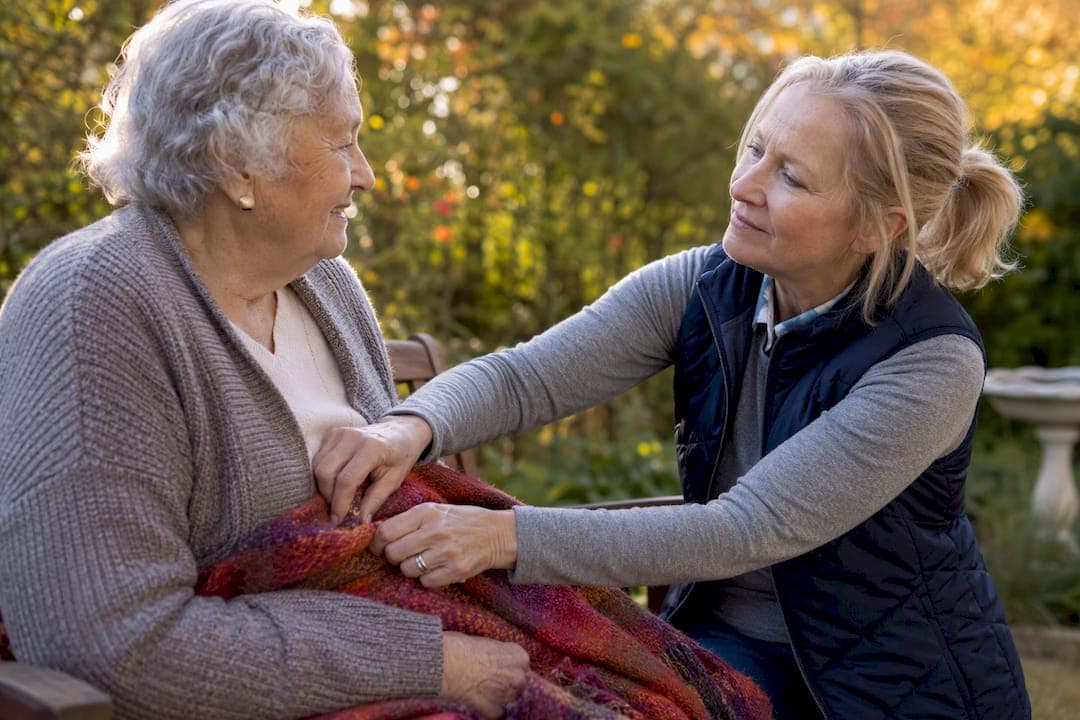
Start by validating your parent's feelings, checking for immediate safety risks, and offering one small, low-stakes trial of help before pushing anything bigger. Forcing the issue almost always backfires and hardens the refusal. But if you see signs of real danger, like a stove left burning or missed medications piling up, safety comes before diplomacy every time.
TL;DR:
- Most resistance to help stems from fear of losing independence, stigma, privacy concerns, or genuine neurological deficits like anosognosia.
- Document clear, observable safety hazards and daily living gaps over time to provide concrete evidence of declining needs to healthcare professionals.
- Using gentle, control-preserving language and starting with low-stakes, trial help options increases the likelihood of acceptance from resistant parents.
- Escalate to professionals like geriatricians or social services only when safety risks persist despite family efforts, not immediately after initial resistance.
- Matching caregivers for shared interests and life stage reduces stigma and builds trust faster, making help more acceptable and less threatening.
Table of Contents
- Why an elderly parent refuses help
- How do you know when a parent needs help?
- What to say when a parent won't accept help
- When should you escalate to a professional?
- How to introduce an in-home helper without a fight
- How caregivers protect their own well-being
- What actually moves the needle on elderly help refusal
- Sources
Why an elderly parent refuses help
Refusal is rarely about stubbornness. It's usually fear wearing a stubborn mask. An older adult who says no to a caregiver, a walker, or even meal delivery is often protecting something bigger: their sense of who they still are.
The most common drivers include fear of losing independence, worry about being seen as a burden, and financial anxiety over what care costs. Privacy plays a role too. Letting a stranger into the bathroom or kitchen can feel like an invasion after decades of managing a home alone. Then there's stigma. Needing help still reads as decline to many people, especially those raised in generations that equated self-sufficiency with dignity.
Sometimes the resistance isn't emotional at all. Anosognosia, a neurological condition where a person genuinely cannot perceive their own deficits, shows up in some dementia and stroke cases and makes the person truly believe nothing is wrong. Family and cultural norms matter here too. In households where accepting outside help was historically seen as a failure of the family itself, the entire concept of "hiring help" clashes with generational expectations.
Common threads behind refusal of help in aging include:
- Fear of losing autonomy or being placed in a facility
- Financial worry about hourly or package care costs
- Privacy concerns about strangers in the home
- Stigma tied to appearing "old" or dependent
- Reduced insight into their own limitations (anosognosia)
- Cultural or family beliefs that outside help reflects poorly on the family
How do you know when a parent needs help?
Trust the pattern, not the single incident. One missed pill isn't a crisis. Three missed doses in two weeks, alongside a stack of unopened mail, is a pattern worth documenting.
Watch for these categories of warning signs:
- Safety hazards: falls or near-falls, a stove or oven left on, expired car registration, or unsafe driving habits like new dents or missed turns.
- Daily living gaps: skipped or doubled-up medications, spoiled food in the fridge, unwashed laundry, or unpaid bills stacking up.
- Cognitive and behavioral shifts: repeating questions, getting lost on familiar routes, or flatly denying problems others have witnessed firsthand.
According to the National Institute on Aging, documenting specific, observable problems works far better than vague statements like "I'm worried about you." Write down dates, exact examples, and who else witnessed the issue. A note that reads "Tuesday, March 3: found the stove burner on two hours after Mom said she'd eaten" carries more weight in a family conversation, and with a doctor, than "she seems off lately."
Pro Tip: Keep a simple shared document, even a notes app both you and a sibling can access, so isolated incidents don't get dismissed as one-offs.
What to say when a parent won't accept help
Language determines whether the conversation opens a door or slams it shut. Swap accusatory "you" statements for I-statements: instead of "You can't keep driving," try "I feel scared when I think about you driving at night." The AARP recommends open-ended questions over ultimatums, and stepping away entirely if the conversation escalates rather than pushing through tension.
Word choice matters more than most families realize. "Caregiver" can sound clinical and final, like an admission of decline. "Companionship" or "home help" often lands softer, especially when you frame the goal as preserving independence rather than replacing it. One caregiver's household example, said instead of "Someone's going to help you shower," try "Let's get you someone to help around the house so you're not doing it all yourself."
Start small. Don't lead with personal care. Lead with the tasks least tied to identity and dignity:
- Grocery delivery or a ride to appointments
- Light housekeeping once a week
- A meal-prep visit twice a month
Offer these as a limited trial with a defined end date, not an open-ended commitment. "Let's try this for two weeks and then talk about how it went" gives your parent an easy exit if it doesn't work, which paradoxically makes them more likely to say yes.
Sometimes you're not the right messenger. A primary care physician carries a kind of neutral authority that adult children simply don't have. The National Institute on Aging notes that clinicians can raise safety concerns in a way that feels like medical advice rather than family criticism. An old friend or sibling your parent trusts can serve the same function.
Finally, give your parent real choices within the plan. Let them pick which days someone comes, what time works best, or which tasks they want covered first. That sense of control over small details often matters more than the help itself.
When should you escalate to a professional?
Some situations move past what family communication alone can fix. If memory problems, repeated falls, or medication errors keep showing up despite your efforts, it's time to bring in outside expertise.
- Loop in the primary care physician or a geriatrician when safety concerns, confusion, or medication mismanagement appear. A clinical evaluation can also rule out reversible causes like infection or medication interactions.
- Consider an Aging Life Care Professional, sometimes called a geriatric care manager, for a formal in-home assessment and to help coordinate services when family members disagree on next steps.
- Contact your local Area Agency on Aging for community resources like meal delivery, transportation, or subsidized in-home support, and understand the difference between medical home health and non-medical companion care.
- Call Adult Protective Services if you suspect neglect or abuse, or dial emergency services immediately for any life-threatening situation, a fall with injury, a fire hazard, or a medical emergency in progress.
Escalating doesn't have to mean overriding your parent's wishes outright. Framing a geriatrician visit as "let's just get a checkup" rather than "we're deciding if you can live alone" often preserves trust even as you bring in more support.
How to introduce an in-home helper without a fight
The way you introduce a caregiver matters almost as much as the decision itself. A rushed or surprise introduction tends to trigger the exact resistance you're trying to avoid.
- Prepare before anyone arrives. Tell your parent who's coming, why, and for how long. Avoid surprising them with a stranger at the door.
- Be physically present for the first meeting. Arriving before the helper does, and staying for the introduction, gives your parent time to settle before someone new enters their space.
- Design a short, defined trial. Start with a small number of low-stakes visits over a limited trial period, focused on companionship or light tasks, with a specific date to review how it went.
- Let your parent choose details. Which days, what time, what tasks come first. Small choices restore a sense of control.
- Match for compatibility, not just availability. Shared interests, similar backgrounds, or comparable life stage all speed up rapport.
That last point isn't just a nice idea. It's the operating principle behind Seniors Helping Seniors® Tucson's approach, which pairs older adults with mature, active caregivers who are seniors themselves. Matching by shared life experience tends to reduce the stigma that comes with the word "caregiver," because the relationship starts to feel more like companionship between peers than a service transaction.
| Step | What it does | Why it lowers resistance |
|---|---|---|
| Advance notice | Removes surprise | Prevents defensive refusal at the door |
| Family presence at arrival | Calms the environment | Reassures the parent this is supervised, not abandonment |
| Short trial with review date | Limits commitment | Gives an easy, dignity-preserving exit if it doesn't fit |
| Choice in scheduling | Restores control | Shifts the dynamic from "done to" to "done with" |
| Compatibility matching | Builds rapport faster | Shared experience reduces the stigma of "needing care" |
How caregivers protect their own well-being
Helping a resistant parent is exhausting precisely because the resistance never fully goes away, even after progress. Protecting your own capacity matters as much as any script or trial period.
Set boundaries you can actually hold. That might mean deciding you won't take calls about non-urgent issues after 8 p.m., or that you'll handle finances but a sibling handles medical appointments. Vague boundaries collapse under pressure; specific ones hold.
If you have siblings, coordinate deliberately instead of by accident:
- Keep a shared log of visits, observations, and decisions
- Set a recurring check-in call, weekly or biweekly, rather than reacting only during a crisis
- Agree in advance on who makes the call in an emergency
Respite care, therapy, and caregiver support groups all exist because burnout is common, not rare, among people in your position. Use them before you hit a wall, not after.
One more thing worth doing early: work with an elder law attorney to put a power of attorney and advance directives in place while your parent can still participate in that decision.
What actually moves the needle on elderly help refusal
Most advice on this topic treats refusal as a communication problem to be solved with the right script. Scripts help, but they're not the whole answer. The bigger lever is sequencing: start with the least-threatening form of help, make it genuinely optional, and let your parent see it work before asking for anything more.
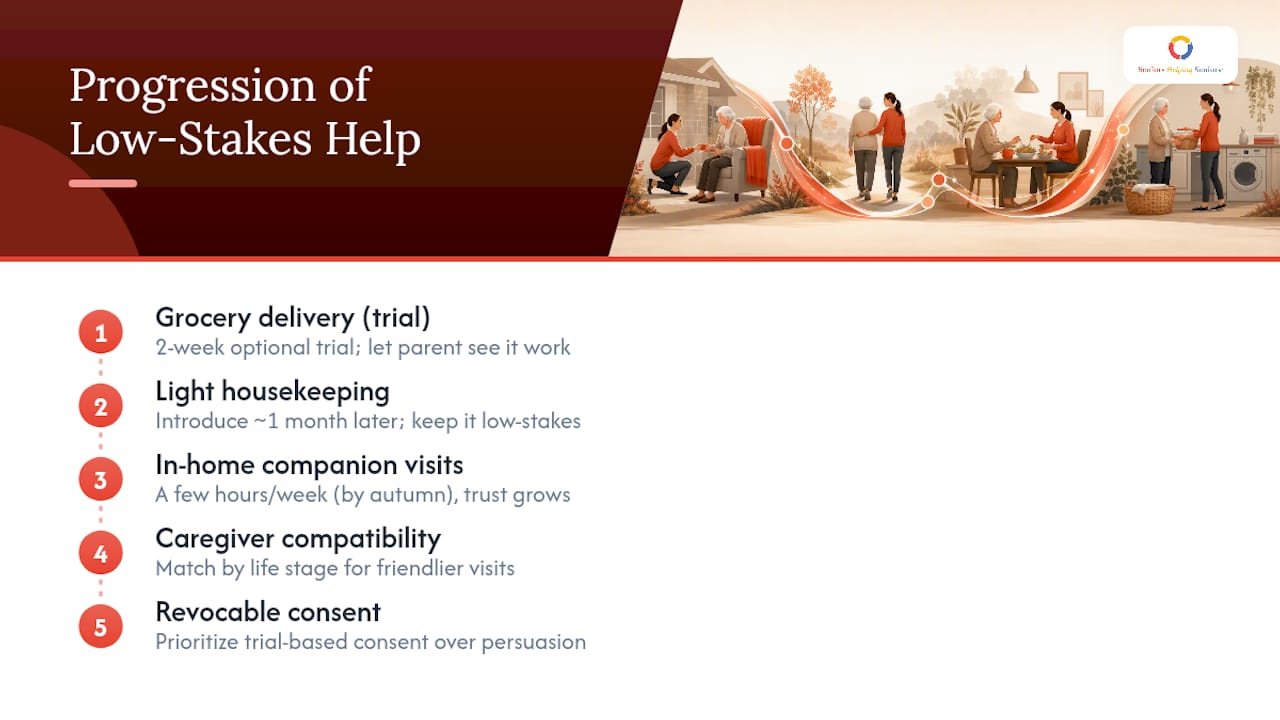
The overrated idea is the single dramatic conversation, the sit-down where everyone finally "gets through" to Dad. That moment rarely exists. What works instead looks more boring: a two-week trial of grocery delivery, then light housekeeping a month later, then maybe someone in the house a few hours a week by autumn. Compatibility matters more than most families assume too. Pairing an 80-year-old with a caregiver in her sixties, someone closer in life stage, changes the entire tone of that first visit from "being handled" to "making a new friend."
If you take one thing from this, prioritize the trial period over the persuasion attempt. Consent that's revocable is consent people can actually give.
— Cameron
If your family is ready to try a low-stakes trial with a caregiver matched for compatibility and shared life experience, Seniors Helping Seniors® Tucson builds its in-home care around exactly that model, pairing active, mature caregivers with older adults in Tucson and the surrounding communities for companionship-first support that starts small and grows only as trust does.
This article is general information, not a substitute for advice from a qualified doctor. Consult a qualified healthcare professional about your own circumstances before acting on anything here.