

"Pet therapy for seniors" gets used online to describe two very different things, and confusing them wastes families' time. In this article, it means paid in-home companionship and caregiving services: a trained caregiver who visits regularly to talk, help with meals, run errands, and keep an older adult engaged and safe at home. It does not mean animal-assisted therapy or therapy dog visits. If you're picturing a golden retriever visiting a nursing home, that's a different service with a different purpose.
The benefits of this kind of companionship care are well documented. Consistent social contact reduces loneliness, gives seniors help with the daily tasks that pile up (grocery runs, meal prep, medication reminders), and supports what most older adults actually want: staying in their own home. Harvard Health notes that aging in place preserves independence and social ties, and can be less expensive than moving into a facility, though Medicare's coverage of nonmedical in-home care is limited, which means most families budget for it out of pocket. The national median hourly rate for private nonmedical in-home care sits near $34 as of 2026.
If you're at the point of deciding whether to act, the next step is simple: request an initial needs assessment from a vetted local provider. In Tucson, that means reaching out to a group like Seniors Helping Seniors® Tucson, which pairs older adults with active, mature caregivers matched for compatibility and shared life experience.
Key Takeaways
Consistent, well-matched in-home companionship reduces loneliness, supports safe aging in place, and works best when reassessed every few months.
| Point | Details |
|---|---|
| Decide urgency first | Use falls, missed medications, or hospital discharge as signals to act immediately; use rising isolation as a planning cue. |
| Vet before you hire | Confirm background checks, CPR/First Aid and dementia training, references, and a written care agreement. |
| Budget realistically | Expect a national median near $34/hour; plan for mostly out-of-pocket payment since Medicare coverage is limited. |
| Set a reassessment date | Review the care plan every few months or immediately after any health change. |
| Consider a matched provider | Seniors Helping Seniors® Tucson pairs clients with mature, background-checked caregivers matched by shared interests and life experience. |
Table of Contents
- When Should You Consider In-Home Companionship for Seniors?
- What Does Companionship-Focused In-Home Care Actually Include?
- How Do You Choose the Right Caregiver or Agency?
- How Does a Care Plan Work, and How Often Should It Change?
- Where Can You Find Vetted Caregivers and Trusted Resources?
- What Do Companionship Services Typically Cost?
- What Benefits Does Consistent In-Home Companionship Provide?
- What Are the Risks, and How Do You Reduce Them?
- How Do You Match a Senior With the Right Companion Caregiver?
- What Does the Timeline Look Like From Decision to Routine?
- What Do Real Care Arrangements Look Like Day to Day?
- A Note From Seniors Helping Seniors® Tucson
- Ready to Talk to Seniors Helping Seniors® Tucson?
- Where Else Can You Look for Guidance?
- Frequently Asked Questions
- Sources
When Should You Consider In-Home Companionship for Seniors?
Some situations demand action within days. Others give you months to plan. Telling the difference keeps families from either panicking unnecessarily or waiting too long.
Signs that call for immediate action:
- A recent fall, even a minor one, especially if it happened while the person was alone
- Sudden confusion, rapid weight loss, or missed medication doses discovered during a visit
- An unsafe home environment: spoiled food in the fridge, unpaid bills piling up, or stove burners left on
- Discharge from a hospital or rehab facility with new mobility limits
Signs that suggest planning ahead over the next few weeks:
- Growing isolation, especially after a spouse's death or friends moving away
- Trouble keeping up with groceries, laundry, or light housekeeping
- Giving up driving, which often triggers a fast slide into isolation
- A family caregiver showing signs of burnout from juggling their own job and a parent's needs
A senior discharged from the hospital after a hip fracture needs care set up within a week, often before they even leave the building, and working with a personal trainer for seniors can support mobility recovery and safe rehabilitation at home. A senior whose adult daughter notices she's stopped calling friends back and skipping meals has more runway, but waiting six more months rarely helps.
What Does Companionship-Focused In-Home Care Actually Include?
Companion care covers what's known in the field as Instrumental Activities of Daily Living, or IADLs: the tasks that keep a household running but don't require a nursing license. That includes social companionship, light housekeeping, meal preparation, grocery shopping, transportation to appointments, and medication reminders.

A typical arrangement might look like two or three visits a week for conversation and errands, daily check-ins for someone managing a chronic condition, daytime respite so a working family member gets a break, or longer live-in shifts for seniors who need more consistent supervision.
One distinction matters here: a companion caregiver reminds a client to take medication, but doesn't administer it or perform clinical tasks. If a senior needs wound care, injections, or skilled nursing, that requires a licensed home health provider, a different category of service entirely. Most families start with companionship and personal care, and add medical support separately if a health condition requires it.
How Do You Choose the Right Caregiver or Agency?
The agency-versus-independent-hire decision comes down to how much risk you want to manage yourself. An independent caregiver usually costs less per hour, but you become the employer: you handle payroll taxes, liability insurance, and finding a replacement if they call in sick. An agency costs more, but background checks, insurance, payroll, and guaranteed backup coverage come built in.
| Factor | Agency | Independent Hire |
|---|---|---|
| Background checks | Conducted and documented by the agency | Falls entirely on the family to arrange |
| Backup coverage | Replacement caregiver provided if one is unavailable | No backup unless privately arranged |
| Insurance and payroll | Handled by the agency | Family may need to manage workers' comp and taxes |
| Training and certification | CPR/First Aid and dementia training typically required | Varies by individual, must be verified |
| Cost structure | Higher hourly rate, often bundled | Lower hourly rate, fewer built-in protections |
Before signing anything, ask direct questions:
- What does your background check process cover, and how often is it repeated?
- What training do caregivers receive for dementia care, CPR, and First Aid?
- What happens if my caregiver is sick or on vacation?
- Can I speak with two or three current client references?
- How do you match caregivers to a client's personality and interests?
Watch for red flags: vague answers about background checks, no references offered, unclear billing with hidden fees, or refusal to provide a written care agreement. High caregiver turnover is another warning sign. If an agency can't tell you who covered a client's last three visits, that inconsistency will eventually show up in your own care.
Trust signals worth confirming: state certification where your state requires it, documented CPR/First Aid and dementia training, a signed service agreement, checkable references, and a defined schedule for reassessing the care plan.
How Does a Care Plan Work, and How Often Should It Change?
A solid care plan starts with an in-home assessment covering the senior's daily routine, mobility risks, medical conditions, personal preferences, and emergency contacts. From there, the caregiver and family agree on specific tasks: which mornings involve a grocery run, which days are for doctor visits, how meals get prepared, and how the caregiver communicates updates back to family.
Reassessment isn't a one-time formality. Care plans should be revisited every few months, or sooner after any health change, whether that's a new diagnosis, a fall, or a hospital stay. Caregiving needs shift gradually, and a plan built six months ago may no longer match reality.
Pro Tip: Treat the first week as a trial, not a commitment. Watch for genuine rapport during the meet-and-greet, confirm tasks are actually getting done, and set a 30-day review date on the calendar before the first visit even happens.
Where Can You Find Vetted Caregivers and Trusted Resources?
Families typically find caregivers through home care agencies, online matching platforms, Area Agencies on Aging, geriatric care managers, senior centers, or personal referrals. Each channel trades off differently on cost, vetting rigor, and backup support.
- Home care agencies handle vetting, training, and replacement coverage, which suits complex or high-hours needs.
- Area Agencies on Aging and the Aging Life Care Association can connect families with geriatric care managers for professional care coordination.
- Local senior centers and community groups often know reliable independent caregivers through word of mouth.
- Online caregiver matching platforms widen your search but shift the background-check burden onto you.
Favor an agency when care involves complex medical needs, a heavy weekly hour count, or when guaranteed backup coverage matters more than saving a few dollars an hour. A single compatible companion hired privately can work fine for lighter, more predictable needs, provided the family does its own due diligence on references and background checks.
What Do Companionship Services Typically Cost?
Costs vary by hours needed and by whether you go through an agency or hire independently. The table below reflects typical costs at a median hourly rate of about $34; local rates in your area may run somewhat higher or lower.
| Weekly Hours | Estimated Monthly Cost |
|---|---|
| 10 hours/week | About one thousand three hundred sixty dollars per month |
| 10 to 15 hours a week | About two thousand seven hundred twenty dollars per month |
| — | About five thousand four hundred forty dollars per month |
Medicare generally does not cover nonmedical companion care, so most families pay out of pocket. Medicaid, in states with a home and community-based services waiver, and VA Aid and Attendance benefits for eligible veterans can offset costs in some cases, and some long-term care insurance policies cover companion care too, though policy terms vary widely.
- Start with a short trial schedule (10 to 15 hours a week) to gauge actual need before committing to a full package.
- Compare hourly versus bundled package pricing, since some agencies discount longer weekly commitments.
- Budget a cushion for backup coverage and gradual rate increases over time.
What Benefits Does Consistent In-Home Companionship Provide?
Regular social contact does more for an aging adult than most families expect going in. Harvard Health's research on aging in place points to preserved independence and stronger community ties as two of the clearest outcomes when seniors get consistent support at home rather than relocating. A caregiver who shows up on a predictable schedule becomes a fixed point in the week, something to look forward to rather than another appointment to manage.
The practical side matters just as much. A caregiver who notices weight loss, a skipped meal, or new confusion during a routine visit often catches problems before they become emergencies. That early catch is worth more than any single service on a task list.
What Are the Risks, and How Do You Reduce Them?
The biggest risk in companionship care isn't the caregiver relationship itself, it's a poor match. A caregiver who doesn't click with the senior's personality or interests tends to get quietly avoided, and the arrangement fades without anyone saying so directly. The strongest predictor of a placement lasting is what agencies call the "soft match": shared interests, cultural fit, and personality compatibility between caregiver and client.
Other risks include inconsistent scheduling, caregivers without adequate dementia training handling a client whose cognition is declining, and financial exploitation from unvetted independent hires. Mitigate these by insisting on background checks, requesting a trial period before a long-term commitment, and keeping a family member looped into weekly updates so changes get noticed early rather than months later.
How Do You Match a Senior With the Right Companion Caregiver?
Matching works less like filling a schedule slot and more like an introduction between two people who might actually get along. Shared hobbies, similar generational references, and comparable life experience all raise the odds of a lasting connection. A retired teacher paired with a caregiver who also spent decades in a classroom has an instant common language. A veteran often does better with a caregiver who understands military culture or has family who served.
Personality fit matters as much as shared history. Interview guidance from caregiver placement experts recommends treating early meetings as genuine interviews, not formalities, and using a trial visit to see whether conversation flows naturally before locking in a schedule.
What Does the Timeline Look Like From Decision to Routine?
Most families move through this in a fairly predictable sequence. First comes recognition, usually triggered by a fall, a hospital discharge, or a family member noticing growing isolation. Next is research: comparing agencies, checking references and vetting steps, and requesting an initial consultation.
The provider then conducts a home assessment and proposes a care plan, typically within a week of first contact. A trial period follows, usually the first two to four weeks, during which the family and caregiver assess rapport and task completion. By day 30, most families have enough information to confirm the arrangement or request a different caregiver match. From there, routine visits settle in, with reassessment built in every few months or after any health change.
What Do Real Care Arrangements Look Like Day to Day?
A daughter juggling a full-time job and an aging father three states away might arrange three weekly visits: one for groceries and meal prep, one for a doctor's appointment, one purely social. Over a few months, the visits shift from transactional to genuinely warm, with the caregiver and father developing inside jokes and a shared crossword habit.
A widow living alone after 50 years of marriage might start with twice-weekly companionship visits focused purely on conversation and light errands. Within a couple of months, those visits often become the anchor of her week, the one guaranteed conversation on her calendar. These patterns repeat across companionship care broadly: consistency and genuine rapport, more than any specific task, determine whether the arrangement sticks.
A Note From Seniors Helping Seniors® Tucson
We built this model around one idea: seniors relate to seniors differently than they relate to a 22-year-old aide, however capable that aide might be. Our caregivers are mature adults, often seniors themselves, matched with clients based on shared interests and life experience rather than just availability. That soft match, the thing that actually predicts whether an arrangement lasts, is where we spend most of our effort upfront.
Every caregiver goes through background checks and training in CPR, First Aid, and dementia awareness before ever meeting a client. We lead with companionship first, because the research and our own experience both point the same direction: a senior who feels genuinely connected to their caregiver sticks with care longer and benefits from it more.
Ready to Talk to Seniors Helping Seniors® Tucson?
If your family is weighing agency options against a private hire, here's the practical difference: Seniors Helping Seniors® Tucson gives you agency-level vetting (background checks, insurance, backup coverage) with the personal fit of a caregiver who's lived a similar life, not a stranger a decade or two out of college.

A first consult with our team starts with an in-home needs assessment, covering daily routine, mobility, and personal preferences. From there, we propose a written care plan with transparent hourly pricing, no vague estimates, and schedule a trial period so you can confirm the caregiver match before committing long term. Reassessment happens on a set schedule, not left to chance. If you're ready to move from research to action, request an in-home assessment and get a proposed care plan and pricing estimate within days.
Where Else Can You Look for Guidance?
- Medicare.gov for official guidance on what nonmedical in-home care coverage does and doesn't include.
- National Council on Aging (NCOA) for a broader list of caregiver-finding channels beyond agencies.
- Aging Life Care Association when you need a professional geriatric care manager to coordinate complex needs.
- Home Care Association of America (HCAOA) for agency vetting standards and questions to ask before signing.
- APlaceForMom for current cost benchmarking by state before you set a budget.
Frequently Asked Questions
Is pet therapy for seniors the same as a therapy dog visit? Not in this context. Here, "pet therapy for seniors" refers to paid in-home companionship and caregiving services, not animal-assisted therapy programs.
How much does in-home companionship typically cost? The national median runs about $34 per hour, though local rates vary and agency pricing tends to run higher than independent hires.
Does Medicare cover this type of care? Generally no. Medicare coverage for nonmedical in-home companionship is limited, so most families budget for it out of pocket.
How often should a care plan be reassessed? Every few months, or sooner after any fall, hospitalization, or significant change in health.
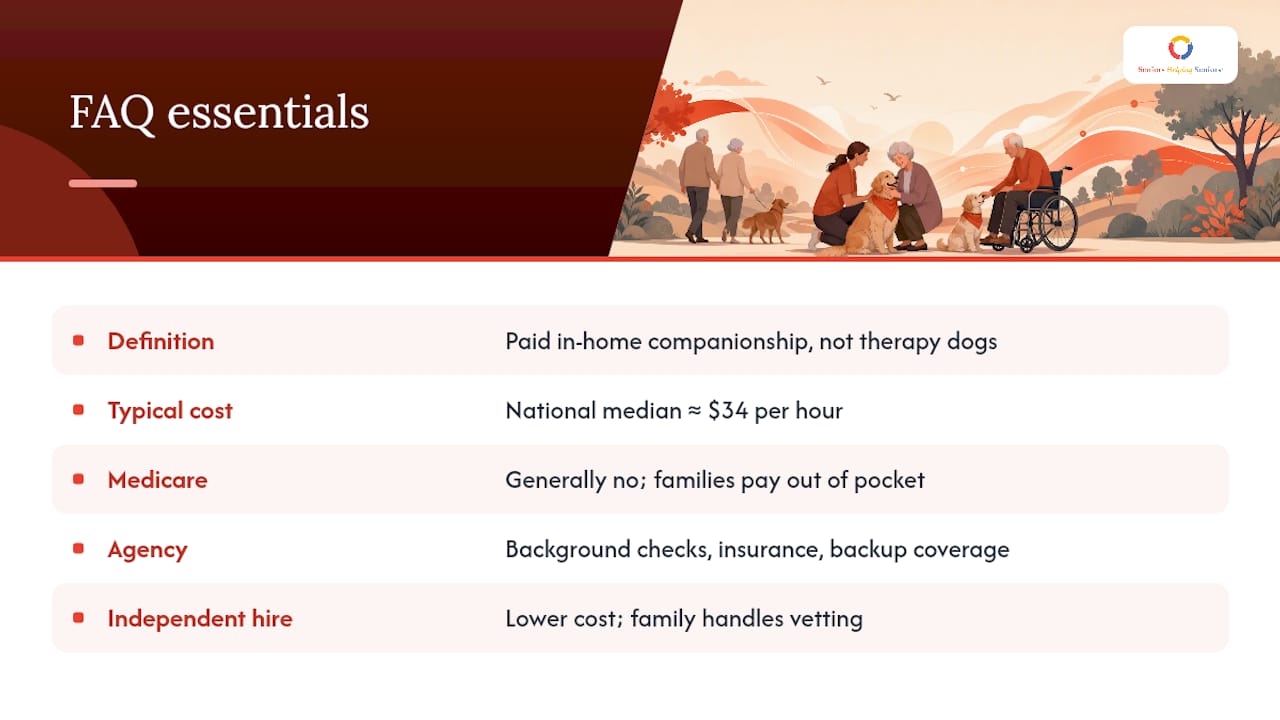
Should I choose an agency or hire independently? Agencies handle background checks, insurance, and backup coverage, which suits complex or high-hours needs. Independent hires can cost less but shift more vetting responsibility onto the family.
Sources
- Independent living with home care assistance: Balancing autonomy and support — Harvard Health
- Medicare
- Home Care Costs in 2026: A State-by-State Guide — APlaceForMom
- How do I find a good caregiver? A step-by-step guide — National Council on Aging (NCOA)
- Choosing a provider — Home Care Association of America (HCAOA)