
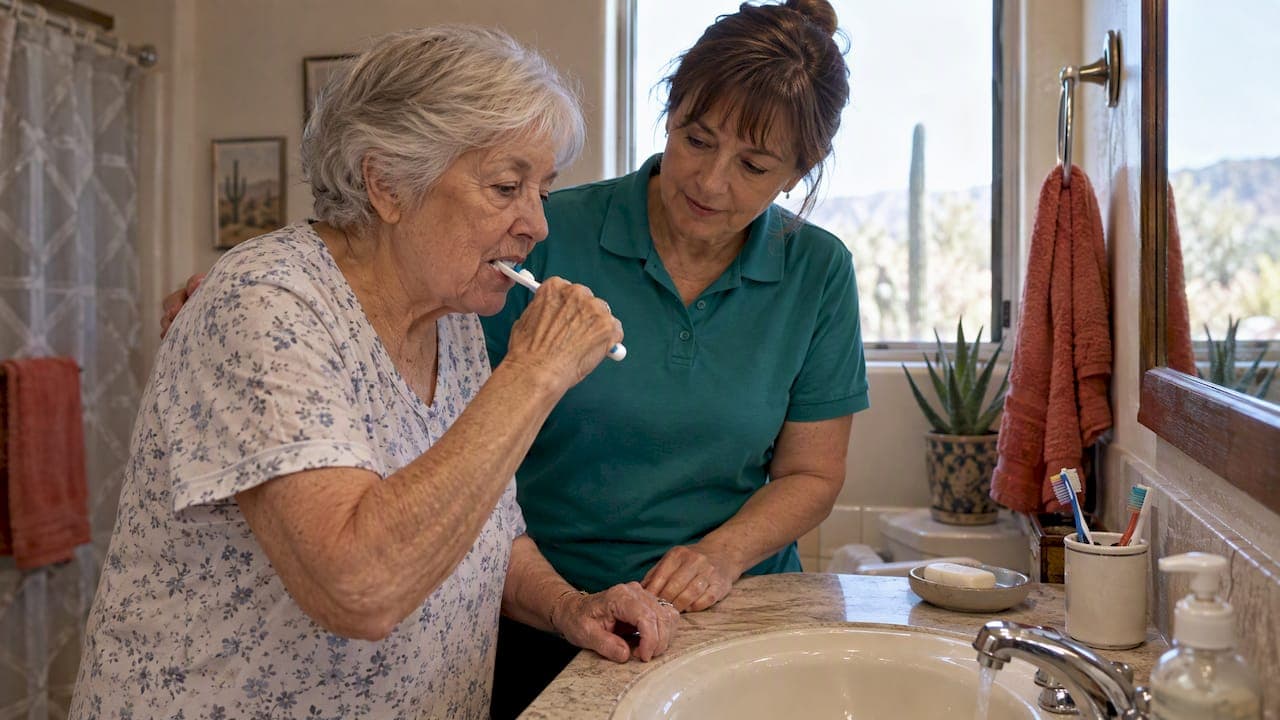
Brush twice a day with fluoride toothpaste, clean between teeth daily, and call a dentist about any sore spot, loose tooth, or persistent dry mouth that lasts more than two weeks. These three habits catch most problems before they become painful or expensive. Caregivers helping with these steps should use adaptive tools and a calm "tell, show, do" approach rather than rushing or taking over completely.
TL;DR:
- Using adaptive tools and calm instruction helps seniors maintain daily oral hygiene without risking injury or resistance during brushing and flossing.
- Dry mouth affects up to 40% of those over 80 and significantly raises the risk of tooth decay, especially when medications are a contributing factor.
- Dentures should be cleaned daily, soaked overnight, and checked regularly for fit to prevent discomfort, ulcers, or bone loss.
- Routine dental visits are necessary for seniors experiencing soreness, loose teeth, or difficulty chewing, with coverage typically limited outside of some Medicare Advantage plans.
- Caregivers can support long-term oral health by assisting consistently with hygiene tasks, managing medication effects, and ensuring regular dental checkups.
Table of Contents
- Daily oral hygiene for seniors: brushing, flossing, and useful tools
- Dry mouth: identify it, understand causes, and safe fixes
- Denture care and tooth-replacement options
- When to see a dentist, what happens at visits, and how to find affordable care
- Caregiver techniques: how to assist respectfully and effectively
- Nutrition, medications, and oral health interactions
- How in-home caregivers can support oral care
- FAQ
- Sources
- Authoritative resources and next steps
Daily oral hygiene for seniors: brushing, flossing, and useful tools
A soft-bristle brush, held at a slight angle to the gum line, cleans better than a hard one and causes less irritation to aging gums. Small circular motions along each tooth, inside and out, for about two minutes twice daily remove plaque without scrubbing away enamel or gum tissue. Replace the brush, or the head on an electric model, every three to four months, sooner if the bristles fray.
Cleaning between teeth matters just as much as brushing, since a brush alone misses up to 40% of tooth surfaces. Options include:
- Traditional floss, effective but hard for stiff or arthritic fingers to manage.
- Pre-threaded flossers, which add a handle and need less dexterity.
- Interdental brushes, small bristled picks that fit between wider gaps.
- Water flossers, which use a pressured stream and work well for bridges, implants, or sensitive gums.
Fluoride toothpaste remains central to preventing cavities and gum disease in older adults, and a dentist may add a prescription-strength gel or an in-office fluoride treatment for someone at higher risk of root decay. For anyone with arthritis, tremors, or reduced grip strength, a few simple swaps help: a toothbrush with a wider or built-up handle, a foam or elastic grip slid over an existing brush, or a powered toothbrush that does more of the scrubbing motion on its own.
Pro Tip: If a senior struggles to hold a standard brush, try wrapping a washcloth or bicycle-handle grip around it before buying anything new.

Dry mouth: identify it, understand causes, and safe fixes
Dry mouth, or xerostomia, shows up as a sticky or cottony feeling, trouble swallowing, cracked lips, or mouth sores that will not heal. It is common: dry mouth affects about 30% of adults over 65 and up to 40% of those over 80, most often as a medication side effect.
The usual causes include taking multiple medications at once, certain drug classes (antihistamines, blood pressure medicines, antidepressants, and diuretics among them), dehydration, underlying disease, and radiation or chemotherapy treatment.
Dry mouth isn't just uncomfortable. It raises the risk of tooth decay and denture problems, since saliva normally washes away food particles and buffers acid.
Simple self-care steps help:
- Sip water throughout the day rather than in large, infrequent gulps.
- Chew sugar-free or xylitol gum to stimulate saliva flow.
- Run a humidifier at night and avoid alcohol, caffeine, and tobacco.
- Try an over-the-counter artificial saliva spray or gel if dryness persists.
Steady fluid intake also matters for overall health, as covered in our piece on dehydration in seniors. When dryness continues despite these steps, a dentist or physician can review the medication list and may recommend a prescription saliva substitute or an adjustment to the drugs causing it, a decision that should always go through the prescriber rather than stopping a medication alone.
Denture care and tooth-replacement options
Dentures need daily cleaning with a denture brush and a cleanser made for the purpose, never regular toothpaste, which is too abrasive. Soaking overnight in water or a denture solution keeps them from warping, and removing them for sleep gives gum tissue a chance to rest and reduces the risk of irritation or fungal infection.
Watch for these warning signs that dentures no longer fit well:
- Soreness or rubbing in one consistent spot.
- Food repeatedly trapped under the plate while eating.
- Slipping or clicking while talking or chewing.
Any of these call for a dental visit rather than a home fix, since gums and jawbone shape change over time and an ill-fitting denture can cause ulcers or accelerate bone loss. For missing teeth generally, a dentist can walk through the tradeoffs among crowns, bridges, implants, and partial or full dentures, weighing cost, bone health, and how many teeth remain. Denture wearers often do best cutting food into smaller pieces, chewing slowly on both sides of the mouth, and favoring softer, moist dishes that are less likely to slip under the plate.
When to see a dentist, what happens at visits, and how to find affordable care
Schedule a dental visit for pain, a mouth sore that lasts more than two weeks, a loose or shifting tooth, or new difficulty chewing and swallowing, any of which can signal decay, infection, or in rare cases something more serious like oral cancer.
A senior-focused visit typically includes a review of medical history and current medications, a check of denture or implant fit, a cleaning, and an oral cancer screening that looks at the tongue, cheeks, and throat.
Paying for this care is often the hardest part. Original Medicare generally does not cover routine dental work, though some Medicare Advantage plans include limited dental benefits, a distinction explained in detail by South Littleton Family Dental's guide to Medicare dental coverage. Medicaid dental coverage for adults varies widely by state. For a broader look at how Medicare Advantage plans work before choosing one, Pounds Health's explainer is a useful starting point.
Practical next steps for lower-cost care:
- Call a local dental school, where supervised students treat patients at reduced rates.
- Look up a nearby community health center or sliding-scale clinic.
- Dial 211 or contact a local United Way for dental referral programs.
- Ask any dental office directly about payment plans before the visit.
Caregiver techniques: how to assist respectfully and effectively
Helping someone else brush and floss works best as a short, predictable routine rather than a rushed task.
- Gather supplies first: brush, toothpaste, floss or a flosser, a cup of water, and a towel or gloves if needed.
- Explain each step before doing it, a method often called "tell, show, do": describe what you will do, demonstrate briefly, then help.
- Seat the person upright with good light, and let them do as much as they safely can before stepping in.
- Use moistened gauze to wipe gums and tongue if brushing is not tolerated, and consider a powered toothbrush or a floss holder when dexterity is limited.
- Keep sessions brief, use the same time each day, offer calm encouragement, and stop if the person becomes distressed rather than pushing through.
These same principles for positioning, pacing, and preserving dignity apply broadly to personal care tasks like dressing assistance and bathing support. Note any new sores, bleeding, or resistance to care, and bring that information, along with a current medication list, to the next dental or medical appointment.
Pro Tip: Keep a small written log of oral care sessions, including any pain or resistance, so patterns are easy to spot and easy to share with a dentist.
Nutrition, medications, and oral health interactions
Taking several medications at once, common among older adults, raises the odds of dry mouth, since many drug classes list it as a side effect. That dryness, combined with a diet heavy in sticky or simple sugars, speeds up decay, particularly around exposed tooth roots.
Protecting teeth starts with diet:
- Limit sticky candies, crackers, and sugary drinks that cling to teeth.
- Choose hydrating, nutrient-dense foods like soups, yogurt, and cooked vegetables.
- Pick chew-friendly proteins such as eggs, fish, or ground meats when chewing is difficult.
Bring a full medication list to every dental visit and ask about saliva substitutes or alternative drugs rather than stopping anything without medical guidance. Unexplained weight loss or new trouble chewing deserves prompt follow-up with both a dentist and a physician.
How in-home caregivers can support oral care
Daily oral hygiene is easier to keep up with steady, familiar help nearby. In-home caregivers can assist with supervised brushing and flossing, denture cleaning and storage, medication reminders tied to dry-mouth-causing prescriptions, and transportation to and from dental appointments. For families managing several moving pieces at once, routine help with these smaller daily tasks often does more for long-term oral health than any single dental visit, since consistency is what prevents small problems from becoming painful ones.

This article is general information, not a substitute for advice from a qualified doctor. Consult a qualified healthcare professional about your own circumstances before acting on anything here.
FAQ
What toothpaste is best for seniors with sensitive teeth?
A fluoride toothpaste formulated for sensitivity works well for most seniors, since it protects enamel while easing discomfort from exposed roots. A dentist can recommend a prescription-strength fluoride option for those at higher risk of root decay.
How often should seniors replace their toothbrush?
A toothbrush, or an electric brush head, should be replaced every three to four months, or sooner if bristles look frayed. A worn brush cleans less effectively and can leave more plaque along the gum line.
Why do so many seniors experience dry mouth?
Dry mouth is common in older adults largely because of medication use, and it affects roughly 30% of people over 65 and up to 40% of those over 80. Dehydration, certain diseases, and cancer treatments can also contribute.
Does Medicare cover dental care for seniors?
Original Medicare generally does not cover routine dental care such as cleanings, fillings, or dentures. Some Medicare Advantage plans add limited dental benefits, which South Littleton Family Dental explains in more detail.
How can caregivers help a senior with dementia who resists brushing?
Short, predictable sessions at the same time each day, paired with simple verbal cues and a calm demonstration before touching the mouth, tend to work better than a rushed approach. Stopping and trying again later if the person becomes upset avoids turning oral care into a stressful struggle.
Sources
- Dry Mouth and Older Adults: Information for Caregivers (NIDCR/NIH)
- Taking care of your teeth and mouth (National Institute on Aging / NIH)
- Oral health tips for adults (CDC)
- Dental Care for Older Adults (PMC article)
Authoritative resources and next steps
- Taking Care of Your Teeth and Mouth (National Institute on Aging)
- Dry Mouth and Older Adults (NIDCR/NIH)
- Oral Health Tips for Adults (CDC)
- Dental Care for Older Adults (PMC)
- Xerostomia (American Dental Association)