

Non-medical home care covers assistance with daily living tasks, companionship, and household support — not clinical treatment. It is the help a senior needs to stay safely at home when the challenge is bathing, meals, or loneliness, not a wound that needs dressing or medication that requires a nurse. According to A Place for Mom, this type of care includes help with activities of daily living (ADLs), homemaker tasks, and companionship. The industry term you'll hear most often is custodial care or personal care, and it sits in a different category from home health care, which requires a physician's order and delivers skilled services like physical therapy or wound care.
The most common services families arrange first:
- Bathing, dressing, and grooming assistance
- Meal preparation and grocery shopping
- Light housekeeping and laundry
- Transportation to appointments or errands
- Companionship and social engagement
Your immediate next step: call your local Area Agency on Aging for a free needs assessment and a list of vetted local providers. Have a current medications list and a brief note on your relative's daily routine ready before that call.
Key takeaways
Non-medical home care covers personal care, homemaker tasks, and companionship for older adults at home — and choosing the right provider comes down to verified credentials, a strong caregiver match, and a clear written agreement.
| Point | Details |
|---|---|
| Know what it covers | Non-medical home care handles ADLs, IADLs, and companionship — not skilled clinical services. |
| Budget realistically | The national median rate is about $33 per hour; Medicaid HCBS waivers and VA benefits may offset costs for eligible individuals. |
| Medicare has limits | Medicare does not cover custodial personal care when that is the only need; confirm coverage before assuming it applies. |
| Vet every provider | Request proof of insurance, background checks, references, and a written contract before any caregiver enters the home. |
| Tucsonshs in Tucson | Seniors Helping Seniors® Tucson matches clients with peer caregivers for personal care, companionship, respite, and more. |
Table of Contents
- What non-medical home care services actually cover
- How much does non-medical home care cost, and who pays?
- How to find and choose a non-medical home care provider
- Understanding your hiring model options
- How quickly can care start, and what does the intake process look like?
- Why respite care matters more than most families realize
- Legal and safety basics to check before hiring
- What peer caregiving gets right that most families miss
- Seniors Helping Seniors® Tucson offers in-home care built around connection
- Sources
What non-medical home care services actually cover
Non-medical home care divides neatly into two service tiers: ADLs and IADLs. ADLs (activities of daily living) are the physical basics — bathing, dressing, toileting, transferring from bed to chair, and eating. IADLs (instrumental activities of daily living) are the tasks that keep a household running: cooking, shopping, managing medications, handling mail, and getting to appointments.
Common services and the situations they solve:
- Bathing and personal hygiene: A senior recovering from hip surgery who can't safely step into a shower alone.
- Dressing assistance: Someone with arthritis whose fingers can no longer manage buttons or zippers.
- Meal preparation: A person with early-stage dementia who forgets to eat or leaves the stove on.
- Light housekeeping: Weekly vacuuming and laundry for an older adult whose mobility makes those tasks risky. MedlinePlus notes that safe home environments are a core part of in-home support planning.
- Medication reminders: A caregiver who prompts the right pill at the right time — not administering medication, just reminding.
- Transportation: Rides to medical appointments, the pharmacy, or a weekly lunch with friends.
- Companionship: Scheduled visits that reduce isolation, which the National Institute on Aging identifies as a meaningful component of in-home support for older adults.
- Respite care: Temporary relief for a family caregiver — a few hours, a full day, or an overnight stay.
Pro Tip: When building an initial care plan, prioritize in this order: safety first (fall risk, wandering, medication errors), then basic physical needs (nutrition, hygiene), then social needs (companionship, outings). Trying to address everything at once usually leads to a plan nobody follows.
How much does non-medical home care cost, and who pays?
A Place for Mom reports a national median of about $33 per hour for non-medical home care in 2025. That figure shifts considerably depending on where you live — rates in rural areas tend to run lower, while major metro markets and coastal cities often land higher. The number of hours per week also matters: a few hours of companionship costs far less monthly than full-time personal care.
Common payment sources:
- Private pay: Out-of-pocket family funds. The most common payment method for non-medical home care, especially at the start of care.
- Long-term care insurance: Policies vary widely, but many cover custodial care explicitly. Pull the policy's benefit triggers and daily maximum before assuming coverage.
- Medicaid HCBS waivers: Medicaid's Home and Community-Based Services programs can cover non-medical home care for eligible individuals, but eligibility rules and covered services differ by state. Your state Medicaid office is the only reliable source for what applies in your situation.
- VA benefits: Veterans may qualify for the Aid and Attendance benefit or other VA programs that cover in-home personal care. Contact your local VA office or a Veterans Service Organization for a benefits check.
- Medicare: Medicare covers home health services only when they are medically necessary, the patient is homebound, and a physician has ordered skilled care. Medicare does not pay for custodial personal care or homemaker services when those are the only needs. Families who assume Medicare will cover a home aide for bathing and meal prep are often caught off guard.
A quick rule of thumb: if the care is about keeping someone comfortable and safe at home rather than treating a medical condition, Medicare is unlikely to pay for it.
How to find and choose a non-medical home care provider
Start with sources that have already done some vetting. Your local Area Agency on Aging (find yours at eldercare.acl.gov) maintains referral lists and can flag state-licensed providers. The VA has its own referral network for veterans. State health department websites list registered home care agencies. From there, narrow the field with direct interviews.
Interview checklist — questions to ask every agency or caregiver:
- Do you conduct criminal background checks on all caregivers, and can I see the policy in writing?
- What training do caregivers receive, and is it documented?
- Are you bonded and insured? What does the policy cover if a caregiver is injured in my home?
- How do you match caregivers to clients? Can we request a different caregiver if the fit isn't right?
- Who supervises caregivers, and how often?
- What is your cancellation and backup policy if a caregiver calls in sick?
- How is billing handled, and what is the minimum shift length?
Caregiver recommends verifying background checks, references, and training documentation before any caregiver enters the home.
Red flags that should end the conversation:
- No written background check policy or refusal to share it
- Vague or unsigned contracts
- Pressure to pay large sums upfront in cash only
- High caregiver turnover with no explanation
- Reluctance to provide references from current or past clients
Agency vs. private hire — a quick comparison:
| Factor | Agency | Private hire |
|---|---|---|
| Background checks | Handled by the agency | Your responsibility |
| Backup coverage | Agency provides a substitute | You find a replacement |
| Tax and payroll | Agency manages | You manage as employer |
| Cost | Typically higher hourly rate | Often lower hourly rate |
| Oversight | Agency supervises | You supervise directly |
| Flexibility | Structured scheduling | More negotiable |

Understanding your hiring model options
Three main models exist for arranging in-home personal care, and each fits a different situation.
Agency hire is the most common starting point for families new to home care. The agency recruits, screens, trains, and insures caregivers. If your regular caregiver is sick, the agency sends a substitute. You pay a higher hourly rate, but you're also buying administrative protection and continuity.
Private hire means you recruit and employ a caregiver directly. The hourly cost is often lower, but you take on the legal role of employer: withholding payroll taxes, carrying workers' compensation insurance, drafting a written employment agreement, and handling liability if the caregiver is injured on the job. This model works well when a family has already found a trusted individual through a personal referral and wants a long-term arrangement.
Senior-matching and peer caregiver programs are a third option that many families overlook. These programs connect older adults with caregivers who are also seniors, often matching on shared interests, backgrounds, or life experiences. The practical benefit is a relationship that feels less transactional and more like a friendship. Tucsonshs operates exactly this model in Tucson.
Pros and cons at a glance:
- Agency: Reliable backup coverage, managed compliance, higher cost, less caregiver continuity.
- Private hire: Lower cost, more control, full employer responsibility, no built-in backup.
- Senior-matching programs: Strong relational fit, companionship built in, availability varies by location.
Administrative checklist for private hires:
- Register as a household employer with the IRS (Form SS-4)
- Withhold and remit Social Security, Medicare, and federal income taxes
- Obtain workers' compensation insurance (required in most states)
- Draft a written agreement covering hours, duties, pay, and termination terms
- Verify work eligibility (Form I-9)
Pro Tip: Even if you hire privately, run a third-party background check through a service like Checkr or Sterling. A personal referral is a good start, but it is not a background check.
How quickly can care start, and what does the intake process look like?
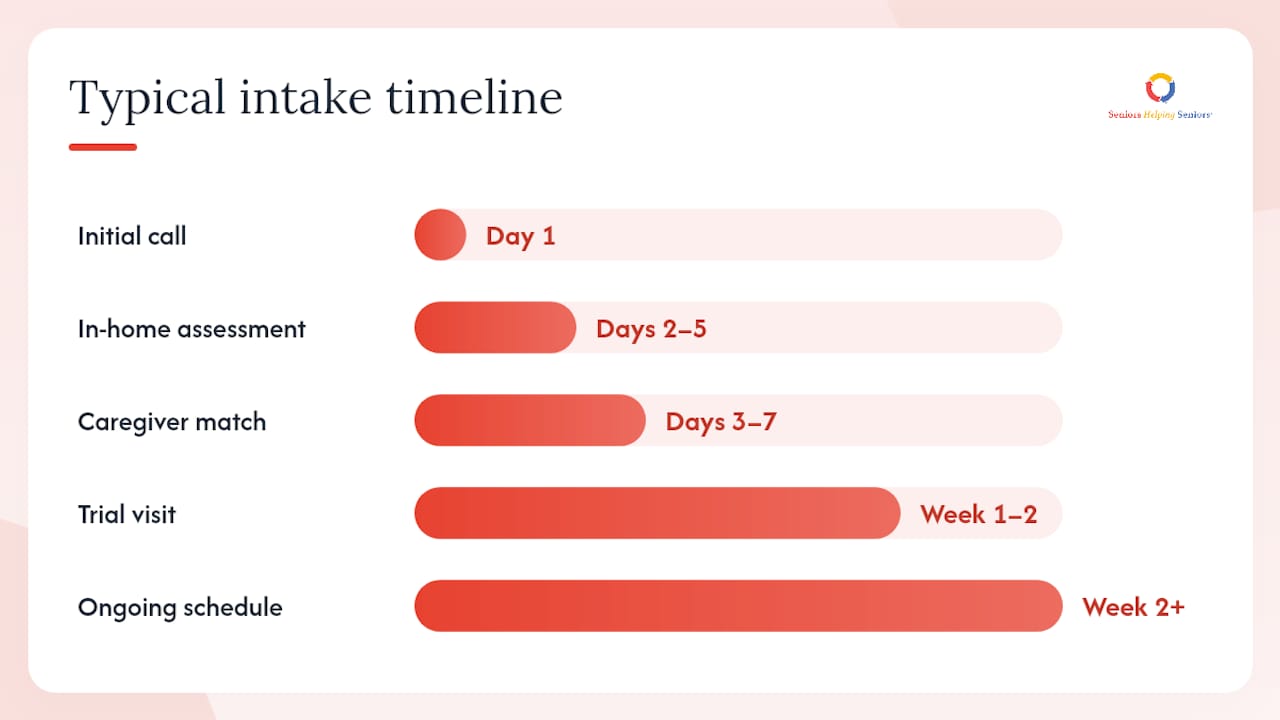
Most agencies can begin non-medical home care within a few days to two weeks of an initial call, assuming no complex medical coordination is needed. Here is a typical timeline:
- Initial call (Day 1): Describe the situation, ask about availability, and confirm the agency serves your area.
- In-home assessment (Days 2–5): A care coordinator visits to evaluate mobility, cognition, home safety, and daily routine. This shapes the care plan.
- Caregiver match (Days 3–7): The agency proposes one or more caregivers based on the assessment and any stated preferences.
- Trial visit (Week 1–2): A supervised or observed first visit to confirm the match works for both parties.
- Ongoing schedule (Week 2 forward): Regular visits begin on the agreed schedule, with a check-in call from the agency after the first week.
Information to have ready before the assessment:
- Current medications list (name, dose, frequency)
- Primary care physician's name and contact
- Emergency contacts and any legal documents (power of attorney, advance directive)
- Notes on daily routine, mobility aids, fall history, and cognitive status
- Insurance cards and any long-term care policy documents
Pro Tip: Use the trial visit to evaluate three things: Does the caregiver arrive on time? Does your relative seem comfortable with them within the first 30 minutes? Does the caregiver ask questions about preferences rather than just following a checklist? Those three signals predict long-term fit better than any interview.
Why respite care matters more than most families realize
Family caregivers often treat respite as optional. It is not. The National Institute on Aging identifies respite care as a key support for caregiver wellbeing, and the evidence behind that recommendation is consistent: caregivers who take regular breaks sustain their caregiving role longer and with fewer health consequences than those who do not.
Respite takes several forms:
- Hourly in-home respite: A paid caregiver covers a few hours so the family member can run errands, rest, or attend an appointment.
- Full-day or overnight respite: Longer coverage for a family caregiver who needs a full night of sleep or a day away.
- Adult day programs: Structured daytime programs where the care recipient socializes and receives supervision outside the home, typically several days per week.
Scheduling respite works best when it is treated like any other appointment — put it on the calendar, protect it, and don't cancel it when things feel manageable. The weeks when everything seems fine are exactly when a break prevents the crash that comes later.
Pro Tip: When scheduling a respite visit, give the caregiver a specific goal for the time: "I'll be back in three hours — please take Mom on a short walk and then do the crossword with her." A structured visit is more restorative for the care recipient than an unplanned one, and it gives you something concrete to evaluate afterward.
Legal and safety basics to check before hiring
Regulation of non-medical home care varies by state. Some states license home care agencies and require specific training hours; others have minimal requirements. New Hampshire, for example, explicitly distinguishes non-medical home care from home health care in its state program guidance and lists covered services separately. Your state's Department of Health and Human Services website is the right place to check what applies locally.
Documents to request from any provider before signing:
- Proof of general liability insurance and workers' compensation coverage
- Written background check policy and confirmation it has been run on your caregiver
- State registration or license number (if your state requires one)
- A written service agreement with clear terms for cancellation, billing, and dispute resolution
- References from at least two current or recent clients
Medicaid's HCBS programs also have state-specific compliance requirements for providers — if you're using Medicaid to pay, confirm the agency is enrolled as a Medicaid provider in your state.
Safety red flags tied to regulatory risk:
- A caregiver who is uninsured or whose agency cannot produce proof of coverage
- Missing or refused background check documentation
- Refusal to provide client references
- No written contract or a contract that lacks cancellation terms
- An agency that cannot confirm its state registration status
What peer caregiving gets right that most families miss
The conventional wisdom in home care selection focuses almost entirely on credentials: background checks, training hours, agency size. Those things matter. But the factor that most predicts whether a senior actually benefits from in-home personal care is something harder to quantify: whether the care recipient wants the caregiver there.
A senior who feels like a burden, or who resents a stranger managing their morning routine, will resist care. They'll cancel visits, refuse help, and isolate further. The credential-first approach misses this entirely.
What peer caregiving addresses is the relational dimension. When a caregiver is also a senior, the dynamic shifts. There's less of a patient-provider gap and more of a mutual exchange. The care recipient doesn't feel managed; they feel accompanied. That distinction changes outcomes in ways that a background check cannot.
Families who choose a peer caregiver model often report that their relative looks forward to visits rather than tolerating them. That's not a soft benefit. A senior who is engaged, socially connected, and comfortable with their caregiver is safer, more likely to eat well, and far less likely to decline rapidly.
Seniors Helping Seniors® Tucson offers in-home care built around connection
Tucsonshs provides the full range of non-medical home care services described in this guide: companionship and socialization, personal care and daily living assistance, memory and dementia support, respite care, meal preparation and grocery shopping, light housekeeping, transportation, and medication reminders.
What sets Tucsonshs apart is the caregiver model. Every caregiver is a mature adult, often a senior themselves, matched to clients based on shared life experiences and compatible personalities. The result is care that feels less like a service and more like a friendship. Families in Tucson who want a provider that combines practical daily assistance with genuine companionship have a direct option here.
To request an in-home assessment or ask about availability, visit Tucsonshs or call the Tucson office directly. Availability and specific services vary by location; the website is the most current source for service area details.
Sources
Use these authoritative resources to verify coverage rules, find local programs, and check provider credentials:
- Services for Older Adults Living at Home | National Institute on Aging
- Home Health Services Coverage
- What Is Nonmedical Home Care?
- Medicaid home and community-based services
- Caregiver
- Home care services - MedlinePlus