

MS home care means bringing personal care, skilled nursing, therapy, and mobility equipment into the home to match a person's actual symptoms, not a generic care template. It helps most right after a relapse, when falls increase, or when a family caregiver is stretched too thin to keep up safely. If any of that sounds familiar, the next move is simple: get an MS-aware assessment scheduled with a neurologist or a home-care agency that already knows the disease.
TL;DR:
- Care needs for MS patients vary widely from episodic help to long-term assistance, and planning ahead reduces stress and costs during relapses.
- Home care includes personal support, skilled nursing, therapy, and equipment, with quick scaling options essential during sudden symptom flares.
- Choosing caregivers with MS-specific experience, continuity, and proper training minimizes health risks and promotes trust, especially during symptom fluctuations.
- Budgeting and coverage details are complex, requiring families to verify benefits with providers and understand distinctions between home health services and durable medical equipment.
- Effective communication, contingency planning, and early transitions to assisted living or long-term care help ensure safety and emotional well-being over time.
Table of Contents
- Who needs MS home care, and how do needs change over time?
- What does MS home care include: services, skilled visits, and equipment?
- What should happen in the first 30 days of MS home care?
- How do you choose and hire an MS-aware caregiver?
- How do you pay for MS home care?
- How does MS home health differ from durable medical equipment?
- What emotional and psychological support helps MS patients at home?
- What are the biggest challenges in managing MS home care, and how do families solve them?
- What technology and assistive devices help with MS home care?
- How should caregivers, patients, and providers communicate?
- How do you plan for long-term care and transitions beyond home care?
- How does caregiver matching affect emotional well-being in MS care?
- How Seniors Helping Seniors® Tucson supports MS home care
- Sources
Who needs MS home care, and how do needs change over time?
Multiple sclerosis does not progress on a schedule, and neither should the care plan. Fatigue, mobility loss, bladder dysfunction, and cognitive fog are the four symptoms that most often push a family from "we're managing" to "we need help," sometimes within weeks of a relapse.
Three profiles show up again and again:
- Light, episodic help — someone managing well most days but needing a few hours a week for transportation, meal prep, or a check-in during flare-ups.
- Post-relapse intensive help — a sudden jump in hours after a hospital stay, often including PT, OT, and daily personal care while function is being rebuilt.
- Progressive, long-term help — steady, increasing hours as mobility and endurance decline over years rather than weeks.
Caregiver burnout tends to sneak up on families in the second profile, when a relapse forces sudden, unplanned hours onto a spouse or adult child. Care that scales quickly and keeps the same caregivers matters more over time than picking the cheapest option now, because starting the search for help during a crisis almost always costs more in stress and money than planning ahead.
What does MS home care include: services, skilled visits, and equipment?
MS home care typically blends personal care, skilled clinical visits, and equipment, and each piece solves a different problem.
Personal care and daily living support covers bathing, dressing, transfers, and mobility assistance, usually the first layer families add. Skilled nursing visits handle tasks that go beyond personal care, including injection or infusion teaching for disease-modifying therapies, catheter care, and wound monitoring for anyone dealing with pressure sores from reduced mobility.
Physical and occupational therapists focus on three things: energy conservation techniques, gait training to reduce fall risk, and bathroom safety modifications. That last one is not cosmetic. Grab bars, shower chairs, and raised toilet seats are the most common pieces of durable medical equipment MS households request, often alongside walkers, wheelchairs, and ankle-foot orthotics.
Common home care components:
- Personal care aide for bathing, dressing, and transfers
- Skilled nursing for DMT injections, catheter care, and wound checks
- Physical therapy for gait, balance, and fall prevention
- Occupational therapy for energy conservation and home safety
- Durable medical equipment: walkers, wheelchairs, shower chairs, grab bars
Pro Tip: Heat sensitivity, known clinically as Uhthoff's phenomenon, can worsen MS symptoms within minutes during hot weather or a fever. Cooling vests and scheduling outdoor activities for early morning are cheap, effective fixes worth building into any care plan.
What should happen in the first 30 days of MS home care?
The first month after a relapse or a decision to get help sets the tone for everything after it. Move too slowly and small problems become emergencies; move too fast without a plan and you overspend on the wrong services.
- Confirm the clinical baseline. Schedule an MS-aware assessment and confirm the disease-modifying therapy plan with the neurologist before adding any care hours, since medication changes affect what kind of help is actually needed.
- Walk the home for safety. Check bathroom footing, clear hallway clutter, and check stair access first. These are where falls happen most.
- Book therapy evaluations. Get PT and OT evaluations on the calendar within the first two weeks. Waiting until "things settle down" usually means waiting until a fall forces the issue.
- Set medication routines. Build a simple, written schedule for injections, infusions, or oral DMTs, and assign a backup person who can administer or remind if the primary caregiver is unavailable.
- Set short-term goals with contingency room. Decide what "better" looks like in 30 and 90 days, and agree in advance on how quickly hours can scale up if a relapse hits.
Pro Tip: Ask any home-care agency directly how fast they can add hours during a relapse. A same-day or next-day scale-up option is worth more than a slightly lower hourly rate, because relapses rarely wait for a staffing meeting.
How do you choose and hire an MS-aware caregiver?
Not every caregiver, agency or private, understands MS well enough to catch the details that matter. Someone trained for general elder care might miss that a client's leg weakness fluctuates by time of day, or that a warm bath before a transfer is a fall risk waiting to happen.
Look for four things before signing anything:
- MS-specific experience, not just general home-care training
- Continuity of staff, since the same one or two caregivers learn a person's patterns faster than a rotating roster
- Training in transfers and bladder or bowel care, which come up constantly in progressive MS
- Background checks and verifiable references, non-negotiable regardless of agency size
During interviews, ask direct questions: "Have you cared for someone through an MS relapse?" "Are you trained to help with catheter care or DMT injections?" "How quickly can you add hours if symptoms flare?" "What's your plan for a hot day, given heat sensitivity issues?" Vague or defensive answers to any of these are a warning sign.
Before signing a contract, confirm hours, cancellation policy, supervision structure, and, most importantly, backup staffing if the assigned caregiver is sick or unavailable. Hiring decisions for MS households usually come down to a tradeoff between the control of a private hire and the administrative simplicity of an agency, and either can work well if the vetting is thorough. Red flags worth walking away from: no references offered, training that sounds generic rather than MS-specific, or reluctance to put backup staffing in writing.
How do you pay for MS home care?
Coverage depends heavily on what kind of care is being delivered and who is providing it, so it pays to ask specific questions rather than assume.
Medicare covers skilled home health services, like nursing visits and therapy, when a physician certifies they are medically necessary. A common misconception is that Medicare only pays when a patient is improving. Following Jimmo v. Sebelius, Medicare also covers maintenance care intended to prevent decline, which matters enormously for a condition like MS that does not always trend toward improvement. Durable medical equipment is often covered too, typically with coinsurance.
Medicaid coverage for home care varies significantly by state, so eligibility and covered services depend entirely on where the patient lives. VA benefits can cover home care for eligible veterans through several distinct programs. Private insurance and out-of-pocket payment fill in the rest, and costs vary by region and hours needed.
Before assuming a service is covered:
- Ask the agency directly how they bill Medicare, Medicaid, or private insurance
- Contact your State Health Insurance Assistance Program (SHIP) for free, unbiased coverage guidance
- Request written physician documentation and a face-to-face evaluation, both usually required for Medicare-covered skilled services
How does MS home health differ from durable medical equipment?
These two categories get lumped together constantly, and the confusion causes real problems when families try to figure out coverage or plan a budget.
Home health refers to services, people coming into the home to deliver skilled nursing, physical therapy, occupational therapy, or personal care. It is billed and authorized based on medical necessity, tied to a physician's plan of care, and typically requires periodic reassessment.
Durable medical equipment (DME) refers to physical items, wheelchairs, walkers, hospital beds, shower chairs, and similar equipment that is expected to last for repeated use. DME is billed separately from home health services, often through a different supplier, and usually requires its own prescription or certificate of medical necessity even when a home health nurse is the one who recommends it.
The practical difference shows up at billing time. A physical therapist's visit to train someone on safe transfers falls under home health. The transfer bench itself is DME, coming through a separate supplier with its own paperwork. Families who assume one covers the other often get blindsided by a bill or a denial. The fix is straightforward: ask the home health agency and the DME supplier each to confirm, in writing, what their piece covers and what the patient is responsible for. Two paperwork trails, two separate approvals, one coordinated plan.
What emotional and psychological support helps MS patients at home?
MS carries a psychological weight that often gets less attention than the physical symptoms, even though depression and anxiety rates run higher in people with MS than in the general population. Losing the ability to do things independently, even small things like buttoning a shirt, chips away at identity in ways that are easy to underestimate from the outside.
In-home counseling and telehealth therapy are increasingly available for people who find travel to appointments exhausting or unpredictable. Peer support groups, many now meeting virtually, connect people with others who understand the specific frustrations of an invisible, unpredictable illness. Family counseling helps address the relationship strain that comes with a caregiver taking on more responsibility, which can quietly build resentment on both sides if never discussed openly.
Companionship matters more than it sounds like it should. A caregiver who shows up consistently, remembers what matters to the person, and treats the relationship as more than a task list reduces isolation in a measurable way. That kind of steady presence also gives caregivers an early warning system. Someone who sees a person regularly notices subtle mood shifts or cognitive changes long before they become obvious to an outsider, and that early flag often makes the difference in getting help before a small problem becomes a crisis.
What are the biggest challenges in managing MS home care, and how do families solve them?
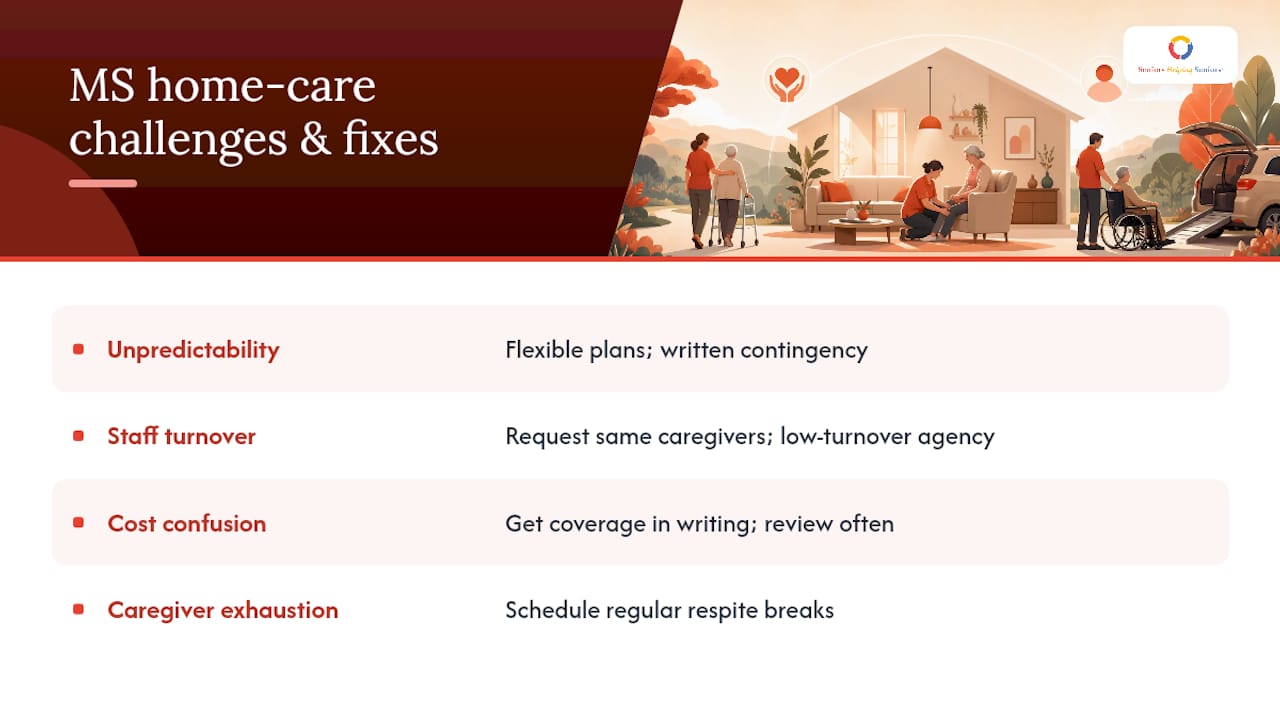
Three problems come up in almost every MS household managing home care, and each has a workable fix.
Unpredictability tops the list. MS relapses do not follow a calendar, so a care plan built for "how things are today" can be outdated within a week. The fix is building flexibility into every arrangement from the start, choosing agencies that can scale hours quickly and keeping a written contingency plan for sudden symptom flares.
Staff turnover undermines the continuity that MS care depends on. A new caregiver every few weeks means constantly re-explaining transfer techniques, medication routines, and personal preferences. Prioritizing agencies known for low turnover and requesting the same one or two caregivers consistently solves most of this.
Cost and coverage confusion frustrates families trying to figure out what insurance actually pays for. The solution is unglamorous but effective: get everything in writing before services start, and revisit coverage questions any time the care plan changes.
Caregiver exhaustion hits family members hardest, since they often absorb hours no formal service covers. Respite care, available in blocks as short as a few hours or as long as several days, exists specifically to give a primary caregiver a genuine break without leaving the person with MS unsupported. Families who build regular respite into the plan, rather than waiting until burnout hits, tend to sustain caregiving longer and with less resentment.
What technology and assistive devices help with MS home care?
Assistive technology has moved well past the basic cane-and-walker era, and a lot of the newer tools solve problems that used to require a caregiver's constant presence.
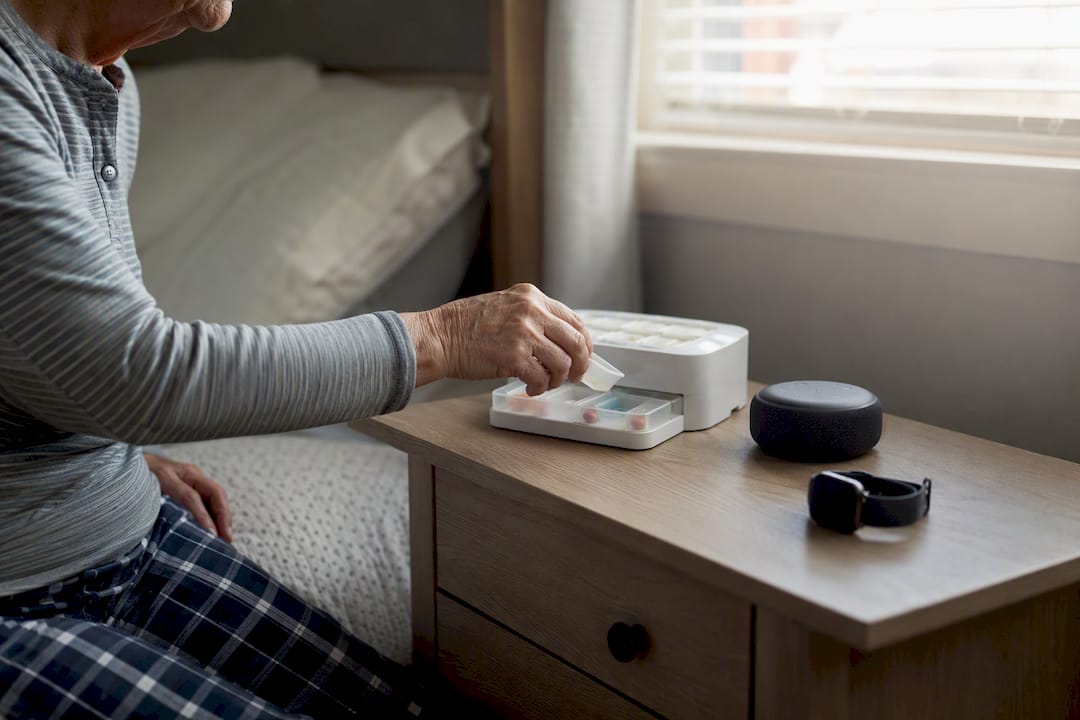
Medication reminder apps and smart pill dispensers cut down on missed or duplicated doses, especially helpful for anyone managing cognitive fog alongside a complex DMT schedule. Fall-detection wearables send alerts automatically when a fall occurs, which matters for anyone spending stretches of time alone. Voice-activated home assistants let someone with limited hand mobility control lights, thermostats, and door locks without needing to physically reach a switch.
Mobility technology has improved too. Power wheelchairs with better battery life and terrain handling, combined with smart-home ramps and stairlifts, extend independence for people whose walking distance has shrunk. Cooling technology, from wearable cooling vests to smart thermostats that flag temperature spikes, directly addresses the heat sensitivity many MS patients deal with.
Telehealth platforms deserve a mention on their own. Video visits with neurologists cut down on the physical toll of travel for routine check-ins, reserving in-person visits for when they genuinely matter. None of this replaces a human caregiver's judgment, but it fills the gaps between visits in a way that catches problems earlier and keeps people safer when nobody else is in the room.
How should caregivers, patients, and providers communicate?
Miscommunication between a home caregiver, the person with MS, and the medical team causes more preventable problems than almost anything else in home care, and it is entirely fixable with a few habits.
A shared, written care log works better than relying on memory or verbal handoffs, especially when multiple caregivers rotate through a household. Logging symptom changes, medication timing, and mobility fluctuations gives the neurologist real data at the next appointment instead of a vague "she's been more tired lately."
Regular family check-ins, even brief fifteen-minute weekly calls, keep everyone aligned on what is working and what is not. Waiting for a crisis to trigger a conversation almost always means the conversation happens too late.
When it comes to healthcare providers, caregivers should feel empowered to ask specific questions rather than general ones. "Should we adjust the PT schedule given the recent fatigue increase?" gets a more useful answer than "how's she doing?" Bringing the written care log to appointments turns a rushed fifteen-minute visit into a genuinely productive one.
Finally, patients themselves should be part of every conversation whenever cognitively possible. Decisions made about someone's care, without someone's input, tend to breed resentment and non-adherence, even when the decisions are objectively reasonable.
How do you plan for long-term care and transitions beyond home care?
Home care is not always the final destination, and pretending otherwise sets families up for a harder transition later. Planning for what comes next, while home care is still working well, makes any eventual change smoother.
Start by defining trigger points in advance: specific signs that home care alone is no longer sufficient. That might be falls happening despite mobility aids, medical needs exceeding what in-home skilled visits can safely handle, or a primary caregiver's health declining. Writing these triggers down before a crisis removes the guesswork and the guilt from a decision made under pressure.
Assisted living and skilled nursing facilities become relevant when medical needs intensify beyond what home visits can cover, or when 24-hour supervision becomes necessary. Touring facilities early, even years before they might be needed, removes the panic of researching options during an emergency.
Legal and financial planning belongs in this conversation too. Power of attorney, advance directives, and long-term care insurance reviews are far easier to handle calmly in month six than in the middle of a health crisis. Families who treat home care as one stage in a longer plan, rather than a permanent fix, make these transitions with far less disruption when the time comes.
How does caregiver matching affect emotional well-being in MS care?
Companionship from a caregiver who has lived through comparable life stages tends to land differently than care from someone decades younger simply checking tasks off a list. That shared context builds rapport faster and keeps people more engaged in their own care rather than passively receiving it.
Continuity compounds that trust. A caregiver who sees the same person consistently over months notices subtle mood or cognitive shifts long before they become obvious, catching problems early rather than after they escalate. That combination, shared experience plus consistency, does more for medication adherence and daily engagement than most families expect going in.
— Cameron
How Seniors Helping Seniors® Tucson supports MS home care
Tucsonshs is the practical alternative to piecing together separate agencies for personal care, companionship, and transportation. One relationship covers companionship and socialization, personal care and daily living assistance, memory and dementia support, respite care, transportation, meal preparation, light housekeeping, and medication reminders, all coordinated instead of scattered across providers.

What sets the model apart for MS households specifically is the matching approach. Caregivers are mature adults, often seniors themselves, matched for compatibility and shared life experience, which supports the continuity and trust that make it easier to catch subtle changes early and stick with a care plan. Respite care is built into the offering too, giving family caregivers a real break without leaving a loved one unsupported.
The first step is a straightforward assessment visit to talk through symptoms, daily routines, and current gaps in support. From there, Tucsonshs can outline a starting schedule and adjust hours as needs change. Reach out through the Tucson care team to schedule that first conversation and see what a compatibility-matched plan looks like for your household.
Sources
A few sources are worth bookmarking as you build out a care plan. The DMEHelper multiple sclerosis guide covers equipment specifics and Medicare coverage caveats in more depth than most general resources. Maxim Healthcare's MS home healthcare overview explains how skilled nursing and therapy roles fit together in a home setting.
For the hiring process specifically, MyMSTeam's caregiver hiring guide walks through burnout warning signs and respite care logistics. And for Medicare specifics, including the Jimmo v. Sebelius maintenance-care rule, MS Home Health Care's coverage explainer is a solid starting point before calling your State Health Insurance Assistance Program (SHIP) for personalized guidance.
This article is general information, not a substitute for advice from a qualified doctor. Consult a qualified healthcare professional about your own circumstances before acting on anything here.