
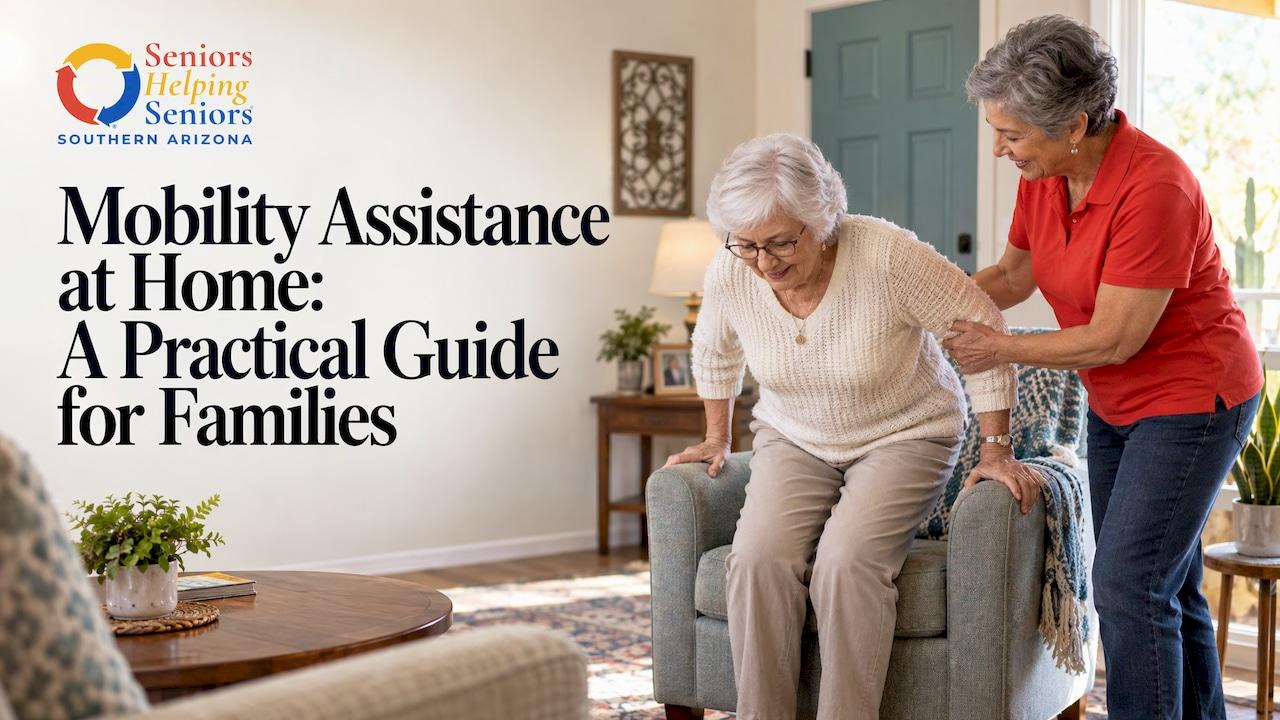
Mobility assistance at home comes down to three things working together: a home that is safe to move through, the right aid fitted to the person, and a trusted person nearby for the moments when balance or strength falls short. Equipment and home changes remove most hazards. A caring companion makes sure they are actually used, every day, without the senior feeling watched over.
Here in Tucson, our caregivers are mature adults, often seniors themselves, matched with clients for shared life experience. That peer connection is why a walker gets used on a hard day and not left in the corner. This guide shows you how to look at a home with fresh eyes, what to choose, and where hands-on help fits in.
Key Takeaways
- Start with a room-by-room review of the home. The National Institute on Aging's home safety checklist covers lighting, clutter, cords, grab bars, nonskid mats and ramps.
- A cane or walker only helps when it is fitted correctly. A cane's top should line up with the hip joint, and it belongs in the hand opposite the weaker leg.
- Wheelchair access needs specific measurements: at least 32 inches of doorway clearance and 36-inch hallways.
- Medicare generally does not pay for grab bars or home modifications, so plan for costs early and ask your local Area Agency on Aging about help.
- A caregiver who walks beside your loved one turns equipment and a safe layout into daily habits. We offer flexible scheduling with no minimums or long-term contracts.
Table of Contents
- What Mobility Assistance at Home Really Means
- Step 1: Walk Through the Home Together
- Step 2: Choose Aids That Fit the Person
- Step 3: Make Rooms Wheelchair and Walker Friendly
- Step 4: Plan for the Cost
- Step 5: Add the Human Piece
- How We Help in Tucson
- Ready for a Steady Hand at Home?
- FAQ
- Sources
What Mobility Assistance at Home Really Means
Mobility is more than walking. It is getting out of bed, standing up from a favorite chair, stepping into the shower, reaching the mailbox and getting to the car. When any of these becomes difficult, a person often starts avoiding them. Avoidance shrinks the world to one room, and that can bring on loneliness as well as weakness.
The CDC's My Mobility Plan makes the point that injuries from falling can reduce the ability to stay mobile and independent. Its advice is practical: go through a home safety checklist to find trip hazards, decide whether you need help or tools for a project, and look to community organizations that supply materials, funds or installation help.
So good mobility assistance has three layers:
- The space: lighting, floors, doorways, bathrooms and entrances.
- The tools: canes, walkers, wheelchairs, shower seats and grab bars.
- The people: someone who offers a steady arm, a ride, a reminder, or simply company on a walk down the hall.
Most families focus on the first two and discover the third later, often after a scare. It is easier to plan for all three together.
Step 1: Walk Through the Home Together
Do this with your loved one, not around them. A senior who helps spot the hazards is far more likely to accept the fixes.
The NIA's Home Safety Checklist is a good place to begin. Among its prompts:
- Check lighting at the top and bottom of stairs.
- Clear clutter and keep walking areas free of cords.
- Install grab bars near toilets and in the tub or shower.
- Add nonskid strips or mats, a plastic shower stool and a hand-held shower head.
- Set the water heater to 120°F to avoid scalding.
- Put a night light on the route to the bathroom.
- Consider a ramp at the front door if a walker or wheelchair is needed.
It also advises reevaluating home safety as needs change. A home that worked last year may not work after a hospital stay.
If you want a second layer of detail, the Rebuilding Together safe-at-home checklist published through the American Occupational Therapy Association looks at entrances (curb cuts, handrails, threshold height), clear door and hall width for a walker or wheelchair, tub entry and toilet height, and kitchen counter heights and knee space. For a simple evening routine that pairs a safe layout with daily check-ins, this safety plan for seniors walks through room-by-room basics.
We also keep a caregiver-friendly room-by-room home safety guide that follows government sources.
When to bring in a professional
If your loved one has fallen, the NIA notes that a doctor might suggest an occupational therapist, physical therapist or nurse visit the home to assess safety and advise on changes. Please follow that advice. An occupational therapist can evaluate how a person actually performs daily tasks, identify hazards and recommend modifications, as the Administration for Community Living's home-modification brochure describes.
Clinical screening tools exist too. The Agency for Healthcare Research and Quality describes a mobility and transfer assessment in which a nurse watches how a person walks with their usual cane, walker or wheelchair and how they move in and out of bed, on and off the toilet, and in and out of a lounge chair. Families do not need to run this test themselves, but it shows which three moments professionals watch most closely: standing up, sitting down and turning.
Step 2: Choose Aids That Fit the Person
A mobility aid that is the wrong height or the wrong type can create a new hazard. Fit matters as much as the product.
Canes
The University of Missouri Extension's fall-prevention safety guide gives clear fitting rules:
- With the cane tip about 4 inches in front of and 4 inches to the side of the foot, the top should line up with the hip joint.
- The elbow should bend about 20 degrees when holding it.
- Hold the cane in the hand opposite the weaker leg, and move the cane and the weaker leg forward together.
- Always use a non-slip rubber tip, and replace it when it wears down.
That last point is easy to miss. A worn tip on a smooth kitchen floor is a quiet hazard.
Power chairs
The same guide lists safe-use habits for power chairs: adjust the seat, armrests and footrests for fit, fasten the seat belt, keep feet on the footrests and hands clear of moving parts, and drive slowly on ramps and corners. Use ramps and curb cuts, avoid steep or uneven ground, charge the chair fully before outings, and check tires, brakes and controls regularly.
A caregiver can make that routine easy: plugging in the chair each night, glancing at the tires and going along on the first few outings.
Bathroom equipment
The bathroom is where many families feel the most worry, and for good reason: wet surfaces, hard edges and the need to sit and stand. Useful items include grab bars, a shower stool, a hand-held shower head, nonskid mats and a raised toilet seat.

The Muscular Dystrophy Association's home-modifications guide offers a warning worth remembering: a towel rod is not a grab bar, because it cannot hold body weight. It also notes that toilets can be raised with a seat riser or spacer, with safety rails on both sides.
The ALS Association adds that grab bars must be screwed into studs or blocking behind the wall. Suction-cup bars are not a substitute. If you are unsure where studs are, ask a licensed contractor to install them.
If toileting is the hardest daily moment, our guide on safer, dignified toileting at home walks family caregivers through it step by step.
Step 3: Make Rooms Wheelchair and Walker Friendly
When a walker or wheelchair enters the picture, the question becomes whether it fits through the house. The ALS Association's home-adaptations guide gives the numbers:
| Space | Minimum |
|---|---|
| Doorway clearance | At least 32 inches (swing-clear hinges or removing the door can help) |
| Hallway width | 36 inches |
| U-turn (360 degrees) | 5-foot-diameter turning circle |
| T-turn (180 degrees) | 3 feet of clear space in each direction |
For bathrooms and kitchens, the Muscular Dystrophy Association's guide specifies that roll-in showers should be 30 inches wide and 60 inches long with the floor sloped to drain. Sinks need clearance underneath the wheelchair and at least 60 inches of open floor in front, with covered plumbing and lever or sensor faucets.
Low-cost changes that help right away
The Administration for Community Living's home-modification brochure lists changes that prevent falls and support independence without a remodel:
- Remove or secure rugs.
- Put high-contrast non-skid tape on stairs.
- Add handrails on both sides of staircases.
- Choose non-skid flooring or low-pile carpet.
- Improve lighting.
Bigger projects include ramps or no-step entries, wider doorways and hallways, and variable-height kitchen counters. The Family Caregiver Alliance's assistive technology page notes that larger modifications such as widening doorways, lowering counters or installing lifts may require a licensed contractor.
If vision is part of the picture, our post on a simple tape fix for macular degeneration at home shows how contrast can make a room easier to read.
Step 4: Plan for the Cost
Families are often surprised by how little insurance covers. The Family Caregiver Alliance says durable medical equipment can be funded by sources such as Medicare, Medicaid waiver programs, private insurance, the VA, United Way, Easter Seals and local Centers for Independent Living when it is prescribed or medically necessary. It also notes that grab bars, bath mats and dressing aids are typically not covered.
A Kentucky Assistive Technology Network guide adds that Medicare pays 80% of expenses and does not cover home modifications. It also says a Medicaid waiver can provide some modifications, but a person cannot qualify for a waiver solely to get equipment. The same guide notes the VA offers a home-accessibility program with amounts based on disability. Programs and amounts change, so confirm details with the program directly.
Veterans in our community should ask their VA care team about the home-accessibility program early, before ordering anything.
For local help finding funds or installers, the Administration for Community Living's brochure points to the Eldercare Locator, which connects older adults and caregivers to Area Agencies on Aging. Tucson and Pima County have their own agency, and calling is a good first step.

Step 5: Add the Human Piece
A safe house and a well-fitted walker still leave gaps. Someone has to be there when a person stands up too fast, when the grocery bags are heavy, when the ride to an appointment is too hard to manage, or when the day simply feels long.
AARP's Home Alone Alliance, developed with the U.S. Department of Veterans Affairs, offers a family caregiving video series in English and Spanish. It covers preparing your home for safe mobility, getting from a car to a wheelchair, what to do when someone falls, using a walker or cane and stairs, and moving from a walker to the shower or bed. It is a good way for family members to learn the basics.
Family caregivers also get tired. Sharing the work protects both people. Here is what that can look like in practice:
- Morning routine: a caregiver helps with getting up, dressing and the walk to the kitchen. Our guide to dressing assistance explains how to do this with dignity.
- Midday: light housekeeping and meal preparation keep floors clear and counters tidy, so there is less to trip over.
- Errands and appointments: transportation means your loved one does not give up outings because of the car.
- Evenings: medication reminders and a calm, unhurried bedtime routine.
For more on how daily tasks fit together, see activities of daily living: what families need to know and how to help an elderly parent with daily activities.
Keeping independence at the center
Mobility help should never feel like being taken over. The best support is quiet: a hand on the elbow, a rhythm matched to the senior's pace, a conversation that makes the walk to the mailbox feel like a visit and not a task. Our guide to keeping seniors independent at home shares how companion care can do that with low friction.
If you want the bigger picture on preventing falls, read our caregiver-first fall prevention plan.
How We Help in Tucson
Seniors Helping Seniors® Tucson provides in-home care that includes companion care, personal care and daily living assistance, transportation and errands, light housekeeping and meals, and medication reminders. We also support families facing dementia, Alzheimer's and Parkinson's, and we offer respite and overnight care so family caregivers can rest.
Our caregivers are mature adults, often seniors themselves, who are vetted and insured and live in the communities we serve, including Tucson, Corona de Tucson, Tucson Estates, Green Valley and Sierra Vista. We match caregivers and clients by shared life experience and by compatibility. Scheduling is flexible, with no minimums and no long-term contracts.
For mobility in particular, you can read about our fall prevention and mobility care. After a hospital stay, Return Home Transitional Care helps bridge the days back at home.
Our Perspective
After years of caring for neighbors across southern Arizona, we believe mobility is as much about confidence as it is about muscles. A person who trusts the person beside them walks more, goes out more and stays connected.
That is why we match caregivers to clients by life experience. When your caregiver grew up in a similar world, raised a family, worked a similar trade, or loves the same desert sunsets, conversation comes easily, and so does accepting help with a walker, a shower or a ride.
Equipment and home changes do their part. Our part is the daily companionship that keeps them in use and keeps a senior's dignity intact. We would rather someone call us before a fall than after one.
Cameron
Ready for a Steady Hand at Home?
If you would like help with walking, transfers, getting out of the house or simply keeping the home on track, we can talk through what your loved one needs. Start with our in-home care services, or look at personal care and companion care in Tucson.

If getting to appointments is part of the challenge, our senior transportation service is another way we support independence. You can also reach us through tucsonshs.com.
FAQ
Can a person in a wheelchair live alone?
Many people do, when the home is set up for it. That means doorways of at least 32 inches, hallways of 36 inches, room to turn, and a bathroom and kitchen laid out for reaching and transferring. Even then, a regular visit from a caregiver for errands, housekeeping and company adds safety and connection. Talk with your doctor or an occupational therapist about what is right for your situation.
What is the first thing to change in a home for someone with mobility problems?
Start with the hazards that cost the least: remove clutter and loose rugs, keep cords out of walkways, brighten the lighting and add a night light on the way to the bathroom. Then add grab bars and nonskid surfaces in the bathroom. The NIA checklist covers each of these.
Does Medicare pay for grab bars or home modifications?
Generally no. Medicare may cover some durable medical equipment when it is medically necessary, but grab bars, bath mats and dressing aids are typically not covered. Ask your Area Agency on Aging, your VA care team if you are a veteran, and your insurer about assistance that applies to you.
How do I know if a cane or walker is the right height?
For a cane, the top should line up with the hip joint and the elbow should bend about 20 degrees when you hold it. Use it in the hand opposite the weaker leg. If you are not sure, ask your doctor or a physical therapist to check the fit.
Can a caregiver help with mobility without taking away independence?
Yes. Good help follows the senior's pace and preferences, supports the tasks that are hard, and leaves the ones the senior can do alone. Our caregivers are matched for compatibility and shared life experience so help feels like companionship.
Sources
- NIA Home Safety Checklist
- CDC My Mobility Plan
- Rebuilding Together safe-at-home checklist (AOTA)
- NIA: Preventing Falls at Home, Room by Room
- Modifying Your Home for Healthy Aging (ACL)
- AHRQ Mobility and Transfer Assessment
- MU Extension Healthy Aging and Fall Prevention Guide
- MDA Home Modifications
- ALS Association Home Adaptations
- Family Caregiver Alliance: Assistive Technology
- Kentucky Assistive Technology Network guide
- AARP Home Alone Alliance video series