
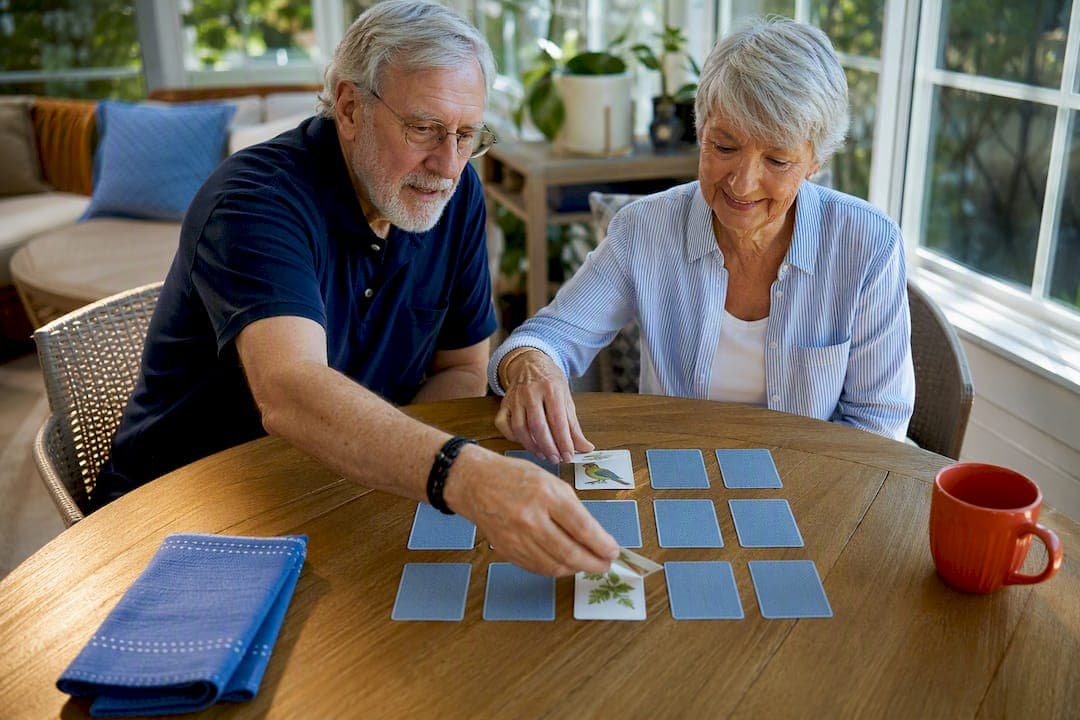
The best memory games for seniors at home right now are matching cards, trivia, jigsaw puzzles, crosswords, bingo, reminiscence with old photos, music-based sing-alongs, tactile sensory bins, and simple motion-based exergames. Pick based on the person's current ability and what they've always enjoyed, not what looks impressive. Playing with someone else beats playing alone almost every time. The sections below cover exactly how to adapt each one and run a session that doesn't end in frustration.
TL;DR:
- Matching and memory card games should be simplified to 6-8 pairs for lower ability, with competitive or timed play replaced by cooperative sessions to reduce stress.
- Puzzles and crosswords should be matched to the senior's current ability, starting with large-print and themed options, with frustration cues prompting quick help or a break.
- Consistently scheduling short (10-20 minutes) active game sessions several times a week yields better cognitive and mood benefits than occasional, lengthy activities.
- Tracking engagement and mood over multiple weeks offers more insight than formal testing and can help identify which activities are most effective and enjoyable.
- In-home support services can help maintain routine, adapt activities for declining ability, and ensure meaningful, regular engagement outside of family efforts.
Table of Contents
- Quick-Reference List: 12 Memory Games To Try At Home
- Crosswords, Sudoku, and Jigsaws: Picking the Right Difficulty
- Matching and Memory Card Games: Quick Setup, Big Personalization Payoff
- Reminiscence, Storytelling, and Conversation Games
- Music and Sensory Games for Later-Stage or Low-Mobility Players
- Digital Games and Exergames: What's Worth Trying
- Adapting Games for Dementia, Low Vision, or Limited Mobility
- How To Run a Short Memory-Game Session at Home
- What the Research Says: A Caregiver-Friendly Evidence Summary
- Frequency and Duration: How Often Should Seniors Play?
- Tracking Progress: How Do You Know It's Working?
- Publisher Perspective: Why Consistency Beats the Perfect Game
- How Seniors Helping Seniors Tucson Supports Memory Activities at Home
- Sources
Quick-Reference List: 12 Memory Games To Try At Home
Each of these takes under 20 minutes and needs almost no setup. Try one, watch how the person responds, and adjust from there.
- Matching/memory cards. Trains visual recall. Setup: 2 minutes. Adaptation: cut the deck to 8 pairs instead of 20. Safety: avoid cards with sharp laminate edges.
- Trivia (decade-themed). Trains verbal memory and processing speed. Setup: none, just a question list. Adaptation: multiple-choice instead of open recall. Safety: keep tone playful, never quiz-like.
- Crossword puzzles. Trains working memory and word retrieval. Setup: 1 minute. Adaptation: use large-print, themed puzzles. Safety: good lighting to avoid eye strain.
- Sudoku (simplified 4x4 grid). Trains logic and attention. Setup: print or buy a beginner grid. Adaptation: use numbered tiles instead of writing. Safety: none significant.
- Jigsaw puzzles (large piece). Trains spatial reasoning and patience. Setup: 3 minutes to sort edges. Adaptation: 24 to 100 pieces depending on ability. Safety: watch for pieces going in mouths if dementia is advanced.
- Bingo. Trains attention and number recognition. Setup: 5 minutes. Adaptation: fewer numbers per card, call slower. Safety: use large chips, no choking risk.
- Reminiscence with photos. Taps long-term autobiographical memory. Setup: pull a family album. Adaptation: focus on one photo at a time. Safety: none.
- Music sing-alongs. Trains emotional and procedural memory. Setup: a playlist from their teens or twenties. Adaptation: hum along if lyrics are hard. Safety: keep volume moderate.
- Tactile sensory bins. Grounds attention through touch. Setup: rice, buttons, fabric scraps. Adaptation: supervise closely for mouthing objects. Safety: no small parts under 1.75 inches.
- Progressive storytelling. Trains sequencing and working memory. Setup: none. Adaptation: caregiver starts the sentence, senior finishes it. Safety: none.
- Word association games. Trains verbal fluency. Setup: none. Adaptation: use picture cards as prompts. Safety: none.
- Simple exergames (tablet-based motion games). Trains dual-task cognition and movement. Setup: 5 minutes to open the app. Adaptation: seated version, shorter rounds. Safety: clear floor space, stay within arm's reach.
Run these in 10 to 20 minute stretches and note which ones get real engagement versus polite tolerance. That single observation will guide every future session more than any guide can.
Crosswords, Sudoku, and Jigsaws: Picking the Right Difficulty
These paper-and-tabletop puzzles train working memory, sustained attention, and reasoning in ways that overlap heavily with the skills seniors use for daily problem-solving. A 2020 meta-analysis of 1,543 adults over 60 found measurable gains in exactly these domains after structured cognitive training, which is a strong argument for keeping puzzles in rotation rather than treating them as a one-time novelty.
The trick is matching difficulty to current ability, not to how sharp the person used to be.
- Start with large-print crosswords and themed word banks rather than blank grids.
- Use a 4x4 or 6x6 Sudoku grid with number tiles instead of pencil and paper.
- Choose jigsaw puzzles with 24 to 60 pieces for early cognitive decline, fewer for advanced stages.
- Solve as a pair rather than testing solo recall.
Pro Tip: If a clue or piece causes visible frustration after two tries, read the answer aloud yourself and move on. The goal is engagement, not a completed puzzle.
Matching and Memory Card Games: Quick Setup, Big Personalization Payoff
Concentration-style matching games work because they force active visual scanning and short-term recall in small, repeatable bursts. Standard playing cards work fine, but personalized cards work better.
- Print family photos, pets, or old vacation snapshots onto blank cards for a version that means something.
- Use themed sets (favorite foods, classic cars, old movie posters) tied to the person's decade.
- Cut the deck down to 6 or 8 pairs for lower ability, and let mismatches happen without correction.
- Play as a team against a timer instead of head-to-head, which removes the pressure of "losing."
Tactile cards with raised textures or Braille-style dots help when vision is fading but fine motor skills are still intact.
Reminiscence, Storytelling, and Conversation Games
Reminiscence taps memories that often survive long after short-term recall fades, which is why photo-based conversation tends to work even in moderate dementia. Reviewing old photographs has been linked to improved quality of life and recall in people living with dementia, and it costs nothing but a shoebox of prints.
- Pull out photo albums and ask open questions like "who's this with you?" instead of "do you remember this?"
- Try decade-specific prompts: what music played at their wedding, what their first car looked like.
- Use progressive storytelling, where the caregiver starts a sentence and the senior finishes it.
- Bring in scent or texture cues (perfume, a wool sweater) alongside the photo to deepen the memory trigger.
Avoid anything that feels like a quiz. The moment reminiscence turns into a memory test, the person shuts down instead of opening up. For more structured prompts, 10 low-effort reminiscence activities offers a ready-made list.
Music and Sensory Games for Later-Stage or Low-Mobility Players
When dexterity or verbal ability declines, sensory and music-based activities often reach someone that a board game can't. Practitioner resources on dementia game design report that music and sensory modalities frequently evoke emotional recall even in later stages, likely because musical memory is stored differently than episodic memory.
- Sing-along bingo with familiar songs instead of called numbers.
- Simple percussion (tambourines, hand drums) for rhythm-based engagement.
- Scent jars with cinnamon, coffee, or lavender for smell-based recall.
- Fidget quilts with buttons, zippers, and textures for restless hands.
Pro Tip: Keep all materials non-toxic and larger than a golf ball, since later-stage dementia sometimes comes with mouthing behaviors. A related music therapy guide has ready-made playlists organized by decade.
Digital Games and Exergames: What's Worth Trying
Motion-based video games that combine physical movement with cognitive tasks show real promise. Randomized trials of exergame interventions produced measurable improvements in MoCA and MMSE scores among older adults with mild cognitive impairment, likely because the dual demand of moving and thinking trains more circuits at once than either task alone.
- Choose tablet apps with large buttons and minimal menus, not console games built for younger reflexes.
- Keep sessions to 10 or 15 minutes with a caregiver nearby to supervise footing and balance.
- Clear floor space of rugs or cords before any standing exergame.
- Pair screen time with a short walk or chair exercise routine so the day isn't dominated by a screen.
UCLA Health's guidance on brain games specifically warns to limit total screen time and combine digital play with social interaction and physical movement rather than letting it replace both.
Adapting Games for Dementia, Low Vision, or Limited Mobility
Every game on this list can flex to meet declining ability, but the adaptation has to happen before frustration sets in, not after. Care guidance for dementia consistently points to personalization over standardization: familiar themes, simplified rules, and a focus on the process instead of the score.
- Remove timers and scoring; competition adds stress without adding benefit.
- Enlarge text, use high-contrast cards, and increase lighting for low vision.
- Swap fine-motor games (small cards, tiny puzzle pieces) for sensory or conversation-based alternatives when dexterity drops.
- Watch for agitation, withdrawal, or repeated wrong answers met with visible distress. That's the signal to stop, not push through.
Pro Tip: Celebrate small wins out loud. "You got that one!" does more for engagement than any correction ever will. The in-home memory care guide covers more adaptations by dementia stage.
How To Run a Short Memory-Game Session at Home
A predictable structure beats a perfect game choice every time. Here's a recipe that works across ability levels:
- 10 to 20 minutes of the core activity (cards, trivia, puzzle, or reminiscence), chosen based on that day's energy level.
- 5 to 10 minutes of social wrap-up, talking about the activity or transitioning to a snack or walk.
- A quick pre-session check: current ability, mood, sensory needs (glasses, hearing aids), and mobility limits.
- Materials staged in advance: large-print cards, good lighting, a chair with arms, nothing with small choking-hazard pieces.
Watch for red flags mid-session: rising frustration, repeated confusion, or physical restlessness. When you see one, don't push through the game plan. Pivot to something passive like music or a photo album instead.
Pro Tip: Keep a small notebook by the game supplies and jot one line after each session, what worked, what didn't. Six weeks of notes tells you more than any single "good day."
What the Research Says: A Caregiver-Friendly Evidence Summary
The evidence for structured games is genuinely encouraging, though it comes with real caveats. The 2020 meta-analysis covering over 1,500 older adults found statistically significant gains in processing speed, working memory, executive function, and verbal memory after cognitive training programs. Separately, randomized trials of exergames showed improvements in global cognition scores among adults with mild cognitive impairment.
Narrative reviews of video and interactive gaming note that benefits show up consistently across studies, but protocols vary so widely between trials that no single game format can claim to be the definitive answer.
That heterogeneity, documented across multiple gaming studies, is the honest caveat: no game is a cure. Combine cognitive play with social time, movement, and good sleep for the best odds of real benefit.
Frequency and Duration: How Often Should Seniors Play?
Consistency matters more than marathon sessions. Most of the trials showing cognitive gains used programs running several times a week over weeks or months, not one-off game nights. That points toward a simple rule: short and frequent beats long and occasional.
A practical target is about 15 to 20 minutes of active game play, multiple days a week. That's enough to build a routine without turning the activity into a chore. Trying to cram an hour of trivia into one weekend session tends to backfire. Attention fades, frustration climbs, and the whole thing starts to feel like a test rather than something enjoyable.
Rotate game types across the week instead of repeating the same puzzle daily. Monday's crossword, Wednesday's matching cards, and Friday's music sing-along keep different cognitive domains active and prevent the flat boredom that comes from doing the identical activity on repeat. For someone in mid to late-stage dementia, shorter is often better. Ten minutes of focused engagement outperforms twenty minutes that ends in confusion or agitation.
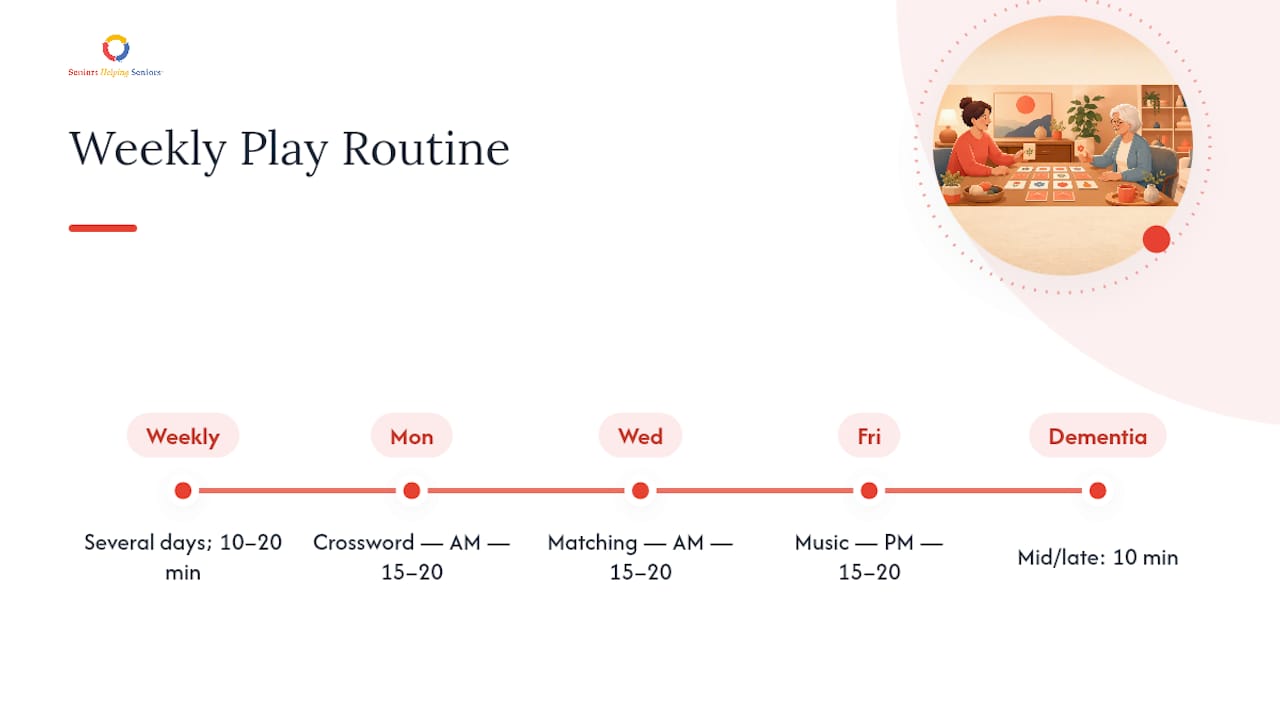
Energy levels shift day to day, sometimes hour to hour. Morning tends to be the sharper window for most older adults, so schedule the more demanding cognitive games (Sudoku, trivia) earlier in the day and save passive activities like music or photo albums for the afternoon slump. Skipping a day here and there is fine. What matters over a month is the overall pattern, not perfect daily attendance.
Tracking Progress: How Do You Know It's Working?
Formal cognitive testing isn't something most families can or should attempt at home. What you can track is engagement, mood, and specific behavioral patterns over time, and that's actually more useful day to day than a test score.
Keep a simple log after each session. Note which game was played, how long the person stayed engaged, and whether they seemed frustrated, neutral, or genuinely enjoying it. A single entry means nothing. Four weeks of entries starts to show real patterns, like whether trivia consistently outperforms puzzles, or whether afternoons are a lost cause for anything demanding.
Watch for concrete markers instead of vague impressions: Are they initiating a game themselves instead of waiting to be prompted? Are they recalling details from yesterday's photo session without help? Is conversation lasting longer after a reminiscence activity than it did a month ago? These small shifts are more meaningful than whether they "won" at bingo.
Mood is a legitimate metric here, not a soft one. If a person is calmer, more talkative, or sleeping better on days with game activity, that's a real signal worth tracking alongside cognitive markers. If a caregiver notices a sudden drop in engagement across every game type, that's worth mentioning to a doctor. It can signal anything from depression to a medication side effect, not necessarily cognitive decline itself.
Publisher Perspective: Why Consistency Beats the Perfect Game
The game you pick matters less than whether it happens on a Tuesday and again on a Thursday. Families often chase the "right" puzzle when the real lever is a caregiver who shows up reliably enough to build a routine. Companion caregivers who are older adults can make reminiscence and card games more meaningful than rushed visits squeezed in between chores. Consider outside support when mobility limits solo setup, when a family caregiver's schedule can't sustain daily consistency, or when memory support needs a steadier hand than occasional visits allow. Fold games into a normal routine, alongside a short walk and real conversation, and the benefit compounds.
— Cameron
How Seniors Helping Seniors Tucson Supports Memory Activities at Home
Running these games consistently is harder than picking the right one, especially when a family caregiver is juggling work, other kids, or their own health. Some in-home care services provide matched companion caregivers who visit on a set schedule and facilitate activities like reminiscence, cards, and music, helping families maintain consistency without requiring a family member's presence every time.

Some services offer companionship, memory and dementia support, and daily living assistance, often matching caregivers with clients based on shared life experience to enhance connection. An initial visit often includes discussion of the senior's history, interests, and abilities to tailor activities like reminiscence and card games effectively. If a loved one's memory activities keep slipping because nobody has the bandwidth to run them consistently, request a consultation for in-home senior care in Tucson and find out what a regular schedule of companionship and activity support could look like.
This article is general information, not a substitute for advice from a qualified doctor. Consult a qualified healthcare professional about your own circumstances before acting on anything here.
Sources
- Cognitive training meta-analysis (2020)
- Video-game–based interventions improve cognition in MCI (Frontiers, 2026)
- 4 worthwhile brain games for older adults (UCLA Health, 2024)
- What should caregivers consider when choosing games for dementia patients? (Hovi Care, 2025)