

The most reliable way to handle medication reminders at home is hiring a trained in-home caregiver, not relying on an app or a pill dispenser that beeps into an empty room. A caregiver watches the dose actually get taken, logs it, and flags problems before they become an ER visit. Caregiver scope generally follows the boundaries outlined by resources like the Area Agency on Aging network: reminders and observation, not clinical administration.
To get started:
- Call a local provider and ask about a free in-home assessment.
- Ask what's documented at each visit, not just what's said.
- Confirm how missed doses or side effects get reported to family.
Key Takeaways
Reliable medication reminders at home depend on hiring a trained, well-documented caregiver rather than a device, and adding RN review for complex regimens.
| Point | Details |
|---|---|
| Hire, don't automate | A caregiver observes doses and documents patterns that apps and dispensers miss. |
| Know the scope line | Caregivers remind and log; licensed nurses handle administration and clinical decisions. |
| Vet thoroughly | Check references, background screening, and require written logs before hiring. |
| Start small, scale up | Cover the highest-risk dosing windows first, then expand as trust and routine build. |
| Tucsonshs option | Seniors Helping Seniors® Tucson pairs matched caregivers with written care plans and RN coordination on request. |
Table of Contents
- Why Medication Reminders at Home Matter for Seniors and Families
- What Caregivers Do Versus What Nurses Must Do
- How to Choose and Vet a Caregiver for Medication Reminders
- Typical Scheduling and Pricing for Medication Reminder Visits
- How to Set Up an Effective Medication Reminder Plan at Home
- Warning Signs That Require Escalation
- How Seniors Helping Seniors® Tucson Supports Medication Reminders at Home
- What Happens From First Call to Ongoing Care
- What In-Home Medication Reminders Actually Cost
- A Publisher's Note on Getting This Right
- Ready to Set Up Reliable Care?
- Frequently Asked Questions
- Sources
Why Medication Reminders at Home Matter for Seniors and Families
A caregiver in the room catches what an app cannot: hesitation, confusion, a pill dropped and never picked up. That's the practical case for hiring help instead of trusting technology alone.
Many seniors manage multiple daily prescriptions, and stacking medications into a routine increases the risk that one may get skipped or doubled. In-home care adds a layer of accountability that goes beyond a reminder chime. Caregivers confirm the correct medication went into the correct person at the correct time, and that oversight reduces errors and improves outcomes in ways an unsupervised alert cannot.
Families who add a caregiver for this purpose typically notice:
- Consistent timing tied to a real person's schedule, not a rigid alarm.
- Help sorting pillboxes and coordinating refills before bottles run empty.
- Earlier detection of side effects like drowsiness or appetite loss.
- Less stress on adult children who previously called every morning to check.
What Caregivers Do Versus What Nurses Must Do
Non-medical caregivers remind, observe, hand over a pillbox, and document. They do not administer medications in the clinical sense, and they do not make judgment calls about as-needed dosing. Licensed nurses handle medication administration such as injections or dose adjustments, and they act under a physician's orders.
Caregivers typically can:
- Give verbal prompts at scheduled times
- Hand over a prepared pillbox or bottle
- Watch the medication get taken and record it
- Note side effects or refusals in a daily log
Caregivers typically cannot:
- Administer injections
- Make PRN (as-needed) clinical decisions
- Adjust dosages without physician direction
- Diagnose a reaction as medical versus benign
Pro Tip: If a loved one is on multiple medications or the regimen changes often, pairing daily caregiver visits with scheduled RN medication reconciliation can help catch interactions that a caregiver isn't trained to spot.
How to Choose and Vet a Caregiver for Medication Reminders
Start by screening for background checks, documented medication-safety training, and real experience with older adults or dementia care. Anyone can claim reliability. Documentation and references prove it.
A working vetting checklist looks like this:
- Verify background check and, where applicable, CPR/CNA-level training.
- Ask for two or three references from recent families, not just employers.
- Request a trial visit before committing to a weekly schedule.
- Confirm a written care plan will exist from day one.
- Require daily medication logs, not verbal check-ins alone.
Interviews go faster with a short list of pointed questions:
| Question | What to Listen For |
|---|---|
| What's included in a medication reminder visit? | Specific tasks: prompting, observing, logging, refill checks |
| How do you handle a missed or refused dose? | A clear, repeatable escalation step, not a shrug |
| Who gets called if something seems off? | Family contact and, when needed, an RN or physician |
| How is each visit documented? | Written logs with date, time, and dose, not memory alone |
Red flags are just as telling as good answers. Walk away from a caregiver or agency that can't produce a reference, gives a vague answer about escalation, or resists keeping written logs. Vague hiring guidance from resources like Qualicare's interview framework exists precisely because families often skip this step and regret it later.
Written documentation matters beyond the moment. A log that tracks doses over weeks reveals patterns, like a senior consistently skipping the evening dose, that a single visit never would.

Typical Scheduling and Pricing for Medication Reminder Visits
Expect hourly billing for shorter visits, package rates for daily reminder schedules, and a premium for overnight or last-minute coverage. Pricing shapes tend to follow how the visit is structured, not just how long it runs.
Common models include:
- A short morning check-in built around breakfast and the first dose of the day.
- Twice-daily visits covering morning and evening medications separately.
- A weekly pill-prep visit paired with brief daily phone check-ins.
- Full daily or 24/7 coverage for complex regimens or cognitive decline.
Before signing anything, ask about overtime and holiday rates, the cancellation policy, and whether a short trial period is available. Many families start by covering just the two riskiest windows, morning and evening doses, rather than trying to fund round-the-clock coverage immediately. That approach eases the senior into accepting help and keeps the caregiver relationship sustainable.
How to Set Up an Effective Medication Reminder Plan at Home
A reliable plan rests on four things: a written master medication list, a routine tied to existing daily habits, a pillbox or organizer, and a documented log every caregiver actually uses.
The first two weeks matter most. Here's a workable sequence:
- Inventory every medication, including over-the-counter drugs and supplements.
- Confirm the full list with the pharmacy or physician to catch duplicates or interactions.
- Build a schedule anchored to meals, waking, and bedtime rather than arbitrary clock times.
- Run a short pilot period with the caregiver present for each dose.
- Review the log after one week and adjust timing or dosage confusion points.
A simple log template covers the essentials:
Pro Tip: Anchor every reminder to something that already happens daily, like brushing teeth or making coffee. A prompt tied to an existing habit sticks better than one tied to a clock.
Weekly pill-prep and refill coordination pull double duty: they cut down on missed doses between visits and reduce how much a caregiver has to sort out live. For regimens that change often or involve five-plus medications, schedule an RN medication reconciliation every few months to catch drift between what's prescribed and what's actually being taken.
Warning Signs That Require Escalation
Escalate immediately for signs of an adverse reaction, repeated missed doses, sudden confusion, dizziness after a medication change, or trouble swallowing pills. These aren't wait-and-see situations.
| Sign | Escalation Step |
|---|---|
| New confusion or disorientation | Caregiver documents, contacts family same day |
| Dizziness after a dose change | Schedule RN review within 48 hours |
| Two or more missed doses in a week | Family notified, schedule adjusted |
| Difficulty swallowing pills | Contact physician before next dose |
| Severe reaction (breathing, swelling) | Call emergency services immediately |
Periodic RN reviews catch problems before they reach this list. A nurse reconciling the full medication regimen every few months often spots an interaction or an ineffective drug well before a caregiver would notice anything wrong day to day.
How Seniors Helping Seniors® Tucson Supports Medication Reminders at Home
Seniors Helping Seniors® Tucson builds medication reminders into a personalized care plan rather than treating them as a bolt-on task. Caregivers are matched for compatibility, often sharing life experience with the client they support, and every plan is written down rather than left to memory.
Services include:
- Caregiver matching based on personality and shared background
- Written care plans reviewed and updated over time
- Daily medication logs kept for every visit
- Weekly pill-prep to reduce mid-week confusion
- RN coordination available for complex regimens
- Background checks and training in medication safety and dementia awareness
..
Families ready to see how this works can schedule a free in-home assessment directly through the Tucson care team.
What Happens From First Call to Ongoing Care
The process typically starts with a phone conversation to describe the medication routine and any recent changes, like a hospital discharge or a new diagnosis. That call usually leads to an in-home assessment, where a coordinator reviews the full medication list, current pillbox setup, and any pattern of missed doses.
From there, a written care plan gets drafted. It specifies visit times tied to dosing windows, what the caregiver will document, and who gets contacted if something's off. Most families start with a trial period, often one to two weeks, so both sides can confirm the schedule and caregiver fit actually work before committing longer term.
Once the trial period ends, visits settle into a routine: morning or evening check-ins, weekly pill-prep, and ongoing logging. Every few weeks, someone, often a family member or care coordinator, reviews the logs for patterns. If the regimen is complex, an RN medication reconciliation gets scheduled on a recurring basis, maybe quarterly, to catch anything a daily visit wouldn't reveal.
Ongoing monitoring isn't static. As a senior's needs shift, whether that's a new prescription or early cognitive changes, the care plan gets revised. That's the real value of a caregiver relationship over a one-time device purchase: the plan grows with the person instead of staying frozen at setup.
What In-Home Medication Reminders Actually Cost
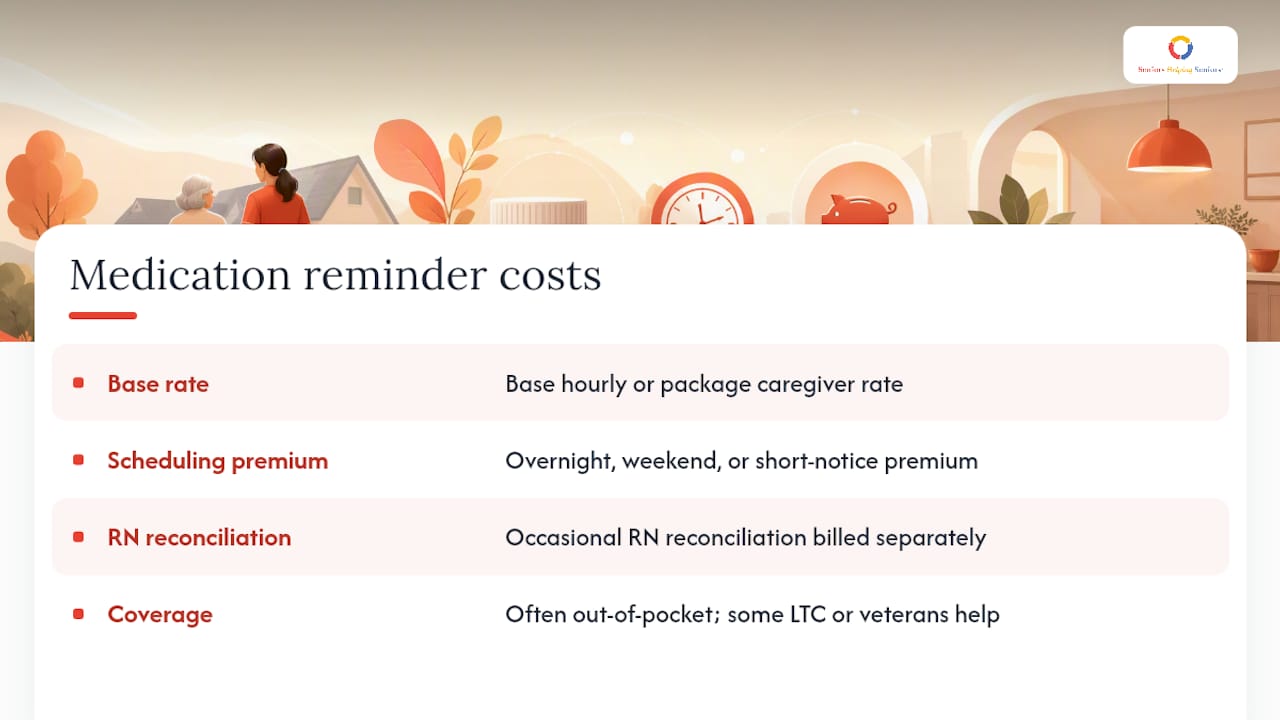
Costs for medication-reminder visits generally follow the same hourly or package pricing structure as other in-home care services, since reminders are rarely billed as a standalone service, and rates vary with visit length and frequency. A short daily check-in costs less than a longer visit that includes meal prep, light housekeeping, or personal care alongside the reminder.
Families should expect three categories of expense. First, the base hourly or package rate for caregiver visits. Second, any premium for overnight, weekend, or short-notice scheduling. Third, occasional costs tied to RN medication reconciliation visits, which are typically billed separately from standard caregiver hours when a hybrid model is in place.
Medicare generally does not cover non-medical in-home caregiving of this kind, since it falls outside skilled nursing care. Some long-term care insurance policies do cover it, and veterans may qualify for benefits that offset the cost. Families exploring coverage options can find useful background on insurance basics through resources like this Medicare-focused blog, which covers adherence and coverage questions relevant to seniors managing multiple prescriptions.
Out-of-pocket costs remain common for families who don't qualify for benefit programs. Starting with targeted coverage, just the highest-risk dosing windows, keeps costs manageable while still closing the biggest safety gaps.
A Publisher's Note on Getting This Right
The core recommendation here isn't complicated: hire a trained caregiver, get it in writing, and add RN review when the regimen gets complex... Reach out to a local office with questions.
Ready to Set Up Reliable Care?
Tucsonshs is the practical alternative to piecing together reminders through apps, family phone calls, and hope. What you get instead is a mature, matched caregiver who shows up, watches the dose get taken, writes it down, and flags anything unusual before it turns into an emergency room visit.

That's a meaningful difference for families juggling work schedules and long-distance caregiving, especially when a loved one is managing five or more prescriptions. Seniors Helping Seniors® Tucson builds medication reminders into a full care plan, with written documentation, weekly pill-prep, and RN coordination available when the situation calls for it. If you're ready to stop guessing whether doses are being taken correctly, schedule a free in-home assessment and get a written plan in place this week.
Frequently Asked Questions
What are medication reminders at home? Medication reminders at home refer to an in-home caregiver prompting, observing, and documenting a senior's medication routine, distinct from clinical administration performed by a nurse.
Can a caregiver legally give medications? Non-medical caregivers can hand over a prepared pillbox and prompt someone to take it, but they generally cannot administer injections or make clinical dosing decisions, which remain nurse-level tasks.
How much do medication reminder visits cost? Costs vary by visit length and frequency, typically following the same hourly or package pricing as other in-home care rather than a separate flat fee.
When should a family add RN oversight? Add periodic RN medication reconciliation when a senior takes five or more medications, has a recent hospital discharge, or experiences frequent prescription changes.
What should be documented at every visit? Each visit should log the date, time, medication, dose, who observed it, and any side effects noted, creating a pattern record for family and physicians.
This article is general information, not a substitute for advice from a qualified doctor. Consult a qualified healthcare professional about your own circumstances before acting on anything here.
Sources
- Hiring a Private In-Home Caregiver for Elderly | Poppins Payroll
Check with your local Area Agency on Aging to confirm caregiver scope rules specific to your state.