

Yes, Medicaid can pay for in-home care, but which services you get and how you qualify depends entirely on your state. There's no single national "Medicaid home care benefit." Instead, states run different combinations of programs, and finding the right one is the actual work.
Your best next move: call your state Medicaid agency or your local Area Agency on Aging today and ask for an eligibility screening. If a loved one is already enrolled in Medicaid, start with their case manager instead.
While you're gathering information, know that most home care funding flows through one of these paths:
- 1915(c) HCBS waivers, which target specific groups and often carry waitlists
- 1915(i) state-plan HCBS, which can cover people at higher income levels than traditional Medicaid
- Regular Medicaid long-term care pathways tied to nursing-facility level of care
- Section 1115 demonstration waivers, which some states use to test broader eligibility rules
Pro Tip: Before you call, pull together proof of income, a photo ID, recent medical records showing functional limitations, and Social Security documentation. Case managers move faster when you show up with paperwork instead of promising to send it later.
Key Takeaways
Medicaid home care coverage depends on matching your specific financial and functional profile to the right state program, since no single national benefit applies uniformly.
| Point | Details |
|---|---|
| Coverage varies by state | Medicaid funds home care through waivers, state-plan HCBS, or regular LTC pathways, and program names differ everywhere. |
| Two eligibility tests apply | You must meet both a financial test (income and assets) and a functional test (level of care) to qualify. |
| Waitlists are common | 1915(c) waivers often cap enrollment, so ask about 1915(i) state-plan options if your state offers one. |
| Document caregiver income carefully | Difficulty of Care payments can be miscounted as income unless you flag them with your case manager. |
| Bridge services exist while you wait | Tucsonshs offers private-pay in-home care for families navigating Medicaid timelines in the Tucson area. |
Where to Verify Program Details and Rules
- Medicaid for federal program definitions
- Your state Medicaid agency's website for local program names and applications
- KFF's eligibility summaries for income and asset thresholds
- Your local Area Agency on Aging for waitlist status and application help
Table of Contents
- What Medicaid Home Care Actually Covers
- Which Medicaid Programs Actually Fund In-Home Care
- Who Qualifies for Medicaid Home Care
- What Services You Can Expect Medicaid to Cover
- How Medicaid Pays for Home Care and What It Costs You
- How to Find and Apply for Coverage in Your State
- Arizona's ALTCS Program Shows How This Works in Practice
- Frequently Asked Questions
- Sources
What Medicaid Home Care Actually Covers
Medicaid home care usually means "home and community-based services," or HCBS: a bucket of benefits designed to keep people out of nursing homes by paying for support where they already live. Medicaid is the largest public payer of long-term services and supports in the country, and nearly every state runs at least one HCBS waiver program.
That's different from Medicare home health, and the distinction trips up a lot of families. Medicare pays for short-term, skilled care after a hospital stay or a medical event, think a nurse visiting twice a week after knee surgery. Medicaid pays for ongoing, long-term support based on functional need, not a recent medical event. If your mother needs help bathing and dressing every day, indefinitely, Medicare almost never covers that. Medicaid, if she qualifies, often can.
Delivery models vary too:
- Agency-delivered home health, where a licensed agency sends staff to the home
- Personal care or attendant care, focused on daily living tasks rather than medical treatment
- Consumer-directed (or "self-directed") care, where the Medicaid recipient hires and manages their own caregiver, sometimes even a family member
Home health under Medicare answers "what happened to you recently." Home care under Medicaid answers "what do you need every day, indefinitely." Confusing the two is the single most common reason families think they don't qualify when they actually might.
Which Medicaid Programs Actually Fund In-Home Care
Four main pathways cover home care, and knowing which one your state emphasizes saves weeks of phone calls.
- 1915(c) HCBS waivers. States design these to divert people from institutional care, and they can cover a wide range of services including personal care, respite, and home modifications. The catch: waivers must prove cost-effectiveness against institutional care, so states cap enrollment. Waitlists are common and sometimes run years long.
- 1915(i) state-plan HCBS. This option lets states cover people with income up to 150% of the federal poverty level, without the same enrollment caps that plague waivers, according to federal 1915(i) guidance. It's a genuine backdoor into HCBS for people who assumed they earned too much for Medicaid.
- 1115 demonstration waivers. States use these to pilot different eligibility rules or delivery approaches. Availability and scope differ sharply from state to state.
- Regular Medicaid long-term care pathways. Tied to meeting a nursing-facility level of care, these are the traditional route and often the default if your state hasn't built out a robust waiver or 1915(i) program.
Program names differ wildly by state. Arizona calls its version ALTCS. Other states use entirely different branding. Never assume the name you've heard applies where you live.
Who Qualifies for Medicaid Home Care
Two separate tests decide eligibility, and you have to pass both.
The financial test looks at income and countable assets, and the thresholds vary by state and by program. KFF's 2026 data shows most states cap the home equity limit for long-term care Medicaid at $752,000, though a handful set it higher. Married couples get spousal impoverishment protections, meaning the spouse who isn't applying can usually keep a portion of joint assets and income rather than being wiped out to qualify the other spouse.
The functional test measures whether the applicant needs a nursing-facility level of care, often abbreviated NFLOC. States define this differently: some require difficulty with two activities of daily living, others require three, according to a practitioner overview of HCBS waiver rules. Cognitive and behavioral issues, not just physical limitations, can also satisfy this test.
A few special pathways worth knowing:
- 1915(i) income expansions can qualify people who exceed regular Medicaid income limits
- Some states run separate eligibility groups specifically for people already receiving home care privately who are spending down assets
Before you call anyone, gather:
- Government-issued ID and Social Security documentation
- Recent pay stubs or benefit award letters
- Medical records documenting ADL and IADL limitations
- A written list of daily tasks the person can't do independently
- Proof of state residence
What Services You Can Expect Medicaid to Cover
Once approved, Medicaid home care benefits typically include:
- Personal care and attendant care (bathing, dressing, toileting, mobility)
- Home health nursing and home health aide visits
- Physical, occupational, or speech therapy delivered at home
- Homemaker services (light housekeeping, laundry, meal prep)
- Home modifications like grab bars or wheelchair ramps
- Durable medical equipment
- Personal emergency response systems (PERS)
- Adult day health programs
- Respite care for family caregivers
The limits matter as much as the list. Most waivers cap the number of hours per week, and very few programs cover 24-hour private duty care, that's the exception, not the rule, and it varies heavily by state. Room and board is almost never covered, even in adult day settings. Some services require prior authorization, which can add days or weeks before care starts.
Providers accepting Medicaid generally fall into three categories: licensed home health agencies, agencies specifically contracted under a waiver program, and individual caregivers hired directly under consumer-directed models.

Pro Tip: Ask your case manager explicitly which services are "waiver-only" versus available under regular Medicaid. Some families discover months in that a needed service was never on their specific program's list.
How Medicaid Pays for Home Care and What It Costs You
Medicaid functions as the payer of last resort, meaning it steps in after other insurance and personal resources are accounted for. Most home care recipients pay little to no direct cost-share, though some states apply a modest patient contribution based on income. For institutional care, KFF reports a median personal needs allowance of $70 a month; for home care recipients, that figure is dramatically higher, a median of $2,982, since they're still covering rent and household bills that institutional residents aren't.
Medicare and Medicaid rarely overlap in home care. Medicare pays for short-term skilled visits after a medical event; Medicaid picks up ongoing personal care and support once someone qualifies. Many families use both at different points, or simultaneously for different needs.
Private long-term care insurance and VA benefits can coordinate with Medicaid too, though the details depend heavily on the specific policy or VA program. Families frequently patch together a mixed strategy: private pay or insurance while a waiver application sits on a waitlist, then a transition to Medicaid once approved. A long-term care insurance advisor can help map out how an existing policy interacts with Medicaid eligibility before you spend down assets unnecessarily.
Pro Tip: If a waiver waitlist is long, ask whether your state offers an "interim" or "bridge" service tier while you wait. Some do; most don't advertise it.
How to Find and Apply for Coverage in Your State
- Locate your state Medicaid agency's website and search specifically for "HCBS waiver" or "home and community-based services."
- Call your local Area Agency on Aging, they often know waitlist status and can point you to the right intake contact faster than a general Medicaid hotline.
- Request a formal eligibility screening, either by phone or online, depending on your state's process.
- Ask for an in-person or telehealth functional assessment. This is where NFLOC and ADL limitations get documented.
- If a waiver has a waitlist, ask to be placed on it immediately, even while you explore other pathways like 1915(i).
Timelines vary, but expect financial eligibility determinations to take a few weeks, and functional assessments can add more time depending on staffing. Waiver waitlists are the biggest wildcard: some states clear them in months, others take years.
Bring to every call:
- A written summary of daily care needs
- Proof of income, including anything unusual like caregiver payments
- Documentation of any Difficulty of Care payments, since automated income systems sometimes misclassify these as countable income unless you flag them explicitly
Arizona's ALTCS Program Shows How This Works in Practice
Arizona's ALTCS program, run through AHCCCS, is one of the clearer real-world examples of Medicaid home care in action. ALTCS covers people who need nursing-facility level of care and lets them receive that care at home instead of in a facility. Assessors use the HCBS Needs Tool, or HNT, to evaluate ADL and IADL limitations and determine which services fit.
Covered services delivered at home include attendant care, personal care, homemaker help, home health nursing, and home-delivered meals. ALTCS also offers member-directed options, letting some recipients hire and supervise their own caregiver rather than working exclusively through an agency.
One recurring snag: Difficulty of Care payments to family caregivers can get miscounted as income if families don't document them properly with their case manager, a paperwork gap that has derailed more than one otherwise-qualified applicant.
Why documentation makes or breaks approvals
Helping families through this process surfaces the same pattern again and again: the applications that stall aren't usually rejected for lack of need, they stall on paperwork gaps. Caregiver income gets flagged by an automated system, or a medical record doesn't explicitly state functional limitations in the language a case manager needs to see.
Pro Tip: If a family member is paid as a caregiver, ask your case manager in writing whether that income qualifies as a Difficulty of Care payment, and get the exclusion documented before it ever hits an eligibility review.
A Local Option While You Sort Out Coverage
Waiting on a waiver waitlist or an eligibility determination doesn't mean a family has to go without support in the meantime. Tucsonshs, Seniors Helping Seniors® Tucson, pairs older adults with mature, active caregivers who are often seniors themselves, matched around shared life experience rather than just a schedule fit. Services include companionship, personal care, respite for family caregivers, and specialized support for memory-related conditions.

For families in Corona de Tucson, Tucson Estates, Green Valley, or Sierra Vista working through the Medicaid process, this kind of private-pay bridge can cover the gap between "we need help now" and "the waiver came through." Tucsonshs can also help document daily needs in a way that supports your eventual Medicaid application. Medicaid acceptance and specific program participation vary, so confirm directly with the provider before assuming coverage applies to your situation. Visit the Tucson care page to check availability and ask about your specific needs.
Frequently Asked Questions
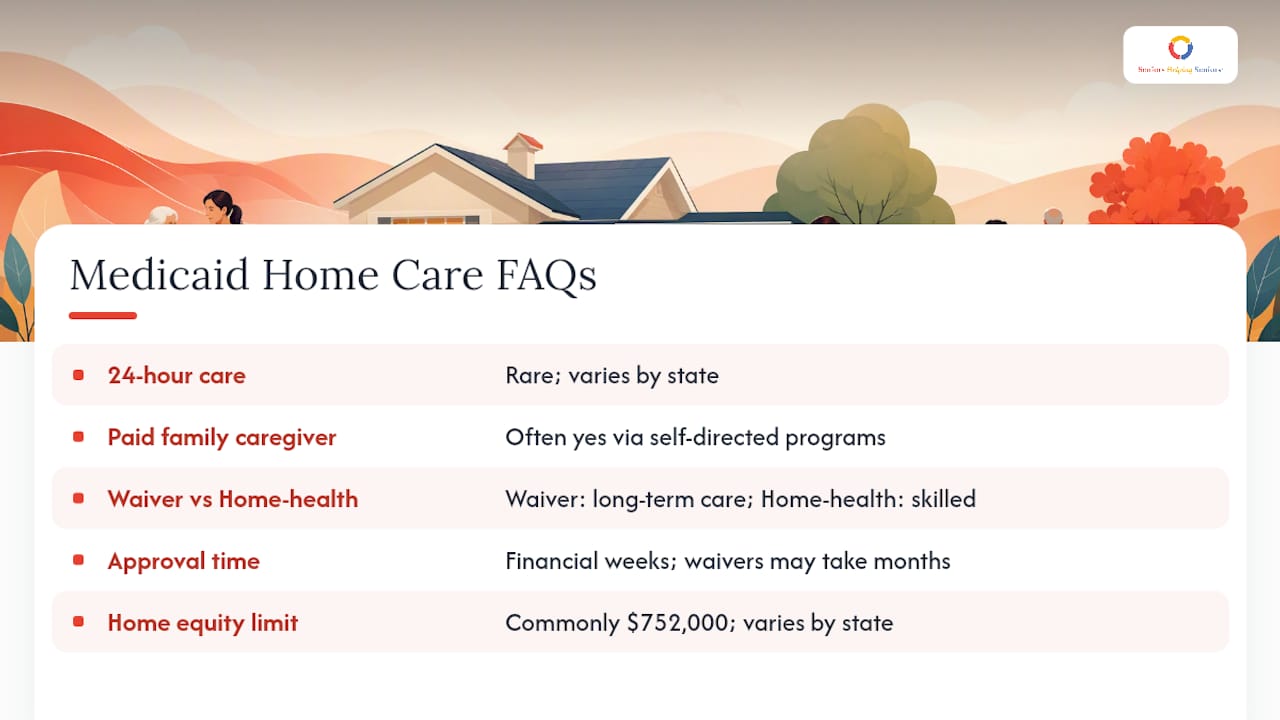
Does Medicaid pay for 24-hour home care? Rarely, and it varies by state. Most Medicaid home care programs cap covered hours per week rather than funding round-the-clock care, though a few states offer limited exceptions for specific medical needs.
Can a family member get paid as a Medicaid caregiver? Often, yes, through consumer-directed or self-directed programs. Make sure any payment is documented correctly with your case manager so it doesn't get miscounted as income during eligibility reviews.
What's the difference between Medicaid HCBS waivers and Medicaid home health care? Waivers cover long-term, non-medical personal care and support services. Home health care under Medicaid, similar to Medicare's version, focuses on skilled nursing and therapy, usually for a defined period tied to a medical need.
How long does it take to get approved for Medicaid home care? Financial eligibility often takes a few weeks. Functional assessments add more time, and if a waiver has a waitlist, approval for that specific program can take months or longer depending on your state.
Does having a house disqualify someone from Medicaid home care coverage? Not automatically. Most states set a home equity limit, commonly $752,000, below which your primary residence doesn't count against you, though rules and exceptions vary by state.
This article is general information, not a substitute for advice from a qualified doctor. Consult a qualified healthcare professional about your own circumstances before acting on anything here.
Sources
- ALTCS: Coverage for Individuals with Long-Term Care Needs
- Home & Community-Based Services 1915
- S74-IG-Individuals Receiving State Plan Home and Community-Based Services
- Medicaid Eligibility Levels for Older Adults and People with Disabilities (Non-MAGI) in 2026 | KFF