

Long-term in-home care means ongoing companion visits and personal care assistance delivered at home, not an insurance product. For most Tucson families, the right immediate move is to start with companion-level visits and lock in a two- to four-week trial with a written care plan before committing to anything longer. Mature, locally matched caregivers tend to preserve independence and social connection better than a rushed jump straight to full personal care.
TL;DR:
- Most families should start with a two- to four-week trial period and a written care plan before committing to long-term care arrangements.
- Agency-based care provides more legal protections, insurance, and backup staffing, which are crucial for families unfamiliar with employer responsibilities.
- Costs typically range in the low to mid $30s per hour but vary by location, care level, and provider, with specialized memory or overnight care generally costing more.
- Private hire may seem cheaper initially but involves significant legal and financial responsibilities, including payroll taxes, workers' compensation, and risk of misclassification penalties.
- Matching caregivers based on shared life experience and personality often leads to better trust, longer retention, and higher satisfaction than scheduling alone.
Table of Contents
- Who Needs Long-Term Home Care and What Does It Cover?
- Agency Care vs. Private Hire: What Changes Legally and Financially?
- What Questions Should You Ask a Home Care Provider?
- How Much Does Long-Term Home Care Cost, and Who Pays for It?
- How Do You Start Home Care Without Getting Burned?
- Why Mature-Caregiver Matching Changes the Equation for Tucson Seniors
- Ready to Start In-Home Care in Tucson?
- Sources
- FAQ
Who Needs Long-Term Home Care and What Does It Cover?
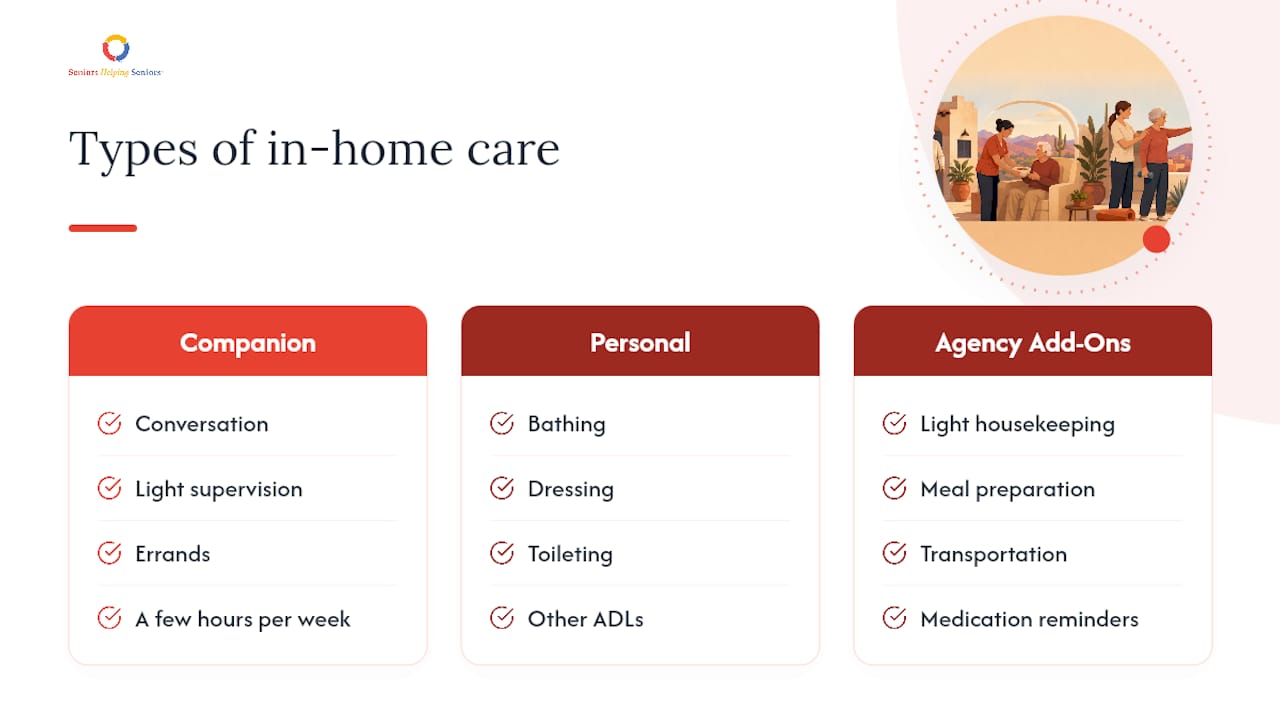
In-home care spans a wide range, from a few hours of companionship each week to daily hands-on help. Companion care covers conversation, light supervision, and errands. Personal care adds bathing, dressing, toileting, and other activities of daily living (ADLs). Beyond that, most agencies offer light housekeeping, meal prep, transportation, medication reminders, and specialized memory support for dementia or Alzheimer's.
A few warning signs tell you it's time to act: a recent fall, skipped medications, unopened mail piling up, weight loss, or a parent who no longer feels safe driving. Isolation counts too. Weeks without a visitor or a phone call is a health risk in its own right, not just a quality-of-life issue.
One distinction trips up a lot of families: home care and home health are not the same thing. Home care is nonmedical, personal, and companionship support. Home health involves licensed clinical services, usually ordered by a doctor, and it's regulated and covered by Medicare differently than everyday home care. If your parent needs wound care or physical therapy, that's home health. If they need help getting dressed and someone to talk to, that's home care.
Agency Care vs. Private Hire: What Changes Legally and Financially?
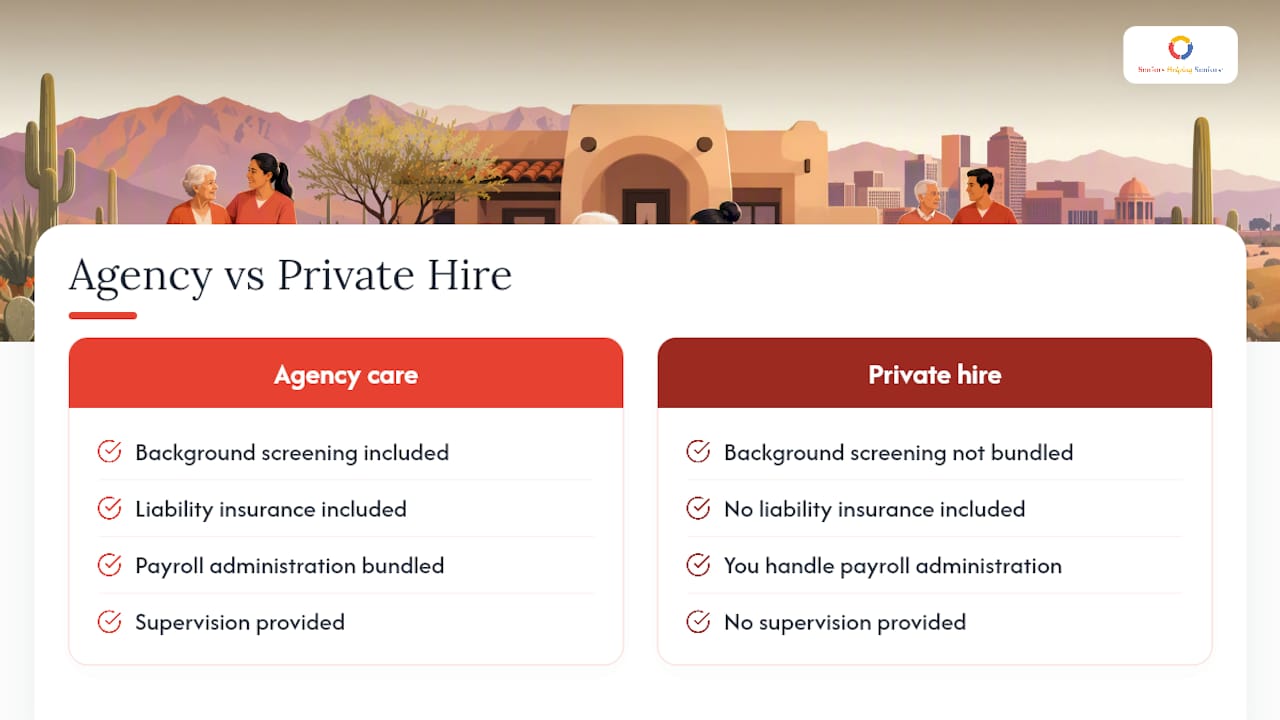
The hourly rate looks better with a private hire. The math looks worse once you account for what an agency actually bundles into its fee: background screening, liability insurance, payroll administration, supervision, and a backup caregiver when your regular aide calls in sick.
Hire privately, and you become a household employer under federal and Arizona law. That means payroll taxes, workers' compensation coverage, and full responsibility for finding a replacement when your caregiver is unavailable. Misclassifying a caregiver as an independent contractor is one of the most common and costly mistakes families make, and it can trigger back taxes and penalties years later if discovered.
Families who go the private route without a payroll service routinely underestimate the total cost and the regulatory exposure. A household payroll service can offload some of that risk, but it doesn't solve continuity when your one caregiver has a family emergency. Agencies solve that with a roster.
The trade-off is real in both directions. Private hire can mean the same face every visit and a lower sticker price. Agency care means more paperwork handled for you, insurance in place, and someone to call when a shift falls through. For most families without direct experience as employers, an agency or managed care model reduces legal exposure enough to be worth the higher hourly rate.
What Questions Should You Ask a Home Care Provider?
Before you sign anything, get straight answers to these:
- Are caregivers bonded and insured, and can you provide a certificate?
- What does your background-check process actually screen for, and how often is it refreshed?
- Will we get a written, personalized care plan before care starts?
- How do you match caregivers to clients, by personality, interests, or shared life experience?
- What happens if our caregiver is sick or a no-show, and how fast is a backup sent?
- Who supervises caregivers, and how often do they check in?
- Can we get two or three references from current or recent clients?
- What training do caregivers complete, especially for memory care or mobility support?
- Is the agency licensed to operate in Arizona?
- How is billing structured, and what's the cancellation policy?
- Is there a trial period before a longer commitment?
Ask for documentation, not just verbal assurances: an insurance certificate, a summary of the background-check process, and a sample care plan template. Experts recommend covering these exact areas, and any provider that hesitates to produce paperwork is telling you something.
The matching question deserves extra weight. A caregiver who shares a client's generation, sense of humor, or life experience tends to build rapport faster and stick around longer than a mismatched pairing, especially when supervisors stay involved rather than setting it and forgetting it.
Pro Tip: Ask the same question of two different staff members at the same agency, one intake coordinator and one field supervisor. Inconsistent answers about backup coverage or billing are a bigger red flag than any single answer sounds.
How Much Does Long-Term Home Care Cost, and Who Pays for It?
Nonmedical caregiver services run in the low to mid $30s per hour nationally, though rates vary by region and level of care. Specialized memory care or overnight coverage tends to sit above that range, and Tucson pricing can shift depending on the agency and the hours requested. Always ask for a written local quote before comparing options.
Nonmedical in-home caregiving typically costs in the low to mid $30 range per hour, but that figure moves with location, schedule, and the intensity of care required.
Funding comes from several directions, and few families rely on just one:
- Private pay covers most in-home companion and personal care hours.
- Long-term care insurance can help, but coverage depends on the policy's benefit triggers, elimination period, and which provider types qualify. Terms vary enormously between policies, so check the actual document rather than assuming.
- VA benefits exist for eligible veterans and surviving spouses.
- Medicaid waivers in Arizona can fund home care for qualifying low-income seniors.
- Medicare rarely covers ongoing nonmedical home care, only short-term skilled home health under specific conditions.
- A local Area Agency on Aging can point you toward regional funding and subsidized programs you might not find on your own.
How Do You Start Home Care Without Getting Burned?
Start small and structured, not with a full-time commitment on day one.
- Request an assessment and get a written care plan covering tasks, schedule, and goals.
- Set a two-to-four-week trial before agreeing to anything longer term.
- Confirm backup protocols in writing: who covers a sick day, and how fast.
- Set a check-in cadence, weekly at first, monthly once things stabilize.
- Keep a simple care log noting mood, appetite, medication timing, and any incidents.
- Review at the 30-day mark and again quarterly, adjusting hours or tasks as needs change.
Trial periods and documented care plans meaningfully reduce mismatch risk compared with jumping straight into a permanent schedule. If a caregiver seems like a poor fit after the trial, say so early. Swapping caregivers in week three is far easier than doing it after six months of routine.
Pro Tip: Keep the care log on paper or in a shared note on the fridge, not buried in an app only one family member checks. Whoever visits next should be able to glance at it in ten seconds.
Why Mature-Caregiver Matching Changes the Equation for Tucson Seniors
Most home care guidance treats caregiver assignment as a scheduling problem: fill the slot, cover the hours. That misses something Tucson families notice fast. A caregiver who's lived through the same decades, the same music, the same milestones as the client tends to build trust faster and stay longer than a mismatched pairing.
One local in-home care provider builds its model around that idea, pairing active senior caregivers with clients based on shared life experience rather than just availability. The goal is companionship that actually feels mutual, not a transaction. Combine that matching approach with the vetting checklist and trial-period discipline covered above, and you get a genuinely lower-risk path to starting care.
— Cameron
Ready to Start In-Home Care in Tucson?
Some in-home care providers offer mature adult caregivers, often seniors themselves, matched to clients based on shared history and personality, with flexible scheduling and no long-term contract locking families in.

Services may include Companion Care, Personal Care, Specialized Care for memory and Parkinson's support, Respite and Overnight Care, Transportation and Errands, and Return Home Transitional Care for anyone coming out of a hospital or rehab stay. Every plan typically starts with a written, personalized care plan and a matching process built around the client's interests and history.
The next step is simple: request an assessment through the full service list, ask for references, and set a two-to-four-week trial before committing further. If your parent is recovering from a hospital stay, the Return Home Transitional Care program is built specifically for that window. Families in nearby Green Valley can find local details on the Green Valley senior care page.
Sources
Claims above draw on the NIA hiring worksheet, Better Health While Aging, the American Caregiver Association, Harvard Health, and A Place for Mom. For household safety planning, see this independent-living resource.
- NIA worksheet: Questions to ask when hiring a care provider
- American Caregiver Association — How to hire a caregiver
- Harvard Health — Independent living with home care assistance
- A Place for Mom — Benefits of home care
FAQ
Do I Have to Pay Payroll Taxes if I Hire a Caregiver Directly?
Yes. Hiring a caregiver privately makes you a household employer under federal and Arizona law, responsible for payroll taxes and workers' compensation coverage. Misclassifying a caregiver as an independent contractor is a common and costly error that families often discover only after an audit.
How Much Does In-Home Care Cost per Hour in Tucson?
Nonmedical caregiver services typically run in the low to mid $30s per hour nationally, with local rates shifting based on the level of care and schedule. Specialized memory or overnight care usually costs more. Always request a written quote before comparing agencies.
Does Medicare Pay for Ongoing Home Care?
Medicare generally does not cover ongoing nonmedical home care. It may cover short-term, doctor-ordered home health services like skilled nursing or therapy, which is a different category from companion or personal care.
How Long Should a Trial Period Last Before Committing?
A two-to-four-week trial with a written care plan is standard practice before agreeing to a longer-term schedule. Documented trials reduce the risk of a poor caregiver match and give families a low-stakes window to adjust hours or tasks.
What Does Seniors Helping Seniors® Tucson Charge for Care?
Pricing depends on the services and hours selected, and current rates are available directly through the Seniors Helping Seniors Southern Arizona service page. Every plan begins with an assessment and a written care plan before hours are scheduled.