
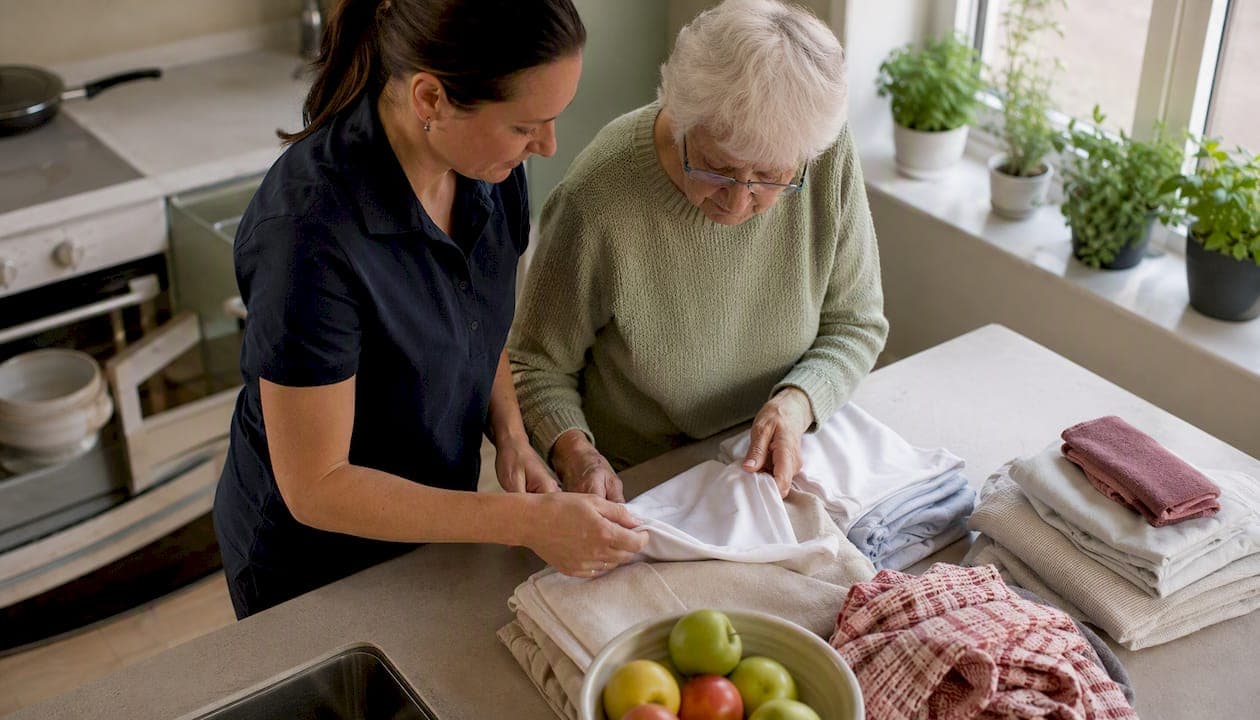
In-home memory care is a viable, widely used option for many people living with dementia or Alzheimer's disease, and for families in the mild-to-moderate stages of the disease, it is often the right first choice. Research published in PMC confirms that staying in a familiar home environment can reduce disorientation and, with the right supports in place, delay or avoid a move to a facility altogether.
In-home care typically works well when:
- Impairment is mild to moderate and the person can still participate in daily routines with prompting
- The home environment is safe or can be made safe with modest modifications
- At least one family caregiver or support person is available part of the time
- Behavioral symptoms (wandering, agitation) are manageable with supervision and structured routines
In-home care often is not enough when:
- The home cannot be made safe despite modifications
- Medical needs require round-the-clock skilled nursing
- Severe wandering, aggression, or self-harm risk exceeds what home supervision can manage
- The primary family caregiver has reached burnout with no backup
Immediate next steps:
- Schedule a professional needs assessment (ask the primary care physician for a referral or contact a local Area Agency on Aging)
- Arrange a short trial visit with a vetted caregiver before committing to ongoing care
- Check Medicare, Medicaid waiver, and VA benefit eligibility
- Draft a simple one-page care plan covering daily schedule, medications, and emergency contacts
- Walk through the home with a safety checklist before the first caregiver visit
Key Takeaways
In-home memory care works best when it combines a vetted, dementia-trained caregiver, a safe home environment, and a written care plan reviewed regularly as needs change.
| Point | Details |
|---|---|
| When in-home care works | Mild-to-moderate impairment, a safe or modifiable home, and at least part-time family support make home care viable. |
| Vet providers carefully | Confirm dementia-specific training, background screening, and a clear backup plan before signing any service agreement. |
| Medicare has real limits | Medicare covers skilled home health under strict clinical criteria but does not cover companion or routine personal care services. |
| Respite is non-negotiable | Scheduled caregiver relief, documented with a backup plan, is the single most important factor in sustaining home care long-term. |
| Seniors Helping Seniors® Tucson | Offers peer-matched, mature caregivers for in-home memory care in Tucson with no long-term contract and trial visits available. |
Table of Contents
- What types of in-home memory care services are available?
- Who provides in-home memory care and what qualifications matter?
- How do you find and vet in-home memory care providers?
- Room-by-room home safety checklist for people with memory impairment
- What does in-home memory care cost and who pays for it?
- Respite care and caregiver support: preventing burnout before it starts
- Signs that in-home care may no longer be safe or sufficient
- Concrete next steps: care plan, legal paperwork, and emergency prep
- How Seniors Helping Seniors® Tucson approaches in-home memory care
- What in-home memory care actually demands from families
- Seniors Helping Seniors® Tucson: request a care assessment
- Sources
What types of in-home memory care services are available?
Families can hire across a wide spectrum, from a few hours of companionship per week to round-the-clock live-in care. The right mix depends on the stage of impairment, the person's daily needs, and how much family support already exists.
| Service category | Typical tasks | Staffing | Best fit | Key consideration |
|---|---|---|---|---|
| Companionship / engagement | Conversation, games, walks, meal company | Unlicensed caregiver | Early-stage, social isolation | No medical tasks permitted |
| Personal care / ADL assistance | Bathing, dressing, grooming, toileting, meal prep | Unlicensed caregiver or CNA | Mild–moderate impairment | Requires comfort with hands-on care |
| Home health / skilled nursing | Wound care, medication management, therapy | Licensed RN, LPN, or therapist | Post-hospitalization, complex medical needs | Medicare may cover when criteria are met |
| Dementia-trained caregiver programs | Structured routines, redirection, behavior management | Specially trained caregiver or CNA | Moderate impairment with behavioral symptoms | Training certification varies by agency |
| Live-in / 24-hour care | All of the above, continuous supervision | Two or more rotating caregivers | Late-stage or high wandering risk | Highest cost; requires adequate home space |
In practice, most families use a blended model. A common arrangement pairs a dementia-trained companion for four to six hours on weekdays with a periodic skilled nursing visit once or twice a week to manage medications and monitor health status. That combination covers daily engagement and safety without the cost of full-time live-in care, and it gives the family caregiver predictable windows of relief.
Pro Tip: Ask any agency whether their caregivers receive dementia-specific training beyond a basic orientation. Look for programs that reference the Alzheimer's Association's dementia care training curriculum or equivalent structured coursework, not just on-the-job shadowing.
Who provides in-home memory care and what qualifications matter?
Understanding who can legally do what prevents costly mismatches between a person's needs and the caregiver hired to meet them.
Provider roles and their scope:
- Unlicensed home care aide / companion: Provides non-medical support — companionship, light housekeeping, meal prep, medication reminders (not administration). No clinical license required, but dementia-specific training is critical.
- Certified Nursing Assistant (CNA): Trained and state-certified to assist with personal care (bathing, dressing, transfers). Cannot administer medications or perform clinical procedures.
- Home health aide (HHA): Similar scope to CNA; may work under a licensed nurse's supervision in a Medicare-certified agency.
- Licensed Practical Nurse (LPN) / Licensed Vocational Nurse (LVN): Can administer medications, perform basic clinical tasks, and monitor health status under an RN's direction.
- Registered Nurse (RN): Full clinical scope including assessments, care plan development, wound care, and IV therapy. Required for complex medical needs.
Credentials and screening checklist:
- State license or certification verification (CNAs, LPNs, RNs are listed in state registries)
- Criminal background check and sex offender registry search
- Reference checks from at least two prior employers or clients
- Proof of liability insurance and bonding (agency-employed caregivers)
- Dementia-specific training documentation (hours completed, curriculum name)
- CPR and first aid certification
Continuity matters more in memory care than in almost any other home care context. People with dementia often struggle with new faces, and rotating staff can trigger anxiety and behavioral setbacks. Whenever possible, request a primary caregiver with a consistent schedule and a single backup.
Pro Tip: When interviewing a caregiver, ask about their own life experiences, hobbies, and interests alongside their clinical background. A shared love of gardening or a similar cultural background can make the difference between a person with dementia who refuses care and one who genuinely looks forward to the visit.

How do you find and vet in-home memory care providers?
Start with sources that have already done some of the vetting work for you. The Eldercare Locator connects families to local Area Agencies on Aging, which maintain vetted provider lists and can often make direct referrals. Alzheimer's.gov's local services finder aggregates dementia-specific programs by ZIP code. For Medicare-certified home health agencies, Medicare Care Compare shows quality ratings and inspection results.
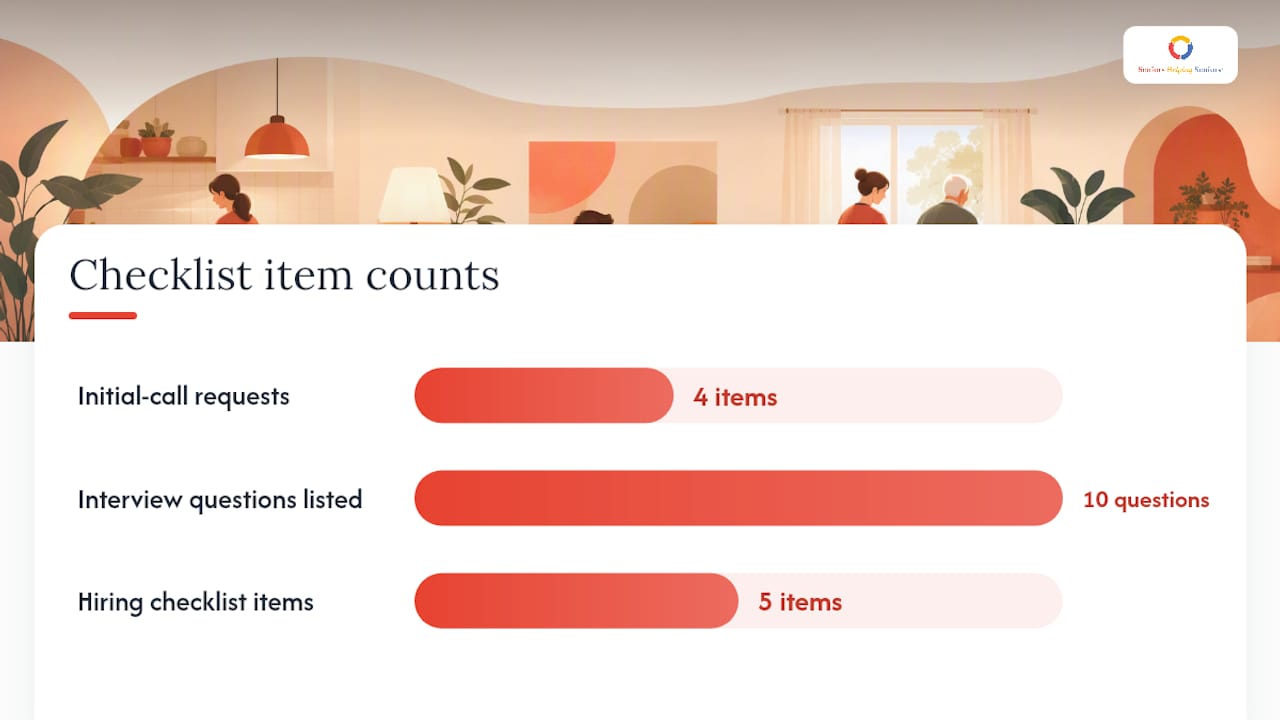
On the initial call, request:
- Proof of general liability insurance and workers' compensation coverage
- The agency's caregiver screening process in writing
- Training records for the specific caregiver being assigned
- A sample service agreement before any commitment
Interview questions that reveal the most:
| Question | What it reveals |
|---|---|
| How do you match caregivers to clients with dementia? | Whether the agency considers personality and life experience, not just availability |
| What dementia training have your caregivers completed? | Depth and recency of training |
| How do you handle a caregiver calling out sick? | Backup planning and continuity |
| Can we meet the assigned caregiver before the first visit? | Flexibility and client-centeredness |
| How do you manage behavioral episodes like agitation or refusal of care? | Practical de-escalation approach |
| What is your supervision model for unlicensed caregivers? | Whether a nurse oversees care plans |
| How do you communicate with families about changes in condition? | Transparency and documentation habits |
| Are caregivers employees or independent contractors? | Insurance, tax, and liability implications |
| What is your minimum hours-per-visit requirement? | Scheduling flexibility |
| What happens if the caregiver and client are not a good match? | Willingness to reassign without penalty |
Hiring checklist:
- Narrow to two or three agencies based on references and screening answers
- Schedule a trial visit (two to four hours) with the proposed caregiver present
- Debrief with your loved one and any family members who observed the visit
- Request a written service agreement that specifies tasks, hours, rates, and cancellation terms
- Review the agreement with a family member or elder law attorney before signing
Room-by-room home safety checklist for people with memory impairment
A safe home is what makes in-home memory care realistic. The ACL Home Modification Action Guide.pdf) identifies practical, low-cost modifications as evidence-informed interventions that help people with dementia stay home longer. Many of the highest-impact changes cost under $50.
Kitchen:
- Remove or lock away sharp knives and cleaning chemicals
- Install stove knob covers or an automatic stove shut-off device
- Label cabinet contents with large-print words and pictures
- Keep counters clear to reduce confusion and trip hazards
Bathroom:
- Install grab bars at the toilet and inside the shower or tub (anchored to studs, not drywall)
- Use a non-slip mat inside the tub and a bath chair if standing balance is poor
- Set the water heater to 120°F or below to prevent scalding
- Remove the lock from the bathroom door or replace with a privacy latch that opens from outside
Bedroom:
- Place a nightlight on the path to the bathroom
- Use bed rails or a bed alarm if nighttime wandering is a concern
- Keep the floor clear of rugs, cords, and clutter
Entryways and common areas:
- Install door alarms or door sensors on all exterior doors
- Consider a door-knob cover or deadbolt that requires a key from the inside to deter wandering
- Improve lighting in hallways and stairwells; motion-activated lights work well
- Remove or secure area rugs throughout the home
Wandering prevention:
- Enroll in the Alzheimer's Association's MedicAlert + 24/7 Wandering Support program
- Place STOP signs or visual barriers (a curtain over the door) at exits
- Use GPS tracking devices worn as a watch or pendant
- Inform neighbors and provide them with a recent photo
Pro Tip: A motion-activated camera in the main living area, paired with a smartphone app, lets a family caregiver check in remotely without being physically present. Many families find this reduces anxiety significantly during the first weeks of home care.
What does in-home memory care cost and who pays for it?
Cost depends heavily on location, hours of care, and whether skilled nursing is involved. Companion and personal care services are generally priced hourly, while live-in arrangements are often quoted as a daily or weekly rate. Skilled nursing visits carry a higher per-visit rate.
| Payment source | What it covers | Key eligibility notes |
|---|---|---|
| Medicare | Skilled home health (nursing, therapy) when homebound criteria are met | Does NOT cover routine personal care or companionship; verify eligibility before assuming coverage |
| Medicaid / HCBS waivers | Personal care, adult day, respite, and sometimes companion services | Varies by state; income and asset limits apply; waitlists are common |
| VA Aid & Attendance | Supplements pension for veterans needing daily assistance | Must be a wartime veteran with limited income/assets; apply through VA benefits office |
| Long-term care (LTC) insurance | Personal care and sometimes companion services per policy terms | Benefit triggers and elimination periods vary; review the policy's definition of "cognitive impairment" |
| PACE program | Comprehensive care coordination for dual-eligible participants | Must live in a PACE service area and meet nursing-home level of care; see CMS PACE |
| Private pay | Any service not covered above | Most flexible; no eligibility criteria |
Medicare covers skilled home health services only when specific clinical criteria are met, and it generally does not cover the companion or personal care services that make up the bulk of in-home memory care. Many families are surprised by this gap.
Steps to check your benefits now:
- Call 1-800-MEDICARE to ask about home health eligibility for your specific situation
- Contact your state Medicaid office to ask about Home and Community-Based Services (HCBS) waiver programs and current waitlist status
- Call the VA benefits line (1-800-827-1000) if your loved one is a veteran
- Pull out any long-term care insurance policy and read the cognitive impairment benefit trigger language carefully
- Contact your local Area Agency on Aging for benefits counseling at no cost
Respite care and caregiver support: preventing burnout before it starts
Alzheimer's.gov's caregiver guidance is direct on this point: caregiver self-care is not optional. Burnout is one of the primary drivers of premature facility placement, and scheduled respite is the most effective way to prevent it.
Types of respite available:
- In-home hourly respite: A paid caregiver covers for the family caregiver for a set number of hours; the most flexible option
- Adult day programs: Structured daytime programs that provide socialization, meals, and activities; typically run Monday through Friday
- Short-term facility stays: Overnight or multi-day stays at a memory care facility; useful during family travel or a caregiver health event
- Volunteer respite programs: Some Area Agencies on Aging and faith communities offer free or low-cost volunteer companions
Caregiver resources worth bookmarking:
- NIA's ADEAR Center offers evidence-based guides on dementia progression, behavior management, and caregiver strategies
- Alzheimer's Association helpline (1-800-272-3900) operates 24/7 and connects callers to local support groups
- Alzheimer's.gov's caregiver section includes training modules families can complete at home
- Local Area Agencies on Aging often fund caregiver training and respite programs at reduced or no cost
Pro Tip: Put respite on the calendar the same way you schedule a medical appointment. A standing four-hour block twice a week is far more sustainable than waiting until you are exhausted and then scrambling for coverage. Write a backup plan, too: who covers if the regular respite caregiver cancels?
Signs that in-home care may no longer be safe or sufficient
Most families do not face a single dramatic moment that signals a transition. The warning signs tend to accumulate gradually, which makes them easy to rationalize away until the situation becomes dangerous.
Reassess the level of care immediately if you observe any combination of the following: repeated falls with or without injury; unmanageable aggression or self-harm behavior; significant unintentional weight loss or signs of dehydration; a medical condition requiring round-the-clock skilled nursing that cannot be safely managed at home; or a primary family caregiver who is physically or emotionally unable to continue, with no backup available. Any one of these alone warrants an urgent conversation with the primary care physician. Two or more together typically indicate that a higher level of care is needed.
When these signs appear, the next steps are not about giving up. Start with an urgent reassessment by the primary care physician and, if possible, a geriatric care specialist. Ask for a temporary increase in caregiver hours while you evaluate options. Schedule tours of memory care facilities before a crisis forces a rushed decision. The NIA's ADEAR Center provides guidance on anticipating these transitions and what to expect at each stage of disease progression.
Concrete next steps: care plan, legal paperwork, and emergency prep
Getting organized before care begins prevents the most common crises. A one-page care plan that every caregiver can read in two minutes is more useful than a binder no one opens.
Documents to gather first:
- Current medication list with dosages, prescribing physician, and pharmacy contact
- Diagnosis summary and specialist contact information
- Durable power of attorney for healthcare and finances
- Advance directive or living will
- Medicare, Medicaid, and insurance cards and policy numbers
- VA benefit documentation (if applicable)
One-page care plan elements:
- Daily schedule: wake time, meals, nap, bedtime, and preferred routines
- Known triggers for agitation and proven calming strategies (specific music, a favorite activity, a particular phrase that helps)
- Dietary preferences, restrictions, and swallowing concerns
- Mobility status: can the person walk independently, use a walker, or require transfer assistance?
- Communication notes: does the person respond better to simple sentences, visual cues, or touch?
- Emergency contacts: primary family contact, backup contact, primary care physician, and nearest emergency room
- Medication notes: what the person takes, when, and any known side effects or refusal patterns
Immediate practical prep:
- Post a laminated emergency phone list on the refrigerator and near the front door
- Give a trusted neighbor a spare key and brief them on the situation
- Consider a medical alert device (wearable button or fall-detection pendant)
- Identify at least one backup caregiver or agency for last-minute coverage gaps
- Store a recent photo of your loved one on your phone for use if wandering occurs
How Seniors Helping Seniors® Tucson approaches in-home memory care
Seniors Helping Seniors® Tucson operates on a model that is genuinely different from a standard staffing agency. Caregivers are active, mature adults, often seniors themselves, matched to clients based on shared life experiences, interests, and personality rather than just availability. For someone with dementia, that match matters: a familiar conversational rhythm, a shared cultural reference, or a mutual love of a particular hobby can turn a reluctant care recipient into someone who genuinely enjoys their caregiver's company.
The approach covers the full range of memory care services at home: companionship and engagement, personal care and daily living assistance, meal preparation, medication reminders, light housekeeping, and transportation. Respite care for family caregivers is a core part of the service, not an afterthought.
How to start care with Seniors Helping Seniors® Tucson:
| Step | What happens |
|---|---|
| Discovery call | Brief phone conversation to understand needs, schedule, and goals |
| In-home assessment | A care coordinator visits to assess safety, daily needs, and caregiver match criteria |
| Caregiver match | A caregiver is selected based on compatibility, experience, and availability |
| Trial visit | A paid trial visit (typically two to four hours) before committing to ongoing care |
| Written service agreement | Clear documentation of tasks, hours, rates, and communication expectations |
Trust signals families should ask about: caregiver background screening, dementia-specific training, supervision model, and how the agency handles caregiver substitutions. Seniors Helping Seniors® Tucson's community-based model means caregivers are local, known, and accountable in ways that national staffing platforms often are not.
For families thinking about legacy and life-story work as part of engagement, online memorial and memory tools can complement in-home care by giving caregivers and family members a shared, meaningful activity that honors the person's history.
What in-home memory care actually demands from families
The families who navigate in-home memory care most successfully share one trait: they treat it as a managed system, not a series of improvised responses. That means a written care plan, a vetted caregiver with a real backup, a scheduled respite block, and a clear threshold for when to reassess.
What gets underestimated consistently is the behavioral dimension. MedlinePlus notes that agitation, aggression, and sudden personality changes in people with dementia most often reflect unmet needs, such as pain, hunger, confusion, or overstimulation, rather than deliberate behavior. Caregivers who understand this respond with curiosity instead of frustration, and that shift in approach changes the entire dynamic of a care visit.
The other thing families underestimate is how quickly their own capacity erodes without scheduled relief. Respite is not a luxury. It is the structural element that keeps everything else functioning. Build it in from the start, document the backup plan, and treat it as non-negotiable.
Seniors Helping Seniors® Tucson: request a care assessment

Seniors Helping Seniors® Tucson offers in-home memory care with a concrete advantage most families notice immediately: the caregiver assigned to your loved one is a mature adult who has lived a comparable life, not a young aide working a shift. That peer relationship tends to produce faster trust, less resistance to care, and more genuine engagement, especially in the early-to-moderate stages of dementia when social connection still matters deeply.
The service runs on private pay with no long-term contract required. The team also helps families research Medicaid waiver options and VA benefits as part of the intake process. A first visit is a trial, not a commitment.
To get started, visit Tucsonshs to request a no-obligation in-home assessment. A care coordinator will walk through your loved one's needs, answer questions about scheduling and cost, and propose a caregiver match before any agreement is signed.
Sources
These U.S. government and nonprofit resources are the most reliable starting points for verifying claims, finding local services, and deepening your understanding of dementia care.
This article provides general information and is not a substitute for professional medical, legal, or financial advice. Confirm current eligibility rules and benefit terms with the relevant agency or a qualified professional.