

IADLs, or instrumental activities of daily living, are the everyday tasks that let someone manage a household and a life on their own, from paying bills to handling medications. If you suspect a parent or spouse is struggling, the fastest next step is a short assessment like the Lawton IADL scale or a printable checklist, taken today. Most gaps it turns up don't require a move or a facility. Targeted, specific in-home support usually closes them.
TL;DR:
- Most IADL gaps, such as missed medications or unpaid bills, can be addressed with targeted in-home support rather than moving to assisted living.
- Repeating the Lawton IADL assessment every three to six months helps track trends and distinguish between minor lapses and meaningful decline.
- Careful caregiver and self-reports may differ, with caregiver input often providing a more accurate picture of daily functioning.
- Small, consistent changes like missed bills or missed appointments indicate patterns that require timely intervention before crises develop.
- A comprehensive IADL assessment takes only 10 to 15 minutes and guides personalized support focused on specific domains like transportation or medication management.
Table of Contents
- What Counts as an IADL? Eight Domains to Watch
- How Are IADLs Different From ADLs?
- How Do You Assess IADLs? The Lawton Scale Explained
- What Are the Warning Signs a Senior Needs Help?
- How Companion Care Supports IADL Independence
- An Honest Take on IADL Assessment and Care
- How to Get Started With In-Home IADL Support
- Sources
- FAQ
What Counts as an IADL? Eight Domains to Watch
IADLs cover the tasks that keep someone running a household and staying connected to the world outside it, not just caring for their own body. The Lawton Instrumental Activities of Daily Living scale, the tool most clinicians and care managers still reach for, breaks this down into eight domains. Some assessment forms label them slightly differently, but the substance stays the same.
- Telephone use: Can they look up a number, dial it, and hold a coherent conversation, or do they need someone to place calls for them?
- Shopping: Can they get to a store, choose what's needed, and manage checkout, or do they need someone to shop with or for them?
- Food preparation: Can they plan and cook a meal, or does the fridge sit full of food that never gets used?
- Housekeeping: Can they keep the home reasonably clean and safe, or is clutter building into a fall hazard?
- Laundry: Can they wash, dry, and put away clothes without help?
- Transportation: Can they drive safely, arrange rides, or use public transit?
- Medication management: Can they take the right dose at the right time without reminders?
- Managing finances: Can they pay bills, balance an account, and avoid scams?
These domains connect in ways that aren't obvious until something breaks. A senior who stops driving safely often stops shopping and cooking soon after, and a missed dose of a blood pressure medication can trigger the dizziness that leads to a fall. One weak domain rarely stays isolated for long.
How Are IADLs Different From ADLs?
ADLs, activities of daily living, cover basic physical self-care: bathing, dressing, eating, toileting, and moving from a bed to a chair. IADLs sit one level up. They're the cognitive and organizational tasks required to run an independent life, and they tend to fail first.
Functional decline usually follows a pattern. IADL problems, forgotten bills, spoiled food, missed refills, typically show up before someone struggles to bathe or dress themselves, according to research reviewed in a PMC clinical analysis. That order matters for care planning. If the issues are confined to IADLs, targeted in-home support, someone to manage groceries, meds, and bills, is often enough to keep a senior safely at home. Once ADLs start slipping too, alongside IADL struggles, that usually signals a need for more hands-on personal care, and it's worth looping in a physician or care manager to reassess the whole picture rather than patching one task at a time.
How Do You Assess IADLs? The Lawton Scale Explained
The Lawton IADL scale remains the most widely used instrument for this, and it's built for accessibility rather than clinical mystique. It scores the same eight domains covered above, telephone use, shopping, food prep, housekeeping, laundry, transportation, medication management, and finances, producing a summary score from 0 to 8, where higher generally reflects greater independence.
Administration typically takes a brief period, often up to a quarter of an hour, and it can be conducted as a spoken interview or a written questionnaire, completed by the senior themselves or by a caregiver familiar with their daily routine, per the University of Missouri geriatric toolkit.
Assessment snapshot: The full evaluation runs 10 to 15 minutes and covers eight domains, with good inter-rater reliability, indicating most raters reach similar scores, according to the NCBI Bookshelf review of ADL-related concepts. That's a solid agreement rate between different raters scoring the same person, but it doesn't hand you a universal cutoff score that means "needs care." Clinicians read the domain-level detail, not just the total.
A few limitations are worth knowing before you rely on a single score:
- Self-report bias is real. Someone can overstate how well they're managing, especially early in cognitive decline.
- The original 1969 version scored food prep, housekeeping, and laundry only for women, a historical convention that modern guidance rejects in favor of scoring all eight domains for everyone, according to a CASRAI guide to the Lawton IADL scale.
- A single snapshot tells you less than a trend. Repeating the assessment every few months shows whether someone is holding steady or sliding.
When a caregiver's account and the senior's self-report disagree, don't just average them. The caregiver's version sometimes tracks real-world function more accurately, since they're watching the routine unfold rather than reporting on it from memory. If the score reveals meaningful gaps, pairing the IADL with a brief cognitive screen, like the MoCA or MMSE, helps clarify whether the root cause is physical, situational, or the early signal of cognitive impairment, a connection the PMC clinical significance review backs directly.
What Are the Warning Signs a Senior Needs Help?
Some red flags show up loudly. Others hide in plain sight until a crisis forces the issue. Watch for these:
- Missed medications or duplicate doses. Pill organizers left untouched, or refills piling up unused, are among the clearest signals.
- Unpaid bills or unusual financial activity. Late notices, bounced checks, or unexplained withdrawals often point to a finance domain breaking down.
- Unexplained weight loss. A freezer full of unopened meal deliveries or a nearly empty fridge suggests food prep and shopping have stalled.
- Missed medical appointments. This often overlaps with transportation or memory issues, and it compounds other problems fast.
- Getting lost while driving familiar routes. This is one of the clearer signs that transportation needs an immediate substitute, not just a conversation.
None of these automatically means assisted living. Most translate into specific, solvable fixes: a medication reminder system or an in-home caregiver who manages the routine, a grocery and meal delivery arrangement, scheduled transportation for appointments, or a few hours of light housekeeping each week. A geriatric care manager or occupational therapist can help translate a Lawton score into exactly which of these to prioritize, and a primary care physician should weigh in whenever the pattern suggests something cognitive rather than logistical.
Pro Tip: Don't wait for one big red flag. Track small changes, like a bill paid a week late for the first time, in a simple notebook or shared note. Patterns over months tell you more than any single incident.
How Companion Care Supports IADL Independence
A unique senior care service builds its entire service model around the exact domains a Lawton assessment measures. Meal preparation and grocery shopping address the food prep and shopping gaps. Medication reminders close the gap that causes the most dangerous downstream effects, missed or duplicated doses. Light housekeeping and transportation assistance round out the domains that most often break down first for an aging adult living alone.
What makes the approach distinct is who delivers it: caregivers who are themselves mature adults, often seniors, matched to clients based on shared life experience. That pairing does double duty, addressing the practical IADL gap and the isolation that so often accompanies it. Support that comes from someone who understands the stage of life firsthand tends to land differently than a checklist alone.
An Honest Take on IADL Assessment and Care
The instinct with any IADL score is to treat it like a verdict, pass or fail, home or facility. That instinct is the biggest mistake families make with this tool. The Lawton scale wasn't built to produce a clean cutoff, and the research backing it is explicit that domain-level detail matters more than the summary number.
A senior who scores a 5 because they've stopped driving and stopped managing bills looks completely different from one who scores a 5 because of scattered, minor lapses across several categories. The first case calls for two specific fixes: transportation and financial oversight. The second calls for closer monitoring and probably a conversation with a physician about what's driving the pattern.
My honest read is that most families either over-react to a single missed appointment or under-react to a slow financial slide, because neither gets weighed against a baseline. Take the assessment once, then take it again in three months. The trend line, not the single score, is what should drive whether you add support, change it, or hold steady.
— Cameron
How to Get Started With In-Home IADL Support
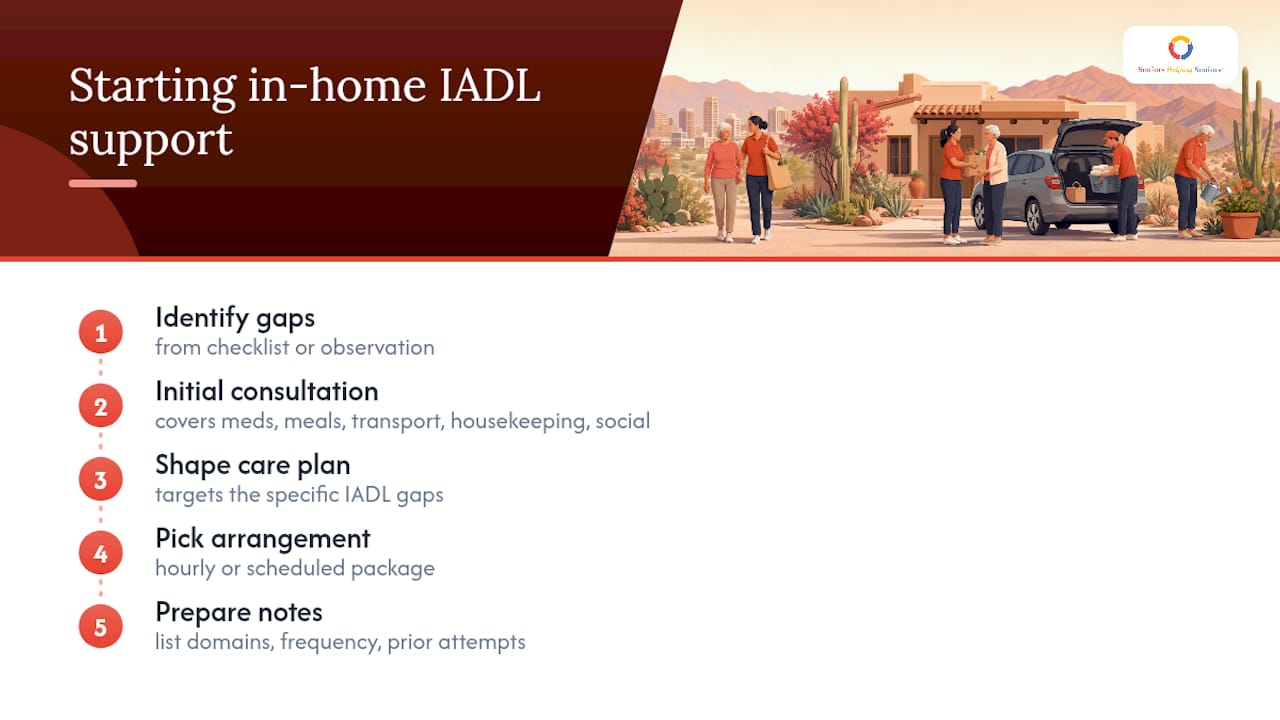
If a checklist or Lawton assessment turned up real gaps, the next move is a conversation, not a commitment. The service starts every relationship with an initial consultation that walks through the same territory an IADL assessment covers: medications, meals, transportation, housekeeping, and how much company someone actually wants day to day. That conversation shapes a care plan built around specific gaps rather than a generic hourly package.

Service arrangements typically run hourly or as a scheduled package, depending on how many domains need coverage and how often. A senior who mainly needs medication reminders and a weekly grocery run needs a different shape of care than someone who needs daily meal prep and transportation to multiple appointments. Both fit inside the same in-home care model.
Before you reach out, jot down what a recent IADL checklist or informal observation turned up: which domains are slipping, how often, and what's already been tried. That detail lets the consultation move straight to solutions. You can start that conversation directly through Seniors Helping Seniors Tucson and ask about scheduling a first visit.
Sources
The printable Lawton IADL form from the University of Missouri geriatric toolkit takes roughly 10 to 15 minutes to complete and works for either self-report or caregiver-report use. For the clinical reasoning behind why IADL decline matters, the PMC review on the clinical significance of IADL loss lays out how it connects to broader functional and cognitive decline. The NCBI Bookshelf chapter on ADLs and related concepts offers a broader instrument comparison if you want to see how the Lawton scale stacks up against alternatives. You can also read more on the difference between ADLs and IADLs for additional context on care planning.
This article is general information, not a substitute for advice from a qualified doctor. Consult a qualified healthcare professional about your own circumstances before acting on anything here.
- LAWTON - BRODY INSTRUMENTAL ACTIVITIES OF DAILY LIVING SCALE (I.A.D.L.) — University of Missouri geriatric toolkit
- Instrumental activities of daily living and their clinical significance — PMC article
- Activities of Daily Living and Related Concepts — NCBI Bookshelf (2022)
FAQ
What Are Two Examples of IADLs?
Managing medications and handling household finances are two classic IADL examples, alongside grocery shopping, meal preparation, laundry, housekeeping, transportation, and telephone use.
What Is the Difference Between ADLs and IADLs?
ADLs are basic physical self-care tasks like bathing, dressing, and eating, while IADLs are the more complex tasks needed to live independently, such as managing money, medications, and transportation. IADL decline typically appears before ADL loss.
What Should a Senior Do Every Day to Stay Independent?
Daily habits that support independence usually include taking medications on schedule, preparing or eating a proper meal, staying mobile with some light activity, and keeping up with basic housekeeping and hygiene routines.
What Are Some Common ADLs for Older Adults?
The core ADLs are bathing, dressing, eating, toileting, transferring (such as moving from bed to chair), and maintaining continence. These are more basic and physical than IADLs.
How Often Should an IADL Assessment Be Repeated?
There's no fixed rule, but repeating a Lawton IADL assessment every three to six months, or after any noticeable change, helps families track a trend rather than react to a single score.