

Hospice support at home means companion care, personal-care help, errands, and respite relief that fill the daily gaps hospice staff don't cover — it never replaces clinical nursing or symptom management. If you need it, call your hospice team today, tell them you're arranging extra help, and schedule a short trial visit with a vetted caregiver before committing to a regular schedule.
TL;DR:
- Non-medical hospice support includes companionship, personal care, errands, and overnight respite but does not substitute clinical nursing or symptom management.
- Coordinating caregivers involves informing the hospice team, providing clear task lists, and setting regular check-ins to prevent task duplication or missed warning signs.
- Verification of caregiver background checks, relevant experience, training, and compatibility tests is essential to ensure reliability and appropriate care.
- Medicare covers inpatient respite care for up to five days at a time, with additional programs available through Medicaid, VA, and private insurance to offset costs.
- Prioritizing a caregiver's shared life experience and rapport often improves daily engagement and reduces loneliness more effectively than just focusing on skills.
Table of Contents
- What Non-Medical Hospice Support Covers
- How Do You Coordinate Caregivers With the Hospice Care Plan?
- Who Provides This Kind of Support?
- Costs and Payer Options for Hospice Support at Home
- How to Choose the Right Caregiver
- First-Week Checklist for Starting In-Home Support
- Why Companionship and the Right Match Matter Most
- Getting Started With Seniors Helping Seniors Tucson
- Sources
- FAQ
What Non-Medical Hospice Support Covers
Non-medical hospice support handles the hours between hospice visits, when someone still needs to eat, move safely, and not feel alone. A hospice nurse might stop by twice a week; a companion caregiver can be there every afternoon.
Here's what that support typically includes:
- Companionship — conversation, presence, and emotional connection, especially valuable in the evenings when isolation peaks
- Meal preparation — cooking to appetite and dietary restrictions, often adjusted daily as appetite changes near end of life
- Light housekeeping — laundry, dishes, tidying the areas the patient uses most
- Errands and transportation — pharmacy pickups, grocery runs, driving family members to appointments
- Medication reminders — prompting a patient to take medication already set up by a nurse or family member, never administering it
- Personal care assistance — help with bathing, dressing, and toileting for patients who need it
- Overnight companionship and respite — someone awake and present so family caregivers can actually sleep
A family often adds transportation and errand help right after a hospital discharge, when nobody has bandwidth to also manage grocery runs. Overnight respite tends to get requested later, once a caregiver has gone several nights without real sleep. One boundary matters more than any other: these caregivers handle daily living and comfort, not clinical decisions. Wound care, pain titration, and symptom changes stay with the hospice nurse.
How Do You Coordinate Caregivers With the Hospice Care Plan?
Supplemental caregivers work best when the hospice team knows exactly who is showing up and what they're doing. Skipping this step is how well-meaning helpers end up duplicating tasks or missing warning signs the hospice nurse needed to hear about.
- Notify the hospice team. Tell them who's coming, how often, and give them a simple written list of the tasks that caregiver will handle.
- Ask what to report. Get a clear list of observations and red flags — labored breathing, skin changes, agitation — and exactly who to call, day or night.
- Request an introduction visit. Where possible, have the hospice nurse or social worker meet the new caregiver in person, even briefly.
- Set regular check-ins. A five-minute weekly call between family, hospice, and the caregiver catches small problems before they become big ones.
- Build a one-page care sheet. Include emergency contacts, where advance directives are kept, and any fall or mobility risks.
Hospice organizations describe respite and added non-medical help as an expected, encouraged part of the care plan, not a workaround families invent on their own, according to VITAS's guidance on caregiver burnout.
Pro Tip: Keep the one-page care sheet on the refrigerator or another spot every caregiver checks automatically. A sheet buried in a drawer helps nobody at 2 a.m.
Who Provides This Kind of Support?
Families typically choose from four sources: relatives and volunteers, a private caregiver hired directly, a home-care agency, or community volunteer programs tied to a hospice organization. Each has trade-offs. Family and volunteers cost nothing but stretch thin fast. Private hires can be flexible but put the vetting burden entirely on you. Agencies handle screening and scheduling but vary widely in quality and cost.
A senior-to-senior caregiving model, where the caregiver is also an older adult, tends to change the dynamic in ways families notice quickly. Shared generational experience makes rapport happen faster, and patients often open up more to someone closer to their own age and life stage than to a much younger aide.
Whichever route you choose, verify the same basics:
- Background checks completed and documented
- References you actually call, not just collect
- Training specific to end-of-life or dementia care, when relevant
- Bonding and insurance coverage
- A compatibility interview, not just a skills checklist
Costs and Payer Options for Hospice Support at Home
Money questions shouldn't delay arranging help, but the rules are worth knowing before you call anyone. Medicare's hospice benefit covers inpatient respite care for family caregivers, but it caps stays at five consecutive days, and the patient typically pays 5% coinsurance of the Medicare-approved amount, according to the official Medicare hospice benefits guide. That respite benefit covers a facility stay for the patient, not a private companion caregiver at home, which is where non-medical support services typically become private pay.
Beyond Medicare, several programs can offset the cost:
- Medicaid home and community-based waivers, where available in your state
- Veterans benefits through the VA's Aid and Attendance or similar programs
- Lifespan Respite Care Program vouchers, which fund state-level respite systems
- National Family Caregiver Support Program grants for counseling, training, and respite
- Private pay or long-term care insurance, still the most common route for ongoing companion care
Adding non-medical support isn't just about convenience. A 2011 peer-reviewed evaluation found that offering families additional non-medical services reduced self-reported caregiver stress by roughly 52%. Ask your hospice team about respite specifically, and contact your local State Health Insurance Assistance Program or Area Agency on Aging to find what's available near you.
How to Choose the Right Caregiver
Reliability matters more than almost anything else on this list. A caregiver who shows up late or cancels without notice creates the exact stress you're trying to eliminate.
- Check experience with end-of-life care specifically. General caregiving skills don't always translate to the emotional weight of hospice support.
- Call references, don't just collect them. Ask former clients directly how the caregiver handled a hard day.
- Confirm background checks and insurance. Get this in writing before the first visit.
- Ask scenario questions. How would they handle nighttime agitation? A missed medication reminder? A fall?
- Test scheduling reliability early. A caregiver's first two or three visits tell you more than any interview.
Watch for red flags: vague answers about actual hands-on experience, no references they're willing to share, or availability that shifts week to week. Those signs tend to predict bigger problems once a routine is established.
Pro Tip: Ask the exact same three scenario questions to every candidate you interview. Side-by-side answers reveal gaps a single conversation never will.
First-Week Checklist for Starting In-Home Support
The first week sets the tone for everything after it. A little preparation up front prevents most of the friction families run into later.
- Home prep: clear high-traffic walking paths, place mobility aids where they're actually used, and write an easy-to-read medication list
- Scheduling: start with short daytime visits before trialing longer shifts or overnight respite
- Check-ins: set a specific day and time each week for a family and hospice update
- Paperwork: have a signed task list, a payment agreement, emergency contacts, and the location of advance directives ready before day one
Short trial visits let everyone, patient included, adjust before anyone commits to a full schedule.
Why Companionship and the Right Match Matter Most
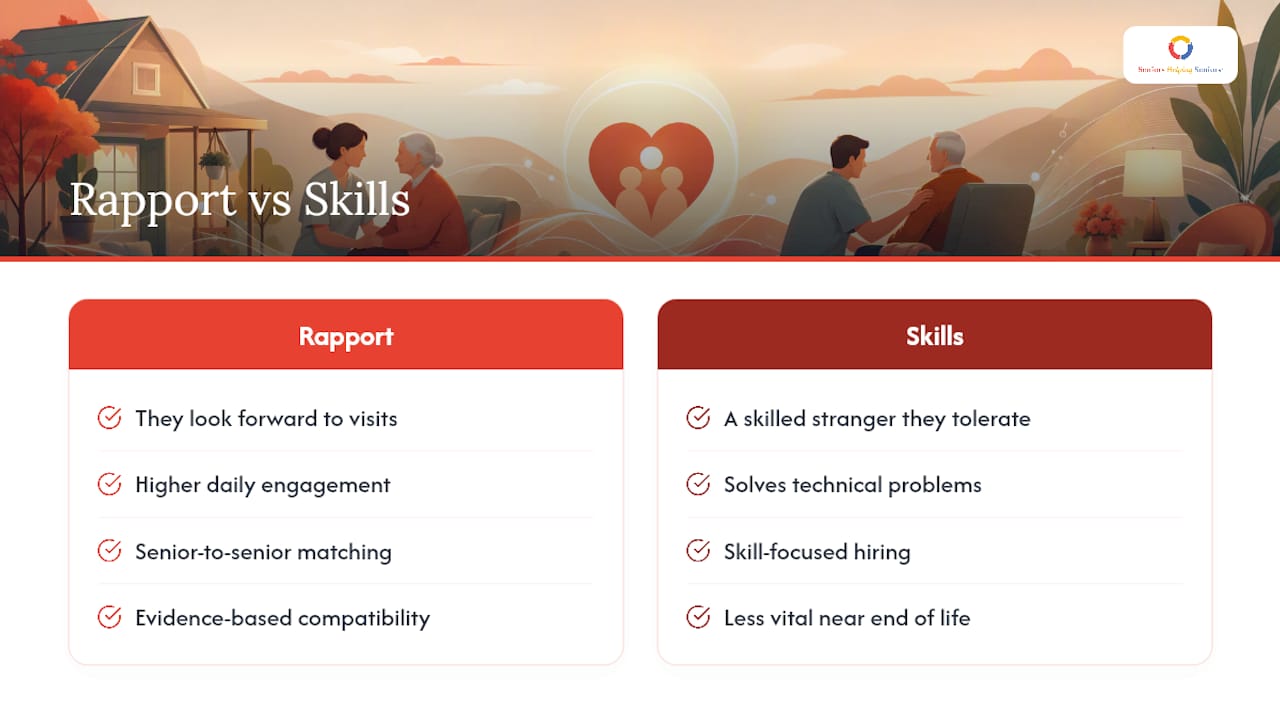
Matching caregivers to patients by shared life experience isn't a nice extra. It's often the difference between a caregiver a patient tolerates and one they actually look forward to seeing. Companies built around a senior-to-senior model, matching caregivers based on background and evidence-based methods for compatibility, tend to see that play out in daily engagement, not just satisfaction surveys.
If you're hiring for hospice support at home, prioritize rapport as heavily as skills. A skilled stranger and a warm, familiar presence solve different problems, and near the end of life, the second one often matters more.
— Cameron
Getting Started With Seniors Helping Seniors Tucson
An agency like Seniors Helping Seniors Tucson can provide matched, non-medical support that works alongside your hospice team. Our Companion Care, Personal Care, and Respite & Overnight Care services cover the meal prep, personal care, and overnight relief families need most, and our caregivers are mature adults, often seniors themselves, matched for shared life experience and compatibility.

If a loved one is coming home from the hospital and needs intensive help getting settled, our Return Home Transitional Care program is built specifically for that transition. Whichever service fits, coordinate with your hospice team first so everyone is working from the same care plan. From there, reach out through our services page to schedule an assessment and arrange a trial visit with a caregiver matched to your family's needs.
Sources
Verify details directly: Medicare hospice benefits PDF, the Medicare Benefit Policy Manual, the ACL's National Family Caregiver Support Program, and the 2011 caregiver stress study. Check your local SHIP office and the Lifespan Respite Care Program for regional options.
- An evaluation project showing added services reduced caregiver stress (2011)
- Medicare hospice benefits (official PDF)
- VITAS — how respite care brings relief for caregiver burnout
FAQ
Does Non-Medical Hospice Support Replace the Hospice Nurse?
No. Non-medical hospice support covers companionship, personal care, errands, and respite, while the hospice nurse handles all clinical symptom management, medication administration, and medical decisions.
How Many Days of Respite Does Medicare Cover?
Medicare's hospice benefit covers inpatient respite in blocks of up to five consecutive days at a time, with the patient generally paying 5% coinsurance of the Medicare-approved amount. Respite can be used more than once, but each inpatient stay is capped at five days.
How Do I Arrange Non-Medical Support Alongside Hospice?
Start by telling your hospice team you're adding a caregiver, then share a written task list so everyone's on the same page. Many families schedule a short trial visit first, through an agency like Seniors Helping Seniors Tucson or a private hire, before committing to a regular schedule.
What Does Senior-to-Senior Caregiving Mean?
It means the caregiver is also an older adult, matched to the patient based on shared life experience and compatibility rather than assigned at random. Families often find this improves rapport and reduces the loneliness that can accompany end-of-life care.
Are There Free or Low-Cost Options for In-Home Hospice Support?
Yes. The National Family Caregiver Support Program and Lifespan Respite Care Program both fund respite, counseling, and training through state and local agencies, and Medicaid waivers may cover additional hours depending on your state. Your local Area Agency on Aging can point you to programs specific to your area.