
Use a room-by-room checklist to find and fix the highest-risk hazards in a home now: clear trip hazards, confirm every smoke and carbon monoxide alarm works, and lock up medicines. These three steps address the most common causes of falls, fires, and poisonings for older adults. Success looks like open walkways, tested alarms, and a written escape plan everyone in the house understands.
TL;DR:
- Securing or removing loose rugs, rerouting cords, and improving lighting are urgent fixes to prevent trips and falls in living areas.
- Installing grab bars into wall studs and testing smoke alarms monthly significantly reduces fall and fire risks for seniors.
- Locking up medicines and hazardous cleaning products, and having visible emergency numbers, minimizes poisoning and poisoning-related injuries.
- Professional home safety assessments are recommended after falls or when multiple hazards are present, with funding options available for major modifications.
- Technology like medical-alert pendants and motion-activated lights supports ongoing safety, especially when caregiver supervision is limited.
Table of Contents
- Room-by-room safety checklist for every area of the house
- Fire and carbon monoxide safety checklist
- Medication and household poison safety
- Fall prevention: quick fixes now, professional help when needed
- Assistive technology and monitoring options worth considering
- Turning the checklist into an action plan
- How Seniors Helping Seniors® Tucson supports ongoing home safety
- What caregivers notice that checklists miss
- How in-home care helps you act on this checklist
- FAQ
- Sources
Room-by-room safety checklist for every area of the house
A home safety checklist works because it forces you to look at each room with fresh eyes instead of relying on habit. The National Institute on Aging's room-by-room worksheet is built around this exact idea: walk through each space and check off specific hazards rather than scanning the whole house at once.
In living areas, start with the floor. Loose rugs, stray cords, and low furniture are the most common trip hazards, and they're also the easiest to fix in a single afternoon. Tape down or remove rugs that slide, run cords along walls instead of across walkways, and rearrange furniture so there's a clear path between rooms. Add a night light or two so the space is never pitch dark when someone gets up after sunset.
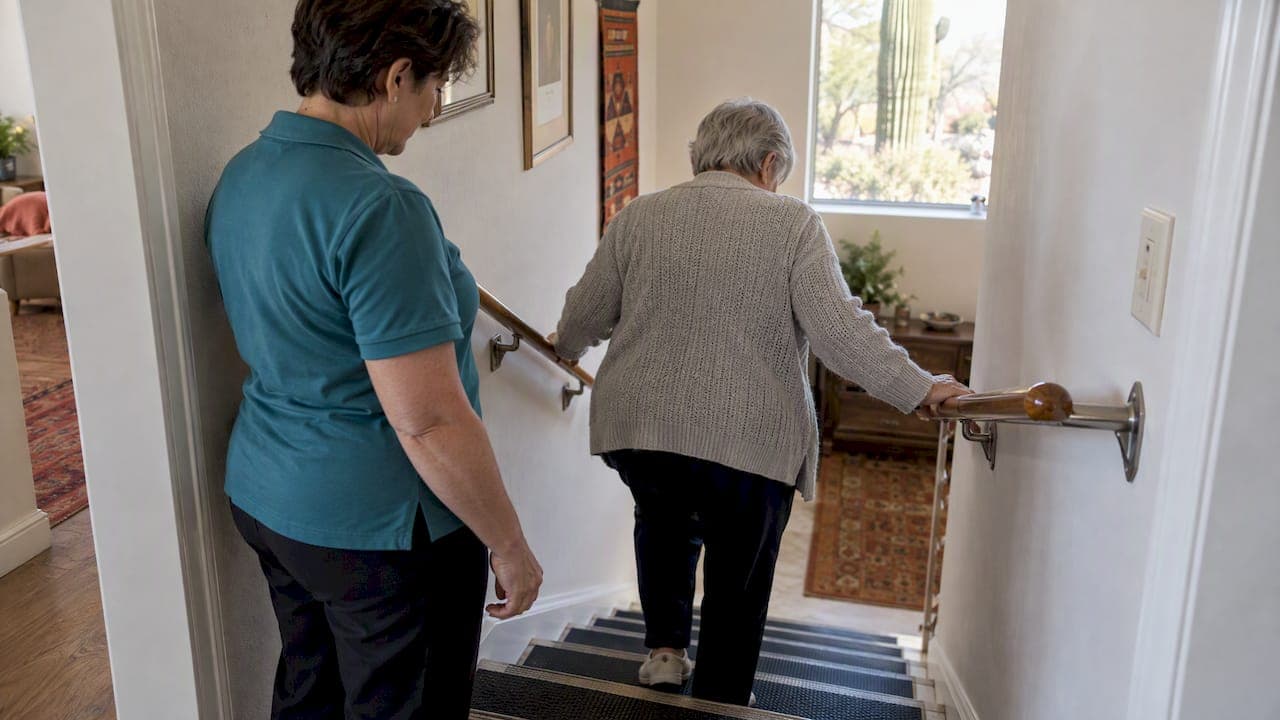
On stairs and in hallways, handrails matter on both sides of the staircase, not just one. Treads should be non-slip, and the area at the top and bottom needs a light switch within reach before stepping onto the stairs, not after. Clear away anything stored on steps, even temporarily.
In the kitchen, move frequently used items to shoulder height so nobody needs a step stool to reach a coffee mug. If memory loss is a concern, the NIA recommends stove safety knobs or an automatic shut-off device. Slip-resistant flooring and a clear path from the counter to the table reduce the chance of a fall while carrying something hot.

In the bathroom, grab bars only work when installed into wall studs or reinforced backing. A guide on expanding access to home modifications notes that towel bars are not a safe substitute, no matter how sturdy they look. Add non-slip mats inside and outside the tub, consider a shower seat or transfer bench, and check that the water heater has an anti-scald valve so a sudden temperature spike doesn't cause a fall or burn. Our guide on safer, dignified toileting at home covers specific equipment choices for this room in more depth.
In the bedroom, a night light near the bed and a clear, obstacle-free path to the door make nighttime trips to the bathroom far safer. Keep glasses, a phone, and hearing aids within arm's reach of the bed rather than across the room.
At entry points and outdoors, check that thresholds aren't raised enough to catch a foot or a wheelchair wheel. A temporary ramp can solve a single step that's become a barrier. Make sure house numbers are visible from the street for emergency responders, and add motion-activated lighting along walkways so the approach to the door is never dark.
- Remove loose rugs and secure or reroute cords across every walkway.
- Install grab bars into studs, never into drywall alone.
- Add night lights in hallways, bathrooms, and bedrooms.
- Keep stairways clear and add light switches at both top and bottom.
- Choose slip-resistant flooring or mats for kitchens and bathrooms.
Fire and carbon monoxide safety checklist
Falls get most of the attention, but fire risk deserves equal weight. The U.S. Fire Administration's guidance for older adults points to a few non-negotiable basics: working alarms, a practiced escape plan, and awareness of how mobility or hearing loss changes what "getting out safely" actually requires.
- Install smoke alarms on every level of the home and test them monthly.
- Replace smoke alarms every 10 years, and follow the manufacturer's replacement schedule for carbon monoxide alarms.
- Identify two ways out of every room and practice the full escape plan at least twice a year.
- Stay in the kitchen while cooking at high heat, and keep anything flammable away from stove tops and space heaters.
- Place space heaters on flat, hard surfaces at least three feet from anything that can burn.
Pro Tip: For anyone with hearing loss, a bed shaker or strobe-light alarm wakes a sleeper that a standard siren can't reach.
Falls remain the leading cause of unintentional injuries and deaths among adults 65 and older, according to CDC STEADI patient resources, and fire risk compounds that danger when mobility limits how fast someone can exit. An escape plan built around how a person actually moves through the house, not an idealized version of a quick exit, closes that gap. Keep glasses and hearing aids on the nightstand so they're grabbed automatically on the way out, not searched for in the dark.
Medication and household poison safety
Medication errors and accidental poisonings are quieter risks than a fall, but they're just as preventable with the right setup. The NIA's safety tips for caregivers recommend locked storage for medicines whenever cognitive impairment is a factor, along with keeping hazardous items out of easy reach.
- Store medications in a locked box or cabinet, especially when memory loss is present.
- Use clear, large-print labels and keep one updated medication list to bring to every appointment.
- Ask a pharmacist or clinician for a medication review to flag drugs that raise fall risk, a strategy the STEADI Compendium lists among the most effective fall-reduction steps.
- Lock away cleaning products and laundry pods, which are easy to mistake for food or candy.
- Post the Poison Control number, 800-222-1222, somewhere visible in the kitchen or near the medicine cabinet.
A supervised pill organizer or automatic dispenser helps when someone is managing several prescriptions at once, cutting down on both missed doses and accidental double-doses. For families managing dementia-specific routines, our guide to in-home memory care goes further into adapting medication systems for cognitive decline.
Fall prevention: quick fixes now, professional help when needed
Some fall-prevention steps take an afternoon. Others need a professional eye. Knowing which is which keeps a safety project from stalling out.
Do these now:
- Clear walkways of boxes, cords, and furniture that narrows the path.
- Secure or remove rugs that slide on hard flooring.
- Add brighter bulbs or additional lighting in dim hallways and stairwells.
- Install grab bars into wall studs, not just drywall anchors.
Behavioral changes matter just as much as physical fixes. Balance-focused programs like Tai Chi or Otago reduce fall risk over time, and a yearly vision check catches changes that quietly affect balance and depth perception. Footwear matters too: loose slippers and worn-out soles undercut even a perfectly decluttered floor. Our piece on chair exercises caregivers can use with seniors offers a low-impact starting point for building strength at home.
When a home has multiple hazards or when a senior has already fallen, a professional home safety assessment is worth requesting. According to CDC fall-prevention research, an occupational therapist evaluates a person's actual functional abilities, not just the structure of the house, and recommends task-specific training alongside physical modifications. An OT might catch that a senior struggles to rise from a particular chair height, a detail a general checklist misses entirely.
Pro Tip: Ask your primary care provider for a referral to an occupational therapist specializing in home safety; many insurance plans cover at least one evaluation.
Funding help exists for bigger projects. Local Area Agencies on Aging and Title III programs connect older adults with services and sometimes funding for home repairs. Rebuilding Together affiliates, Weatherization Assistance Programs, and HARP programs offer no-cost or low-cost modification services in many areas. Our guide to maintaining independence at home walks through how these low-friction steps add up over time.
Assistive technology and monitoring options worth considering
Technology fills gaps a checklist alone can't close, particularly for households where a caregiver can't be present around the clock. A partner resource on in-home monitoring outlines how these tools integrate with broader care plans rather than replacing hands-on supervision.
- Medical-alert pendants let a senior call for help after a fall without needing to reach a phone.
- Automatic stove shut-off devices cut power if a burner is left on too long, addressing a common dementia-related risk.
- Motion-activated night lights turn on automatically when someone gets up, removing the need to fumble for a switch.
- Bed shakers or strobe alarms give a visual or physical alert for anyone who can't rely on hearing a siren.
When choosing among these, weigh ease of use and battery maintenance as heavily as the core function. A device that's confusing to operate or constantly needs new batteries gets abandoned. Professional monitoring services add a layer of response for pendants and sensors, while self-monitored options cost less but rely on a family member checking in. Whatever you choose, involve the senior in the decision. A device that feels like surveillance gets resisted or disabled, while one chosen together tends to actually get used.
Turning the checklist into an action plan
A long list of fixes is only useful if it gets worked through in order. Triage hazards into three tiers based on urgency and effort.
- Immediate (this week): test alarms, clear trip hazards, lock up medications.
- Short-term (this month): install grab bars, improve lighting, secure loose rugs permanently.
- Long-term (this year): build ramps, modify bathrooms, widen doorways if mobility needs are changing.
Write each task down and assign it to a specific person and date, whether that's a family member, a hired contractor, or a caregiver. Low-cost fixes like night lights and rug removal can happen the same day; grab bar installation usually takes a single visit from a handyman. Bigger projects like ramp construction or bathroom remodels take longer and cost more, which is exactly where funding programs help most.
Start with a local Area Agency on Aging to find what's available in your area, then check whether a nearby Rebuilding Together affiliate or Weatherization Assistance Program covers home modifications. For anyone unsure where to start with a professional evaluation, a primary care provider can refer to an occupational therapist who specializes in home safety.
How Seniors Helping Seniors® Tucson supports ongoing home safety
A checklist identifies hazards. Following through on it day after day is a different challenge, and that's where consistent, in-home support makes the difference. Our caregivers help with the tasks that keep a home safe over time: light housekeeping that keeps walkways clear, medication reminders that reduce missed or doubled doses, and transportation to medical appointments and pharmacy visits. Because our caregivers are themselves mature adults, often seniors, matched for shared life experience, the relationship tends to support real follow-through rather than a one-time inspection. Our guide to low-friction independence at home describes how this kind of steady companionship supports the habits a safety checklist depends on.
What caregivers notice that checklists miss
The hazards I see repeated most often aren't exotic. They're the rug nobody thought to remove and the hallway bulb that burned out months ago and never got replaced. A simple weekly habit catches both: walk the same path through the house every week, and test every alarm the same night each month. Small, repeated checks beat one thorough sweep that never gets redone.
Partner with a clinician on medication and vision reviews rather than guessing at what's changed. A pharmacist catches drug interactions a family member wouldn't think to flag, and an eye exam explains a stumble better than any rug ever could.
— Cameron
How in-home care helps you act on this checklist
Identifying hazards is the first step. Getting them fixed and keeping them fixed is the part that actually protects someone. Our caregivers at Seniors Helping Seniors® Tucson help with the ongoing pieces of a safety plan: light housekeeping to keep floors and walkways clear, medication reminders to reduce errors, transportation to follow-up appointments after a professional home assessment, and regular companionship visits that double as informal safety checks.

- We offer flexible scheduling.
- Our caregivers are mature adults, matched for shared experience.
- We coordinate care locally in the surrounding communities.
If a loved one's home needs ongoing support to stay safe, visit our services page to request a care assessment and see which services fit your situation.
This article is general information, not a substitute for advice from a qualified doctor. Consult a qualified healthcare professional about your own circumstances before acting on anything here.
FAQ
What should be on a basic home safety checklist for seniors?
A basic checklist covers trip hazards, lighting, grab bars, smoke and carbon monoxide alarms, and medication storage in every major room. The NIA's room-by-room worksheet organizes these checks by living area, kitchen, bathroom, and bedroom so nothing gets missed.
How often should smoke alarms be tested and replaced?
Test smoke and carbon monoxide alarms monthly and replace smoke alarms every 10 years, following the U.S. Fire Administration's guidance for older adults. Carbon monoxide alarms should be replaced on the schedule the manufacturer recommends.
When should a senior get a professional home safety assessment?
A professional assessment from an occupational therapist is worth requesting after a fall, when memory loss affects daily safety, or when a checklist reveals several hazards at once. According to CDC fall-prevention research, an OT evaluates functional ability alongside the physical home, which a general checklist can't fully capture.
How do you install grab bars safely?
Grab bars must be installed into wall studs or reinforced backing to hold body weight safely, not into drywall alone. A home modification action guide notes that towel bars are never an acceptable substitute, even when they appear sturdy.
Where can seniors find help paying for home modifications?
Local Area Agencies on Aging and Title III programs connect older adults with funding and services for repairs, according to ACL guidance on home modification programs. Rebuilding Together affiliates and Weatherization Assistance Programs also offer low-cost or no-cost modification help in many areas.
Sources
- CDC STEADI patient resources
- Worksheet: Home Safety Checklist (NIA)
- Fire Safety for Older Adults (USFA)
- STEADI Compendium (CDC)