

Here are the 10 questions you must ask when vetting home care — ask them on the first call or the first visit, before you schedule anything else.
A well-structured 30-minute phone screen with the right questions can filter out many unsuitable providers by surfacing red flags in safety protocols and operational basics. This alone justifies having this list in front of you before you dial.
The 10 must-ask questions for your first contact:
- Is the agency licensed in Arizona, and can you give me your license number right now?
- Are your caregivers W-2 employees or independent contractors?
- What background checks do you run, and do they include a national criminal search and OIG Exclusions screening?
- What specific services are included, and what requires an add-on fee?
- Can you send me a written fee schedule that includes holiday rates, overtime, and short-notice surcharges?
- What is the minimum visit length, and do you charge for travel time?
- Who do I call at 2:00 AM if something goes wrong, and can that person dispatch immediate help?
- How do you handle caregiver call-outs — who covers, and how fast?
- Can we schedule a trial visit before signing a long-term agreement?
- Can you provide three client references I can contact this week?
Pro Tip: Write down the answers verbatim during the call. Vague answers to questions 7 and 8 are the single most common red flag families miss — "we have an on-call team" is not the same as a named supervisor with clinical authority who can act.
One red flag to watch immediately: if an agency cannot give you a license number on the spot or says "we'll follow up with that," end the call. Licensed providers know their number. The National Institute on Aging explicitly recommends getting fee information and backup procedures confirmed in writing before you engage any provider. Seniors Helping Seniors® Tucson, for example, provides written care plans and documented backup staffing as standard practice.

Table of Contents
- What does "home care" actually cover?
- Questions to ask a home care agency, grouped by what matters most
- How to interview an individual caregiver directly
- Red flags to watch for, and what strong answers sound like
- How to move from first call to first paid visit
- Why competency questions and documented screening actually predict outcomes
- Key Takeaways
- What families underestimate about caregiver compatibility
- Seniors Helping Seniors® Tucson: a local option worth calling
- Where to verify licensing, accreditation, and complaints
What does "home care" actually cover?
Families often call an agency asking for "home care" and get quoted for something entirely different from what they need. The terminology matters because it determines who pays, who supervises, and what questions you should be asking.

| Service Type | What It Includes | Who Regulates / Pays | Typical Staffing |
|---|---|---|---|
| Non-medical personal care / companion | Bathing, dressing, meal prep, companionship, errands | State licensure; private pay or long-term care insurance | Home care aides, companions |
| Skilled home health | Nursing visits, physical/occupational therapy, wound care | Medicare (if physician-ordered and medically necessary); state licensure | RNs, LPNs, therapists |
| Hospice / palliative | Comfort care, pain management, family support at end of life | Medicare Part A (if terminal diagnosis); state licensure | Interdisciplinary team |
| Respite care | Temporary relief for a primary family caregiver | Private pay; some Medicaid waiver programs; VA benefits | Varies by provider |
| Live-in care | 24-hour presence, typically with sleep time | Private pay; long-term care insurance | Live-in aides |
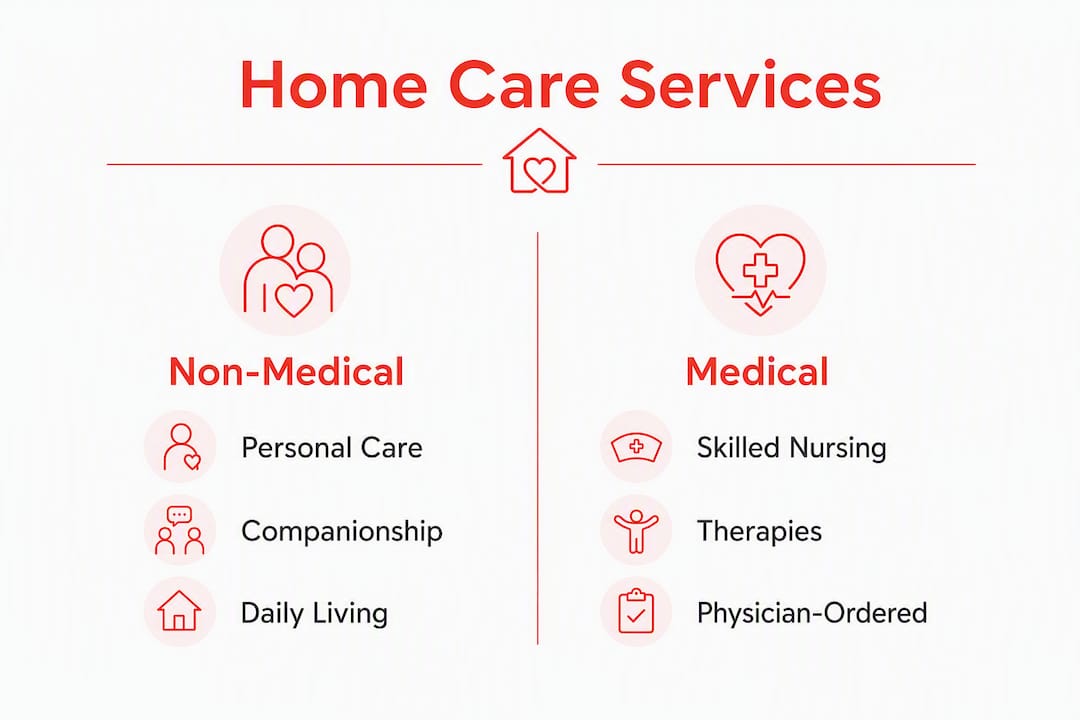
Medicare covers skilled home health services when a physician orders them and the patient meets homebound criteria. It does not cover ongoing custodial personal care — the daily bathing, companionship, and meal preparation that most families actually need. That distinction is where most families get surprised by a bill.
The terms "home health" and "home care" are used interchangeably in conversation but refer to legally distinct service categories. Home health involves a licensed clinician and a physician's order. Home care is non-medical assistance with daily living. If you call a skilled nursing agency expecting companion services, you will either be redirected or quoted for services you do not need. Know which category applies before you make the first call.
Respite care deserves a specific mention. It is not a separate service type so much as a scheduling arrangement — short-term coverage that gives a family caregiver a break. Most personal care agencies offer it, but the minimum hours, advance notice requirements, and rates vary significantly. Ask about it explicitly if a family member is the primary caregiver.
Questions to ask a home care agency, grouped by what matters most
A single agency interview covers a lot of ground. Grouping your questions by concern keeps the conversation organized and makes it easier to compare two or three agencies afterward.
Agency credentials and oversight
- What is your state license number, and which Arizona agency issued it?
- Are you accredited by a national body such as The Joint Commission or CHAP?
- How long have you been operating in Tucson, and can you share any state inspection reports?
- Do you carry general liability insurance and workers' compensation for your caregivers?
A good answer names the license number, the issuing body, and offers to send documentation. An evasive answer — "we're registered, don't worry" — is a reason to pause.
Caregiver recruitment, training, and supervision
- What is your hiring process, and what percentage of applicants do you actually hire?
- Do caregivers receive formal orientation training before their first assignment?
- How often are caregivers supervised or evaluated after placement?
- What certifications do your caregivers hold (CNA, HHA, CPR/First Aid)?
Verifying whether caregivers are W-2 employees or independent contractors is one of the most consequential questions you can ask. W-2 employees are covered by the agency's workers' compensation and liability insurance. Independent contractors shift that risk to you. If a contractor is injured in your home, you may be liable. Agencies that employ W-2 staff also have more control over training standards and can enforce conduct policies.
Scheduling, continuity, and backup
- Will my family member have a consistent, primary caregiver?
- How much advance notice do you give when a caregiver is changed?
- What is your backup policy when a caregiver calls out sick?
- Who is the on-call contact after hours, and what authority do they have to dispatch help?
After-hours support is a critical operational gap at many agencies. Some route overnight calls to a generic answering service with no authority to act. Ask specifically: "If my father falls at 2:00 AM and the caregiver calls out, who makes the decision to send a replacement?" The answer should name a role or a person, not a phone tree.
Services, care planning, and documentation
- Do you conduct an in-home assessment before creating a care plan?
- Who writes the care plan, and how often is it reviewed?
- How do you communicate changes in a client's condition to the family?
- Can family members access care notes or a communication log?
Billing, fees, and payment options
The advertised hourly rate is rarely the final cost. Request a written fee schedule that itemizes the base rate, holiday and weekend premiums, overtime rates, short-notice surcharges, minimum visit charges, and any fees for specialized care (dementia, post-surgical). Ask whether mileage is billed separately for transportation tasks.
- What is the minimum number of hours per visit?
- Do you accept long-term care insurance, and do you handle the billing?
- What are your cancellation terms if we need to pause service?
- Is there a deposit or contract lock-in period?
Pro Tip: Ask for the fee schedule as a PDF before the in-home assessment. Agencies that hesitate to send it in writing before you sign anything are showing you exactly how they will handle billing disputes later.
The NIA recommends written fee disclosures and formal backup protocols as baseline requirements before engaging any provider. If an agency cannot produce a written fee schedule on request, that is a red flag, not a negotiating position.
Safety, liability, and references
- Do you run national criminal background checks on all caregivers?
- Do you screen against the OIG Exclusions Database?
- Does your agency carry bonding insurance?
- Can you provide three client references, including at least one whose care needs are similar to ours?
How to interview an individual caregiver directly
Whether a caregiver is assigned by an agency or hired privately, you should meet them before care begins. The meeting does not need to be long, but it needs to be structured.
Competency-based, past-behavior questions predict future caregiving performance significantly better than hypotheticals. "What would you do if..." questions invite rehearsed, idealized answers. "Tell me about a time when..." questions surface actual behavior. That distinction shapes every question below.
High-value competency questions to ask in person:
- "Tell me about a time a client became confused or agitated. What did you do, and how did it resolve?"
- "Describe a situation where you noticed a change in a client's health. How did you handle it, and who did you contact?"
- "Tell me about a time you had a conflict with a family member about a client's care. How did you handle it?"
- "Walk me through your typical first hour with a new client."
- "Have you ever had to refuse a client's request? What happened?"
Strong answers are specific: they name the situation, the action taken, and the outcome. Vague answers ("I always stay calm and do my best") are a signal to probe further or move on.
Verification checklist for the in-person meeting:
- Government-issued photo ID
- Proof of relevant certifications (CNA, HHA, CPR/First Aid)
- Driving record if transportation is part of the role
- Written references from at least two prior employers or clients
- Background check documentation (if hiring privately, you run this yourself)
- OIG Exclusions Database check (searchable at oig.hhs.gov)
If you are hiring privately rather than through an agency, you become the household employer. That means payroll taxes, workers' compensation, and liability insurance become your responsibility. Agencies typically absorb those obligations as the employer of record. Factor that into the cost comparison before assuming private hire is cheaper.
Pro Tip: Structure a 15-minute trial observation at the end of the interview. Ask the caregiver to assist with one routine task while you observe. Watch for punctuality, how they introduce themselves to the senior, whether they ask before touching, and how they respond to pushback. You will learn more in 15 minutes of observation than in 45 minutes of questions.
Red flags to watch for, and what strong answers sound like
Most families know something feels off before they can articulate why. These are the specific signals worth trusting.
Red flags that should prompt follow-up or a different provider:
- Cannot provide a license number on the call
- Refuses to disclose whether caregivers are employees or contractors
- No written fee schedule available before signing
- Backup plan described as "we'll figure it out" or "call the main number"
- Unwilling or unable to provide client references
- No formal supervision structure for caregivers after placement
- After-hours support routes to a voicemail or generic answering service
- Pressure to sign a long-term contract before a trial visit
What strong, specific answers sound like:
On licensing: "Our Arizona license number is [number]. You can verify it at the Arizona Department of Health Services website under Home Health Agencies."
On backup staffing: "If your caregiver calls out, our on-call coordinator — who has authority to dispatch a replacement — is notified within 30 minutes. We maintain a pool of trained backup staff and aim to have someone at your door within two hours."
On fees: "Here is our written fee schedule. The base rate is $X per hour, with a two-hour minimum. Holiday rates are 1.5x, and short-notice requests under 24 hours carry a $Y surcharge."
On after-hours support: "Our on-call supervisor is a registered nurse who can be reached directly at this number between 8 PM and 7 AM. She can authorize emergency dispatch or coordinate with 911 if needed."
On references: "We can give you three references today. Two are current clients whose families have agreed to speak with prospective clients, and one is a discharge planner at a local hospital who refers to us regularly."
Quick evaluation checklist for phone screens:
- License number provided: Yes / No
- Employment model disclosed: Yes / No
- Written fee schedule offered: Yes / No
- Named after-hours contact with authority: Yes / No
- References offered without prompting: Yes / No
- Trial visit permitted: Yes / No
Six "yes" answers is the floor for moving to an in-home assessment.
How to move from first call to first paid visit
The process from initial research to a caregiver walking through the door typically takes one to three weeks. Here is what each step looks like in practice.
Step 1: Phone screen (30 minutes). Use the 10-question checklist from the opening of this article. Record answers in writing. Agencies that pass move to step 2; those that fail on licensing, employment model, or after-hours support are eliminated.
Step 2: In-home assessment (60 to 90 minutes). A care coordinator visits the home, meets the senior, and documents care needs. This is when you ask the full agency toolkit questions from the section above. Bring your written list. Ask about caregiver matching criteria specifically.
Step 3: Written service agreement and fee schedule. Do not proceed without both documents in hand. The agreement should specify the care plan, scheduled hours, caregiver name (or matching process), backup policy, and cancellation terms. The fee schedule should be a line-item document, not a single hourly rate.
Step 4: Trial visit. Request one paid trial visit before committing to ongoing service. Use it to observe caregiver punctuality, interaction style, and how the senior responds. Document what you observe.
Step 5: Onboarding documentation. Collect and store: signed service agreement, written care plan, caregiver certifications, proof of agency insurance, and emergency contact protocol. If hiring privately, add workers' compensation policy and payroll setup confirmation.
Step 6: 30-to-90-day review. Schedule a formal check-in with the agency at the 30-day mark. Review whether the care plan still fits, whether the caregiver relationship is working, and whether any billing discrepancies have appeared.
Specialized caregivers — for dementia, Parkinson's, or post-surgical recovery — may take longer to match, sometimes two to three weeks. Ask about current availability during the phone screen so you are not surprised.
Pro Tip: During the trial visit, step out of the room for 10 minutes. Watch how the caregiver and your family member interact without an audience. The dynamic often shifts noticeably, and that shift tells you more than anything said during the interview.
Why competency questions and documented screening actually predict outcomes
The research behind structured interviews is consistent: asking caregivers about real past situations, rather than hypothetical ones, produces answers that correlate with actual on-the-job behavior. Competency-based questions are significantly more predictive than "what would you do" scenarios, which tend to surface idealized responses rather than real patterns.
A simple scoring rubric helps families compare responses across multiple candidates or agencies without relying on gut feel alone.
Scoring rubric for caregiver and agency responses (0–2 per criterion):
| Criterion | 0 | 1 | 2 |
|---|---|---|---|
| Specificity | Vague or generic ("I always do my best") | Partially specific (situation named, action vague) | Fully specific (situation, action, and outcome named) |
| Documentation | No mention of records or reporting | Mentions documentation in passing | Describes specific documentation process |
| Continuity plan | No backup plan described | General backup mentioned | Named backup person or protocol with timeline |
| Emergency protocol | "Call 911" only | Mentions agency contact | Named on-call person with authority and response time |
A score of 6 or higher out of 8 is a reasonable threshold for advancing a candidate or agency to the next step. Below 4 is a clear pass.
Three sample scored answers:
"I always try to keep clients calm and comfortable." Score: 0. No specificity, no documentation, no protocol.
"When a client had a fall last year, I called the family right away and filed an incident report with the agency." Score: 5. Specific situation, mentions reporting, but no continuity or emergency protocol detail.
"Last March, a client I was caring for had a sudden change in alertness. I documented the time and symptoms, called our on-call nurse within five minutes, and stayed with the client until the family arrived 20 minutes later. The nurse authorized calling 911, and I followed the agency's emergency protocol exactly." Score: 8. Fully specific, documented, named escalation path, clear emergency response.
A well-structured 30-minute initial consultation with the right questions can filter out roughly 80% of unsuitable providers. The scoring rubric above makes that screen reproducible across multiple agencies, so you are comparing apples to apples rather than impressions.
Key Takeaways
Choosing the right home care provider comes down to four actions: use the 10-question checklist on the first call, demand written fees and a backup policy, prioritize competency-based caregiver answers, and schedule a trial visit before signing anything.
| Point | Details |
|---|---|
| Use the 10-question checklist first | A 30-minute phone screen using the opening checklist filters roughly 80% of unsuitable providers. |
| Demand written fees and backup policy | The NIA recommends written fee disclosures and formal backup protocols before engaging any provider. |
| Prioritize competency-based answers | Past-behavior questions predict caregiver performance better than hypotheticals; score responses with the 0–2 rubric. |
| Verify credentials independently | Check state licensure, the OIG Exclusions Database at oig.hhs.gov, and Medicare Care Compare for certified agencies. |
| Tucsonshs as a local option | Seniors Helping Seniors® Tucson provides written care plans, documented backup staffing, and mature caregiver matching as standard. |
What families underestimate about caregiver compatibility
The questions in this guide rightly focus on credentials, licensing, and operational protocols. Those are the filters that protect against harm. But once a provider clears those filters, the factor that most determines whether care actually works is something harder to quantify: whether the caregiver and the senior genuinely connect.
Families often treat personality fit as a nice-to-have, something to consider after the practical boxes are checked. The evidence points the other way. Seniors who feel comfortable with their caregiver are more likely to follow care routines, communicate symptoms honestly, eat and hydrate consistently, and engage in the social interaction that research consistently links to cognitive health. A technically skilled caregiver who the senior dislikes or distrusts produces worse outcomes than a slightly less credentialed caregiver the senior looks forward to seeing.
This is not an argument for ignoring credentials. It is an argument for treating compatibility as a screening criterion, not an afterthought. Ask agencies specifically how they match caregivers to clients. Do they consider shared interests, life experience, cultural background, or language preference? Or do they assign whoever is available on the schedule?
Cultural and language alignment matters more than most families anticipate, particularly for seniors with memory conditions. A caregiver who shares a client's native language or cultural reference points can reach a person with dementia in ways a clinically superior but culturally distant caregiver cannot.
When trade-offs arise — and they will — the right call depends on the care level required. For a senior with complex medical needs, clinical competence must come first. For a senior whose primary need is companionship, daily structure, and someone to share a meal with, personality fit and shared experience may matter more than any certification.
Seniors Helping Seniors® Tucson: a local option worth calling
Families who have worked through this guide know what good home care looks like on paper. Seniors Helping Seniors® Tucson is built around making that standard the actual experience, not just the pitch.
What sets Tucsonshs apart is the caregiver model itself. Caregivers are mature adults, often seniors themselves, matched to clients based on shared life experience, interests, and personality, not just availability. Every engagement starts with a free phone consultation and an in-home assessment, followed by a written care plan. Background checks, written fee schedules, documented backup staffing, and a named on-call contact are standard, not optional add-ons.
Services include companionship and socialization, personal care and daily living assistance, memory and dementia support, respite care, meal preparation, light housekeeping, transportation, and medication reminders. Veterans' care is also available.
If you are ready to move from research to a real conversation, contact Tucsonshs to schedule your free consultation. Ask for the written fee schedule and backup policy on that first call. They will have both ready.
Where to verify licensing, accreditation, and complaints
No agency's word is a substitute for independent verification. These are the primary sources to check, and what each one tells you.
| Source | What It Verifies | How to Search |
|---|---|---|
| Arizona Department of Health Services | State licensure for home health and home care agencies | Search by agency name or license number at azdhs.gov |
| OIG Exclusions Database | Whether a provider or individual is excluded from Medicare/Medicaid programs | Search by name or NPI at oig.hhs.gov/exclusions |
| Medicare Care Compare | Quality ratings and inspection results for Medicare-certified home health agencies | Search at medicare.gov/care-compare |
| NIA Hiring Checklist | Structured question framework for families evaluating providers | Download the PDF worksheet directly from nia.nih.gov |
| Better Business Bureau / State AG | Consumer complaints and dispute history | Search by agency name at bbb.org or your state attorney general's site |
Verification steps that take under 10 minutes:
- Ask the agency for their license number during the phone screen.
- Search that number on the Arizona DHS provider registry. A valid license shows the issue date, expiration, and any violations.
- Run the agency name and the assigned caregiver's name through the OIG Exclusions Database. Any match is disqualifying.
- Search the agency on Medicare Care Compare if they claim Medicare certification. Review the star rating and any recent inspection findings.
- Search the agency name on the BBB site and your state attorney general's consumer complaint database.
A red-flag entry on any of these databases — an expired license, an OIG exclusion, a pattern of unresolved complaints — outweighs any positive impression from the phone screen. Verification takes less time than a second interview and carries more weight than any reference a provider selects for you.