

Hiring a caregiver privately is a realistic option for most families — and often the right one. You get more control over who enters your loved one's home, a closer personal match, and typically a lower hourly rate than a home care agency charges. The trade-off is real: you become the employer. That means payroll taxes, federal paperwork, and the responsibility of backup coverage when your caregiver calls in sick.
The single first action is to assess what care is actually needed, then check your employer obligations before you post a single ad.
Start here:
- Assess care needs. List every activity of daily living (ADL) and instrumental ADL (IADL) the person needs help with, plus any medical or behavioral requirements.
- Check your employer status. Use the IRS household employee guidance and the DOL direct-care checklist to confirm whether you will owe payroll taxes.
- Decide: private hire or agency. If the care needs are medically complex or your family has limited bandwidth for HR tasks, an agency may be the smarter starting point.
The IRS is clear: if you control both what work is done and how it is done for in‑or‑around‑the‑home work, the IRS generally treats the worker as a household employee and you may owe household employment taxes.
Pro Tip: Before you search for candidates, write a one-paragraph summary of the care recipient's needs. You will use it in every interview, in the job description, and in the contract. Doing it once saves hours later.
Key Takeaways
Hiring a caregiver privately is viable when you want control and a close personal match, but it requires treating the process like a structured HR task: needs assessment, legal compliance, written contract, and a documented backup plan.
| Point | Details |
|---|---|
| Assess needs first | List every ADL and IADL before recruiting; the job description follows directly from this list. |
| Confirm employer status | Use the IRS household employee guidance—that is, whether you control both what work is done and how it is done—and the DOL checklist before the first paycheck to avoid misclassification penalties. |
| Written contract is mandatory | Cover duties, pay, overtime, termination, confidentiality, and dispute resolution; AARP warns handshake deals leave both parties exposed. |
| Plan for backup coverage | Pre-identify two backup contacts and document the absence policy before the caregiver's first shift. |
| Tucsonshs as a managed alternative | Families in Tucson who want vetted, matched caregivers without the HR burden can contact Tucsonshs for a service agreement. |
Table of Contents
- Practical pros and cons of hiring a private caregiver versus using an agency
- How to decide if private hiring fits your situation
- What private caregivers typically cost: hourly rates and live-in budgets
- How to pay a private caregiver legally: taxes, payroll, and your employer obligations
- Where to find private caregivers and what to expect from each source
- How to write a job description, interview well, and spot red flags
- What to put in a written caregiving contract and your ongoing employer responsibilities
- Special considerations when hiring a live-in caregiver
- How to onboard, supervise, and manage a private caregiver while maintaining boundaries
- How the Seniors Helping Seniors® Tucson model works and when families should choose it
- Tucsonshs offers a managed path when private hiring feels like too much
- Official resources and helpful links to bookmark
- Sources
Practical pros and cons of hiring a private caregiver versus using an agency
The honest comparison comes down to three things: cost, control, and administrative burden. Private hire usually wins on the first two. Agencies win on the third.
| Factor | Private hire | Home care agency |
|---|---|---|
| Hourly cost | Lower gross rate; you add employer taxes on top | Higher rate; agency absorbs payroll and HR costs |
| Scheduling control | You set the schedule directly | Agency assigns shifts; less flexibility |
| Caregiver vetting | You run background checks and references | Agency pre-screens and credentialed |
| Backup coverage | Your problem to solve | Agency provides substitute caregivers |
| Payroll and taxes | Your responsibility (Schedule H, FICA, FUTA) | Handled by agency |
| Training and support | You provide or arrange | Agency trains and supervises |
| Legal/liability risk | Higher — you are the employer | Lower — agency carries employer liability |
When private hire makes sense:
- Budget is tight and the family can absorb the HR workload
- The care recipient has strong preferences about who enters the home
- Needs are primarily companionship, light housekeeping, and transportation rather than skilled nursing
- A trusted referral is already available through family or community networks
When an agency is the smarter call:
- The care recipient has dementia, behavioral challenges, or complex medical needs requiring trained staff
- The family has no bandwidth for payroll, tax filings, or scheduling gaps
- 24/7 or near-continuous coverage is required and backup reliability is non-negotiable
One point families often underestimate: the lower hourly rate of a private caregiver shrinks when you add the employer's share of Social Security and Medicare taxes, federal unemployment tax, and any state-mandated workers' compensation premiums. The savings are real but not as large as the raw hourly difference suggests.
How to decide if private hiring fits your situation
Before you write a job posting, you need a clear picture of what the role actually involves. That picture drives every downstream decision: who you hire, what you pay, and what goes in the contract.
ADL and IADL checklist — mark every item that applies:
- Bathing, grooming, and dressing
- Toileting and continence care
- Mobility assistance and transfers (bed to chair, chair to car)
- Meal preparation and feeding assistance
- Medication reminders or administration
- Light housekeeping and laundry
- Transportation to appointments and errands
- Companionship and social engagement
- Dementia or memory care support
- Behavioral management or de-escalation
Decision guidelines:
- If three or more ADLs require hands-on physical assistance, consider whether the caregiver needs formal training (CNA certification, for example) and whether your state requires it.
- If dementia or behavioral needs are present, an agency with specialized training protocols is often the safer choice.
- If the family has one person who can manage scheduling, payroll, and check-ins, private hire is operationally feasible.
- If coverage gaps would create a safety risk (a fall-risk individual left alone), document your backup plan before you hire anyone.
Once you have completed the checklist, write a single paragraph summarizing the care recipient's needs, preferred schedule, and any non-negotiables (language, gender preference, driving required). That paragraph becomes the foundation of your job description and your first filter in interviews.
AARP recommends starting with a clear assessment of the care recipient's preferences, ADLs/IADLs, and doctor recommendations before recruiting, because the job specification determines who is a good match.
What private caregivers typically cost: hourly rates and live-in budgets
Rates vary by geography, experience, and the complexity of care. The figures below reflect general U.S. market ranges; always verify against your state's minimum wage, since federal and state law both apply and the higher rate governs.
| Care arrangement | Low end | Midrange | High end |
|---|---|---|---|
| Part-time hourly (private hire) | A typical low-end rate | A midrange hourly rate | A higher hourly rate |
| Full-time hourly (40 hrs/week) | An estimated low-end weekly gross wage | A midrange weekly gross wage | A higher weekly gross wage |
| Live-in (room, board, wages) | A low-end total weekly compensation estimate | A midrange total weekly compensation estimate | A higher total weekly compensation estimate |
Rates are illustrative market ranges. Check your state wage laws before setting pay.
Three sample monthly budgets:
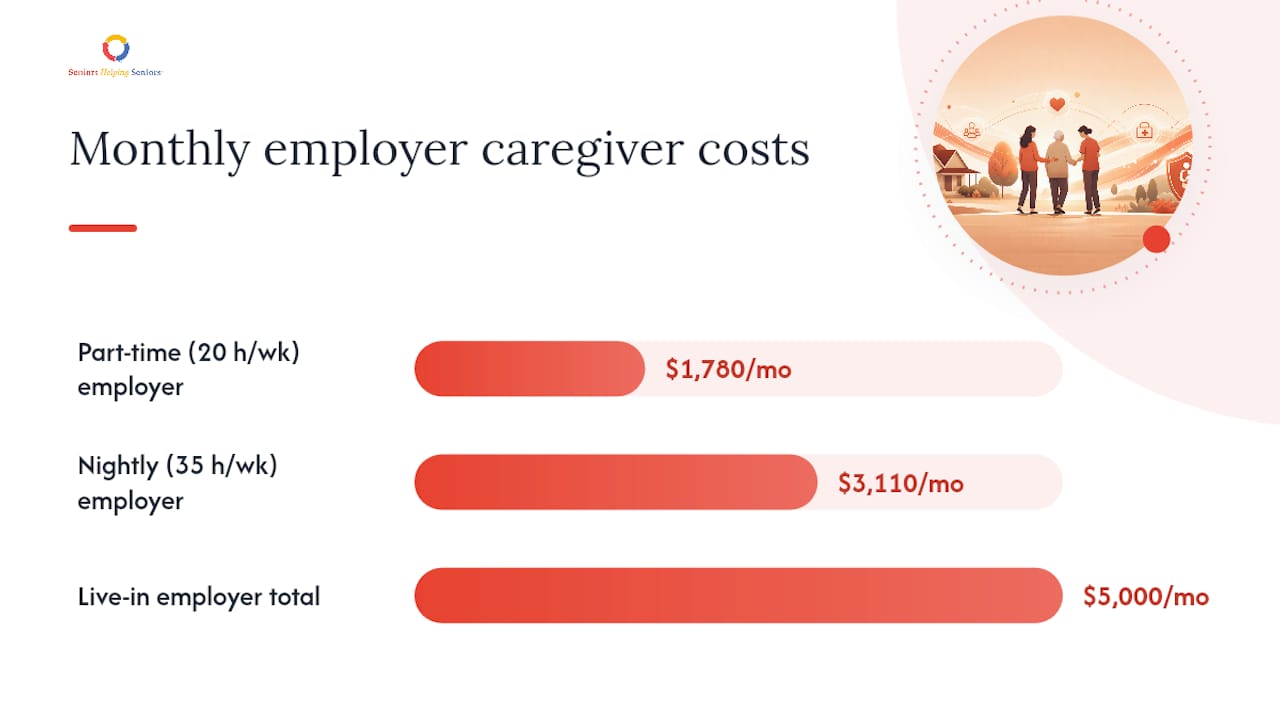
- Part-time (20 hours/week): At $20/hour, gross wages run roughly $1,600/month. Add approximately 10–12% for the employer's share of Social Security and Medicare taxes and federal unemployment taxes, and you are looking at $1,760–$1,800/month in total employer cost.
- Nightly care (35 hours/week): At $20/hour, gross wages are about $2,800/month. Employer taxes push the total to approximately $3,080–$3,140/month.
- Live-in arrangement: A consolidated wage-plus-room-and-board package commonly runs $4,400–$5,600/month depending on location, with the room and board component potentially reducing the taxable wage base under IRS rules (see Publication 926 for details on how to calculate this).
Key cost factors to watch:
- State minimum wage may exceed the federal floor; always pay the higher of the two
- Overtime (time-and-a-half) kicks in after 40 hours in a workweek under federal law
- Workers' compensation insurance premiums vary by state and add to total cost
- Live-in arrangements require careful tracking of compensable versus free time
How to pay a private caregiver legally: taxes, payroll, and your employer obligations
This is where most families get into trouble. The IRS does not care how you found the caregiver or what you call the arrangement. If you control both the work and how it is done, the worker is generally considered a household employee by the IRS and you may owe household employment taxes.
Misclassifying a caregiver as an independent contractor is one of the most common and costly mistakes families make. A contractor sets their own hours, works for multiple clients, and supplies their own tools. A caregiver who works in your home following your instructions, where you control both what work is done and how it is done, is generally treated by the IRS as a household employee.
Step-by-step compliance checklist:
- Determine worker status. Use the DOL direct-care checklist and IRS household employee guidance to confirm status before the first paycheck.
- Get an Employer Identification Number (EIN). Apply free at IRS.gov. You need this to file payroll taxes.
- Complete Form I-9. Verify employment eligibility for every new hire. Retain the form for the required period.
- Collect Form W-4. Have the employee complete a W-4 (Employee's Withholding Certificate) so you can withhold the correct federal income tax from each paycheck.
- Set up payroll. Calculate gross wages, withhold federal income tax and the employee's share of Social Security and Medicare (FICA), and pay the employer's matching FICA share.
- File Schedule H or alternate employer forms. IRS Topic 756 explains when to attach Schedule H to your Form 1040 versus using business employer forms (941, 940, 944). Publication 926 walks through the calculations with examples.
- Report the new hire to your state. Most states require new-hire reporting within 20 days of the first day of work. Check your state new-hire reporting website for the specific portal.
- Check state unemployment and workers' comp requirements. Rules vary; some states require household employers to carry workers' compensation insurance above a certain wage threshold.
Payroll options:
- Do it yourself using IRS worksheets and state payroll guides (feasible for one employee, time-consuming)
- Hire a household payroll service such as a dedicated household payroll firm (they handle withholding, filings, and year-end W-2s)
- Consult a CPA or employment attorney if the arrangement is complex, involves live-in care, or spans multiple states
Recordkeeping basics: Federal law requires that covered employers keep time and pay records. Log hours worked each day, the rate of pay, and total wages paid each period. Keep these records for at least three years.
Where to find private caregivers and what to expect from each source
Finding candidates is rarely the hard part. Vetting them is. Here are the most reliable sourcing channels, with honest notes on what each delivers.
Word of mouth and personal referrals remain the highest-trust source. A caregiver recommended by someone who has employed them gives you a real employment reference before you even post an ad. The pool is small, but the signal quality is high.
Area Agencies on Aging (AAAs) and the Eldercare Locator connect families to local referral networks, sometimes including lists of screened private caregivers or registries. The Eldercare Locator operates a national call center (1-800-677-1116) alongside its website to help families find local eldercare resources. This is the right first call for families who are new to the process.
Online caregiver marketplaces list large pools of candidates and often include self-reported background checks and reviews. The vetting burden still falls on you: platform-provided background checks vary in depth, and you should run your own independent check before hiring.
Community bulletin boards, faith communities, and local colleges (nursing or social work programs) can surface motivated candidates who are not yet on the major platforms. Expect a wider range of experience levels and plan for more thorough screening.
Writing an effective ad: State the hours, duties, required experience, and whether driving is required. Include the pay range. Vague ads attract vague applicants. Specify that a background check is required — this filters out candidates who know they will not pass.
Safe first-meeting practices: Conduct the first interview in a neutral location or with another family member present. Do not share the care recipient's home address until after references have been checked.
How to write a job description, interview well, and spot red flags
A clear job description does two things: it attracts the right candidates and gives you a legal document to reference if duties are ever disputed.
Job description template — include every one of these elements:
- Job title (e.g., "In-Home Personal Care Aide")
- Care recipient's general situation (age, mobility level, any relevant conditions — no private medical details in a public ad)
- Specific duties (ADLs, IADLs, medication reminders, transportation)
- Hours and schedule (days, start/end times, whether overnight or live-in)
- Required experience and certifications
- Driving requirement and whether a personal vehicle is needed
- Pay rate and frequency
- Background check requirement
- Reporting line (which family member is the primary contact)
Top interview questions:
- "Walk me through a typical day with your most recent care client."
- "Describe a time a client's condition changed suddenly. What did you do?"
- "How do you handle a client who refuses to take medication or cooperate with personal care?"
- "What would you do if you arrived for a shift and found the client had fallen?"
- "Are you comfortable signing a written employment contract that specifies your duties and pay?"
Red flags to watch for:
- Vague or inconsistent answers about previous employment dates or duties
- Reluctance to provide professional references (not just personal ones)
- Unwillingness to submit to a background check
- Arriving late to the interview without acknowledgment
- Dismissive or impatient tone when discussing the care recipient's needs
- Inability to describe specific caregiving tasks in concrete terms
AARP's guidance on private caregiving contracts reinforces that treating private hiring like a structured HR process — written job description, consistent interviews, references, background checks, written contract — is the minimum standard that prevents disputes.
What to put in a written caregiving contract and your ongoing employer responsibilities
A handshake deal is not a contract. AARP warns explicitly that lacking a written agreement leaves both parties exposed to disputes over pay, duties, and termination. A written contract protects the caregiver as much as it protects you.
Essential contract clauses:
- Start date and duration (open-ended or fixed term, with renewal terms)
- Duties and scope (reference the job description; attach it as an exhibit)
- Hours and schedule (specific days, start/end times, overtime policy)
- Pay rate and frequency (hourly rate, pay period, method of payment)
- Overtime rules (time-and-a-half after 40 hours per workweek, per federal law)
- Termination notice (typically two weeks from either party, with cause provisions)
- Confidentiality (care recipient's health information, household details)
- Liability and insurance (who carries what; note that homeowner's insurance may not cover a household employee injury)
- Sick time and vacation (accrual rate, carryover rules, notice required)
- House rules (phone use, visitors, parking, meals)
- Dispute resolution (mediation or arbitration clause before litigation)
Ongoing employer responsibilities:
- Log hours worked every day and retain records for at least three years.
- Run payroll on the agreed schedule; never pay late.
- File Schedule H with your annual Form 1040 (or use alternate employer forms per IRS Topic 756).
- Issue a W-2 to the employee by January 31 each year.
- Report new hires to your state agency within the required window.
- Renew Form I-9 documentation as required.
- Review and update the contract annually or when duties change significantly.
When to get professional help:
- An employment attorney: before the first hire, or if a dispute arises
- A CPA or household payroll service: before the first paycheck
- An insurance agent: to confirm whether your homeowner's policy covers a household employee injury, and whether you need a separate workers' compensation policy
Pro Tip: Keep a physical or digital folder for each caregiver: signed contract, I-9, W-4, timesheets, and any written performance notes. If a dispute ever reaches a state labor board, documentation is your only defense.
Special considerations when hiring a live-in caregiver
Live-in arrangements are the most complex form of private hire. The pay structure, hour tracking, and house rules all require more precision than hourly care.
How live-in compensation is typically structured:
| Component | Common approach | Legal caution |
|---|---|---|
| Cash wages | Hourly rate for all compensable hours | Must meet or exceed state minimum wage |
| Room and board | Deducted from wages at fair market value (IRS rules apply) | Cannot reduce net pay below minimum wage |
| On-call/sleep time | Partially compensable depending on interruptions | DOL guidance on breaks and compensable time applies |
| Days off | At least one full day off per week is standard | Document in the contract |
The trickiest part of live-in pay is sleep and on-call time. The DOL's guidance makes portions of on-call or waiting time compensable in some circumstances, so tracking actual engaged hours carefully is not optional. If the caregiver is woken up twice a night to assist with toileting, those interruptions are likely compensable time.
House rules checklist for live-in arrangements:
- Private space (bedroom with a door that locks; bathroom access)
- Meal arrangements (what the caregiver may eat, when, and where)
- Visitors (whether guests are permitted and under what conditions)
- Vehicle use (personal vehicle, household vehicle, or neither)
- Phone and internet use during off-hours
- Scheduled days off (at least one full day per week, documented)
- Quiet hours and household schedule expectations
- Pet responsibilities (if applicable)
Put every house rule in the written contract. Verbal agreements about living arrangements are the most common source of disputes in live-in care.
How to onboard, supervise, and manage a private caregiver while maintaining boundaries
Hiring the right person is step one. Onboarding them well is what determines whether the arrangement actually works.
Onboarding checklist for the first week:
- Walk through the care recipient's daily routine in detail, including preferences and sensitivities
- Review the medical plan: medications, dosing schedule, physician contacts, and what constitutes an emergency
- Provide a written list of emergency contacts (family, physician, pharmacy, poison control)
- Grant access to the home (keys, alarm codes) and document what was provided
- Introduce the caregiver to the care recipient with time for them to get acquainted before the first solo shift
- Shadow the first one or two shifts to observe the dynamic and answer questions in real time
- Set up the care log (paper or app-based) and show the caregiver how to complete it
Communication plan:
- Weekly check-in call or visit with the primary family contact
- Daily care log entries (activities completed, meals, mood, any incidents)
- Clear escalation path: what the caregiver should do if the care recipient falls, refuses care, or shows a change in condition
- Monthly review of the care plan to adjust duties as needs change
Maintaining healthy boundaries:
Boundary drift is common in private hire. Caregivers and care recipients form genuine relationships, which is a feature — but it can blur professional lines. Set expectations in writing from day one: the caregiver is not a financial advisor, a decision-maker for medical care, or a substitute family member. Revisit those boundaries at the monthly review.
Preventing caregiver burnout:
- Schedule realistic hours; avoid routinely asking for extra shifts without additional pay
- Build in paid time off from the start, even for part-time arrangements
- Arrange respite coverage so the caregiver has genuine days off
- Acknowledge good work specifically and regularly
Pro Tip: Create a one-page "Care Snapshot" document: the care recipient's name, key preferences, medical alerts, and emergency contacts. Post it inside a kitchen cabinet. Every substitute or backup caregiver can be up to speed in five minutes.
How the Seniors Helping Seniors® Tucson model works and when families should choose it
Not every family wants to become an employer. For families in Tucson who want experienced, compatible caregivers without the HR overhead, Seniors Helping Seniors® Tucson offers a managed alternative worth understanding.
The model is built around one idea: mature caregivers who are seniors themselves tend to connect more naturally with the people they care for. Tucsonshs matches caregivers and clients based on shared life experiences, interests, and temperament — not merely availability. That matching process is what distinguishes it from a standard staffing approach.
Services families care about most:
- Companionship and socialization matched by life experience and personality
- Personal care and daily living assistance (ADLs and IADLs)
- Memory, dementia, and Alzheimer's support from caregivers with relevant experience
- Respite care for family caregivers who need a break
- Meal preparation, light housekeeping, medication reminders, and transportation
- Veteran care with caregivers who understand that experience
Questions to ask Tucsonshs before signing a service agreement:
- How does the matching process work, and what happens if the first match is not a good fit?
- What is the backup coverage policy when a caregiver is unavailable?
- How are caregivers screened, trained, and supervised?
- What are the contract terms, pricing structure, and minimum hours?
The case for a matched model: When a caregiver and care recipient share a background — a profession, a hobby, a life stage — the relationship tends to be more consistent and more honest. Clients are more likely to accept help from someone they genuinely like, and caregivers are more likely to stay in a placement that feels meaningful. That consistency is what makes the difference in long-term care quality.
What families most often miss when hiring privately
The operational gap I see most often is not a legal one. Families research the IRS rules, draft a contract, and run a background check. Then the caregiver calls in sick on a Tuesday morning and there is no plan. No backup contact. No documented protocol. The care recipient is left waiting while the family scrambles.
The fix is simple and takes about 20 minutes: before the caregiver's first shift, identify two backup contacts — a neighbor, a family member, a local respite service — and write their names and numbers into the care plan. Document the absence policy in the contract: how much notice is required, what counts as an excused absence, and who the family calls first when coverage falls through. Pre-deciding these details is the single most practical thing a family can do to make private hire sustainable.
Tucsonshs offers a managed path when private hiring feels like too much
Private hiring gives you control, but it also hands you a part-time HR job. For families in Tucson who want experienced, vetted caregivers without managing payroll, tax filings, and backup coverage on their own, Tucsonshs is the concrete alternative.
Tucsonshs handles caregiver matching, screening, and scheduling so you are not starting from scratch with a job posting. The caregivers are mature adults, often seniors themselves, selected for compatibility with the client's personality and life experience. When a caregiver is unavailable, Tucsonshs arranges coverage. When care needs change, the service agreement adjusts. Families who start with private hire and find the administrative load unsustainable can transition to a managed service agreement without losing continuity of care.
To find out whether Tucsonshs is the right fit for your family's situation, Tucsonshs to discuss care needs, pricing, and caregiver matching. The conversation starts with your loved one's needs, not a sales script.
Official resources and helpful links to bookmark
Every family hiring privately should keep these federal and local resources within reach.
- IRS Household Employee Guidance: Confirms worker classification and outlines employer tax obligations.
- IRS Publication 926: The household employer's tax guide with filing examples and Schedule H instructions.
- IRS Topic 756: Explains FICA/FUTA obligations and when to use Schedule H versus alternate employer forms.
- Form W-4: Collect a completed copy from every new employee before the first paycheck.
- Form I-9 (USCIS): Required for employment eligibility verification; retain on file for the required period.
- DOL Direct-Care Checklist: Determines whether federal minimum wage and overtime apply to your arrangement.
- DOL Minimum Wage and Overtime Requirements: Federal standards effective since January 1, 2015, covering most direct-care workers.
- AARP Private Caregiving Contract Guide: Practical contract clause guidance and a checklist of what to include.
- Eldercare Locator: Connects families to local Area Agencies on Aging and community referral resources nationwide.
- State New-Hire Reporting Websites: Find your state's portal for new-hire reporting and unemployment insurance registration.
State minimum wage: Federal law sets the floor, but your state may require more. Check your state's Department of Labor website for the current minimum wage and any household employer-specific rules before setting pay rates.
This article is general information, not a substitute for advice from a qualified lawyer. Consult a qualified legal professional about your own circumstances before acting on anything here.
Sources
Screening is where private hire demands the most discipline. There is no agency HR department doing this for you.
Core screening steps:
- Hiring household employees | Internal Revenue Service
- Check Your Requirements | U.S. Department of Labor
- How to create a private caregiving contract | AARP
- What are the minimum wage, overtime pay, and recordkeeping requirements? | U.S. Department of Labor
- Eldercare Locator | Administration for Community Living
- Topic no. 756, Employment taxes for household employees | Internal Revenue Service
- Form I-9, Employment Eligibility Verification | USCIS
- Form W-4 (Employee's Withholding Certificate) | IRS
- Publication 926, Household Employer's Tax Guide | IRS
Sample reference questions that actually reveal something:
Background check types and legal notes:
Pro Tip: Ask every reference the same questions in the same order. Inconsistencies across references are more revealing than any single answer.