

Non-medical heart failure home care can support daily living, catch early warning signs, and ease caregiver burnout, but it works alongside medical treatment, not instead of it. A trained companion caregiver can handle medication reminders, low-sodium meal prep, transportation, and daily check-ins. Seniors Helping Seniors® Tucson builds this kind of support around mature, life-experienced caregivers matched to the client, with transitional care available right after a hospital stay.
TL;DR:
- Caregivers can assist with sodium-restricted meals, medication reminders, and daily activity help, but they cannot administer medications or perform clinical tasks.
- A thorough pre-hire assessment should evaluate mobility, cognition, medication routines, diet, weight tracking, and social isolation risks, prioritizing safety and adherence.
- Building a customized, detailed care plan with specific numerical targets and escalation protocols improves management outcomes, especially post-hospital discharge.
- Selecting caregivers with prior heart failure experience, verified references, CPR certification, and scenario-based questions ensures reliable and competent support.
- Consistent, trained caregivers who foster trust are essential for medication adherence, routine compliance, and emotional support, especially when paired based on shared experience.
Table of Contents
- What Heart Failure Home Care Covers (And What It Doesn't)
- Assessing What a Person With Heart Failure Actually Needs
- Building a Heart-Failure-Specific Care Plan
- Vetting Caregivers Who Actually Understand Heart Failure
- Coordinating Home Care With Doctors and Discharge Plans
- Warning Signs That Need Immediate Medical Attention
- What Heart Failure Home Care Costs and How to Compare Agencies
- Nutrition Beyond Just Cutting Salt
- The Emotional Weight Nobody Talks About Enough
- Why Medication Adherence Depends So Much on the Caregiver
- Telehealth and Remote Monitoring in Home-Based Care
- Why the Caregiver Match Matters More Than People Assume
- Start With an Assessment From Seniors Helping Seniors® Tucson
- Sources
What Heart Failure Home Care Covers (And What It Doesn't)
Companion and personal care fill a specific gap: the hours between doctor visits when someone still needs help managing daily life. Non-medical caregivers can prepare meals with sodium limits in mind, remind a client when it's time for pills, help with bathing and dressing, run errands, drive to appointments, and simply sit and talk. That last piece matters more than people expect. Isolation makes heart failure harder to manage, and a caregiver who shows up consistently becomes an early-warning system just by paying attention.
What non-medical caregivers cannot do is just as important. They don't administer medications, start IVs, change wound dressings, or make clinical judgment calls. That line stays fixed no matter how experienced the caregiver is.
Here's what falls squarely inside the non-medical scope:
- Low-sodium meal planning and cooking
- Medication reminders (not administration)
- Bathing, dressing, and grooming assistance
- Light housekeeping and laundry
- Transportation to appointments and errands
- Companionship and conversation
Daily weight checks sound like a medical task, but a caregiver simply recording the number and reporting sudden change is a non-medical job with real clinical value, since guideline reviews of home-based heart failure care list weight monitoring as a core self-care component.
Assessing What a Person With Heart Failure Actually Needs
Every family walks into this differently. Some need help mostly with meals and transportation. Others are managing a parent who forgets pills or has started avoiding the stairs. A short, structured conversation before hiring anyone saves weeks of trial and error.
Walk through these categories during a 20 to 30 minute conversation or home visit:
- Mobility and daily activities. Can they climb stairs, get in and out of the shower, walk to the mailbox without stopping to catch their breath?
- Cognition. Are they forgetting doses, missing appointments, or repeating questions about their diagnosis?
- Medication routine. How many prescriptions, how often, and has a dose ever been skipped or doubled by mistake?
- Diet and meal prep. Who shops and cooks now, and how closely does that match a low-sodium plan?
- Weight and symptom tracking. Is anyone currently weighing them daily and writing it down?
- Isolation and transportation. How many days a week do they see another person, and can they get to appointments on their own?
Rank the findings by risk, not by convenience. A missed medication or a fall risk outranks a messy kitchen every time.
Pro Tip: Ask to see the pill bottles during the home visit. A quick count against the prescription date tells you more about adherence than any conversation will.
Building a Heart-Failure-Specific Care Plan
A generic care plan for an older adult and a plan built for someone with heart failure look different on paper. The heart failure version needs numbers, triggers, and a chain of contacts, not just a task list.
A solid plan includes:
- A daily weight log with a clear target range and a defined "call the doctor" threshold
- A medication reminder schedule tied to meal times, written out by name and dose
- Low-sodium meal templates the caregiver can rotate through the week
- A light activity plan approved by the clinician, with rest breaks built in
- Emergency contacts and step-by-step escalation instructions posted somewhere visible
Vague goals fail. "Watch their diet" means nothing to a caregiver at 7 a.m. "Keep sodium under 2,000 mg daily and log the number" does.
| Goal | How to measure it |
|---|---|
| Track weight daily | Weight logged every morning, same scale, same time |
| Avoid missed critical medications | Zero missed doses of diuretics or heart medications per week |
| Attend follow-up care | First follow-up appointment scheduled within 7 days of discharge |
| Maintain low-sodium diet | Daily sodium estimate logged with meals |
Review the plan every few weeks, and sooner if a hospitalization or medication change happens. Note food preferences, cultural or religious dietary needs, and anything the client has said they won't tolerate. A plan nobody follows is worse than no plan at all.
Vetting Caregivers Who Actually Understand Heart Failure
Not every companion caregiver has worked with heart failure before, and that gap shows up fast in an emergency. Before hiring anyone, confirm background checks, verifiable references, current CPR and first-aid certification, and a documented infection-control policy.
Ask direct, scenario-based questions in the interview:
- "The client gains three pounds overnight. What do you do?"
- "They refuse their afternoon medication reminder. How do you handle it?"
- "Walk me through how you'd help someone with limited mobility get from a chair to the bathroom safely."
Answers that mention documenting and calling a family member or nurse line show better judgment than answers that mention improvising a fix.
Confirm the agency trains caregivers on recognizing heart failure red flags, logging weights accurately, safe transfer techniques, low-sodium cooking basics, and clear communication protocols with family. Ask what happens if the assigned caregiver is sick. A real backup staffing plan, not a vague promise, separates a dependable agency from one that leaves families scrambling.
Pro Tip: Ask the agency for a sample weight log or shift note template before you sign anything. If they can't produce one, that tells you how seriously they track this.
Coordinating Home Care With Doctors and Discharge Plans
The days right after a hospital discharge carry the highest risk, and research on post-discharge home health care links early, frontloaded follow-up with lower 30-day readmission rates. Non-medical caregivers can't run that follow-up, but they can make sure it actually happens.
Give the clinician a copy of the written care plan, the weight log, and a plain summary of anything the caregiver has noticed, swelling, breathlessness, appetite changes, before or during appointments.
Caregivers support the transition without stepping into clinical territory by:
- Scheduling and confirming the follow-up appointment within that critical first week
- Driving to and from appointments and sitting in on the visit if the family wants a second set of ears
- Keeping the daily weight and symptom log current and legible
- Flagging anything unusual to the family the same day, not at the next scheduled check-in
A short handoff conversation between hospital discharge staff, the primary clinician, and whoever will be doing daily care closes the biggest gap in the whole process. Reviewing an after-hospital care plan together before discharge day gives everyone the same script.
Warning Signs That Need Immediate Medical Attention
Non-medical caregivers are trained to notice trouble, not to treat it. Knowing where the line sits keeps everyone safer.
Escalate immediately if any of these appear:
- Weight gain of two to three pounds overnight or five pounds in a week
- Breathlessness that's worse than usual, especially at rest or lying flat
- Chest pain or pressure
- Fainting or a near-fainting spell
- Rapid swelling in the legs, ankles, or abdomen
Home care workers who spend the most hours with heart failure patients are often the first to notice these changes, though research on home care workers in heart failure points out that the evidence base on outcomes from that role is still thin and mixed. That's a reason to document carefully, not a reason to skip it.
Call the clinician for moderate changes; go to the emergency room for chest pain, fainting, or severe breathlessness. Either way, the caregiver should write down exactly what changed and when, then hand that note directly to the family and the clinical team.
What Heart Failure Home Care Costs and How to Compare Agencies
Non-medical home care rates commonly run $25 to $40 per hour depending on the market, the level of hands-on help needed, and how often visits happen. Overnight or live-in arrangements price differently than a few hours of daytime companionship.
Before signing with any agency, ask:
- What's included in the hourly rate, and what triggers an extra fee?
- Is there a minimum shift length or a cancellation penalty?
- How is travel time billed?
- Who covers a shift if the regular caregiver is out?
- Can I get a written estimate before committing?
Long-term-care insurance sometimes covers non-medical home care, though policies vary widely, so check the specific plan rather than assuming. Private pay remains the most common route. A written estimate, itemized rather than a flat quote, is the single best protection against billing surprises later.
Nutrition Beyond Just Cutting Salt
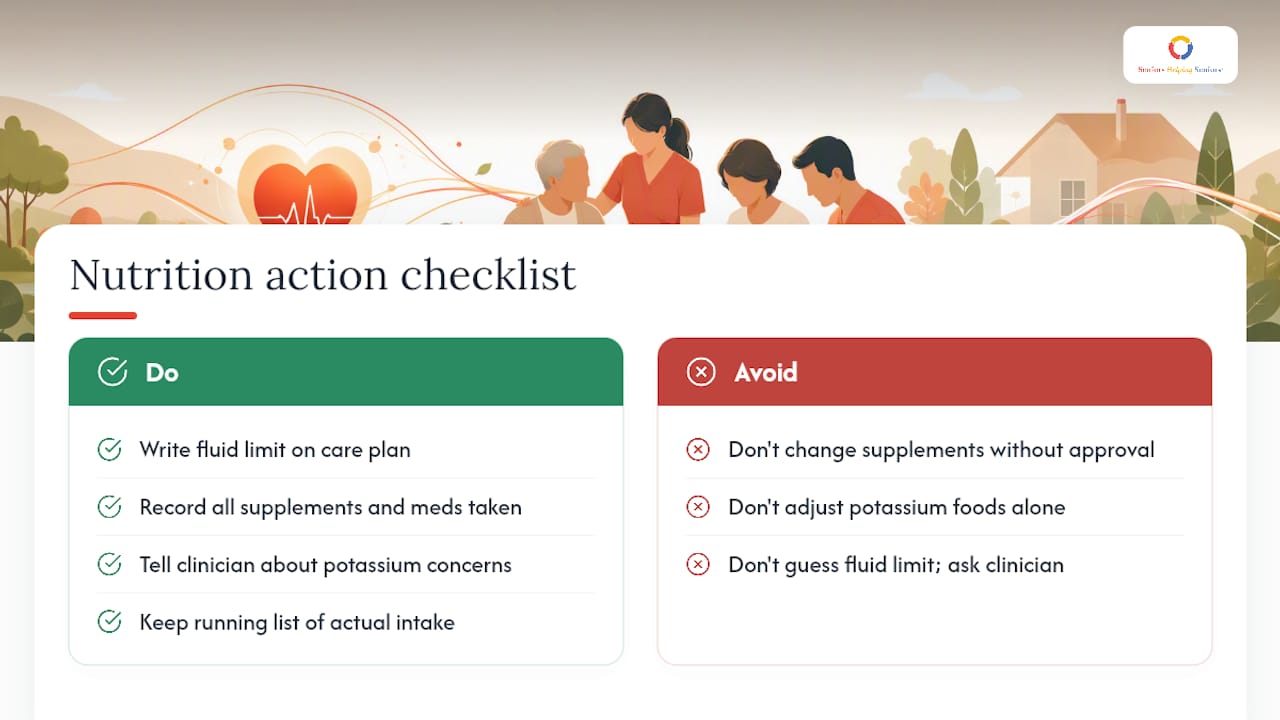
Low-sodium eating gets most of the attention, but heart failure nutrition has other moving parts that matter just as much day to day. Fluid restriction is one of them. Many people with heart failure are told to keep total daily fluid, including soup, coffee, and ice, under a specific limit set by their cardiologist, often somewhere between 1.5 and 2 liters, though the exact number depends entirely on the individual's condition and current medications. A caregiver who doesn't know that number is guessing, so it belongs on the written care plan next to the sodium target, not buried in a verbal instruction.
Potassium deserves attention too, especially for anyone on diuretics, since these medications can push potassium levels up or down depending on the type. That's a conversation for the clinician, not a decision a caregiver or family member should make alone by adjusting bananas or leafy greens in the diet.
Supplements are trickier ground. Fish oil, coenzyme Q10, and various herbal blends get marketed heavily to heart patients, but many interact with common heart failure medications like warfarin or diuretics. Nobody in a non-medical caregiving role should add or stop a supplement without the prescribing doctor signing off first. The safest approach is treating every bottle in the cabinet, vitamins included, as something worth mentioning at the next appointment. A caregiver who keeps a running list of what's actually being taken, not just what's prescribed, closes a gap that trips up a lot of families.
The Emotional Weight Nobody Talks About Enough
A heart failure diagnosis changes how someone thinks about their own body. Depression and anxiety show up often, sometimes because of the diagnosis itself, sometimes as a side effect of reduced activity and isolation that follows it. Someone who used to garden, drive to church, or babysit grandchildren suddenly can't, and that loss deserves acknowledgment, not just a symptom checklist.
This is where a matched companion caregiver earns their keep in a way a clinical visit never quite can. A fifteen-minute nurse call covers vitals and medications. A caregiver who sits at the kitchen table for three hours covers something else entirely, conversation, shared history, the simple fact of not being alone with a scary diagnosis. Caregivers who share a similar generation or life experience with the client tend to build that rapport faster, which is part of why matched-caregiver models exist in the first place.

Families should watch for withdrawal, loss of interest in things the person used to enjoy, or increased irritability, and mention it to the clinical team rather than assuming it's just "part of getting older." Mood changes in heart failure patients are common enough that they're worth naming out loud, both to the doctor and within the family, instead of quietly working around them.
Why Medication Adherence Depends So Much on the Caregiver
Heart failure medication regimens get complicated fast, sometimes five or six prescriptions with different timing, some taken with food, some avoided with certain other drugs. Missing doses of diuretics or blood pressure medications is one of the most common reasons people end up back in the hospital.
A non-medical caregiver can't administer these medications, but the reminder role they play is far from minor. A caregiver who sets a consistent routine, pills laid out at the same time each day, a simple checklist crossed off after each dose, catches the slow drift toward missed doses before it becomes a crisis. Home nursing interventions that reduced readmissions commonly built medication management directly into the visit structure, which says something about how much this single task matters.
Caregivers should also flag side effects they notice, dizziness, unusual fatigue, swelling that seems tied to a medication change, and report it rather than deciding on their own whether it's serious. Requesting help through a medication reminder service gives families a structured way to close this gap without asking a caregiver to step outside their non-medical role.
Telehealth and Remote Monitoring in Home-Based Care
Video visits and remote monitoring tools have become a normal part of heart failure management for a lot of families, and they pair naturally with non-medical caregiving. A caregiver present in the home during a telehealth call can describe what they've observed that week, weight trends, appetite, energy level, in a way that fills gaps the patient might gloss over or forget to mention.
Some households use connected scales that send weight readings directly to a clinician's office, or simple symptom-tracking apps that flag concerning trends before they become emergencies. None of this replaces in-person care, and a caregiver's job stays the same: record accurately, notice changes, and communicate them clearly. The technology just gives that information a faster path to the people who can act on it.
The limitation worth naming honestly: remote monitoring only works if someone reliably collects the data every day. That's often exactly where a consistent, trained caregiver matters more than the device itself.
Why the Caregiver Match Matters More Than People Assume
The heart failure home care conversation tends to focus on tasks, weights logged, meals prepared, pills reminded, and treats the person delivering that care as interchangeable. That's a mistake. Adherence to a daily routine, showing up for the weigh-in, eating the low-sodium meal without resentment, taking the walk instead of skipping it, depends heavily on whether the person asking has earned some trust.
Seniors Helping Seniors® Tucson built its model around that idea directly: caregivers are mature adults, often seniors themselves, matched to clients based on shared life experience rather than assigned at random. A caregiver who's navigated their own health scares or raised a family through hard years brings something a younger, unmatched caregiver often can't replicate quickly, which is credibility. That credibility is what gets a resistant client to actually eat the meal or take the walk. Combined with transitional support after a hospital stay, that kind of match turns a generic care plan into something a person will actually follow.
— Cameron
Start With an Assessment From Seniors Helping Seniors® Tucson
Most families comparing non-medical home care options end up choosing between an agency that assigns whoever's available that shift or one that actually matches caregivers to the person receiving care. Seniors Helping Seniors® Tucson takes the second approach, pairing clients with mature caregivers chosen for compatibility, not just availability, which matters enormously when the daily routine depends on trust.

Services relevant to heart failure home care include After-Hospital Home Care, Return Home Transitional Care for the critical weeks right after discharge, plus ongoing companion and personal care, meal prep, transportation, and medication reminders. The next step is simple: request a free in-home assessment, review the proposed caregiver match before committing, and ask for a written care plan spelling out weights, meals, and emergency steps in black and white. Start that conversation on the Tucson senior care services page or reach out directly through Tucsonshs.
Sources
- A systematic review on clinical guidelines of home health care in heart failure patients - PMC
- Home care workers in heart failure: a systematic review