
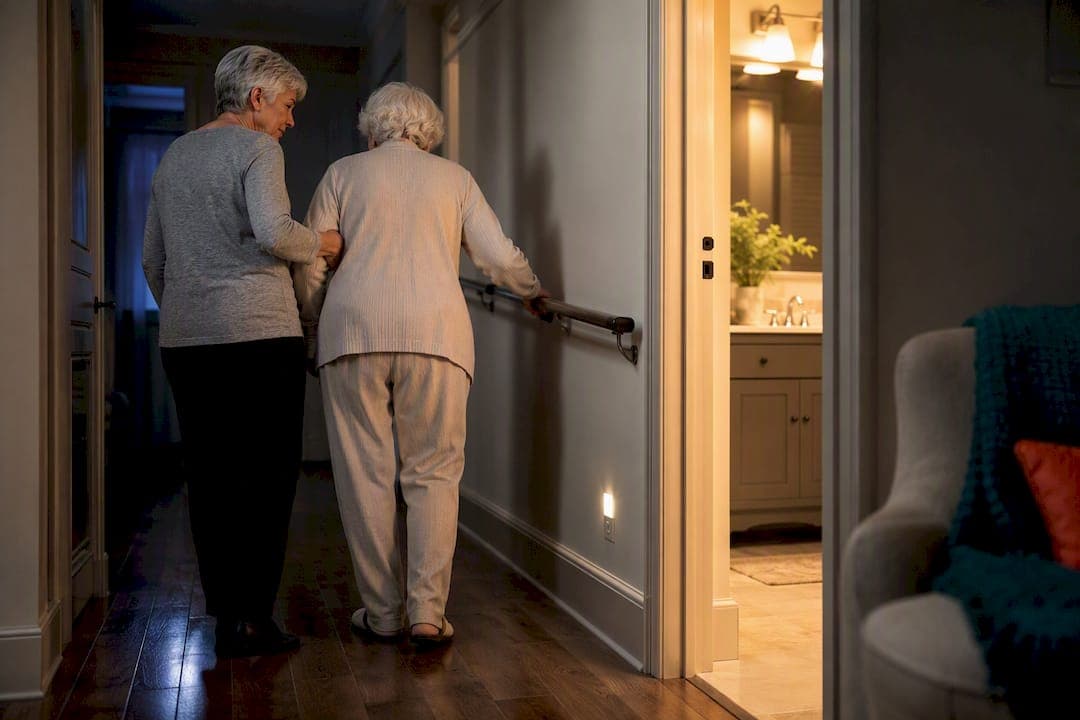
Start with a clinician screening, fix the bathroom and the night path first, and add balance and strength exercise this week. More than 1 in 4 adults over 65 falls each year, and the CDC's STEADI framework, along with Mayo Clinic guidance, points to the same three levers: medical review, home fixes, and movement. Everything below breaks those three into steps you can actually do.
TL;DR:
- Addressing five or more medications and reviewing sedatives, antidepressants, and blood pressure drugs can significantly reduce fall risk.
- Regular balance and strength exercises, such as sit-to-stand and heel raises, should be done weekly for several weeks to improve stability.
- Immediate home safety fixes focusing on the bathroom and hallway, like grab bars and lighting, are the most effective initial steps.
- Falls often result from poor vision, hearing loss, or improper footwear, so annual checkups and footwear upgrades are vital.
- In-home caregiving from peer-based providers offers ongoing support to catch mobility or medication issues before they cause falls.
Table of Contents
- Talk With Your Healthcare Team About Fall Risk Screening
- Exercise for Fall Prevention: What Actually Works
- The Room-by-Room Home Safety Checklist That Actually Gets Used
- Vision, Hearing, and Footwear: The Overlooked Fall Risks
- Canes, Walkers, and Medical Alert Systems: What Actually Helps
- What to Do Immediately After a Fall
- When Family Caregiving Needs Backup: Signs It's Time for In-Home Help
- Nutrition and Hydration: The Quiet Fall-Prevention Factor
- Bringing the Whole Family Into Fall Prevention
- The Fear After a Fall: Rebuilding Confidence
- Outside the Front Door: Sidewalks, Curbs, and Weather
- Why the Standard Fall Prevention Advice Falls Short
- How Seniors Helping Seniors Tucson Can Help
- Sources
Talk With Your Healthcare Team About Fall Risk Screening
A fall risk conversation with your doctor takes about ten minutes and can change everything that follows. The CDC's STEADI initiative runs on three steps: Screen for fall risk, Assess the specific factors involved, and Intervene with a targeted plan. Clinicians typically start by asking three questions: Have you fallen in the past year? Do you feel unsteady when standing or walking? Are you worried about falling?
A "yes" to any of those usually triggers a closer look. Bring your full medication list, including over-the-counter drugs and supplements. Taking five or more medications significantly raises fall risk, and certain classes, sedatives, antidepressants, antipsychotics, and some blood pressure drugs among them, carry outsized risk on their own.
Ask specifically about these assessments:
- The Timed Up and Go test (how fast you rise from a chair, walk 10 feet, and return)
- The 4-stage balance test (progressively harder standing positions)
- The 30-second chair stand (a rough measure of leg strength)
If any test flags a problem, ask for a referral to physical or occupational therapy.
Pro Tip: Photograph your medicine cabinet and bring the photo to your appointment. It's faster than writing out doses, and your doctor can spot risky combinations at a glance.
Exercise for Fall Prevention: What Actually Works
Balance and strength training is one of the best-documented ways to cut fall risk, but the exercise has to be the right kind, and done often enough to matter. Aim for regular sessions each week, and give it several weeks before expecting a real difference in steadiness.
Four exercises cover most of the ground:
- Sit-to-stand. Rise from a chair without using your hands, ten repetitions. Builds the leg strength you need to catch yourself.
- Single-leg stance. Hold onto a counter, lift one foot, balance for 10 seconds. Progress to letting go once it's easy.
- Heel raises. Rise onto your toes and lower slowly. Strengthens ankles, which matter more for stability than most people realize.
- Tandem walking. Walk heel-to-toe along a hallway, one hand near a wall. Mimics the narrow base you use on uneven ground.
Start near a sturdy chair or countertop for support, and stop if anything causes pain rather than muscle fatigue. Community centers and senior centers often run low-cost balance classes led by certified instructors, and a physical therapist can build a custom program for anyone with arthritis, a prior stroke, or significant mobility limits.
Pro Tip: Do sit-to-stands during commercial breaks or while the coffee brews. Ten reps, three times a day, adds up faster than one dedicated workout you keep postponing.
The Room-by-Room Home Safety Checklist That Actually Gets Used
Trying to fix an entire house at once is exactly why most fall-prevention checklists never get finished. Sort every fix into three buckets: Do Now (bathroom and the path to it), Do Soon (bedroom and main living areas), and Done Later (garage, basement, guest rooms). The ElderSafetyGuide approach to room-by-room triage exists for a reason: it turns a paralyzing list into a weekend project.
The bathroom deserves top priority because it combines water, hard surfaces, and low lighting, a genuinely bad mix. The path from bedroom to bathroom, walked at 2 a.m. half-asleep, is the second-highest-risk zone in most homes.
Bathroom (Do Now):
- Install grab bars near the toilet and inside the shower, anchored to wall studs, not just drywall anchors
- Add a non-slip mat inside the tub and a secured rug outside it
- Use a nightlight or motion-sensor light in the bathroom and hallway
Bedroom and living areas (Do Soon):
- Clear a walking path from bed to bathroom, free from cords, shoes, and furniture edges
- Secure or remove loose area rugs
- Add handrails on both sides of any interior stairs
Entryways and exterior (Done Later):
- Fix uneven thresholds between rooms
- Add motion-sensor lighting at exterior doors and along walkways
The Consumer Product Safety Commission has flagged poor lighting and unsecured rugs as two of the most common, and most fixable, hazards in older adults' homes. A caregiver or family member can knock out the bathroom and hallway fixes in about an hour with a drill, a stud finder, and a $20 hardware store run.
Vision, Hearing, and Footwear: The Overlooked Fall Risks
Poor vision or hearing changes how you sense your surroundings long before you'd think to blame it for a stumble. Schedule an eye exam every year, and specifically ask your eye doctor about depth perception and contrast sensitivity, not just reading vision. Untreated hearing loss also affects balance, since your inner ear handles both hearing and equilibrium, so an annual hearing check belongs on the same calendar as the eye exam.
Footwear matters more than most people assume:
- Choose shoes with a firm sole, low heel, and a back strap or laces, not slip-on styles
- Avoid walking in socks alone or in slippers with a smooth, slick sole
- Replace shoes once the tread wears smooth
For low-vision situations, use nightlights with a warm, non-glare tone and place them at floor level along hallways, not just at outlet height. High-contrast tape on stair edges also helps eyes that struggle with depth perception in dim light.
Canes, Walkers, and Medical Alert Systems: What Actually Helps
The wrong mobility aid can be as risky as none at all, so a cane or walker should come from a gait assessment, not a guess at the pharmacy. A cane suits mild balance issues on one side; a walker offers more support for broader instability, and a physical therapist can fit either one to the correct height.
In the bathroom, a shower chair, grab bars, and a raised toilet seat reduce the sit-to-stand strain that causes many falls. Have grab bars installed by someone who can locate wall studs. A towel bar was never built to bear body weight.
- Cane: mild, one-sided balance issues
- Walker: broader instability or reduced leg strength
- Shower chair plus grab bars: reduces bathroom transfer risk
- Raised toilet seat: eases the sit-to-stand motion
Medical alert devices with fall detection add a real safety net, but automatic detection isn't foolproof. Slow falls or falls onto soft surfaces can go undetected, so a wearable button still matters as backup.
Pro Tip: Test any fall-detection device by simulating a controlled, gentle sit onto a cushion. It shows you exactly what triggers an alert and what doesn't, before you actually need it.
What to Do Immediately After a Fall
The first sixty seconds after a fall determine whether a scare becomes an injury. Move through it in order.
- Stay still for a moment. Check for pain, dizziness, or an inability to move a limb before attempting to get up.
- Call for help if needed. Use a medical alert button, phone, or call out. Don't push through serious pain to avoid "bothering" anyone.
- Get up safely if uninjured. Roll to your side, get onto hands and knees, and use a sturdy chair or bed to pull yourself up slowly.
- Watch for red flags. Head trauma, confusion, severe pain, inability to bear weight, or visible deformity all mean calling emergency services, not waiting it out.
- Document and follow up. Write down what happened, what you were doing, and how you felt beforehand. Share it with your healthcare team and schedule a follow-up visit, including another medication review.
That last step gets skipped constantly, and it's often the one that prevents fall number two.
When Family Caregiving Needs Backup: Signs It's Time for In-Home Help
Caregivers catch things clinicians never see: the extra unsteadiness getting out of bed at 3 a.m., the new limp, the medication bottle that isn't emptying on schedule. That everyday observation is exactly what makes in-home caregiving such a practical fall-prevention tool, not just a comfort service.
Trained in-home caregivers directly reduce fall risk through:
- Medication reminders that catch missed or doubled doses
- Hands-on support for transfers, walking, and getting in and out of the shower
- Nightly safety checks, clearing pathways, checking nightlights, securing loose items
- Household hazard spotting caregivers see daily and family members stop noticing
- Accompaniment to medical appointments, so nothing gets lost between visits
Consider bringing in regular help if you're seeing a recent fall, a growing medication list, a noticeable change in mobility, or a family caregiver who's stretched thin and starting to miss things. Seniors Helping Seniors® Tucson pairs clients with active, mature caregivers, often seniors themselves, matched around shared life experience rather than a generic staffing assignment. That peer-to-peer model tends to preserve dignity in a way that pure task-based in-home care services sometimes miss, and it makes daily safety checks feel like a visit from a friend instead of a clinical intervention.
Nutrition and Hydration: The Quiet Fall-Prevention Factor
Weak bones break on impact; weak muscles cause the impact in the first place. Both come down partly to what's on the plate. Calcium and vitamin D support bone density, which determines whether a fall ends in a bruise or a fracture. Dairy, leafy greens, and fortified foods cover calcium; vitamin D comes from fortified milk, fatty fish, and sensible sun exposure, though many older adults need a supplement since skin absorbs less vitamin D with age.

Protein matters just as much and gets less attention. Muscle mass declines with age regardless of activity level, a process called sarcopenia, and inadequate protein accelerates it. Eggs, poultry, fish, beans, and Greek yogurt spread across meals work better than one large protein serving at dinner, since the body uses protein for muscle repair more efficiently in smaller, steady doses.
Dehydration deserves its own warning. Mild dehydration causes dizziness and light-headedness, and the sense of thirst weakens with age, so many older adults are dehydrated without feeling thirsty. That dizziness on standing, orthostatic hypotension, is a direct fall trigger, especially first thing in the morning or after sitting for a long stretch.
A practical fix: keep a water glass visible on the kitchen counter and by the bedside, and set a phone reminder if plain water gets forgotten. Limit alcohol, since it compounds both dehydration and balance impairment, a combination that shows up often in fall statistics tied to evening hours.
Bringing the Whole Family Into Fall Prevention
Fall prevention fails more often from inconsistency than from a bad plan. One family member reminds Mom to use her cane; another forgets, and rushes her to the mailbox without it. That patchwork is where most home fall-prevention efforts quietly break down.
Hold a short family meeting, in person or by phone, to walk through the home safety checklist together, so everyone knows which fixes are done and which are still pending. Share the medication list with every family member who spends time with the person, not just the primary caregiver, since a sedating new prescription matters to whoever's driving them to dinner that week too.
The CDC has found that caregiver involvement improves STEADI outcomes specifically because caregivers notice subtle changes, a slower gait, a new grip on the stair rail, before the person experiencing them mentions it, or even notices it themselves. Encourage every family member to speak up about small observations rather than waiting for something dramatic enough to seem worth mentioning.
Watch, in particular, for the combination of nighttime bathroom trips and a new sedating medication. That pairing shows up repeatedly in fall cases and is one of the easiest patterns for a caregiver to catch before it causes a problem.
The Fear After a Fall: Rebuilding Confidence
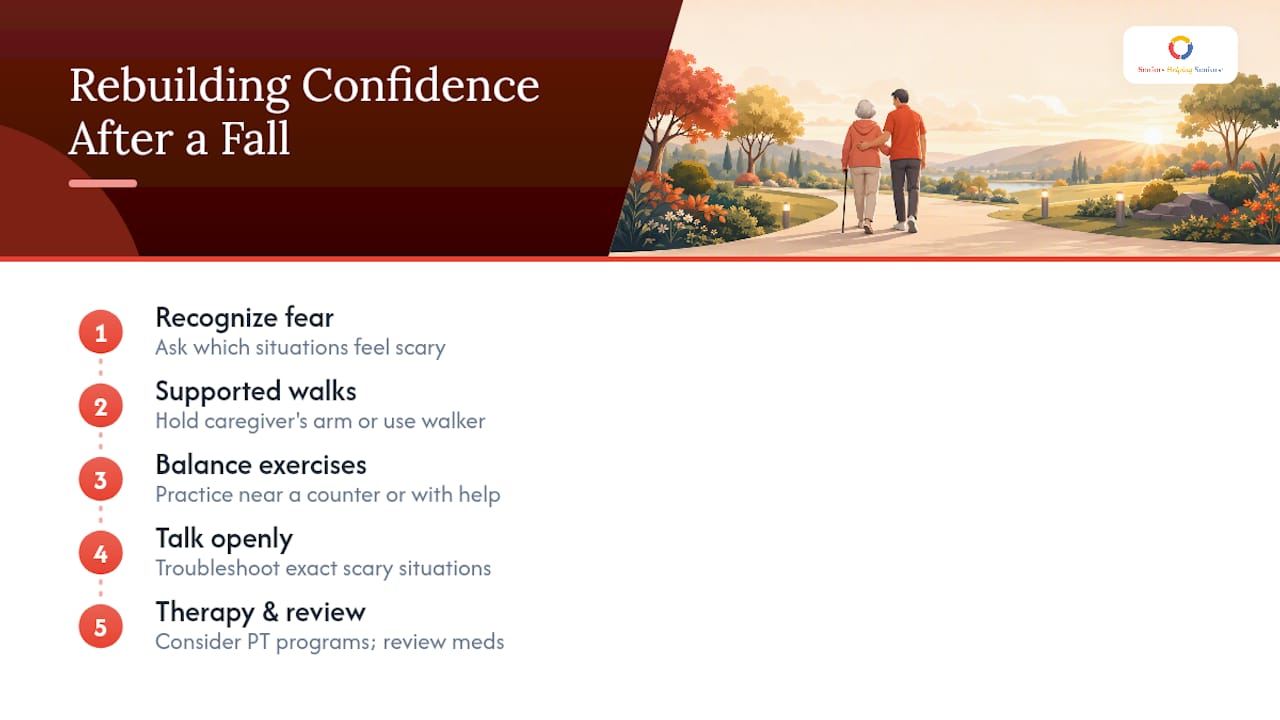
A fall's physical damage often heals faster than the fear that follows it. Fear of falling again causes many older adults to quietly cut back on walking, stop attending social gatherings, or avoid stairs altogether, and that withdrawal creates a genuinely bad cycle: less movement weakens the muscles and balance that prevent the next fall.
Confidence rebuilds through small, controlled wins rather than a single motivational push. Short, supported walks, holding a caregiver's arm or using a walker, matter more than pushing for distance early on. Balance exercises practiced in a safe space, near a counter or with someone present, let a person relearn trust in their own footing gradually.
Talking about the fear openly, rather than minimizing it, tends to help more than reassurance alone. Ask directly what specific situations feel scary, going down stairs, walking on grass, standing to shower, and troubleshoot that exact scenario rather than offering a general "you'll be fine."
Physical therapists sometimes use structured programs specifically aimed at fall-related fear, not just physical recovery, since the two rarely improve on the same timeline. If avoidance is limiting daily life weeks after a fall has physically healed, that's worth raising at the next medical appointment, alongside the usual review of medications and balance.
Outside the Front Door: Sidewalks, Curbs, and Weather
Fall risk doesn't stop at the threshold. Cracked sidewalks, uneven curbs, and wet leaves cause a large share of falls that happen just steps from home, often on routine trips to the mailbox or the car.
A few outdoor habits reduce that risk meaningfully. Walk on maintained sidewalks rather than grass shortcuts, since uneven turf hides dips and roots. Use handrails on any exterior steps, even ones climbed daily for years, since familiarity breeds carelessness more than caution. Choose well-lit routes for evening walks, and consider a small flashlight or headlamp for early morning trips before full daylight.
Weather changes the calculus fast. Rain, ice, and fresh snow turn a familiar path into a genuine hazard, and waiting an extra hour for a sidewalk to be salted or shoveled is rarely a real inconvenience compared to the alternative. Parking lots deserve particular caution, uneven pavement, curb stops, and shopping carts create a cluttered obstacle course that's easy to underestimate.
If mobility is already a concern, a cane with a wide, textured tip grips uneven outdoor surfaces better than a standard rubber tip. For anyone using a walker outdoors, confirm the wheels and brakes work smoothly on pavement, not just indoor flooring, since a walker that catches on a sidewalk crack can cause the exact fall it's meant to prevent.
Why the Standard Fall Prevention Advice Falls Short
Most fall-prevention checklists treat every fix as equally urgent, which is precisely why so many families stall after installing one grab bar. The evidence points somewhere more specific: screen and review medications first, fix the bathroom and night path immediately, and layer in exercise, because those three moves address the highest-frequency causes, drug side effects, bad lighting, and weak legs, in the order they actually cause harm.
The piece most guides underweight is the caregiver's role in spotting problems before they become falls. A clinician sees a patient for fifteen minutes twice a year. A caregiver, family or professional, sees the missed medication, the new limp, and the blocked nightlight in real time. That's not a nice addition to a fall-prevention plan; it's often the difference between catching a risk in week one and discovering it in an emergency room.
Peer caregiving models, where the person helping is also an older adult, add something clinical checklists can't measure: a client is more likely to accept help, admit to a near-miss, or ask for a grab bar installation, from someone who understands aging from the inside rather than from a training manual. That trust changes whether safety advice actually gets followed.
— Cameron
How Seniors Helping Seniors Tucson Can Help
A home safety checklist only works if someone's there consistently to catch the small changes between doctor visits, and that's the gap most fall-prevention plans leave open. Seniors Helping Seniors® Tucson fills it with active, mature caregivers, often seniors themselves, matched to clients based on shared life experience rather than a generic staffing roster.

That peer-to-peer approach covers the exact tasks that reduce fall risk day to day: medication reminders, mobility support, nightly safety checks, light housekeeping to keep pathways clear, and transportation to the medical appointments where screening actually happens. Because caregivers are matched for compatibility, clients tend to be more open about near-misses and mobility struggles they might otherwise minimize with a stranger.
If a recent fall, a growing medication list, or a stretched-thin family caregiver has you thinking about extra support, look at the full range of in-home senior care services available, or reach out through Seniors Helping Seniors Tucson to schedule a consultation and talk through what a safety-focused care plan could look like for your family.
Sources
- About STEADI | STEADI - Older Adult Fall Prevention | CDC
- Fall prevention: Simple tips to prevent falls — Mayo Clinic
- Polypharmacy and fall risk (PMC article)
- CPSC report on older Americans and hidden hazards
This article is general information, not a substitute for advice from a qualified doctor. Consult a qualified healthcare professional about your own circumstances before acting on anything here.