
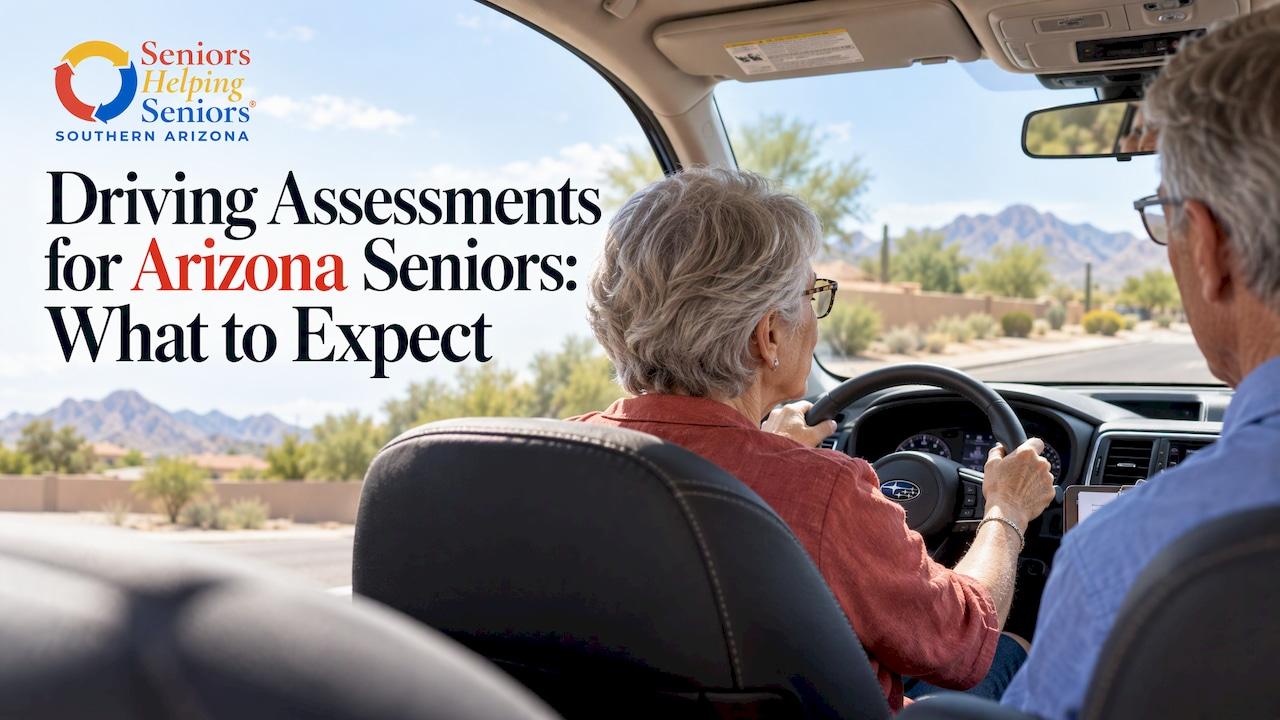
A driving assessment for a senior is a professional check of the vision, thinking and physical skills that safe driving depends on, often with a drive in a specially equipped car. In Arizona you can arrange one on your own, with your doctor's support, or after a family conversation, and it gives you facts instead of worries and arguments. Whatever the result, a plan for getting to the doctor, the grocery store and friends' homes makes the outcome much easier to live with.
This guide explains the two kinds of assessment, what happens during one, what it costs, how Arizona's own rules for older drivers work, and what to do with the results. It is written for older drivers and for the sons, daughters and spouses who are quietly wondering whether it is time to ask.
Key Takeaways
- There are two main types: a driving skills evaluation (an in-car check of how you drive) and a clinical driving assessment (an occupational therapist looks for medical causes behind any difficulty), according to AAA Exchange.
- AAA Exchange puts a skills evaluation at roughly $100 to $200 and a full clinical assessment at $200 to $400 or more, so it helps to know which one fits your situation before you call.
- In Arizona, drivers 60 and older renew every five years, in person, with proof of adequate vision, according to the IIHS.
- A good assessment can end in several ways: keep driving, add training or vehicle adaptations, drive less, or plan other transportation.
- Rides, errands and companionship at home can keep an older adult independent and connected whatever the result.
Table of Contents
- What a senior driving assessment is
- When it makes sense to consider one
- What the assessment looks at
- What happens during a full assessment
- Where to get an assessment in Arizona
- What an assessment costs
- Arizona's rules for older drivers
- Making sense of the results
- Planning rides before you need them
- Our perspective
- How we can help
- FAQ
- Sources
What a senior driving assessment is
Most people picture a road test like the one they took at sixteen. A senior driving assessment is closer to a wellness checkup for your driving.
AAA Exchange describes two categories of professional assessment. A driving skills evaluation is an in-car evaluation with a recommendation on further training. It is a snapshot of how you drive on that day and does not diagnose any medical problem. A clinical driving assessment is done by an occupational therapist who specializes in driving rehabilitation, and it looks for the underlying medical causes of any difficulty.
AAA Exchange compares regular assessment to an annual doctor visit: it helps you notice small problems early and can lead to a training plan built around your own habits.
An assessment is not a verdict handed down by the state. It is information for you and your family. In most cases it is a chance to keep driving with confidence, and when the news is harder, to plan the next chapter calmly rather than after an accident.
When it makes sense to consider one
AAA Exchange lists several reasons to think about an assessment: your driving skills seem to have slipped, a self-check has raised concerns, you have a diagnosed condition that can affect driving (poor vision, dementia, diabetes, seizures, sleep disorders or a stroke), near misses or small crashes are becoming more frequent, or friends and family have said they worry.
The last one is often the hardest. Families notice a dented bumper, a missed turn on a road the driver has known for decades, or new hesitation at a busy Tucson intersection like Oracle and Ina. Bringing it up feels like taking something away.
A neutral assessment can take the personal edge off the conversation. "Let's have a professional take a look" is easier to say, and easier to hear, than "I think you should stop." If your family is already further along in that conversation, our guides on warning signs that it may be time to stop driving and on what to do after repeated tickets can help you plan it with kindness.
What the assessment looks at
Driving depends on three things working together: vision, thinking and movement. The VA's fitness-to-drive guidance names vision, cognition and motor or sensory function as the three key areas, and says a problem in any one can raise the risk of a crash.
Vision
This covers how clearly you see, and also how well you handle glare, dim light and what happens at the edges of your sight. Arizona requires proof of adequate vision at every license renewal for older drivers.
Thinking and memory
The Merck Manual notes that cognitive checks cover memory, processing speed, attention, executive function (planning and judgment) and visual processing. Clinicians may use short paper-and-pencil tasks such as drawing a clock face or connecting numbers and letters in order, along with a screening test called the Montreal Cognitive Assessment, which must be given by a trained, certified clinician.
Strength, flexibility and reaction
The same source lists rapid-pace walking, neck and limb range of motion, strength and sensation. Turning your head to check a blind spot, or moving a foot quickly from gas to brake, are physical skills too.
These office tests are screening tools. They help a clinician decide whether a closer look is needed, and they are not a pass or fail for your license.
What happens during a full assessment
Per the Merck Manual's section on interventions with the older driver, an occupational therapy driving rehabilitation specialist performs clinical tests of vision, movement and thinking, then an on-road evaluation. The car is equipped so the specialist can safely take control, for example with a passenger-side brake.
Afterward you receive recommendations. These can include:
- A rehabilitation or training plan.
- Adaptive equipment with training, such as a spinner knob or hand controls.
- Feedback to you, your relatives and your physician about whether your abilities are adequate or restrictions make sense.
- Mobility counseling and advice on other ways to get around.
The VA guidance adds that specialists can recommend rehabilitation when abilities can be restored, and modifications such as hand controls or a left-foot accelerator when a physical limitation can be worked around.
A few practical tips make the day go better. Bring your glasses, your list of medications and the name of your doctor. Sleep well the night before. Ask a family member to come along so that there are two sets of ears for the recommendations. Many drivers are nervous, and that is normal.
Where to get an assessment in Arizona
You have a few routes.
Driving rehabilitation specialists. Occupational therapists with driving credentials do clinical assessments. One Arizona example is Jenny Nordine, OTL, CDRS, of Driving to Independence, LLC in Tempe, who offers clinical driver assessment and behind-the-wheel evaluation and training in a sedan or a van. Her listing gives the phone number 480-449-3331.
Authorized driving schools. DrivingMBA is authorized by the Arizona Department of Transportation to provide driver's license services, and its Senior Driver Assessment takes two to three hours. It includes a detailed report with a recommendation based on your performance, and a customized training program if particular skills need work.
Hospital rehabilitation departments. AAA Exchange says the American Occupational Therapy Association keeps a nationwide database of driving programs and specialists. If you find nothing there, it suggests contacting the occupational therapy department at a local rehabilitation hospital.
Your doctor. Your physician can tell you whether a clinical assessment is right, particularly if you have a condition such as Parkinson's disease, a past stroke or memory changes. Program details and availability change, so call ahead to confirm what is offered, who does it and where.
What an assessment costs
AAA Exchange gives these typical ranges:
| Type | Typical cost | Follow-up |
|---|---|---|
| Driving skills evaluation | About $100 to $200 | Supplemental training about $75 to $150 per hour |
| Full clinical driving assessment | $200 to $400 or more | Rehabilitation about $100 per hour |
These are national ranges, so Arizona providers will quote their own prices. Ask what the fee includes, whether a written report is part of it, and whether a family member may ride along.
For comparison, the license itself is inexpensive: the Arizona Department of Transportation lists a five-year driver license for age 50 and older at $10.
Arizona's rules for older drivers
Arizona does not require a driving assessment at a certain birthday. It does have specific rules about renewal and about medical concerns.
Renewal. According to the IIHS license renewal table, Arizona's general renewal cycle is 16 years, but people 60 and older renew every five years. Proof of adequate vision is required at every renewal, and mail or online renewal is not permitted for the older group. The Governors Highway Safety Association reports that 37 states and the District of Columbia have special provisions of some kind for mature drivers, so Arizona is in good company.
Medical review. The state's Medical Review Program looks at drivers after self-reports and after reports from law enforcement, medical professionals, MVD offices and concerned citizens. It may require a driving skills re-examination, written testing or a medical or psychological evaluation. The driver is responsible for reporting any medical condition that may affect safe driving.
After a report. When someone reports an unsafe driver, MVD may require an exam by a licensed medical professional, vision screening and tests that can include a knowledge test, a vehicle control test and a skills test. The outcome may be driving without restrictions, restrictions such as daylight-only driving, periodic re-evaluation, or suspension if safety cannot be ensured.
The state also cannot issue a license to someone who is required to take an examination and has not passed it, under Arizona Revised Statute 28-3153.
One useful way to see it: a voluntary assessment you arrange yourself puts you in charge, while a report to the state starts a process you do not control. Many families find the first path far less stressful. For questions about your own license or medical situation, your physician and the Arizona MVD are the right people to ask.

Making sense of the results
Results rarely come down to "drive" or "don't drive." The middle ground is large.
You keep driving as you are. That is reassuring and worth repeating every so often, just as you would with a yearly checkup.
You keep driving with changes. Training, a new vehicle setup, or limits such as avoiding night driving, rush hour or freeways. Daylight-only driving is one of the restrictions MVD itself can apply, so choosing it yourself first can feel very different from having it imposed.
You drive less. Many people keep short trips close to home and arrange other rides for longer or harder ones.
You retire from driving. This is the result families dread most, and the loss is real. Driving stands for freedom, and for many Tucsonans who have crossed the desert on their own for sixty years, the car keys carry a great deal of meaning.
Staying physically steady helps in every scenario. Strength, flexibility and good balance support the head turns and quick foot movements that driving requires. If your assessment points to physical limits, an article on balance training for seniors walks through safe exercises, and our own piece on chair exercises caregivers can use offers gentler options at home. Vision changes matter too, and our guide to making the home easier with macular degeneration is a good place to start.

Planning rides before you need them
The hardest part of any driving decision is rarely the driving. It is the fear of being stuck at home: missing the cardiologist, cancelling lunch with a friend, depending on a daughter who works across town.
The best time to build a transportation plan is before the assessment, while no one is under pressure. Write down the trips that matter most each week, such as medical visits, the pharmacy, groceries, church, the senior center and visits with friends. Then decide who or what covers each one. Our guides to senior transportation options in Tucson and rides to the doctor walk through the local choices. If you live in the Green Valley and Sahuarita area, this look at staying active there may help too.
Families also tell themselves the transition is only about logistics. It is also about company. A ride is more than a ride when the person beside you is someone you enjoy talking to.
Our perspective
We hear it often: "I'm not ready to give up my keys." We understand. At Seniors Helping Seniors Tucson, our caregivers are mature adults, many of them seniors themselves, so they know what that moment feels like.
We believe an assessment should be treated as good news, because it replaces guessing with information. Whatever the result, the goal stays the same: a life that is still your own, with the people and places you love.
That is why we match caregivers and clients by shared life experience and not just by schedule. A companion who has also had to think about the road ahead can make an errand run feel like an outing, and a hard day feel a bit lighter.
Our Transportation & Errands service is there for medical visits, shopping and social trips, and our Companion Care keeps days from becoming lonely when the car stays in the garage. There are no minimums and no long-term contracts, so families can start with a few hours and adjust as needs change.
Cameron
How we can help
If an assessment, a doctor's advice or a family decision means you are driving less, we can help you stay independent. Transportation & Errands covers rides and shopping trips, Companion Care brings friendly company into the home, and for someone living with memory loss our dementia care offers patient, familiar support. Our caregivers are vetted, insured and live in the communities we serve, from Tucson to Green Valley.

You can see everything we offer on our services page, or start at tucsonshs.com to talk with a local team about what would help most.
FAQ
Is a driving assessment required for seniors in Arizona?
No age triggers a required assessment. Arizona does require drivers 60 and older to renew every five years in person with proof of adequate vision, according to the IIHS. The Medical Review Program can require testing or a medical evaluation if a concern is reported.
How long does a senior driving assessment take?
It depends on the provider and the type. One Arizona driving school lists two to three hours for its senior assessment. A clinical assessment includes office tests plus an on-road evaluation, so ask for the full schedule when you book.
Does a driving assessment mean I will lose my license?
Not necessarily. Recommendations can include training, vehicle adaptations, restrictions or mobility counseling, as well as no changes. Your license status is handled by Arizona MVD, so your own doctor and MVD can answer questions about your situation.
How should a family bring up the idea?
Start with specific, caring observations and offer the assessment as a way to get a professional opinion. Offer to go along, and talk about how you will keep the person's routine going whatever the outcome.
What if driving is no longer an option?
Mobility counseling is one of the outcomes an assessment can produce. Local rides, errands and companionship can fill the gap, and our caregivers can help with trips to appointments and the store.
Sources
- Evaluate Your Driving Ability, AAA Exchange
- Functional Assessment of the Older Driver, Merck Manual Professional Edition
- Interventions With the Older Driver, Merck Manual Professional Edition
- Capacity and Fitness to Drive a Motor Vehicle, U.S. Department of Veterans Affairs
- Driving to Independence, LLC listing, ADED
- Senior Driver Assessments, DrivingMBA
- Fees (Driver License), Arizona Department of Transportation
- License renewal procedures, IIHS
- Mature & Elderly Drivers, Governors Highway Safety Association
- Medical Review, Arizona Department of Transportation
- Reporting an Unsafe Driver, Arizona Department of Transportation
- Arizona Revised Statute 28-3153