
Seat the senior in a sturdy chair, dress top to bottom, let them handle whatever they still can, and keep one adaptive aid within reach for the parts that hurt or take too long. That combination handles most dressing struggles without turning the morning into a fight or a fall risk.
Three things to do right now:
- Clear and seat. Move rugs and clutter, then bring in a chair with arms.
- Offer two choices, not ten. "The blue shirt or the gray one?" keeps decision-making simple and respects preference.
- Grab one tool. A sock aid or long-handled shoehorn solves the single most common complaint: not being able to bend that far anymore.
Pro Tip: Keep a "dressing basket" near the chair with a sock aid, shoehorn, and dressing stick already inside. Reaching for one tool beats hunting through drawers mid-routine.
For anything beyond these basics, an occupational therapist, an adaptive-clothing retailer, or a caregiver's guide on aging in place can fill in the specifics for a particular condition.
Key Takeaways
Dressing assistance works best when it follows a top-down, seated sequence, uses one or two targeted adaptive aids, and lets the senior make real choices at every step.
| Point | Details |
|---|---|
| Seat before you start | A sturdy chair with arms cuts fall risk and makes every step below easier. |
| Dress top to bottom | The top-down approach preserves modesty and keeps clothing on longer during the routine. |
| Match the aid to the limitation | Sock aids solve bending; shoehorns solve reaching; button hooks solve grip. |
| Stage outfits the night before | Full outfits on one hanger reduce decision fatigue and speed up mornings. |
| Escalate at red flags | Sudden decline, repeated falls, or new confusion mean it's time for an OT evaluation. |
| Consider in-home support | Tucsonshs matches mature caregivers with seniors for consistent, dignity-focused dressing help. |
Table of Contents
- Why Dressing Assistance for Seniors Becomes Necessary
- Step-by-Step Dressing Assistance Techniques for Caregivers
- Adaptive Clothing and Dressing Aids That Actually Help
- Building a Safer, More Dignified Dressing Routine
- When Dressing Assistance Needs a Professional
- A Dignity-First In-Home Care Option Worth Knowing
- What Most Dressing Advice Gets Backward
- A Path to Consistent, Dignity-Focused Dressing Support
- Sources
Why Dressing Assistance for Seniors Becomes Necessary
Dressing rarely becomes hard all at once. It usually slides, and the slide has a cause worth naming before you change anything.
Common culprits include:
- Arthritis or joint pain that makes buttons, zippers, and overhead reaches painful.
- Reduced shoulder range of motion, which turns pullover shirts into a wrestling match.
- Balance problems, making standing to dress genuinely dangerous.
- Cognitive changes, like forgetting the sequence of putting clothes on or confusing seasons.
- Fatigue or low stamina, where dressing itself becomes the day's biggest workout.
The cause should drive the fix. Limited shoulder movement points toward front-opening tops. Balance trouble means dressing seated, full stop, not just "when tired." Confusion calls for fewer choices and more narration. Watch for a week before overhauling the routine. Note which specific step causes hesitation, wincing, or frustration. That single observation tells you more than any generic checklist.
Step-by-Step Dressing Assistance Techniques for Caregivers
The top-down approach means dressing the upper body first while the senior remains seated and covered, then moving to pants, socks, and shoes last. It keeps clothing on longer, preserves modesty, and reduces the number of times skin is exposed.
Here's a sequence that works for most mornings:
- Bra or undershirt first. Have the senior lean forward slightly; guide arms through straps rather than pulling fabric over the head if shoulder movement is limited.
- Shirt or top next, threading the weaker or more painful arm in first, then the stronger arm, then over the head.
- Pants while still seated. Bunch each pant leg like a sock, guide feet in one at a time, then have the senior stand briefly (holding your arm or a stable surface) to pull pants to the waist before sitting back down to fasten.
- Socks, using a sock aid if bending past the knee is difficult or painful.
- Shoes last, with a long-handled shoehorn so nobody has to bend at all.
Talk through each step before you do it: "I'm going to slide your left arm in now." Confusion and resistance both drop when the senior knows what's coming next, a point echoed in caregiver training resources on communication during personal care.
On body mechanics: kneel or crouch at the senior's level rather than bending from the waist, keep your spine neutral, and stay close to their body instead of reaching across a gap. Guidance from AARP Foundation's caregiving workshops stresses this exact posture to prevent caregiver back injuries, which are common enough to end a caregiving arrangement entirely.
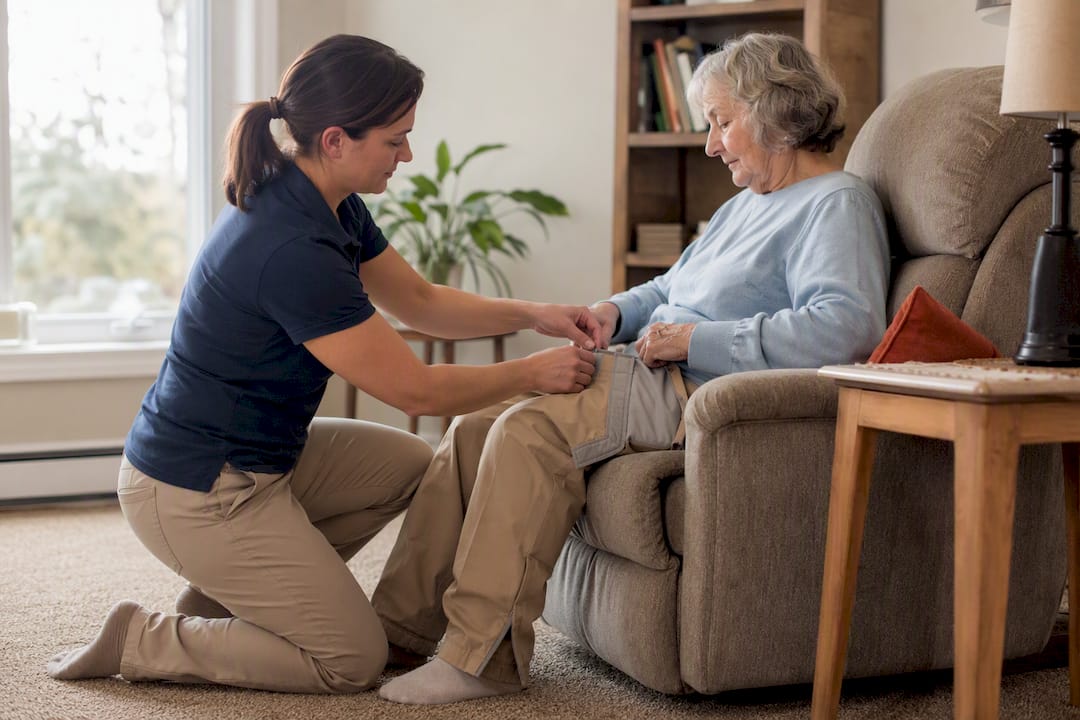
Pro Tip: If a senior resists a specific step, stop and ask what feels wrong before pushing through. Nine times out of ten it's pain, not stubbornness.
Adaptive Clothing and Dressing Aids That Actually Help
Adaptive clothing swaps traditional fasteners for ones that don't require fine motor control. Magnetic closures, Velcro tabs, side or back zippers, and open-back designs let someone with arthritis, limited range of motion, or cognitive challenges get dressed with far less pain and far less caregiver help.
Each dressing aid targets one specific limitation:
- Button hooks solve fine motor and grip problems, letting stiff fingers fasten buttons without pinching.
- Sock aids eliminate the need to bend past the knee.
- Long-handled shoehorns remove bending from the shoe step entirely.
- Dressing sticks help pull up pants, push sleeves into place, or retrieve dropped clothing without reaching to the floor.
- Zipper pulls turn a small metal tab into something a stiff or shaky hand can actually grip.
You don't need a medical supply catalog to start. Mainstream retailers now carry adaptive lines that look like ordinary clothes, and AARP's guide to adaptive clothing notes this shift has cut both the cost and the stigma of adaptive wear. Specialty suppliers still matter for harder cases (severe arthritis, post-surgical recovery, wheelchair-specific cuts), but for most seniors, start with a $10 to $15 sock aid or shoehorn from a pharmacy before investing in a full adaptive wardrobe.
Building a Safer, More Dignified Dressing Routine
A few environmental changes cut both fall risk and frustration, often faster than any technique change.
- Furniture: a chair with armrests, positioned near good lighting, gives something stable to push off of.
- Floor: clear rugs, cords, and clutter from the dressing area; add grab bars near the closet if standing is part of the routine.
- Wardrobe: stage the full outfit on one hanger the night before, and keep frequently worn items at waist height instead of high shelves or low drawers.
- Cognitive cues: label drawers or use color-coded bins for someone with memory changes, so "shirts" doesn't require a search.
- Timing: dress during the senior's best energy window, and if medication affects stiffness or alertness, plan dressing around that schedule rather than against it.
The National Institute on Aging's guidance on aging in place backs up nearly all of this: better lighting and non-slip flooring are consistently linked to fewer falls during routine daily activities like dressing.
When Dressing Assistance Needs a Professional
Some signs mean it's time to bring in help beyond what a family caregiver can reasonably provide.
Watch for sudden functional decline, repeated falls or near-falls during dressing, new pain that wasn't there last month, or confusion that's escalating week over week rather than staying stable. Any of those warrant a call to a doctor or a referral for an occupational therapy evaluation.
An occupational therapist does more than hand over a catalog of gadgets. They assess exactly how a person moves, recommend equipment matched to that specific limitation, and can re-sequence tasks in ways that restore real independence rather than just managing decline.
In-home care fills a different gap: consistency. A family caregiver juggling a job and a household can't always be present at the same time every morning. Professional in-home support means dressing happens on schedule, safely, every day, without a family member absorbing all of the physical and emotional load alone.
A Dignity-First In-Home Care Option Worth Knowing
Tucsonshs pairs seniors with mature, active caregivers, many of whom are seniors themselves, matched for shared life experience rather than assigned at random. That matters for something as personal as dressing assistance, where trust and comfort shape how well the routine actually goes.
- Caregivers are matched for compatibility, not just scheduling convenience.
- The model treats companionship and personal care as connected, not separate services.
- Dignity and personal preference stay central to how care is delivered day to day.
Readers looking for ongoing, in-home dressing support can review the Tucsonshs care model directly.
What Most Dressing Advice Gets Backward
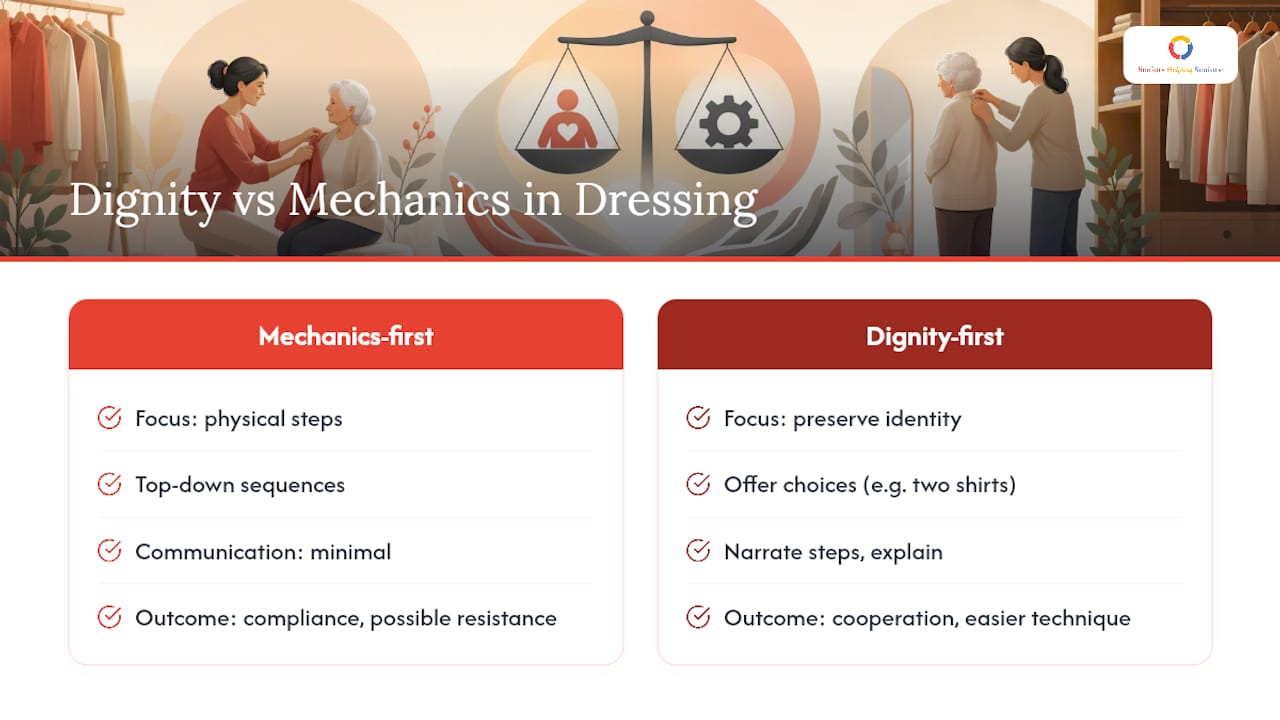
Most guidance on dressing assistance for seniors treats it purely as a mechanical problem, hinges, fasteners, sequences, and skips the part that actually determines whether the routine works: whether the senior still feels like themselves while doing it.
The mechanics matter. Top-down dressing, seated positioning, and the right aid all reduce injury and frustration. But the research on communication and cognitive support points somewhere the checklists usually miss. Offering two shirt choices instead of forcing a decision, narrating each step instead of just doing it, that's not a soft add-on. It's the difference between cooperation and a daily standoff.
If you take one thing from this guide, prioritize preserving choice before you optimize technique. A perfectly executed top-down sequence still fails if the person on the receiving end feels handled rather than helped. Get the dignity part right first, and the adaptive aids and body mechanics become a lot easier to apply, because you're no longer fighting resistance you created yourself.
A Path to Consistent, Dignity-Focused Dressing Support
Family caregivers hit a wall eventually, not from lack of effort, but from the sheer daily repetition of dressing assistance layered on top of everything else. Tucsonshs exists for exactly that wall. Instead of one person shouldering every morning routine alone, Tucsonshs matches seniors with mature caregivers who bring both the physical technique and the shared-generation understanding that makes dressing assistance feel like help from a peer rather than a task being performed on someone.

That matching approach is what separates it from generic scheduling services: caregivers are selected for compatibility, not just availability. If dressing assistance has become a daily strain in your household, reach out through the Tucsonshs website to discuss a care plan built around your loved one's actual routine and preferences.
Sources
- Babyboomer
- Adaptive clothing guide — AARP
- Aging in place: Growing older at home — NIA (National Institute on Aging)
- PubMed entry related to caregiving and activities of daily living