

Home health care is clinician-ordered skilled medical care delivered in the home, provided by nurses and therapists under a doctor's plan of care. Home care is nonmedical personal support and companionship, typically hired privately, with no physician order required. Medicare and most insurers pay for home health under strict eligibility rules, while home care is usually private pay and can continue indefinitely.
TL;DR:
- Medicare covers home health only for skilled medical treatments ordered by a physician, does not include long-term aide services once skilled care ends, and requires the patient to be homebound.
- Home care provides nonmedical support like bathing, meal prep, and companionship, billed hourly or by shift, and can continue indefinitely without physician orders or homebound status.
- Many agencies offer both services, but it's important to verify whether the provider is Medicare-certified for home health and to plan for coverage gaps after skilled visits end.
- The decision between home health and home care depends on whether the primary need is clinical treatment or assistance with daily activities and long-term support.
- Families often overlook the transition period after skilled care ends, risking gaps in support, especially for ongoing daily living assistance, which is outside Medicare's scope.
Table of Contents
- What's the Difference Between Home Care and Home Health Care?
- What Does Home Health Care Actually Cover?
- What Does Home Care (Nonmedical) Actually Cover?
- Where Home Care and Home Health Overlap
- Home Care vs. Home Health: The Practical Differences
- How Much Does Each One Cost, and Where Does Coverage Break Down?
- How Do You Decide Which One You Need?
- How Tucsonshs Fits Into Long-Term Nonmedical Care
- What Families Get Wrong About This Transition
- Get Nonmedical Support That Fits Your Family's Pace
- Sources
- FAQ
What's the Difference Between Home Care and Home Health Care?
That verdict holds up once you look at how each service actually operates day to day. Home health exists to treat a medical condition. Home care exists to help someone live safely and comfortably at home, medical treatment or not. One requires a doctor's signature. The other requires a phone call and a credit card, or a family member willing to arrange it.
The confusion is understandable, because agencies sometimes use "home care" as an umbrella term for both. But the distinction matters for coverage, cost, and how long the help will last. Get this wrong and you either pay out of pocket for something Medicare would have covered, or you expect Medicare to fund something it never will.
What Does Home Health Care Actually Cover?
Home health care means skilled, licensed medical treatment delivered in a patient's home under a physician's plan of care. It typically includes:
- Skilled nursing (wound care, injections, monitoring vital signs after a hospital stay)
- Physical, occupational, or speech therapy
- Medical social services
- Limited home health aide help, but only when it's tied to an active skilled-care need
A doctor or another allowed provider has to order it, certify the patient as homebound, and set the plan of care. Medicare covers these services when a physician orders them, the patient meets the homebound standard, and the care follows that physician-established plan.
Pro Tip: Ask the discharge planner directly whether the agency is Medicare-certified before you sign anything. An uncertified agency can still call itself "home health," but Medicare won't pay for its visits.
Home health runs on a visit model, not a shift model. A nurse might stop by three times a week for 30 to 45 minutes. It's built for recovery, not for permanent daily supervision.
What Does Home Care (Nonmedical) Actually Cover?
Home care covers the nonmedical tasks that let someone stay independent at home. That includes:
- Bathing, dressing, and grooming
- Meal preparation and light housekeeping
- Errands, transportation, and shopping
- Medication reminders (not administration)
- Companionship and supervision, especially for dementia
MedlinePlus describes nonmedical home care as personal care, housekeeping, and companionship typically arranged through an agency or hired privately, paid out-of-pocket or through sources outside Medicare. Caregiver qualifications vary widely between agencies and independent hires, so credentials and background checks are worth confirming before hiring. AARP recommends going through an agency specifically because it handles recruitment, background checks, and scheduling, which a family hiring privately has to do itself.
Billing runs by the hour or by shift, not by visit, and it can continue for months or years. That makes it the more common choice for long-term dementia supervision or ongoing assistance with daily living.
Where Home Care and Home Health Overlap
The two services aren't as separate as the definitions suggest. A few things stay true no matter which one a family chooses:
- Both are delivered in the person's own home, aimed at supporting safety and independence rather than a facility stay.
- Both can involve aides who help with daily tasks, and both typically coordinate with family caregivers already involved.
- Many agencies, including some Medicare-certified ones, run separate home health and private-duty divisions under one roof.
That last point is worth remembering when you're vetting providers. Asking whether an agency offers both products in-house can simplify a transition later.
Home Care vs. Home Health: The Practical Differences
Here's where the decision actually gets made. Six axes separate the two services, and each one has real consequences for cost and continuity.
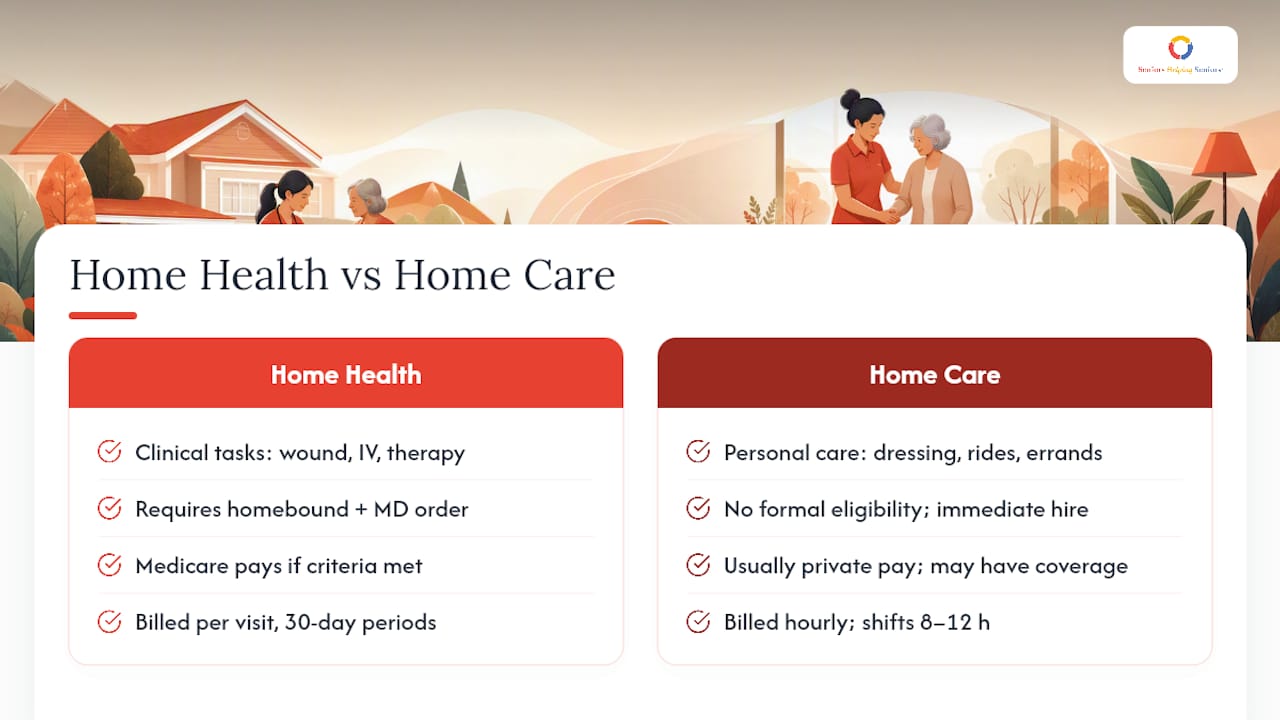
Services and tasks. If the need is a wound check, an IV, or retraining someone to walk after a stroke, that's a clinical task requiring home health. If the need is help getting dressed or a ride to the pharmacy, that's home care.
Eligibility and who orders it. Medicare home health requires homebound status, a physician's order, and a documented skilled need, per CMS's Benefit Policy Manual. Home care requires none of that. Anyone can hire a home care agency the same afternoon they decide they need one.
Payment. Medicare pays for home health when criteria are met. Home care is usually private pay, though long-term care insurance, Medicaid waivers, and VA benefits can cover it for eligible people.
Billing model. Home health bills in visits under 30-day payment periods. Home care bills in hourly shifts, which can run 8 to 12 hours for dementia supervision versus a 30 to 45 minute therapy visit.
Care team. Home health staff are licensed clinicians. Home care staff are trained aides and companions, a distinction the Bureau of Labor Statistics formalizes by tracking home health aides and personal care aides as separate occupations with different training paths.
Duration. Home health is intermittent and tied to recovery. Home care can run indefinitely, which is exactly why so many families need both, just not at the same time.
How Much Does Each One Cost, and Where Does Coverage Break Down?
Medicare covers home health when a physician orders it, the patient is homebound, and a skilled need exists. What it does not do is pay for aide services once the skilled need ends. Medicare.gov is explicit about this: home health aide help is only covered as part of covered skilled care, and coverage stops when that skilled care stops.
That's the trap most families hit. A parent finishes physical therapy after a hip replacement, the nurse visits end, and suddenly the family assumes the aide who'd been coming twice a week will keep coming. She won't, at least not on Medicare's dime.
Home care, by contrast, runs on private-pay rates set by the agency, with long-term care insurance, Medicaid waivers, or VA benefits as possible alternate sources depending on eligibility.
- Confirm the agency's Medicare certification status before signing anything
- Get a written cost estimate for both the covered period and any private-pay continuation
- Ask directly how the agency handles the transition once skilled care ends
Pro Tip: Have the private-pay conversation before discharge, not after. Agencies that offer both Medicare home health and private-duty care can often slide a client from one into the other without a gap.
How Do You Decide Which One You Need?
The rule of thumb: a clinical need points to home health, a daily-living need points to home care. Most families end up asking these questions in some order:
- Does a doctor need to order this, or does the person just need help with daily tasks?
- Is there a payer pathway (Medicare, Medicaid waiver, VA, long-term care insurance) covering it, or is this private pay?
- Is this a short recovery window or an ongoing, possibly permanent, need?
Answer those three and the right service usually becomes obvious. For situations that involve both a medical condition and a long-term supervision need, an eldercare manager or discharge planner can help coordinate the handoff so care doesn't lapse.
Pro Tip: If discharge is happening this week, ask the hospital's social worker for a same-day referral list. Don't wait until the day of discharge to start calling agencies.
How Tucsonshs Fits Into Long-Term Nonmedical Care
Seniors Helping Seniors Tucson focuses on the nonmedical side of this equation: companionship, personal care, and memory support, delivered by mature caregivers matched with clients for shared life experience. That model fits the long-term, hourly-shift side of care, not the clinician-ordered visits that Medicare home health covers. If a physician has ordered skilled nursing or therapy, that's home health territory. If the need is daily support, supervision, or company, that's where a nonmedical home care model like this one applies.
What Families Get Wrong About This Transition
Families plan for the hospital stay and the therapy visits. They rarely plan for what happens the week after skilled care ends, when the nurse stops coming and nobody arranged what comes next. That gap is where most bad outcomes start, not in the medical care itself.
— Cameron
Get Nonmedical Support That Fits Your Family's Pace
If what your family actually needs is companionship, help with daily routines, or steady supervision for someone with memory loss, that falls squarely outside what Medicare home health will ever cover. The model is built around exactly that gap: caregivers who are themselves mature adults, matched with clients for compatibility rather than assigned at random.

Services include companionship, personal care and daily living assistance, memory and dementia support, respite care, and transportation, billed by the hour so families can scale support up or down as needs change. If skilled care is winding down and you're wondering who picks up the daily routine afterward, request an in-home care assessment to talk through scheduling and next steps for your area.
This article is general information, not a substitute for advice from a qualified doctor. Consult a qualified healthcare professional about your own circumstances before acting on anything here.
Sources
- Home health: getting started (Medicare)
- CMS Medicare Benefit Policy Manual excerpts (consolidated billing and homebound rules)
- Home care services (MedlinePlus)
- Home health and personal care aides (BLS)
FAQ
What Does Home Health Care Not Include?
Home health care does not include long-term personal care, housekeeping, or companionship once the skilled medical need ends. Medicare specifically stops paying for aide services when covered skilled care stops.
Is a Home Health Aide the Same as a Home Care Aide?
No. The Bureau of Labor Statistics classifies them as separate occupations: home health aides work under a clinical plan of care, while personal care or home care aides focus on nonmedical daily living support.
What Does a Home Health Care Provider Actually Do?
A home health provider, usually a nurse or therapist, delivers skilled treatment ordered by a physician, such as wound care, medication management, or rehabilitation therapy, following a documented plan of care.
What Are the Disadvantages of Home Health Care?
Home health is intermittent, tied strictly to a skilled medical need, and ends once that need resolves, which leaves a coverage gap for families who still need daily support. It also requires a physician order and homebound status, so it's not available on demand the way private home care is.
Does Medicaid or the VA Cover Home Care Costs?
Medicaid waivers and VA benefits can cover nonmedical home care for eligible individuals, though eligibility and coverage amounts vary by state and by veteran status.