
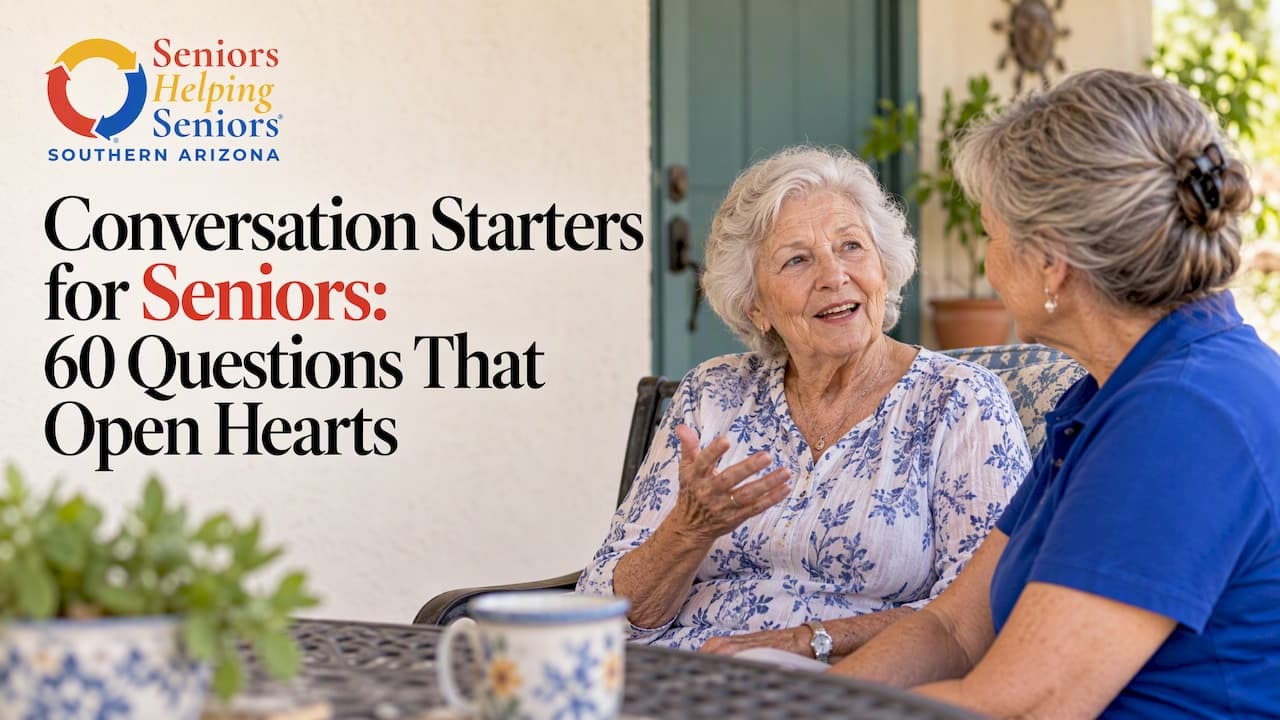
The best conversation starters for seniors are open, gentle questions about things a person loves: a favorite meal, a first job, a song that still makes them smile. Ask one question at a time, then listen longer than feels natural. Below you will find 60 questions sorted by mood and purpose, along with ways to adapt them for hearing loss, memory changes and the days someone simply does not feel like talking.
A good conversation does more than pass the time. It tells a person that their life still matters to the people around them. If you want to go deeper on the idea, this look at healing through conversation shows how being heard can change how a person feels.
Key Takeaways
- Open-ended questions about favorite things, work and family work better than quiz-style questions about facts.
- Ask one question at a time, allow plenty of silence, and share a little about yourself so it feels like a visit, not an interview.
- With memory loss, aim for feelings and connection, not correct answers, and avoid "Do you remember when..."
- If a question stirs up sadness, ask whether your loved one wants to keep going, and be ready to simply sit together.
- Regular, friendly company at home is one of the best ways to keep these conversations going between family visits.
Table of Contents
- Start With How You Ask, Not Just What You Ask
- Easy Icebreakers for a First Visit or an Awkward Day
- Reminiscence Questions About Childhood and Family
- Questions About Work, Love and Life Lessons
- Fun and Playful Questions That Make People Laugh
- Adapting Conversations for Memory Loss
- When Hearing Loss Gets in the Way
- What to Do When Someone Does Not Want to Talk
- Our Perspective: Why Peers Make Conversation Easier
- Making Conversation a Daily Habit
- When Family Cannot Be There Every Day
- Frequently Asked Questions
- Sources
Start With How You Ask, Not Just What You Ask
Before the questions, a few habits matter more than any list. Most awkward silences come from tone, not topic.
The National Institute on Aging advises using formal language by default, such as Mr. or Ms., and avoiding pet names like "dear." It also suggests simply asking how a person prefers to be addressed. The same guidance reminds us that hearing, vision or memory changes do not diminish an adult's maturity, so we speak to older people as the fellow adults they are.
A few other habits help every time:
- Sit at eye level, in a quiet spot, with the television off.
- Ask one question, then wait. Count to ten in your head if you need to.
- Follow the thread. If Dad mentions the Tucson heat in 1962, ask about that, not your next question on the list.
- Share something of your own. The AARP Foundation suggests pairing a question with something about yourself and using active listening, which turns questions into an exchange.
That last point is something our caregivers know well. Because many of them are seniors too, they tend to swap stories naturally rather than interview.
Easy Icebreakers for a First Visit or an Awkward Day
When you are not sure where to begin, start light. These questions carry no pressure and are almost impossible to get wrong.
- What was the best thing you ate this week?
- What is your favorite meal of all time?
- Have you read any good books lately?
- What do you like to do with your spare time?
- Is there a song you could listen to over and over?
- What is your favorite spot to sit in this house, and why?
- What would you watch today if you could pick any movie?
- What did you enjoy most about the morning?
- Is there a plant or flower you love having around?
- What is your favorite time of day?
- Which season do you like best here in southern Arizona?
- Do you have a favorite spot in Tucson, maybe a place you like to see the mountains from?
The first few of these echo the sort of easy starters the AARP Foundation recommends: books, hobbies and favorite foods. Food is an especially good doorway. Nearly everyone has a story about a dish, a kitchen or the person who cooked it.
Reminiscence Questions About Childhood and Family
Reminiscing is more than nostalgia. Backus Hospital describes reminiscence, sometimes called life review, as a way for older adults to put past experiences into perspective alongside their present life and what lies ahead. That is a meaningful thing to offer someone.
Try these childhood and family questions:
- What was your childhood home like?
- What did your street or neighborhood look like?
- Who was your best friend growing up, and what did you two get up to?
- What games did you play as a child?
- What did your mother or father do for work?
- What was dinner like in your house?
- Did you have a nickname growing up?
- Which relative could always make you laugh?
- What chores did you have, and which did you dislike most?
- What was school like for you?
- Tell me what it was like when you went to high school.
- What was a holiday like when you were little?
- Who taught you the most when you were growing up?
- What family recipe do you wish everyone still made?
- How did your family spend summer evenings?
The open prompt "Tell me what it was like when you went to high school" comes straight from Backus Hospital's advice for encouraging a story. Notice that it is an invitation, not a test.
Questions About Work, Love and Life Lessons
Many seniors spent decades building a career or raising a family, and nobody asks about it anymore. These questions restore that identity.
- What was your very first job?
- What jobs have you had, and which was your favorite?
- What did you want to be when you were young?
- What are you proudest of from your working years?
- Who was the best boss or coworker you ever had?
- How did you meet your spouse or your closest friend?
- What was your wedding day like?
- What was the happiest day of your life?
- What was it like the day your first child was born?
- What is the best advice anyone ever gave you?
- What would you tell your younger self?
- What is the secret to a long friendship?
- What do you hope younger people understand about your generation?
- What is something you learned the hard way?
- What are you most grateful for today?
For veterans, ask about service with respect and let them lead. Questions such as "What was your hometown like before you left?" or "Who did you serve alongside?" invite a story without pushing toward hard memories.
Fun and Playful Questions That Make People Laugh
Laughter is a perfectly good goal. The Alzheimer's Association notes that humor can lighten the mood and ease communication for people living with Alzheimer's, as long as it is used respectfully. That means laughing with someone, never at them.
- What was the funniest thing that ever happened to you?
- If you could have dinner with anyone, living or gone, who would it be?
- What was your favorite dance or song to dance to?
- What was the most mischievous thing you did as a kid?
- What was your first car, and what do you remember about it?
- What is the best prank you ever played or saw?
- If you could take a trip tomorrow, where would you go?
- What fashion did you love back then that you secretly miss?
- What would your perfect Sunday look like?
- Which pet had the most personality?
If you like to turn talk into play, our guide to memory games caregivers can run at home has short activities that pair well with these questions.
Adapting Conversations for Memory Loss
When someone lives with dementia, the rules shift. The goal is no longer accurate recall. The U.S. Department of Veterans Affairs explains that in reminiscence work the aim is not to test memory or elicit factually correct information, but to help a person connect emotionally to their past and present.
Here is what that looks like in practice:
- Skip the quiz. The Alzheimer Society of B.C. suggests avoiding the phrase "Do you remember when" because it can cause frustration, and asking open-ended questions about their life instead.
- Use photos and objects. The VA guide recommends asking what a person sees, hears, smells or feels in a picture. "What does this picture make you think about?" works well.
- One question at a time. The Veterans Health Administration notes that people with dementia may process information more slowly, and recommends one question or request at a time.
- Offer simple choices. The National Institute on Aging suggests allowing time to respond, trying yes-or-no questions or rephrasing, and never talking about the person as if they are not there.
The Alzheimer's Association adds that in the early stage, people should be included in conversations about their own care, and in the middle stage, quiet one-on-one settings with little distraction help most. If you are unsure where your loved one is on that path, our family guide to Alzheimer's stages can help.
Some feelings-based questions that suit this stage:
- What does this song bring to mind?
- This looks like a happy day. What do you think was going on?
- Does this smell remind you of anything?
- Would you like tea or lemonade?
- You always had such a lovely garden. Which flowers do you like best?
For more ideas, see our low-effort reminiscence therapy activities for family caregivers.
When Hearing Loss Gets in the Way
Hearing loss can quietly turn a talkative person into a withdrawn one. They are not bored. They are tired of guessing.
Face the person, speak a little slower rather than louder, and reduce background noise. Rephrase instead of repeating the same words, and keep questions short. Written cue cards or a photo can carry a topic when words get lost. Our article on communication moves for hearing loss goes through more of these in detail, because isolation grows fast when conversation becomes hard work.

What to Do When Someone Does Not Want to Talk
Some days a question lands wrong. Maybe your mother is tired, or maybe a memory has a sorrow tucked inside it.
Backus Hospital advises that if an older adult looks anxious or upset during a reminiscence conversation, you ask whether they want to keep talking or stop for now. It may be time to stop. Sit with them briefly to show you care. You do not need to fix the feeling.
If your loved one is aware of their memory changes and wants to talk about them, the National Institute on Aging says to be open, empathetic and nonjudgmental. Listen first. Reassure second.
If the reluctance is about accepting help at home, not about chatting, our guide to talking with aging parents offers scripts that start from respect.
Our Perspective: Why Peers Make Conversation Easier
We have heard it many times from families in Tucson: "Mom talks to the mail carrier more than to me." It is not a failure of love. Adult children often carry worry into the room, and worry makes questions sound like checklists.
Our caregivers are mature adults, many of them seniors themselves, and we match them with clients by shared life experience. A former teacher may be paired with a client who loves books. Someone who raised a family in the desert may sit with a neighbor who did the same. The questions in this article feel less like questions when the person asking has lived some of the same years.

We also believe conversation is part of care, not an extra. A person who is heard tends to feel less alone, and that is as important as help with bathing, meals or medication reminders. Our approach is built on dignity and personal attention, so we begin by learning what a person loves, how they like to be addressed and what they would rather not revisit.
If you take one thing from this list, let it be this: ask, then wait. The answer is rarely in the first sentence.
— Cameron
Making Conversation a Daily Habit
A single deep talk is lovely, but small, steady moments do more. Try a "question of the day" at breakfast or over afternoon tea. Keep a notebook where you jot down stories you hear, then read them back at the next visit. Many families later turn these notes into a short life story for grandchildren.
The Alzheimer Society of Canada offers an All About Me template that prompts caregivers to record preferences such as foods, music, favorite topics and daily routines. Even without dementia, a page like that helps any visitor start well.
The habit also builds emotional steadiness. Our piece on daily habits that give seniors emotional support covers more routines you can add.
When Family Cannot Be There Every Day
Distance, work and caregiver fatigue are real. Not every conversation can happen with a son or daughter, and that is okay. Companionship at home can fill the gaps, so that your parent has someone to chat with about the morning news, the garden or the 1950s.
At Seniors Helping Seniors® Tucson, our caregivers offer companionship, personal care, meal preparation, light housekeeping, transportation and errands, medication reminders, respite and overnight care, and support for dementia, Alzheimer's and Parkinson's. We offer flexible scheduling with no minimums or long-term contracts, and our staff are vetted, insured and live in the communities we serve.

You can see everything we offer on our services page. If your loved one is coming home after a hospital stay, our Return Home Transitional Care is designed for that first stretch. Families in Green Valley can read about in-home senior care in Green Valley.
Frequently Asked Questions
What are good conversation starters for seniors who are shy?
Start with low-pressure topics such as a favorite meal, a song or a pet. Share a short story of your own first, so they can answer without feeling put on the spot. Give them time, and let silence be comfortable.
What should I avoid asking an older adult?
Avoid quiz-style questions that test memory, such as "Do you remember when...", and avoid talking about them as if they are not there. Also skip pet names unless they have said they like them. If a topic brings distress, ask whether they want to continue and be ready to stop.
How do I talk to someone with dementia?
Ask one simple question at a time, allow extra time to answer, and focus on feelings instead of facts. Quiet surroundings and gentle visual prompts like photos or music help. The goal is connection, not correct answers.
How often should I have these conversations?
Short, regular talks usually work better than occasional long ones. Ten to fifteen minutes at a familiar time, such as after lunch, is a comfortable rhythm for many families. Follow your loved one's energy for the day.
Can a caregiver help with conversation and companionship?
Yes. Companion care is about steady, friendly presence as much as practical help. A caregiver who shares life experience with your parent can often start conversations that feel natural and unforced.
Sources
- Easy Conversation Starters, AARP Foundation
- Talking With Your Older Patients, National Institute on Aging
- Communicating With Someone Who Has Alzheimer's Disease, National Institute on Aging
- Communication, Alzheimer's Association
- Sharing Memories With Older Adults, Backus Hospital
- A Guide to Using Photos to Support Veterans with Dementia, U.S. Department of Veterans Affairs
- Questions to Stimulate Conversation, Alzheimer Society of B.C.
- STAR-VA Intervention Manual, Veterans Health Administration
- All About Me Conversation Starter, Alzheimer Society of Canada
- Healing Through Conversation: Your 2026 Guide