

Companion care delivers four measurable benefits: emotional and social connection, cognitive and mental health support, practical daily assistance paired with safety monitoring, and respite for family caregivers. It works alongside medical care, not instead of it, and Medicare typically won't pay for it long term, so most families lean on VA benefits, long-term care insurance, or local aging agencies to cover the cost. The sections below walk through the public-health evidence behind each benefit and how to put it into practice.
TL;DR:
- Companion care improves emotional well-being through social interaction, pet therapy, and shared activities, which can lift mood and appetite.
- Regular social participation in companion care is linked to a 64% reduction in cognitive impairment risk among older adults.
- Practical support tasks include meal prep, transportation, light housekeeping, and medication reminders, with safety monitoring emerging as a key benefit.
- Most improvements are gradual and measurable through specific outcomes like appetite or mood, emphasizing the value of consistent visits over time.
- Family caregivers benefit from scheduled respite, which reduces burnout, improves relationships, and supports continued independent living for seniors.
Table of Contents
- The Core Companion Care Benefits, Explained
- What the Research Actually Shows About Social Connection and Aging
- What a Typical Companion Care Visit Actually Looks Like
- How to Start Companion Care and What to Ask Before Hiring
- How Seniors Helping Seniors® Tucson Puts the Evidence Into Practice
- What Families Actually Notice Once Companion Care Starts
- Ready to Explore Companion Care Options in Tucson?
- Sources
- FAQ
The Core Companion Care Benefits, Explained
Every family asks the same question before hiring help: will this actually make a difference, or is it just company? The honest answer is both, and the difference shows up in specific, observable ways.
Companionship and emotional support are the most visible benefit. A companion who shows up for conversation, a shared crossword, or a walk around the block gives an older adult a reason to get out of a chair. Some agencies build in pet therapy sessions specifically because animal interaction tends to lift mood and appetite in ways conversation alone sometimes doesn't. Families often notice the shift in small things first: a parent who starts asking when the next visit is, or who eats a full meal because someone sat with them.

Cognitive and mental health support comes from consistent social participation, not from any single activity. Research tracking older adults found that engaging in at least one regular social activity was associated with roughly a 64% reduction in cognitive impairment risk in some analyses, and that protective effect appears to build with regularity rather than intensity. A weekly card game matters more over time than one long outing.
Practical daily help covers the tasks that quietly become harder with age: meal prep, grocery runs, light housekeeping, transportation to appointments, and medication reminders. Companions handle these homemaker-style tasks; they are not clinical staff and don't perform hands-on medical care, a distinction Harvard Health draws clearly when advising families on what to expect from in-home help.
Safety monitoring happens almost as a byproduct of regular visits. A companion who sees someone three times a week notices the bruise from a fall, the medication bottle that's fuller than it should be, or the fridge that's gone empty. That early flag to family or a clinician often matters more than any single intervention.
Respite for family caregivers reduces the burnout that comes from being on call around the clock. Scheduled relief, even a few hours twice a week, tends to improve family relationships because visits stop being defined entirely by caregiving tasks.
Quality of life is the sum of all of it: staying home longer, keeping a routine, and feeling like a person instead of a patient.
- Emotional connection through conversation, shared hobbies, and pet therapy
- Cognitive protection through regular, meaningful social activity
- Practical support with meals, errands, housekeeping, and transportation
- Safety monitoring that catches falls, medication issues, and health changes early
- Caregiver respite that lowers burnout and improves family dynamics
Pro Tip: Track one specific outcome, like appetite or mood, for the first month of care. It gives you something concrete to discuss at the next family check-in instead of a vague "how's it going?"
What the Research Actually Shows About Social Connection and Aging
The strongest evidence for companion care doesn't come from marketing claims. It comes from public health research on isolation itself.
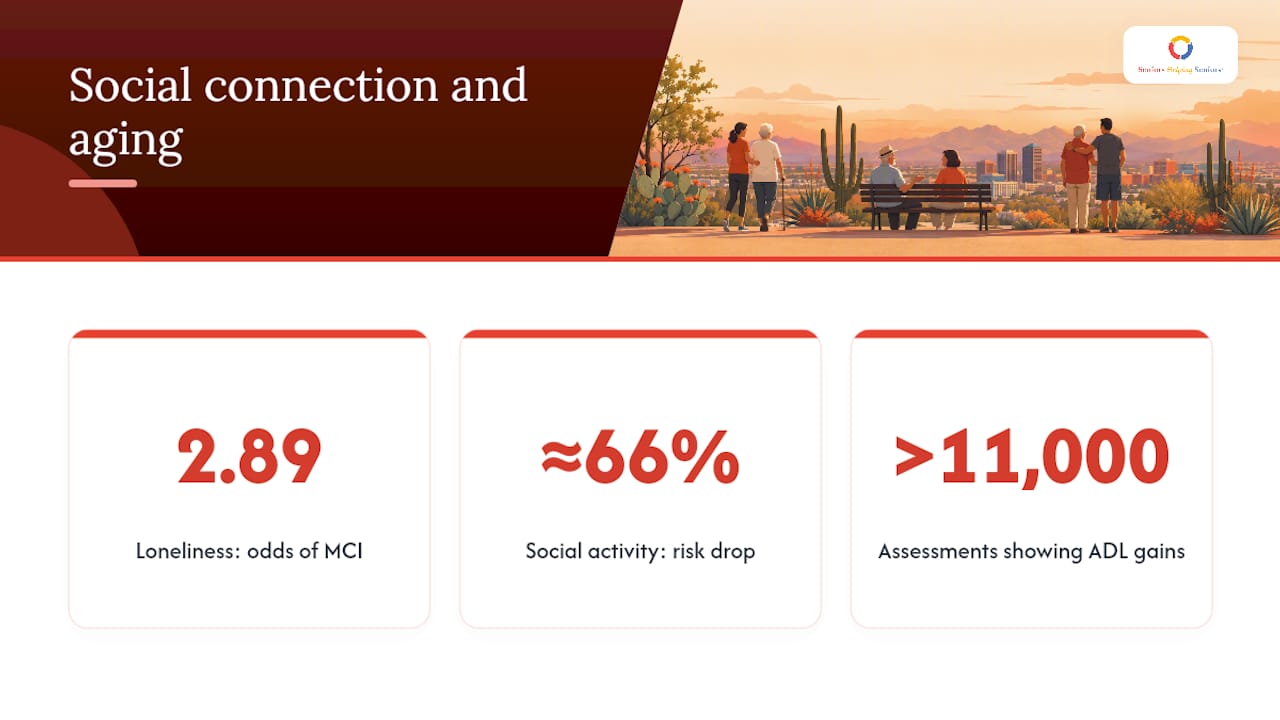
A 2026 meta-analysis of studies conducted through November 2024 found that loneliness nearly tripled the odds of mild cognitive impairment, with an odds ratio of 2.89, while participating in at least one social activity was linked to roughly a two-thirds reduction in cognitive impairment risk in some of the reviewed analyses.
That's not a small effect for something as low-tech as regular company. The meta-analysis pooling this data treats social isolation as a modifiable risk factor, on par with the kind of lifestyle factors doctors already screen for.
The CDC and National Academies go further, framing loneliness and social isolation as serious public-health risks tied to higher rates of dementia, cardiovascular events, and premature death. That framing is why more clinicians now ask about social connection the same way they ask about diet or exercise.
There's also a growing model for how nonmedical care fits into this picture. The Journal of Gerontological Nursing describes applying the Age-Friendly 4Ms framework, what matters, medication, mentation, and mobility, inside the home through nonmedical companion visits. Early practice evaluations drawing on more than 11,000 assessments show improvements in tasks like laundry, grocery shopping, bathing, and hydration.
None of this makes companion care a clinical treatment. The studies behind these numbers vary in design and population, and companion care works as a protective layer around medical care, not a replacement for it. Reviewers of the 4Ms model themselves note that rigorous, long-term outcome data is still limited, even as early signals look promising.
What a Typical Companion Care Visit Actually Looks Like
A good visit follows a rhythm, not a rigid script. Most companions rotate through a handful of core activities depending on the day and the person's needs:
- Meal preparation — cooking a real meal together or ensuring leftovers get eaten, not just stored.
- Light housekeeping — laundry, dishes, tidying, tasks that pile up fast without help.
- Transportation — driving to a doctor's appointment or the grocery store.
- Medication reminders — prompting at the right time, never administering.
- A walk or light movement — preserving mobility matters as much as any single exercise.
- Conversation and shared activity — cards, puzzles, reminiscing, whatever keeps someone engaged.
- Appointment accompaniment — sitting in during a doctor visit and helping relay details afterward.
Good companions document what they see, brief visit notes on mood, appetite, and mobility, shared weekly with family. That habit is what turns a friendly visit into an early warning system. And there's a clear line companions don't cross: wound care, injections, or diagnosing symptoms belong to a clinician, not a companion. When something looks off, the job is to flag it, not treat it.
How to Start Companion Care and What to Ask Before Hiring
Start smaller than you think you need to. A single two-hour visit once a week, focused on one clear activity, tells you more about fit than a long conversation ever will. Harvard Health specifically recommends this incremental approach because it builds trust without overwhelming someone used to independence.
Before signing anything, ask a prospective provider or caregiver:
- What background checks and reference verification do you run on caregivers?
- What happens in a medical emergency during a visit?
- How do you match caregivers to a client's personality and interests?
- Can visit frequency change if needs shift?
- How is progress documented and shared with family?
- What's included versus billed separately?
- Is there a trial period before a longer commitment?
Define "what matters" early, whether that's staying in a longtime home, keeping a specific routine, or simply having consistent company, and put it in writing so every caregiver works from the same page.
Pro Tip: Ask for a two-week trial with brief written notes after each visit. That short window tells you more about fit than any interview.
On cost: Medicare generally doesn't cover long-term companion care, since it isn't classified as medically necessary. Families typically look to VA benefits, long-term care insurance riders, or local Area Agency on Aging programs instead, and some agencies offer sliding-scale or short trial packages. Understanding living benefits options tied to existing insurance policies can also help offset costs before they become a barrier.
How Seniors Helping Seniors® Tucson Puts the Evidence Into Practice
One companion care approach matches clients with mature caregivers based on shared life experience rather than availability alone. That continuity is what turns a scheduled visit into a real relationship.
The strongest companion care outcomes come not from the number of hours delivered, but from whether the caregiver and client actually connect. Matching for shared background is a practical way to make that connection more likely.
The approach draws on the same age-friendly principles discussed earlier, applying "what matters," medication, mentation, mobility, and routine reinforcement directly in the home. Families interested in this model can request a consultation to talk through specific needs and expectations.
What Families Actually Notice Once Companion Care Starts
The pattern shows up again and again in conversations with families: the biggest shift isn't dramatic. It's a parent who starts eating full meals again, or a daughter who stops calling three times a day because someone reliable is already there twice a week.
Start with modest expectations and a short trial. Measure something specific, appetite, mood, a single safety concern, rather than hoping for a wholesale transformation. Consistency, more than any particular activity, is what makes companion care work over months rather than weeks.
— Cameron
Ready to Explore Companion Care Options in Tucson?
Seniors Helping Seniors® Tucson is built around the exact model this research supports: mature caregivers matched by shared experience, applying age-friendly routines that reinforce medication schedules, mobility, and daily structure right in the home. Instead of rotating strangers through a client's door, the focus stays on relational continuity, the factor most linked to real outcomes.

Pricing is typically discussed upfront before any commitment, and short trial visits may be available for families who want to see the fit before scheduling something longer term. If you're weighing options for a parent or spouse, schedule a free consultation to talk through specific needs, or browse Tucson-area care services to see what a typical care plan includes.
Sources
For deeper detail on the research behind this article, see the cognitive impairment meta-analysis, the 4Ms home care framework, CDC loneliness guidance, and Harvard Health's in-home care advice.
This article is general information, not a substitute for advice from a qualified doctor. Consult a qualified healthcare professional about your own circumstances before acting on anything here.
- Meta-analysis linking social relationships and cognitive impairment (PMC12975201)
- Aging and Health Matters: Loneliness risks for older adults (CDC/NAS discussion)
- Bringing the 4Ms home: elevating the role of nonmedical home care (Journal of Gerontological Nursing)
- When should you hire in-home help or health aides? (Harvard Health blog)
FAQ
What does companion care cover?
Companion care typically covers conversation, meal preparation, light housekeeping, transportation, errands, and medication reminders, but not hands-on medical tasks like wound care or injections.
How much do private caregivers get paid?
Pay varies widely by region and experience level and isn't standardized nationally; local agencies, including Seniors Helping Seniors® Tucson, can provide current rate information for a specific area.
Does Medicare pay for companion care?
Medicare generally does not cover long-term nonmedical companion care since it falls outside medically necessary services; families often turn to VA benefits, long-term care insurance, or state aging agency programs instead.
How is companion care different from home health care or a CNA?
Companion care focuses on nonmedical support like company, errands, and light housekeeping, while a CNA or home health aide handles hands-on personal and medical care under clinical supervision.
How do I know if my loved one needs companion care?
Watch for signs like skipped meals, a messier-than-usual home, missed medications, or withdrawal from activities they used to enjoy; these often signal it's time to consider companionship support.