
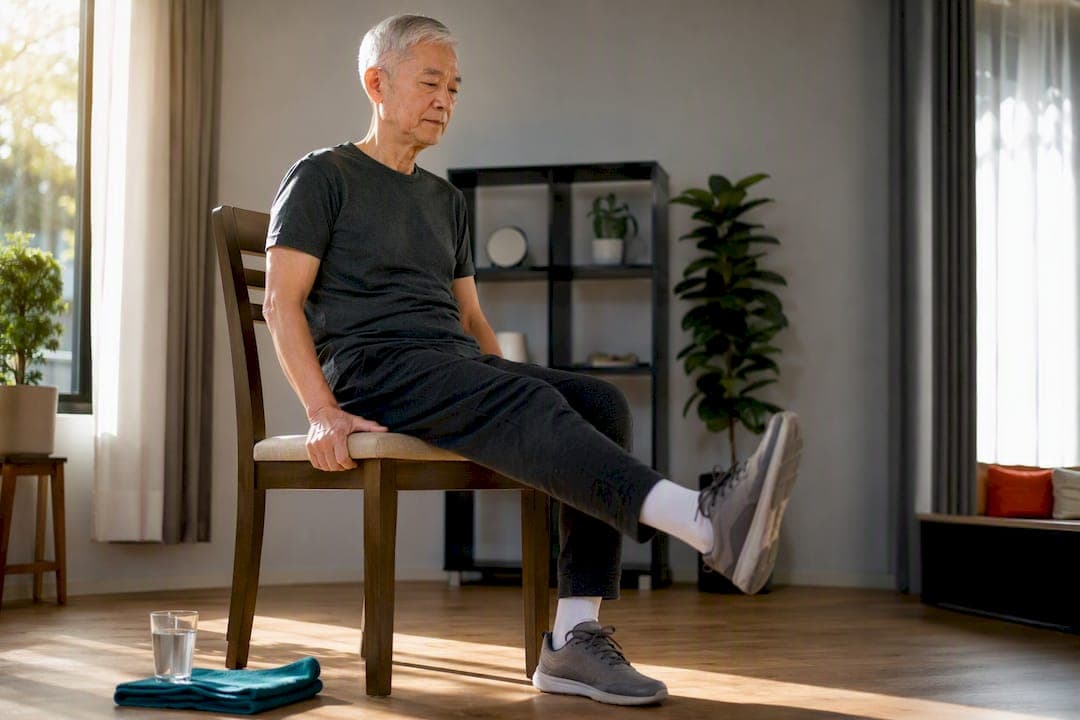
Chair exercises work. Research on chair-based programs shows real, measurable gains in strength, balance, and daily function for older adults, and most people can start today with nothing but a sturdy chair and 15 minutes. A safe session typically runs around 10 to 20 minutes: a short warm-up, two to four strength moves, a few mobility stretches, brief seated cardio, and a cool-down. Stop immediately for chest pain, dizziness, severe shortness of breath, or sharp joint pain, and check with a healthcare provider before starting if you have a heart condition, uncontrolled blood pressure, or a recent injury.
TL;DR:
- Most older adults see measurable strength and balance improvements within four to twelve weeks of consistent chair exercises.
- People with heart issues or uncontrolled blood pressure should seek medical approval and monitor exertion levels during activity.
- Proper chair setup, like preventing sliding and ensuring correct knee angles, is essential for a safe, effective workout.
- Key exercises include chair stands, seated leg extensions, heel raises, and seated rows, which target muscles vital for daily independence.
- Regular, short routines paired with caregiver support and monitoring for warning signs enhance safety and promote long-term habit formation.
Table of Contents
- What Are the Real Benefits of Chair Exercises for Seniors?
- When Should You Get Medical Clearance Before Starting?
- How Do You Set Up a Safe Chair for Exercise?
- What Does a Full Chair Exercise Session Look Like?
- Which Strength Exercises Work Best From a Chair?
- What Are the Best Chair Stretches for Flexibility and Mobility?
- How Do You Add Cardio and Balance Work From a Chair?
- How Do You Know the Routine Is Actually Working?
- How Can Caregivers Make Chair Exercises Part of Daily Life?
- Getting Consistent Support for a Safe Exercise Routine
- A Caregiver's Honest Take on Sticking With It
- Sources
What Are the Real Benefits of Chair Exercises for Seniors?
The evidence here isn't thin. A systematic review and meta-analysis of chair-based exercise programs found consistent improvements in upper and lower extremity function among older adults, including grip strength and standing endurance. These aren't abstract lab numbers. They translate directly into things people actually do: getting out of a car, carrying a grocery bag, climbing two stairs without grabbing the railing.
A separate meta-analysis of 19 studies found statistically significant gains in handgrip strength, the 30-second arm curl test, and the 30-second chair stand test after structured chair-based programs. The chair stand test alone is a decent proxy for fall risk, so improvement there matters more than it sounds.
None of this happens overnight. Most programs show measurable change within four to eight weeks of consistent practice, with more noticeable functional improvement by the 12-week mark. Chair exercises are also a legitimate option for people who are frail or deconditioned, not just a watered-down substitute for "real" exercise, according to a Delphi consensus on chair-based exercise delivery.
When Should You Get Medical Clearance Before Starting?
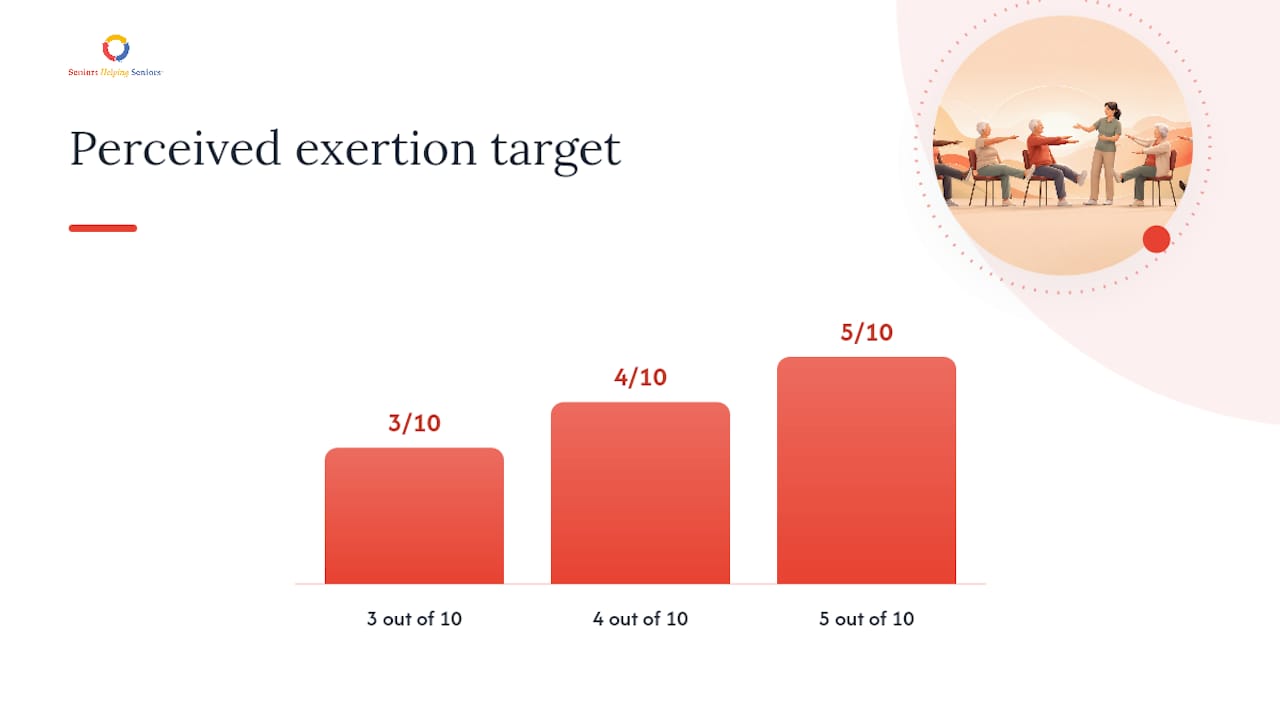
Chair exercises are low-impact, but low-impact doesn't mean risk-free. Anyone with heart disease, uncontrolled blood pressure, a recent surgery, or a healing injury should talk to a doctor before beginning a routine, according to guidance from the National Institute on Aging. The same source recommends the "talk test" as a simple intensity check: if you can speak in short sentences while exercising but couldn't sing, you're in the right zone. That usually lands around 3 to 5 out of 10 on a perceived-exertion scale, moderate enough to build strength without overloading the heart.
Caregivers watching a session should know the warning signs cold. Stop the exercise right away if you see or hear any of these:
- Chest pain, pressure, or tightness
- Sudden dizziness, faintness, or confusion
- Severe shortness of breath that doesn't ease with rest
- Sharp or stabbing joint pain (different from normal muscle fatigue)
- Nausea or a sudden change in skin color
A good rule for caregivers: sit or stand close enough to catch a stumble, and never leave someone mid-exercise to answer the phone. If a chair stand or reach looks unsteady, spot from the side, not from behind, so you can see their face.
How Do You Set Up a Safe Chair for Exercise?
The chair itself is part of the safety equation, not an afterthought. According to the CDC's Growing Stronger guide, the right chair is sturdy, has no wheels, has no arms (for most exercises), and lets the knees sit at roughly a 90-degree angle when the feet are flat on the floor.
A few setup details make a real difference:
- Push the chair against a wall or set it on carpet so it can't slide during a stand or reach.
- If the seat is too low, a firm cushion or a yoga block under the seat can bring the knee angle closer to 90 degrees.
- Clear a three-foot radius around the chair, especially for seated marches or arm swings.
- Keep a water bottle within reach, not across the room.
Optional gear helps with progression but isn't required to start: light dumbbells (1 to 5 pounds), a resistance band, ankle weights, or a small soft ball for squeezing. Canned goods or filled water bottles work fine as substitutes if you don't want to buy equipment yet.
What Does a Full Chair Exercise Session Look Like?
A complete session, start to finish, takes 10 to 20 minutes and follows a simple shape:
- Warm-up (5 minutes): Seated marching in place, shoulder rolls, and ankle circles to get blood moving into the joints.
- Strength set (5 to 8 minutes): Two to four exercises, 8 to 12 reps each, using a slow tempo, about two seconds up and two seconds down. Controlled movement builds more strength and risks less injury than fast, momentum-driven reps, a point backed by practical chair-workout guidance from Fitnoova.
- Mobility and cardio (3 to 5 minutes): A few stretches paired with short bursts of seated marching or heel-toe rocks.
- Cool-down (2 to 3 minutes): Slow breathing and two or three gentle stretches held for 20 to 30 seconds.
Start with sessions every other day, 10 to 15 minutes total. As form and stamina improve over two to three weeks, build toward 3 to 5 sessions a week, 20 to 30 minutes each. Session length matters less than consistency. Three short sessions a week for a month beat one long session followed by two weeks off.
Which Strength Exercises Work Best From a Chair?
These moves target the muscles seniors rely on most for daily independence: legs for standing and walking, arms for lifting and carrying, shoulders for reaching overhead.
- Chair stand: Sit toward the front edge, feet flat, lean slightly forward, and stand up without using your hands if possible. This is the single best exercise for safer transfers in and out of chairs, cars, and beds. Avoid rocking or using momentum. Progress by doing it slower or adding a light weight held at the chest.
- Seated leg extension: Sit tall, extend one knee until the leg is straight, hold for two seconds, lower slowly. Common mistake: letting the back round. Progress with an ankle weight.
- Heel raises: Feet flat, rise onto your toes, hold, lower. Helps with balance and walking stability. Hold the chair seat lightly if needed, not the armrest, so you build real balance.
- Seated row with a band: Loop a band around a sturdy anchor, pull elbows back, squeeze shoulder blades. Strengthens posture muscles that keep seniors from hunching forward.
- Biceps curl: Palms up, curl a light weight toward the shoulder. Helps with carrying groceries and grandchildren alike.
- Overhead press: Press light weights straight overhead, avoiding arching the lower back. Skip or shorten range if shoulder mobility is limited.
- Triceps extension: Extend one arm overhead, bend at the elbow, straighten slowly. Supports pushing up from a chair or bed.
Pro Tip: Film yourself (or have a caregiver watch) doing one rep of each exercise the first week. Comparing form after four weeks is often the most convincing proof that the routine is working, before the tape measure or the scale shows anything.
What Are the Best Chair Stretches for Flexibility and Mobility?
A short stretching block, done after the strength set or as its own mini-session, keeps joints from stiffening between workouts.
- Seated hamstring stretch: Extend one leg straight, flex the foot, hinge gently forward from the hips. Hold 20 to 30 seconds per side.
- Seated shoulder opener: Clasp hands behind the chair back or reach both arms overhead, breathing slowly through the stretch.
- Neck rotation: Turn the head slowly side to side, then tip an ear toward each shoulder. Never force this one.
- Seated torso twist: Cross arms over the chest and rotate gently toward each side, keeping hips facing forward.
For anyone with arthritis or stiff joints, shrink the range of motion and cut hold times to 10 to 15 seconds rather than pushing for a deep stretch. A simple three-stretch cooldown, hamstring, shoulder, and neck, held 20 to 30 seconds each, closes out most sessions well.
How Do You Add Cardio and Balance Work From a Chair?
Seated cardio raises the heart rate without stressing the knees or hips, and balance drills chip away at fall risk over time.
- Seated march: Lift knees alternately at a brisk pace for 30 seconds, rest 30 seconds, repeat three to four rounds.
- Modified seated jumping jack: Open and close the arms and legs slightly while seated, staying controlled rather than fast.
- Heel-toe rocks: Rock from heels to toes while seated or standing at the chair back, building ankle stability.
- Single-leg taps (if stable): Standing behind the chair for support, tap one foot forward and back, then switch sides.
For someone recovering from a fall or with significant balance concerns, spend more time on heel-toe rocks and single-leg taps and less on cardio intervals until confidence improves. For someone stronger and steadier, push the cardio intervals first and treat balance work as maintenance.
How Do You Know the Routine Is Actually Working?
Progress in chair exercise shows up in small, trackable ways before it shows up on a scale. The clearest test is the 30-second chair stand, count how many full stands you complete in 30 seconds, since improvement on this exact measure showed up across the meta-analysis of chair-based programs.
Other signs worth tracking:
- Standing from the chair without pushing off with your hands
- Fewer stops or breaks needed for the same routine
- Easier time with unrelated daily tasks, like getting out of the car or off the toilet
Progress the routine gradually. In the first few weeks, focus purely on form with bodyweight and 10 to 12 reps. Around weeks five through eight, add small weight increments, 1 to 2 pounds, or an extra set. By weeks nine through twelve, a second short circuit or slightly faster (but still controlled) tempo is usually appropriate. If progress stalls past 12 weeks, that's a reasonable point to bring in a physical therapist for a form check.
How Can Caregivers Make Chair Exercises Part of Daily Life?
Caregivers add something clinical guidelines can't: presence. A caregiver who cues "slow on the way down" during a chair stand, or gently corrects a rounded back during a leg extension, prevents more injuries than any warning label. Timing matters too. Schedule sessions when medication has kicked in and fatigue is lowest, often mid-morning for many seniors, and skip the routine entirely on days marked by poor sleep or illness.

Pairing movement with connection works better than treating it as a chore. A short chat during warm-up, or finishing with a favorite show, keeps the habit alive longer than a rigid checklist. For seniors managing cognitive decline, adapting movement to include simple, engaging prompts, similar to the approach described in dementia-friendly games that boost connection and calm, tends to hold attention better than counting reps out loud. Caregivers supporting someone with dementia can also draw on ideas from memory care activities that actually work to blend movement with familiar, calming routines.
Getting Consistent Support for a Safe Exercise Routine
Building a habit alone is hard at any age, and it's harder when balance or memory adds a layer of caution to every rep. That's where a second set of eyes, someone trained to spot a wobble before it becomes a fall, changes the outcome. Seniors Helping Seniors® Tucson pairs older adults with mature caregivers who understand both the physical and emotional side of staying active later in life, from cueing proper form to simply making the 15 minutes feel less like a task and more like time well spent.
The team's in-home senior care services can weave a chair exercise routine into the rest of a daily visit, alongside meal prep, medication reminders, or a walk to the mailbox. If dehydration or fatigue is a concern during activity, it helps to recognize the warning signs of dehydration in seniors before they derail a session. For families in Tucson exploring what steady, in-home support actually looks like, the Tucson senior care overview is a reasonable place to start.
A Caregiver's Honest Take on Sticking With It
The routines that actually stick aren't the ambitious ones. They're the boring, repeatable ones: same chair, same time of day, same six moves, three days a week. I'd rather see someone do 10 minutes of chair stands and heel raises every other day for three months than attempt a 45-minute program twice before quitting.
What gets missed in most guides is that consistency depends more on the person cueing the session than on the exercises themselves. A caregiver who notices when grip strength improves, or when a stand happens without hands, turns a workout into a small daily win. Watch for new or worsening symptoms, chest tightness, unusual dizziness, joint pain that doesn't fade, and treat those as a reason to call a clinician, not push through.
— Cameron
This article is general information, not a substitute for advice from a qualified doctor. Consult a qualified healthcare professional about your own circumstances before acting on anything here.
Sources
- The Effect of Chair-Based Exercise on Physical Function in Older Adults: A Systematic Review and Meta-Analysis
- National Institute on Aging — Exercise and older adults (2025 guidance)
- Growing Stronger — Strength Training for Older Adults (CDC)