

Prioritize three things right now: one daily self-care habit you can't skip, a scheduled respite break you treat as non-negotiable, and one evidence-backed stress-management skill like problem-solving or brief mindfulness practice. Research consistently shows these categories, self-management training, scheduled breaks, and social support, produce the most reliable drops in caregiver depression and burden. The rest of this guide breaks down the signs to watch for, the tactics that hold up under real caregiving schedules, and where to find help.
TL;DR:
- Caregivers managing more than 20 hours weekly, living with the recipient, or handling complex medical tasks face higher burnout risks.
- Daily self-care habits, scheduled respite, and stress-management skills like problem-solving significantly reduce depression and burden.
- Consistent routines, such as short walks, regular sleep cues, and quick relaxation techniques, improve stress resilience without requiring large time investments.
- In-home respite, adult day programs, and short residential stays should be scheduled proactively and revisited regularly to prevent caregiver depletion.
- Asking for specific, time-limited help and planning emergency and legal details early are crucial to avoiding burnout and maintaining long-term sustainability.
Table of Contents
- What Caregiver Stress and Burnout Look Like
- Why Caregiver Stress Matters for Your Health
- Which Strategies Actually Reduce Depression, Anxiety, and Burden?
- Daily Routines That Fit a Real Caregiving Schedule
- Finding Respite Care and Support Groups
- How to Ask for Help Without the Guilt Spiral
- When to Seek Professional Help
- How Seniors Helping Seniors® Tucson Supports Caregiver Wellness
- Managing Guilt and the Emotional Weight of Caregiving
- Communicating Well With Care Recipients and Family
- Planning for Emergencies and Sudden Caregiving Demands
- Building a Long-Term Caregiver Support Plan
- A Few Honest Words on Staying Sustainable
- How Seniors Helping Seniors® Tucson Can Lighten Your Load
- Sources
What Caregiver Stress and Burnout Look Like
Caregiver stress is the day-to-day strain of managing someone else's needs on top of your own life. Burnout is what happens when that strain goes unaddressed long enough to produce emotional exhaustion, detachment, and a sense that nothing you do makes a difference. The distinction matters because stress responds to daily coping tools, while burnout often requires stepping back, restructuring the care arrangement, or bringing in outside help.
Watch for signs across four categories:
- Emotional: irritability, hopelessness, resentment toward the person you're caring for
- Cognitive: brain fog, forgetfulness, trouble concentrating on simple tasks
- Behavioral: withdrawing from friends, skipping your own medical appointments, increased alcohol use
- Physical: disrupted sleep, frequent headaches, getting sick more often than usual
Certain conditions push risk higher: caregiving more than 20 hours a week, living with the care recipient, having no real choice in taking on the role, financial pressure, and managing complex medical tasks like wound care or medication schedules. If you're navigating dementia-specific caregiving, several of these risk factors tend to stack at once.
Why Caregiver Stress Matters for Your Health
Chronic stress changes how your brain works before it changes anything else. Under sustained pressure, the amygdala, your brain's threat-detection center, takes over decision-making while the prefrontal cortex, responsible for planning and patience, gets deprioritized. That shift produces the "survival mode" fog many caregivers describe: forgetting appointments, snapping at people you love, losing track of conversations. It's reversible, but only if the stress load comes down.
Left unaddressed, this pattern doesn't stay contained to mood. It raises risk for clinical depression and anxiety, and it strains immune and cardiovascular function over time.
A 2021 meta-analysis found that nonpharmacological self-management interventions produced a moderate reduction in caregiver depression, with an effect size of -0.62, along with similar improvements in stress and burden. That's a meaningful signal that structured coping skills, not just willpower, move the needle.
Which Strategies Actually Reduce Depression, Anxiety, and Burden?
Not every intervention works the same way, and knowing which one targets your actual problem saves time. A meta-review published in BMC Geriatrics found psychoeducation and counseling or therapy consistently reduce depression and improve caregivers' sense of mastery and quality of life. Mindfulness practices show similar benefits for mood, though results for burden and anxiety are more mixed across studies.
Here's how the main categories break down:
- Psychoeducation: teaches you what to expect and how to respond, the strongest evidence for reducing depression
- Counseling or therapy: addresses guilt, grief, and relationship strain directly
- Mindfulness practices: short, repeatable exercises that lower reactivity in the moment
- Problem-solving and self-management training: builds concrete skills for daily logistics and decision-making
- Multicomponent programs: combine several approaches but vary widely in quality and consistency
- Digital and app-based tools: convenient for short-term support, best paired with periodic in-person contact
Burden and anxiety respond less predictably than depression, which means picking a program tailored to your specific stressors, financial strain, medical complexity, isolation, matters more than picking the most popular option. A generic program aimed at the average caregiver will underperform one built around your actual bottleneck.
Pro Tip: If you start with a free app or digital program, add a booster session with a real person, a therapist, social worker, or support group, every few months. Digital tools alone tend to fade in effectiveness once the novelty wears off.
Daily Routines That Fit a Real Caregiving Schedule
Consistency beats intensity here. A 20-minute walk five days a week does more for your stress hormones than one exhausting workout you can't repeat.
- Sleep hygiene for interrupted nights. Keep a consistent wind-down cue, dim lights, no screens, even if bedtime shifts. A 20-minute nap after a rough night beats pushing through exhausted.
- Short, repeatable movement. A 20-minute daily walk or ten minutes of chair exercises measurably lowers physiological stress, even on days you feel too busy to start.
- Three fast relaxation techniques. Try box breathing (four seconds in, four hold, four out, four hold) for two minutes; a 60-second body scan while waiting for coffee to brew; or naming five things you can see and hear to interrupt a spiral.
- Realistic nutrition. Keep protein-forward snacks on hand, nuts, string cheese, hard-boiled eggs, and set a water bottle where you'll see it. Skipping meals under stress is common and makes brain fog worse.
None of these require a spare hour. They require a repeatable trigger, tied to something you already do, so the habit survives a bad week.
Finding Respite Care and Support Groups
Respite isn't a luxury; it's maintenance. Harvard Health frames self-care as a requirement for caregiving to continue at all, not a reward you earn after everything else is done. If you're the only one managing care, your own health becomes the single point of failure for the whole arrangement.
Three respite formats cover most situations:
- In-home respite: a caregiver comes to you, useful for medical complexity or mobility limits
- Adult day programs: structured social time away from home, good for caregivers needing full workdays back
- Short residential respite: overnight or multi-day stays, best before travel or a medical procedure of your own
Start your search with your local Area Agency on Aging, disease-specific organizations (Alzheimer's Association chapters, for instance), and senior centers, which often know about subsidized or sliding-scale options your insurance won't mention. Read our guide to respite care at home for a closer look at scheduling it consistently. The habit that matters most: put respite on the calendar in advance, the way you'd schedule a dentist appointment, instead of waiting until you're depleted to ask.
How to Ask for Help Without the Guilt Spiral
Vague requests get vague responses. "Can you help me sometime?" rarely produces action. "Can you sit with Mom Tuesday from 2 to 3:45 so I can go to a doctor's appointment?" almost always does. Specific, time-boxed asks lower the mental effort required to say yes, which is exactly why they work better.
A short delegation checklist helps:
- Delegate errands first, groceries, pharmacy pickups, before anything involving hands-on care
- Bundle small tasks for one person rather than spreading five tiny asks across five people
- Put your request in writing (text or email) so there's no ambiguity about time or task
Geisinger clinicians recommend formalizing your breaks like work meetings, calendar invite, voicemail redirect, the works, because informal "I'll take time when I need it" plans quietly disappear under pressure.
Pro Tip: Keep a running list on your phone titled "Tasks I could hand off." When someone offers to help, you already have three specific options ready instead of freezing and saying "I'm fine."
When to Seek Professional Help
Some signs mean it's time to bring in outside support, not just more coping tricks. Persistent daily depression or anxiety, thoughts of self-harm, increased substance use, or an inability to manage basic daily tasks (yours or the care recipient's) are firm red flags that call for professional intervention, not another self-help article.
Start with your primary care provider, who can screen for depression and refer you appropriately. Therapists, like those in directories such as Align Therapy Collective, geriatric care managers, and medical social workers each address different pieces: mental health, care logistics, and benefits navigation. Bring a short list of your symptoms, sleep patterns, and any medications to your first appointment so the visit isn't spent reconstructing history from memory.
How Seniors Helping Seniors® Tucson Supports Caregiver Wellness
Seniors Helping Seniors® Tucson pairs care recipients with mature, often senior, caregivers matched for shared life experience. That matching does two things at once: it eases the isolation many older adults feel, and it gives family caregivers a genuine respite window instead of a stranger-in-the-house adjustment period.
Because caregivers are peers rather than distant outsiders, the model tends to build the kind of rapport that makes regular respite easier to actually use, not just plan. Services extend to companionship, personal care, and support like medication reminders, covering the daily logistics that wear caregivers down fastest.
Managing Guilt and the Emotional Weight of Caregiving
Guilt shows up in almost every caregiving relationship, and it rarely follows logic. You feel guilty for resting, guilty for losing patience, guilty for wanting your old life back, sometimes guilty for all three in the same afternoon. Left unexamined, that guilt often drives caregivers to refuse help they desperately need, which accelerates burnout rather than preventing it.
The most useful reframe: guilt usually signals that you care, not that you've failed. It's a normal byproduct of holding yourself to an impossible standard, being endlessly patient, perfectly informed, and available around the clock, none of which any human sustains for long.
A few concrete moves help loosen guilt's grip. Name it out loud, to a friend, a journal, or a support group, instead of letting it churn silently. Separate the feeling from the facts: feeling guilty about a respite break doesn't mean the break was wrong. Set one small boundary and notice that the world doesn't collapse when you hold it. Our breakdown of caregiver guilt covers specific triggers and responses in more depth.
If guilt starts driving major decisions, refusing all help, ignoring your own medical needs, it's worth raising with a therapist or counselor rather than working through alone.
Communicating Well With Care Recipients and Family
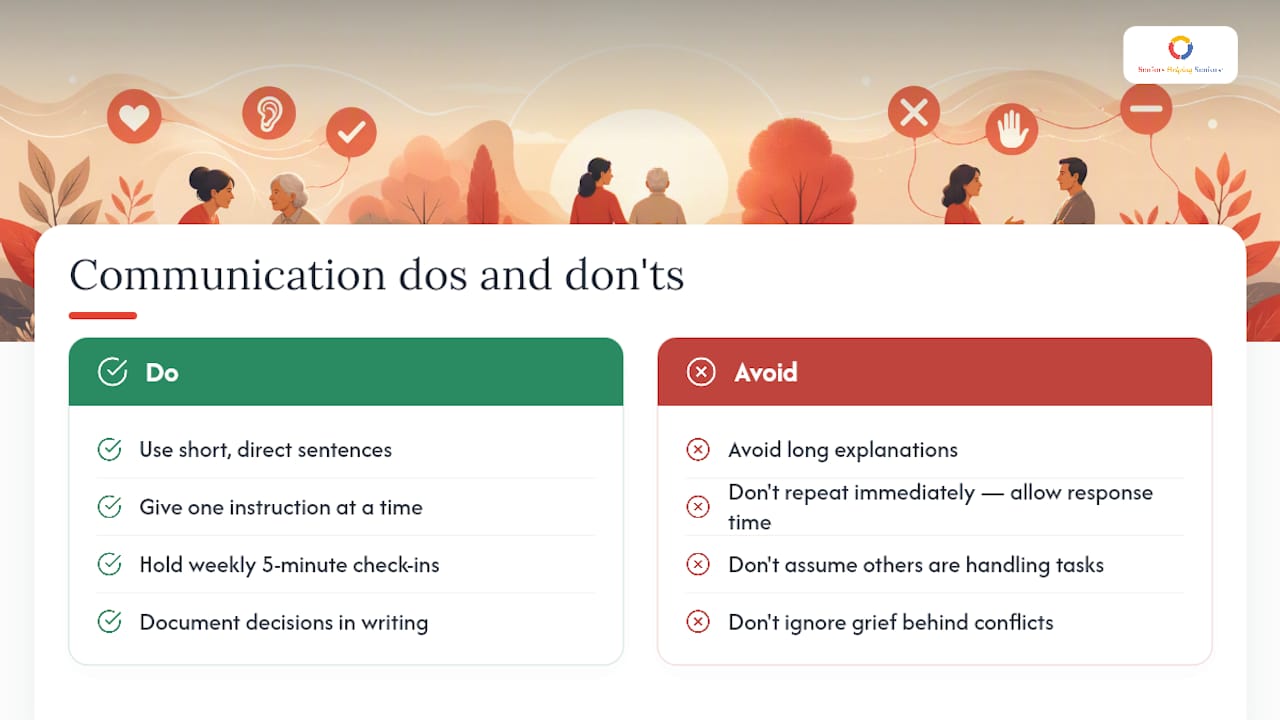
Most caregiving conflict traces back to unclear expectations, not bad intentions. With the person you're caring for, short, direct sentences work better than long explanations, especially if cognitive decline is involved. Give one instruction at a time, allow extra response time before repeating yourself, and match your tone to calm rather than urgency, since agitation is often mirrored right back at you.
With family members, the biggest fix is usually structure. A weekly five-minute check-in, by phone or text, on what changed, what's needed, and what's coming up, prevents the buildup of resentment that comes from everyone assuming someone else is handling things. State needs as specific requests rather than complaints: "I need someone to cover Thursday mornings" lands better than "nobody helps me."
When conflict does arise, especially around care decisions, separate the disagreement about logistics from the underlying grief or fear driving it. Siblings arguing about a parent's care plan are often really arguing about loss. Naming that directly, "I know this is hard because it means Dad is declining," can defuse tension that logistics alone won't touch.
Document decisions in writing after family conversations, even a quick group text summary, so plans don't quietly unravel from memory drift a few weeks later.
Planning for Emergencies and Sudden Caregiving Demands
Caregiving rarely stays predictable for long. A fall, a hospitalization, or a sudden decline can upend a stable routine overnight, and the caregivers who handle it best are the ones who prepared before the crisis, not during it.
Build a one-page emergency sheet now: current medications and dosages, allergies, primary physicians, insurance information, and emergency contacts. Keep a copy on the refrigerator and a photo of it on your phone. Identify a backup caregiver, a neighbor, family member, or in-home care service, who could step in on short notice if you're suddenly unavailable.

Pack a small hospital bag in advance for the care recipient: a change of clothes, a phone charger, a list of current medications. It sounds excessive until you're standing in an emergency room at 2 a.m. trying to remember dosages from memory.
Finally, talk through worst-case scenarios with family before they happen. Who takes over if you get sick? Who has legal authority to make medical decisions? These conversations feel uncomfortable in calm moments, which is exactly why calm moments are when they should happen.
Building a Long-Term Caregiver Support Plan
Sustainable caregiving requires more than daily coping tricks. It needs a structure that survives changes in health, finances, and family dynamics over months and years.
Start with legal basics: a durable power of attorney and health care proxy for the care recipient, so decisions can be made quickly if they lose capacity. Confirm these documents exist and know where they're stored. If they don't exist yet, an elder law attorney can typically draft them in a single consultation.
On the financial side, map out what care currently costs and what it might cost if needs escalate, memory care, home modifications, additional paid help. Long-term care insurance, veteran's benefits, and Medicaid planning all carry different eligibility rules, and starting that research early avoids scrambling under pressure later.
Build a rotating support network rather than relying on one person, yourself included. That might mean a paid caregiver for structured respite, a sibling for weekend coverage, and a support group for emotional processing. Revisit the plan every six months, because care needs shift, and a plan built for today's situation won't necessarily fit next year's.
A Few Honest Words on Staying Sustainable
Here's what surprises most first-time caregivers: the hardest part usually isn't the physical tasks. It's giving yourself permission to need a break before you're completely depleted. My three-item checklist for anyone reading this today: pick one daily self-care habit and protect it like an appointment, schedule respite this week instead of "when things calm down," and identify one person you can ask for a specific, time-boxed favor before Friday.
Asking for help isn't a failure of character. It's the skill that keeps caregiving sustainable long enough to matter. If things feel urgent right now, thoughts of self-harm, inability to function, don't wait on this article, call a professional or a crisis line today.
— Cameron
How Seniors Helping Seniors® Tucson Can Lighten Your Load
If you've read this far, you already know respite can't stay theoretical, it has to actually get scheduled. Seniors Helping Seniors® Tucson offers a direct way to do that: senior caregivers matched to your loved one for companionship, personal care, and daily support like medication reminders, so the break you plan is one you can actually trust enough to take.

This works especially well for families juggling full-time jobs alongside caregiving, or anyone whose current arrangement has no real backup plan. Services are available across Tucson and nearby communities, with coverage details varying by household, so it's worth a direct conversation rather than guessing. Start by exploring current service options or reaching out through the Tucson senior care page to ask what a trial visit would look like for your specific situation.
Sources
Meta-analysis on nonpharmacological interventions (2021), Harvard Health on caregiver self-care, Geisinger on preventing burnout, and the NIA caregiver tips page.
This article is general information, not a substitute for advice from a qualified doctor. Consult a qualified healthcare professional about your own circumstances before acting on anything here.
- Digital and nonpharmacological interventions meta-analysis (2021)
- Preventing caregiver burnout — Geisinger (2025)