
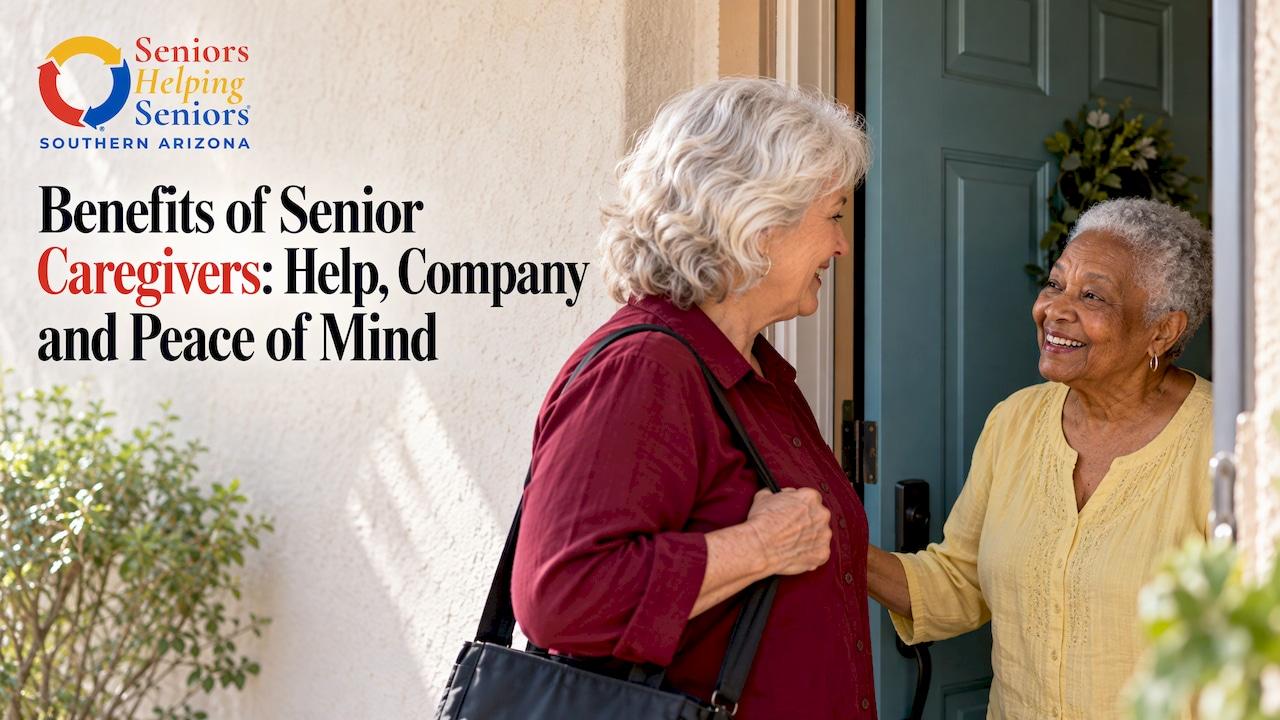
A caregiver who is a senior too brings what a younger helper often has to learn: lived experience of the same stage of life. That shared understanding is the heart of how we care at Seniors Helping Seniors® Tucson. It makes everyday help feel like a visit with a friend, not a service. Practical help with bathing, meals and errands keeps a person independent at home. Regular company eases loneliness, and families finally get to rest, knowing someone dependable is there.
Below, we walk through each benefit, what the research says, and how to bring a caregiver into your home gently, whether you are the senior, the daughter or son, or the spouse who has been carrying it all.
Key Takeaways
- In-home help covers personal care, meals, chores, transportation and safety, so older adults can stay at home as independently as possible, according to the National Institute on Aging.
- Regular companionship is a core part of caregiving, not an extra, and it matters because loneliness is linked to poorer health.
- A caregiver in the home is a second set of eyes for falls, medication routines and changes in how someone is doing.
- Respite care gives family caregivers real breaks, and a back-up plan means one person is never the only safety net.
- Our caregivers are seniors themselves, matched with clients for shared life experience, with flexible scheduling and no minimums or long-term contracts.
Table of Contents
- Everyday help that protects independence
- Companionship: the benefit people underestimate
- A safer home, with someone paying attention
- Relief for the family who has been doing it all
- For veterans and their families
- Who pays, and what to expect
- Our perspective
- How to bring a caregiver into the home gently
- Talk with us about care at home
- FAQ
- Sources
Everyday help that protects independence
Most people do not want to move. They want to stay in the house they know, with their own kitchen and their own mornings. The National Institute on Aging describes in-home support as exactly that: help with bathing, dressing, grooming, eating and moving around, plus household chores, meals, transportation and safety, so older adults can live as independently as possible.
This is a big reason caregivers matter. Independence rarely disappears all at once. It wears down at the edges: the shower becomes a worry, the grocery trip feels too far, cooking a full meal is tiring. A few hours of help each week can take the pressure off exactly those tasks, so the person keeps doing what they enjoy and can still do.
The need is common. The Caregiving in the US 2025 report found that almost two-thirds of caregivers help with at least one activity of daily living, such as bathing or dressing. The most common task, reported by 45 percent, is helping someone get in and out of beds and chairs. These are ordinary moments of the day, and they are the ones where steady, patient hands make the biggest difference.
Help that respects the person's own pace
How help arrives matters as much as what it covers. The geriatrics educators at HealthInAging.org suggest including the older person in planning, starting slowly with one helper for a limited time, and giving them as much control as possible. Help works best when it is framed as a way to stay independent, not a step toward giving it up.
That is where a caregiver of a similar age can shine. Someone who has raised a family, worked a career, or served in the military understands why a person wants to keep making their own coffee, their own choices. They can offer a steady hand without taking over. Our caregivers are matched with clients for shared life experience, so the first conversation often starts with common ground, not a task list.

The tasks a caregiver can take on
The services families ask us about most fall into a few groups:
- Personal care: bathing, dressing, grooming and getting around the home. Our personal care service covers this daily living assistance.
- Meals and housekeeping: meal preparation, shopping and light housekeeping, so the kitchen stays safe and the fridge stays stocked.
- Transportation and errands: rides to appointments, the pharmacy and the store. See senior transportation.
- Medication reminders: a friendly nudge at the right time. Our guide to hiring a caregiver for medication reminders explains how this works at home.
- Companionship: conversation, shared activities and a familiar face. More on companion care.
If you are not sure which of these fits your situation, our article on in-home care services in Tucson and what to ask when hiring is a good place to sort it out.
Companionship: the benefit people underestimate
It is easy to think of caregiving as a list of chores. Yet the National Academies describe emotional and social support as a core caregiving function: providing companionship, talking through life's challenges, taking part in leisure activities, and helping manage difficult emotions.
That matters because isolation takes a toll. AARP's in-home care guide notes that isolation and loneliness are associated with poorer health. It suggests ways to keep connections alive: community arts programs, visits from friends and relatives, or going out to eat together. A caregiver adds one more reliable thread. Someone arrives on a known day, notices how you are, and sits down for a cup of tea.
Why a peer makes the difference
Companionship lands differently when it comes from someone who has lived through similar seasons of life. A retired teacher can talk books with a former librarian. A veteran can talk with someone who understands service. A neighbor from the Catalina foothills can swap stories about monsoon storms and desert sunsets. These are small moments, and they are what turns a visit into a relationship.
Families who live far away often tell us this is what they worry about most: not whether the dishes get done, but whether Mom has anyone to talk to between phone calls. Our article on daily habits that give seniors emotional support shares simple ways families and caregivers can keep that connection going.
A safer home, with someone paying attention
Safety is the quiet benefit. A caregiver who is in the home regularly spots the loose rug, the dim hallway, the new unsteadiness on the stairs, before they become a fall.
The NIA advises reevaluating home safety periodically, going room by room and fixing immediate dangers first, such as loose stair railings and poor lighting. AARP lists practical fixes: removing throw rugs, adding automatic night-lights, installing grab bars, handrails and adjustable shower seats, and setting up a medical alert system.
For people living with memory loss, the University of California, San Francisco's Memory and Aging Center notes that falls and infections are common risks that lead to hospitalization. It recommends predictable routines and a home arranged so the person can do as much as possible safely, with better lighting, less clutter and stronger color contrast. Our room-by-room home safety checklist turns these ideas into a walk-through you can do this weekend.
Falls, balance and the stairs
A caregiver can also encourage gentle movement. Regular, safe balance exercises that help prevent falls are one way older adults build confidence on their feet, and a companion makes it easier to keep the habit going. Check any exercise plan with a doctor first.
If stairs are the main obstacle in your home, a practical guide on a stairlift for family caregiving explains how that kind of equipment fits into daily care. For a broader plan, see our fall prevention steps for caregivers.
Dementia and memory support at home
Familiar surroundings can be calming for someone with dementia, and a consistent caregiver is part of that. The federal Alzheimer's.gov caregiver tips include using a sturdy shower chair for an unsteady person, narrating each step during bathing or dressing, and serving meals in a way that reduces confusion. A caregiver who knows the routine makes these small techniques second nature.
We offer dementia care and Parkinson's support, and a few of our guides go deeper: caring for a parent with dementia at home in Sierra Vista and memory care activities that work.
Relief for the family who has been doing it all
Many families begin as the caregiver themselves, then realize it is too much. AARP advises family caregivers to build a larger team, put the plan in writing, and make a back-up plan for when the main caregiver is unavailable, because their own health and the quality of care suffer if they try to do everything.
A 2025 study of veterans and their care partners, published in the Journal of Applied Gerontology, found that networks were usually judged adequate whatever their shape, but that veterans rarely had a Plan B if their main care partners could not help. Unmet needs included home health aide support. A trusted caregiver can be that second person.
What respite care means
The Department of Veterans Affairs defines respite care as temporary care that gives the family a break, provided by a trained person in the home or elsewhere, during the day or overnight. Signs it is time to ask for help, according to the Washington State Department of Health, include chronic fatigue, trouble concentrating, irritability and neglecting your own care.
If you recognize yourself there, respite care can give you an afternoon, a weekend or a full night's sleep. Overnight care is there for the hours that worry families most.
After a hospital stay
Coming home from the hospital is a fragile time. Our Return Home Transitional Care is built for that stretch, so the first days back are supported by someone who is there to help.
For veterans and their families
Veterans may have access to support beyond what a family arranges privately. The VA's Welcome Kit explains that its Caregiver Support Program includes a general program for caregivers of Veterans enrolled in VA health care, with no formal application required, offering education, training and support. It also lists geriatric and extended care services such as home-based primary care, home health aide, adult day health care and caregiver respite.
The VA's Welcome guide lists the Caregiver Support Line at 855-260-3274, and Aid and Attendance and Housebound payments for Veterans who need another person's help in daily life or are housebound. Eligibility rules apply, so the VA is the place to confirm what you qualify for.
None of this replaces a caring person in the room. We offer veteran care, and many of our caregivers understand service because they have lived their own version of it.

Who pays, and what to expect
In-home help is usually paid for privately. The NIA says that Medicare, Medicaid and private insurance generally do not cover companion visits, though some long-term care insurance plans do. Volunteer visiting programs cost nothing, and home health agencies charge a fee. Because coverage varies, ask your insurer and your local Area Agency on Aging what applies to you.
We do not publish prices. Care is billed hourly or by package, and we are happy to talk through what your family needs.
Our perspective
Over the years, the families who come to us usually describe the same fear. It is rarely about a task. It is that someone they love is alone in the house for too many hours, or that they themselves are stretched past what is fair to ask of one person.
That is why our caregivers are seniors. They are mature, active people who know what it means to want your own routine, your own pace and your dignity left intact. We match each caregiver with a client for shared life experience, because we believe a good match is where trust begins, and trust is what makes care work.
We also keep things simple for families. Our scheduling is flexible, with no minimums and no long-term contracts. Our staff are vetted and insured, and they live in the communities we serve, from Tucson to Sierra Vista and Green Valley, so care can be coordinated close to home and quickly.
If you take one thing from this article, let it be that asking for help is not giving up. It is how many people stay home, stay themselves and stay connected.
Cameron
How to bring a caregiver into the home gently
The first conversation is the hardest, and it goes better when it is not a surprise. A few steps that families find helpful, drawing on the HealthInAging.org and NIA guidance above:
- Start with the person. Ask what feels hardest and what they want to keep doing themselves. Let them lead the plan.
- Start small. Begin with one caregiver for a few hours a week, doing a task that is welcome, like a drive to the store or help with lunch.
- Be clear about time. Say how many hours are needed and when, and write the plan down so everyone on the family team is aligned.
- Plan for later. Think about the help likely to be needed in the future, so a change in health does not mean starting from scratch.
- Ask about the match. Ask how a caregiver is chosen for your parent, and what the schedule can flex around.
If an older person is resisting help while their health is at risk, HealthInAging.org suggests bringing in a professional or an Area Agency on Aging caseworker. Our guide to keeping seniors independent at home with companion care lays out eight low-pressure steps.
Talk with us about care at home
Seniors Helping Seniors® Tucson provides companion care, personal care, transportation and errands, light housekeeping and meals, medication reminders, dementia and Parkinson's support, respite and overnight care, and return-home transitional care. Caregivers are mature adults, often seniors themselves, who live in the community they serve, and scheduling is flexible with no minimums or long-term contracts.

See all of our in-home care services or reach us through tucsonshs.com to talk about what would help your family most. For a closer look at how care works locally, read how in-home care supports seniors in Sierra Vista.
FAQ
What are the main benefits of having a senior caregiver at home?
A caregiver helps with personal care, meals, household chores and transportation, so an older adult can stay independent at home. They also offer regular companionship and watch for safety risks like falls. Families gain breaks and peace of mind.
Does a caregiver help with loneliness?
Yes. Companionship is a recognized part of caregiving. A regular visit gives an older adult someone to talk with and do activities alongside. A caregiver with shared life experience can make those conversations feel natural.
How do I know when a family caregiver needs respite?
Watch for chronic fatigue, trouble concentrating, irritability and neglecting your own care. These are signs to ask for help and take breaks. Respite care can cover a few hours, an overnight stay or longer, at home.
Is in-home care covered by Medicare?
Medicare, Medicaid and private insurance generally do not cover companion visits, according to the National Institute on Aging, though some long-term care insurance plans do. Veterans may have additional options through the VA, so confirm eligibility with them.
Sources
- Aging in Place: Growing Older at Home, National Institute on Aging
- Services for Older Adults Living at Home, National Institute on Aging
- Caregiver Guide: Problems of Daily Living, HealthInAging.org
- What are Caregivers Doing? Caregiving in the US 2025
- Families Caring for an Aging America, National Academies
- Guide to Providing In-Home Care for a Loved One, AARP
- Tips for Daily Life, UCSF Memory and Aging Center
- Tips for Caregivers and Families of People With Dementia, Alzheimer's.gov
- Visualizing Veterans' Care at Home, Journal of Applied Gerontology
- Home and Community Services, U.S. Department of Veterans Affairs
- In-Home Services Roadmap, Washington State Department of Health
- VA Welcome Kit
- Welcome to VA guide