

Seat your loved one before the water runs, keep the room at 75°F or warmer, test the water on your wrist to ensure it is comfortably warm but not hot, and wash one area at a time while everything else stays covered with a dry towel. That single routine, backed by CDC data showing most bathroom falls happen in or near the tub or shower, prevents the two things that make bathing dangerous: slipping and shock from sudden temperature change.
Run this checklist before you turn on the faucet:
- Grab bar installed and steady when you pull on it
- Non-slip mat inside the tub and a bath mat outside it
- Shower chair or transfer bench in place, brakes locked
- Water heater capped at a safe maximum temperature to prevent scalding, bathroom warmed adequately ahead of time.
- All supplies within arm's reach so you never leave the room
If your loved one becomes combative, cannot support their own weight, or you feel your back strain during a transfer, stop the bath and switch to a sponge bath instead. That is not a failure. It is the correct call.
Key Takeaways
Safe bathing assistance for elderly adults depends on a warm, well-equipped bathroom, a consistent step-by-step routine, and dignity-preserving techniques like the towel-drape method.
| Point | Details |
|---|---|
| Fix the room first | Install stud-mounted grab bars, non-slip mats, and keep water under 120°F with the room at 75°F or warmer. |
| Match help to ability | Use setup, prompting, standby, or hands-on assistance based on current mobility, not habit. |
| Follow a fixed washing order | Wash feet to torso to back, save the perineal area and head for last, then dry within three minutes. |
| Watch for resistance triggers | Refusal usually signals cold, fear, pain, or embarrassment, not stubbornness. |
| Consider a mature caregiver match | Tucsonshs pairs clients with senior caregivers trained in dignity-first bathing techniques when family caregiving becomes unsafe or unsustainable. |
Table of Contents
- Bathing Assistance for Elderly Parents Starts With the Room, Not the Routine
- Signs Your Loved One Needs Bathing Assistance
- How Much Help Does Your Parent Actually Need?
- A Step-by-Step Routine for Safe, Assisted Bathing
- What to Buy for a Safer Bathing Setup
- Bathing a Parent With Dementia or Alzheimer's
- When to Bring in Professional Bathing Help
- Why Mature Caregivers Change the Bathing Equation
- What Actually Matters When You Strip Away the Advice
- A Different Kind of Bathing Help for Tucson Families
- Sources
Bathing Assistance for Elderly Parents Starts With the Room, Not the Routine
Most caregivers focus on how to wash someone before they fix the space where the washing happens. That order is backward. A bathroom set up correctly does more to prevent injury than any technique you use once the water is running.
Start with the fixtures that don't move:
- Grab bars anchored into wall studs, not just drywall anchors. A bar that pulls loose mid transfer is worse than no bar at all.
- Non-slip mats on both sides of the tub threshold. Wet tile and bare feet are a bad combination even for people with good balance.
- Bright, even lighting over the tub and sink. Dim bathrooms hide water pooling on the floor.
- A shower chair or transfer bench with a weight rating that comfortably exceeds your loved one's weight, paired with a handheld showerhead so you can direct water without asking them to stand or turn.
Temperature matters more than most families realize. Keep the bathroom at 75°F or warmer and set the water heater so it cannot exceed a safe maximum temperature. A cold room causes shivering, tense muscles, and a much higher fall risk the moment someone tries to stand.
Before you start, build a pre-bath kit so you never have to leave a wet, seated senior alone to grab something you forgot:
- Two towels, one for drying and one to keep them covered
- Soap or a no-rinse cleanser, washcloth, and shampoo
- Fresh clothes and any incontinence supplies laid out in order
- A cup or container for rinsing if you're not using a handheld sprayer
Signs Your Loved One Needs Bathing Assistance
The shift from independent to assisted bathing rarely happens overnight. Watch for these patterns instead of waiting for a crisis.
- Physical struggle: unsteady gait near the tub, gripping the sink for balance, or visible hesitation before stepping over the tub wall.
- Skipped steps: forgetting to rinse shampoo, washing the same spot twice, or losing track of where they are in the routine.
- Behavioral change: agitation, anxiety, or flat refusal when bath time comes up, often rooted in fear of falling rather than stubbornness.
- Hygiene evidence: persistent body odor, skin rashes in skin folds, or repeat urinary tract infections, all signs that cleaning isn't happening thoroughly.
If you notice several of these at once, or if a fall has already happened in the bathroom, it's worth asking a physician or occupational therapist for a home safety evaluation. An OT can assess transfer ability in ways a family member simply isn't trained to catch.
How Much Help Does Your Parent Actually Need?
Bathing assistance for elderly adults isn't one thing. It's a range, and matching the right level to their current ability preserves independence while still keeping them safe.
- Setup help: you gather supplies, run the water, and adjust the temperature, but they wash themselves.
- Prompting: they can physically do it but need reminders about sequence, like "now shampoo, then rinse."
- Standby assistance: you stay in the room for balance support but don't touch them unless needed.
- Hands-on assistance: you actively wash areas they can't reach or safely manage, like their back or feet.
- Full transfer support: you handle getting them in and out of the tub or shower, often with a gait belt or transfer bench.
When even hands-on help in a shower isn't safe, sponge baths, bed baths, or seated sink shampoos fill the gap without forcing a risky transfer. None of these are lesser options. They're the correct tool when the tub genuinely isn't safe that day. Give your loved one the smallest amount of help that keeps them safe. Doing everything for someone who could still manage part of it erodes confidence faster than it protects them.
A Step-by-Step Routine for Safe, Assisted Bathing
Following the same sequence every time reduces confusion for your loved one and reduces risk for you. Here's the order that works.
Before the water runs: gather every supply, warm the room, and test water temperature against your own wrist, not your fingertips, since wrists are more sensitive to heat. Keep two towels warming nearby if you can, since a towel pulled straight from a dryer does more to prevent shivering than anything else in this list.
Getting them seated: always seat your loved one before water touches them. Use a gait belt for the transfer if their balance is uncertain, and lock the wheels or brakes on any transfer bench before they put weight on it. Never attempt an unsupported lift alone. It's the fastest way to injure both of you.
Washing in order: work feet first, then legs, torso, arms, back, and save the perineal area and head for last. Washing head last, with the person seated and leaning back slightly, avoids the sudden chill and disorientation that comes from wetting the scalp early in the routine.
- Feet and legs
- Torso and arms
- Back
- Perineal area
- Hair, last
Finishing up: turn off the water while they're still seated, not while they're standing to towel off. Dry and moisturize within three minutes of finishing to lock in skin moisture before it evaporates. Dress them while seated, and take a quick look at their skin for redness, rashes, or new bruising before you help them out of the room.
Pro Tip: Keep a small notebook in the bathroom cabinet. Jotting down anything unusual, a new red patch, a wince when you touch a knee, right after the bath takes ten seconds and gives you a real record to bring to a doctor's appointment instead of trying to remember it three weeks later.
What to Buy for a Safer Bathing Setup
Not all bathroom equipment is worth the money, and some of it matters far more than families expect.
The non-negotiables: a shower chair or bench rated for well above your loved one's actual weight, a handheld showerhead with at least a five-foot hose, stud-mounted grab bars near the tub entrance and inside the shower, non-slip mats on both sides of the threshold, and a long-handled sponge for reaching feet and backs without bending or twisting.

If your loved one can't lift a leg over the tub wall at all, a transfer bench that spans the tub edge solves the problem without a full remodel. For households where standing balance has mostly disappeared, a bath lift or professional grab bar and step installation is worth the investment, particularly since unsupported lifts carry high injury risk for caregivers as well as for the person being lifted.
When comparing shower chairs specifically, check:
- Weight capacity, with margin above current weight
- Drainage holes in the seat so it doesn't pool water
- A backrest and armrests for people with limited core strength
- Handset length long enough to reach the entire body while seated
Bathing a Parent With Dementia or Alzheimer's
Dementia changes the calculus. Fear, confusion, and loss of control drive most bathing resistance in dementia patients, not obstinance. The National Institute on Aging recommends simplifying every step, using one instruction at a time, and letting the person do whatever they're still capable of doing themselves.
A few practices make a real difference:
- Pick a consistent time of day when your loved one is typically calmest, often mid-morning.
- Use the towel-drape method: keep them wrapped in a dry towel and only uncover the section you're actively washing. It preserves both warmth and dignity at the same time.
- Warm towels, soft background music, and a calm, slow narration of what's happening next reduce agitation more than rushing through the task.
- Never leave someone with dementia alone in the bath, even for a few seconds, and involve a clinician quickly if you notice new skin issues or a sudden spike in resistance.
Pro Tip: If your parent tenses up the moment you reach for the washcloth, hand it to them instead. Letting them wash their own hands or face first, even briefly, often defuses the fear response before you move to the areas they can't reach themselves.
Sponge baths remain a legitimate substitute on days when a full shower triggers too much distress.
When to Bring in Professional Bathing Help
Some signs point clearly toward hiring outside help: you've strained your back during a transfer, your loved one refuses to let you help but tolerates a professional, or their medical needs have moved beyond what family caregiving can safely manage.
Bathing assistance for elderly clients generally comes from one of three sources: personal care attendants, certified home health aides, or agency caregivers trained specifically in transfers and dementia care. Certified home health aides typically handle more complex medical situations, while personal care attendants and agency caregivers focus on daily hygiene and companionship.
Before hiring anyone, ask:
- What specific experience do you have with transfers and dementia care?
- Can you accommodate a same-gender caregiver preference?
- What training and certifications do you hold?
- Have you passed a background check, and can you provide references?
On payment, most families cover this privately. Medicare typically pays only for skilled nursing needs, not routine personal care, so check state Medicaid programs or local Area Agency on Aging resources for coverage options.
Why Mature Caregivers Change the Bathing Equation
Tucsonshs built its care model around a detail most agencies overlook: who actually shows up matters as much as what they're trained to do. Matching clients with mature caregivers, often seniors themselves, removes the parent-child dynamic that makes so many adult children's bathing attempts tense and embarrassing for everyone involved.
The evidence-based practices stay consistent regardless of who's providing care: towel-drape for warmth and modesty, a warmed room before anything starts, and stepwise assistance that gives seniors as much control as they can safely keep.
A caregiver close in age and life experience to the person they're helping often defuses resistance that a well-meaning son or daughter simply can't. It's not about skill alone. It's about who's in the room.
What Actually Matters When You Strip Away the Advice
Most bathing guides for caregivers read like checklists written by someone who's never actually stood in a wet bathroom trying to keep a frightened 84 year old from grabbing a towel bar that isn't rated to hold her weight. The checklists aren't wrong. They're incomplete.
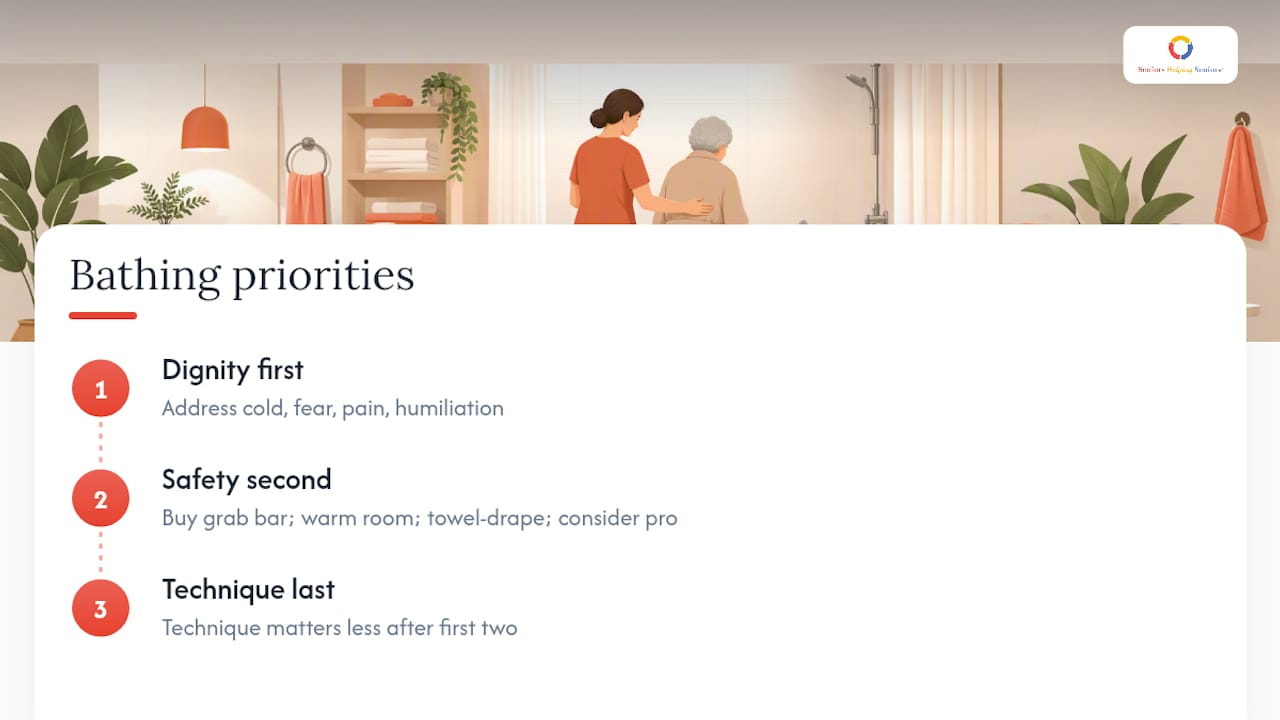
Here's what the research and the caregiving reality both point to: refusal is almost never about hygiene. It's about cold, fear of falling, pain, or the specific humiliation of being washed by your own child. Fix those four things and most of the "difficult" bathing situations families describe resolve on their own. Buy the grab bar, warm the room, use the towel-drape, and consider whether a professional caregiver might get further than you will, not because you're failing, but because the relationship itself is different.
The conventional advice obsesses over technique and skips the emotional physics of the situation. Prioritize dignity first, safety second as a close partner, and technique last. Get those first two right and the technique mostly takes care of itself.
— Cameron
A Different Kind of Bathing Help for Tucson Families
If reading through all of this made you realize you're already stretched thin, or that your back genuinely can't handle another transfer, that's worth listening to. Tucsonshs pairs your loved one with a mature, active caregiver, often a senior themselves, who brings the same towel-drape and stepwise techniques described here, minus the parent-child tension that makes bathing so fraught for families.

That match matters more than most families expect. A caregiver who has navigated her own aging body understands the fear of falling in a way a younger aide or an adult child often can't fully anticipate. Beyond bathing, Tucsonshs caregivers assist with the daily routines that surround it, dressing, mobility, medication reminders, so the bathroom isn't the only place where safety gets rebuilt. If you're weighing whether it's time for outside support, reach out to Tucsonshs to talk through your loved one's specific needs and see how a compatible caregiver match could work for your household.
Sources
- Bathing Assistance for Elderly: Caregivers Guide
- Alzheimer’s caregiving: bathing, dressing, and grooming
- CDC: Older adult falls data and research
- MedlinePlus: Bathing and skin care patient instructions