
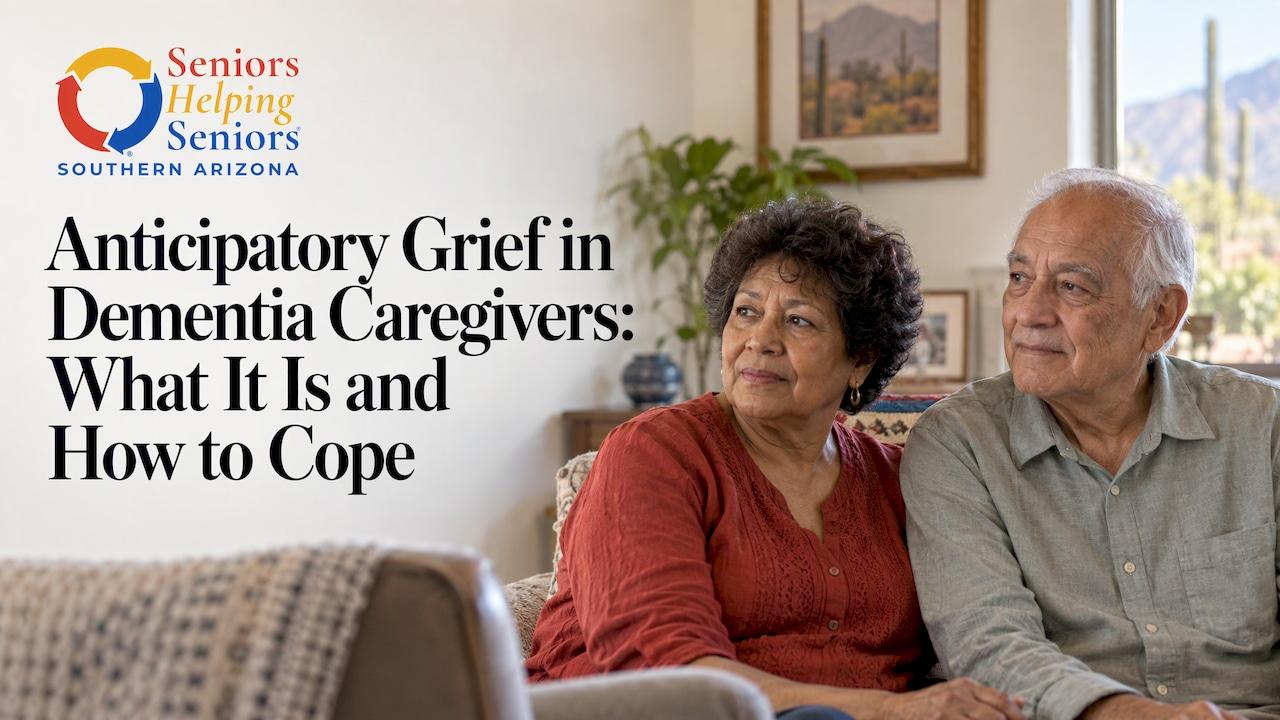
If you care for someone with dementia and you are already mourning them, nothing is wrong with you. This is anticipatory grief: sorrow for losses that have happened and for the ones you know are coming, felt while your person is still alive. It is common, it is real, and it is easier to carry when you have steady help. In Tucson, that help can mean a trained, mature caregiver who sits with your loved one so you can rest, grieve and breathe. Our caregivers at Seniors Helping Seniors® are seniors themselves, and families often tell us that this peer understanding makes the difference.
Key Takeaways
- Anticipatory grief is the sorrow of expecting a loss. In dementia it is often tied to ambiguous loss: the person is physically here but changing.
- Caregivers can feel this grief from the very start. One study found high anticipatory grief in family caregivers right after a diagnosis of mild cognitive impairment or Alzheimer's.
- Grief is not a phase you finish. You may feel it again with each new loss, and that is normal.
- Talking with someone you trust, joining a support group and taking regular breaks are the steps national dementia organizations recommend most.
- Respite is not a luxury. Having a trusted caregiver step in gives you room to grieve, rest and stay well for the long road.
Table of Contents
- What anticipatory grief means in dementia caregiving
- Why you can grieve someone who is still alive
- Signs of anticipatory grief
- Why it matters for your health
- Practical ways to cope
- What the research says about help that works
- How in-home help makes room for grief
- Care built around your family
- Our perspective
- FAQ
- Sources
What anticipatory grief means in dementia caregiving
Anticipatory grief is the emotional process of expecting a loved one's death. Alzheimer's Texas says it can be as powerful as grief after a death.
With dementia, the grief often starts earlier and looks different. Your husband may still be at the kitchen table, yet he no longer remembers your anniversary. Your mother may still hug you, yet she calls you by your sister's name. Researchers describe this as ambiguous loss: someone is physically present but psychologically changed. The same Alzheimer's Texas guide notes that caregivers may feel their loved one is already gone even though they are in the room.
A peer-reviewed model by Blandin and Pepin describes dementia grief as a particular kind of anticipatory grief, built from many losses stacked on one another. Changes in communication and in the person's awareness of their illness can make it harder to share feelings or settle old conflicts, even early on.
So if you are asking whether it is too soon to grieve, the answer is no. The losses are already happening.
Why you can grieve someone who is still alive
Most of the significant losses in dementia happen before death. The Blandin and Pepin model explains that these losses pile up as the disease progresses, from early memory and communication problems to later declines in cooking, driving and dressing. Because they come and go, and never arrive with a clear ending, there is no single moment to mourn. The authors point out that the median caregiving span is 5 to 8 years, so caregivers grieve again and again over a long stretch.

This is also why anticipatory grief can feel so tiring. Alzheimer's Texas explains that once you accept one level of impairment, another loss follows. Just when you adjust, the ground moves.
If you want to understand what each stage tends to bring, our family guide to Alzheimer's stages walks through progression and care in plain language.
The losses caregivers name most often
The Alzheimer Society of Canada lists many of them in its guide on ambiguous loss and grief. They include shared dreams and future plans, a confidant and partner, shared roles, driving, going out or being left alone, friendships, and eventually being recognized. Moving a loved one to long-term care and the need for help with personal care appear on that list too.
Many families do not think of these as griefs. They think of them as logistics. Naming them as losses is often the first relief.
Signs of anticipatory grief
Grief does not look the same in everyone. Alzheimer's Texas groups the symptoms in three ways:
| Type | What you may notice |
|---|---|
| Cognitive | Forgetfulness, disorientation, trouble making decisions, poor judgment, difficulty concentrating |
| Emotional | Sadness, loneliness, anger, irritability, guilt, depression, anxiety, numbness |
| Physical | Changes in sleep and eating, fatigue, body aches, agitation |
Source: Alzheimer's Texas, Coping with Anticipatory Grief
The Alzheimer's Association adds some signs you may recognize: hoping the person will get better, resenting the demands of caregiving, thinking "I should have done more," crying often and pulling away from friends. It also says caregivers may move through denial, anger, guilt, sadness and acceptance, and that these do not arrive neatly in order.
Guilt deserves its own mention. Many caregivers feel guilty for being angry, for needing time away, or for grieving at all. Our article on caregiver guilt looks at why it happens and how to manage it.
Who feels it most
Anticipatory grief is not rare, and it is not reserved for the late stages. A 2012 study of family caregivers found mean grief levels were already high among people caring for someone newly diagnosed with mild cognitive impairment or Alzheimer's. Being female, heavier caregiving burden and depression each predicted more grief.
Alzheimer's Texas also cites research showing that spouses caring for a partner in later-stage dementia report the highest levels of anticipatory grief and burden, compared with earlier-stage spousal caregivers and adult children. If you are caring for your husband or wife, you are carrying a double weight: you are a caregiver and you are losing your partner.
Why it matters for your health
Grief and exhaustion feed each other. According to the Minnesota Department of Health, dementia caregivers report twice as many substantial emotional, financial and physical difficulties as other caregivers, along with more depression and anxiety, poorer sleep and a higher risk of emergency room and hospital visits. The same page notes that in 2021 more than 11 million family members and friends provided 16 billion hours of unpaid dementia care in the United States.
Those numbers are not there to alarm you. They are there to say that your tiredness is not weakness. It is what this work does to people, and it is the reason to ask for help early.
A review of research on grief in family carers also found that limited use of services was linked with higher grief after the death. Reaching for support now matters for later too.
Practical ways to cope
There is no cure for grief, and nobody should promise one. But national dementia organizations agree on a set of steps that help people carry it.
1. Name it and let it be normal
Alzheimer Society guidance says that when grief is not acknowledged by the people around you, it becomes disenfranchised grief, which can be more debilitating. Naming and validating the loss is described as a useful first step. Say it out loud: "I am grieving, and he is still here."
2. Expect to grieve more than once
The Alzheimer's Association advises caregivers to prepare to experience grief more than once, to claim the process as their own, and to talk with someone they trust or a grief-counseling therapist. If your sadness is heavy, lasting, or comes with thoughts of hopelessness, please see your doctor or a licensed counselor.
3. Find people who understand
Alzheimer's Texas recommends dementia-specific support groups because caregivers learn their feelings are not unreasonable or atypical, so there is less need to push grief down. In Arizona, the Alzheimer's Association's Desert Southwest Chapter lists support groups, education and local resources for people from Phoenix to Tucson.
If you are sorting through what is available around you, a set of community resource guides can help you think through which kinds of local support to look for.
For immediate support at any hour, the Alzheimer's Association 24/7 Helpline is free at 800.272.3900. Specialists and master's-level clinicians offer confidential support, crisis help and local referrals, with interpreters in more than 200 languages. Dial 711 to use a TRS operator.
4. Keep a few things that are yours
Keep up enjoyable activities, make time for grieving, journal, take a walk at dusk when the Tucson heat eases. Alzheimer's Texas also lists mindful meditation, spirituality and self-compassion among the steps that help. Small, regular things add up more than a big weekend away that never happens.

5. Take respite breaks before you need them
The Minnesota Department of Health lists respite care among the supports caregivers say they need, alongside classes, help accessing services, support groups and individual counseling. Alzheimer's Texas likewise lists respite and attendant care. Rest is how you stay able to grieve without breaking.
6. Stay close to the person, in new ways
Grieving the old relationship does not mean losing the new one. Shared moments still matter, even when memory is fading. Our guides to reminiscence activities and memory care activities that work offer easy ways to connect, and our piece on daily habits for emotional support covers small routines that comfort both of you.
What the research says about help that works
A 2026 scoping review of 30 articles found that spousal caregiving and heavier involvement were linked with higher anticipatory grief, while adaptive coping and social support were generally linked with lower grief. Approaches that focus on acceptance and preparedness showed promise.
A 2026 meta-analysis in The Gerontologist looked at psychosocial programs and found a long-term improvement in anticipatory grief at six months or more, along with short-term reductions in depression. The takeaway for a busy family is simple: support builds over time, so start early and keep going.
How in-home help makes room for grief
Grief needs space, and a full-time caregiver has very little. When you are managing medications, meals, bathing, wandering and sleepless nights, there is no hour left to cry, rest or sit with a friend. That is where in-home help changes things.
At Seniors Helping Seniors® Tucson, our caregivers are mature adults, often seniors themselves, matched with clients for shared life experience. For a person with dementia, that can mean a companion who understands what it is to have a long life behind you. For you, it can mean an afternoon off with peace of mind.
What we offer that fits this season of caregiving:
- Respite care so you can rest, attend a support group or see a counselor.
- Overnight care so you can sleep, which grief and fatigue both make harder.
- Dementia and Alzheimer's care for daily routines, safety and companionship.
- Companion care for conversation, walks and time together.
- Transportation and errands for appointments and groceries, so one more task leaves your list.
If you are weighing options at home, our complete guide to in-home memory care explains what it looks like, and our post on caring for a parent with dementia in Sierra Vista covers routine and safety for families in southern Arizona.
Care built around your family
We serve families in Tucson, Corona de Tucson, Tucson Estates, Green Valley and Sierra Vista. Our caregivers are vetted, insured and live in the communities they serve. Scheduling is flexible, with no minimums and no long-term contracts, so you can start with a few hours and adjust as needs change.

If you are ready to talk about what a few hours of help could look like, see our in-home care services or visit Seniors Helping Seniors Tucson to reach our team. If your loved one is coming home from a hospital or rehab stay, our Return Home Transitional Care is built for that moment.
Our perspective
We sit at kitchen tables with families every day, and the same thing comes up in different words: "I feel like I'm losing her, and I feel guilty for saying it." We want you to hear that this is not a failure of love. It is love, meeting loss.
Our caregivers are seniors too. They know what it is to age, to lose friends, to wonder who will remember them. That shared experience is why we match caregivers and clients by life experience, not just by schedule. A person with dementia deserves dignity and a companion who meets them where they are. A family caregiver deserves to know someone kind is there, so they can step out, rest and feel what they feel.
Grief in dementia is not one wave. It comes back with every change. That is why we believe support should be flexible, with no minimums or long-term contracts, so it can grow or shrink as your family's needs do.
Please do not wait until you are exhausted. A few hours of respite, a good night's sleep, a support group, a phone call to the helpline: these are not extras. They are how you keep going with your heart intact.
Cameron
FAQ
Is anticipatory grief the same as depression?
No, though they can overlap. Anticipatory grief is a response to expected loss, and it often includes sadness, anger and guilt. Research found that depression and higher caregiving burden each predicted more anticipatory grief. If your low mood is constant, interferes with daily life, or you feel hopeless, talk with your doctor or a licensed counselor.
Is it normal to feel relief as well as sadness?
Yes. The Alzheimer's Association says it is normal to feel loss while caring for someone with Alzheimer's, and Alzheimer's Texas lists ambivalence and mixed emotions among common reactions. Feeling relief when a hard day ends does not cancel your love. It means you are human.
How do I get help for dementia caregiving right now?
Call the Alzheimer's Association 24/7 Helpline at 800.272.3900. It is free, confidential and open around the clock every day of the year, and it offers local referrals and crisis help. For in-home help in southern Arizona, our team can talk through respite, overnight and dementia care.
Does grief end after my loved one dies?
Not all at once. Researchers note that final resolution of dementia grief typically cannot occur until physical death. Many caregivers find that years of grieving along the way softens what comes after, but every person's path is their own.
Sources
- Alzheimer's Texas: Coping with Anticipatory Grief
- Alzheimer's Texas: Anticipatory Loss, Grief, and Dementia
- Blandin and Pepin, Dementia Grief: A Theoretical Model
- Garand et al., Anticipatory Grief in New Family Caregivers
- Alzheimer Society of Canada: Supporting Clients Through Ambiguous Loss and Grief
- Alzheimer Society of Montreal: Ambiguous Loss and Grief
- Alzheimer's Association: Coping with Grief and Loss in Alzheimer's Caregiving
- Alzheimer's Association 24/7 Helpline
- Alzheimer's Association Desert Southwest Chapter
- Minnesota Department of Health: Alzheimer's Disease and Related Dementias Information for Caregivers
- International Psychogeriatrics: Grief in family carers of people living with dementia
- Scoping review: Anticipatory grief among caregivers of people living with dementia
- The Gerontologist: Effectiveness of psychosocial interventions for anticipatory grief
- WellCheck: Community Resource Guides for Health Advocates