
You may qualify for ALTCS home care in Arizona if you need nursing-facility-level care as measured by the Pre-Admission Screening (PAS) and Home and Community Based Services Needs Tool (HNT), and your income and resources fall within AHCCCS financial limits. Both AHCCCS and its assessors administer this two-track test. If you think you might qualify, a Private Request PAS can confirm the medical side before you commit to a full application.
TL;DR:
- Nearly all applicants qualify if they are Arizona residents over 65 or with disabilities, need help with at least two activities of daily living, and have resources near or below about $2,000.
- The PAS score of 60 or higher indicates immediate risk of institutionalization, which is the primary threshold for ALTCS approval for home or facility care.
- Most income, including Social Security and pensions, counts toward eligibility limits, but exemptions like a primary residence, one vehicle, and burial funds are allowed.
- A 60-month look-back period applies to transfers, with penalties resulting from gift or asset transfers below fair value, unless they involve spouses, disabled children, or specific trusts.
- Accurate documentation, especially a 30-day log of daily assistance, is essential for a correct PAS score, which significantly influences approval and care plan details.
Table of Contents
- Quick Checklist: Who Likely Qualifies for ALTCS Home Care
- How Do the PAS and HNT Assessments Work?
- What Are the Financial Eligibility Rules for ALTCS?
- How Do Transfers and the Look-Back Period Affect Eligibility?
- What Are the Steps to Apply for ALTCS Home Care?
- What Home-Based Services Does ALTCS Cover?
- Can a Local Home Care Provider Help With the ALTCS Process?
- A Local Perspective on Avoiding ALTCS Mistakes
- How Tucson Seniors Helping Seniors Supports ALTCS Families
- Sources
Quick Checklist: Who Likely Qualifies for ALTCS Home Care
Before you spend hours gathering paperwork, run through this self-screen. It won't replace a formal review, but it tells you whether it's worth pursuing.
You likely meet the baseline if:
- You're an Arizona resident who is 65 or older, blind, or living with a qualifying disability.
- You're a U.S. citizen or qualified immigrant under AHCCCS rules.
- You need hands-on help with at least two or three activities of daily living, such as bathing, dressing, or transferring from a bed to a chair.
- You or a family member has noticed memory loss, wandering, or behavior that puts you at real risk if left alone.
- Your countable resources sit near or below the typical modest limit for a single applicant, not counting your home, one vehicle, or a burial fund.
If the medical picture is unclear but you want an early read, request a Private Request PAS. If you're unsure whether your income disqualifies you, call the AHCCCS ALTCS intake line before you fill out anything. A ten-minute phone call can save weeks of wasted paperwork.
How Do the PAS and HNT Assessments Work?
The Pre-Admission Screening is the gatekeeper for ALTCS home care eligibility, and it's conducted by a registered nurse or social worker. The assessment happens face-to-face, by phone, or virtually, and its only job is to determine whether you need the kind of care typically given in a nursing facility.
The PAS instrument combines a functional score and a medical score into one total. A combined score of 60 or higher signals immediate risk of institutionalization, which is the threshold ALTCS uses to approve nursing-facility-level care, whether that care happens in a facility or at home through HCBS. The HNT then takes that clinical picture and helps translate it into an actual authorization for home-based hours.
Assessors look at a specific, itemized list drawn from the PAS tool template, including:
- Bathing, dressing, toileting, and transferring ability
- Mobility, including fall risk and use of assistive devices
- Cognitive status, orientation, and behavioral or emotional symptoms
- Medical interventions such as wound care, injections, IV therapy, or ventilator support
- Skilled nursing needs that require professional oversight rather than family help
Scoring depends heavily on documentation covering the last 30 days of functional history, not a single diagnosis on a chart. A single fall six months ago won't move the needle the way a documented pattern of daily assistance will.
Pro Tip: Ask a caregiver, home health aide, or family member to write down exactly what help was given each day for the past month, including how long it took and whether the person could do it alone. That daily log often matters more to the score than a doctor's diagnosis.
If you only want to confirm medical eligibility before dealing with finances, a Private Request PAS is worth considering. It can indicate likely eligibility for up to 180 days, but keep in mind a PRP result can't be appealed the way a full application decision can.
What Are the Financial Eligibility Rules for ALTCS?
Meeting the medical threshold gets you halfway there. The other half is financial, and it trips up more applicants than the PAS does.
AHCCCS counts most regular income, including Social Security, pensions, and annuities, toward your eligibility limit. Some income is excluded, including certain difficulty-of-care payments made to family caregivers under IRS rules. For resources, a single applicant generally needs countable assets at or below a modest limit, commonly cited around $2,000, though the exact figure is set by AHCCCS and can change, so verify the current number directly with the agency rather than relying on any article, including this one.
Common exemptions that don't count against you:
- Your primary residence, up to an equity limit set by AHCCCS
- One vehicle, regardless of value
- A pre-paid burial plan or designated burial fund
- Certain household goods and personal effects
If you're married, spousal impoverishment protections matter enormously. The Minimum Monthly Maintenance Needs Allowance (MMMNA) protects a portion of household income for the spouse who isn't applying, so the community spouse isn't left destitute while the other qualifies for care. Without this protection, families could be forced to spend down nearly everything before either spouse gets help.
When income exceeds the limit but assets don't, a Miller trust (also called an income-only or qualified income trust) is a common planning tool. It redirects excess income into a trust so the applicant's countable income falls back under the ALTCS limit. Setting one up correctly is not a do-it-yourself project. Talk to an elder law attorney before assuming a trust will fix an income problem, and always check AHCCCS's own published figures before making decisions based on limits that may have shifted.
How Do Transfers and the Look-Back Period Affect Eligibility?
Arizona applies a 60-month look-back to review transfers made before you apply. If AHCCCS finds you gave away money or property for less than fair value during that window, you can face a penalty period during which ALTCS won't pay for care.

The penalty is calculated by dividing the total uncompensated transfer amount by Arizona's average private-pay nursing home rate. Give away $60,000 and the resulting penalty could stretch for months, depending on that rate at the time of your application.
Standard exceptions exist:
- Transfers to a spouse
- Transfers to a blind or permanently disabled child
- Certain transfers into specific trusts for the sole benefit of a disabled individual
If you or a family member made any significant transfers in the past five years, gather every record now: bank statements, deeds, gift letters, anything showing the transaction's purpose and value. Applying without that documentation ready is one of the most common reasons cases stall. For six-figure transfers, talk to an attorney before you file, not after AHCCCS flags it.
What Are the Steps to Apply for ALTCS Home Care?
The application process has a rhythm to it, and knowing the sequence helps you avoid the delays that trip up first-time applicants.
- Start the application through HealtheArizonaPlus or by contacting AHCCCS intake directly.
- Request a PAS or PRP to establish medical eligibility, especially if you're unsure whether you'll qualify.
- Submit financial documentation for the income and resource review.
- Get assigned to an ALTCS health plan, which manages your ongoing care once approved.
- Meet your case manager, who authorizes your specific care plan and home-based service hours.
You'll need a fairly thick folder to move through this smoothly: identification, Social Security number, recent income statements, bank and investment records, property deeds, and medical records including discharge summaries and therapy notes. The DE-828 applicant brochure from AHCCCS lays out the full document list in one place.
Timelines vary, but PAS assessments typically happen within a few weeks of request, while financial determination and care-plan authorization can take longer if paperwork is incomplete. Missing bank statements or unclear property records are the single biggest cause of delay. If your application is denied, you have the right to appeal. A PRP denial doesn't carry that same right, since it's a pre-screen rather than an official determination.
What Home-Based Services Does ALTCS Cover?
Once approved, ALTCS members receive Home and Community-Based Services designed to keep people out of institutional care. Coverage includes attendant and personal care, homemaker services, skilled nursing visits, physical, occupational, and speech therapy, respite care for family caregivers, home modifications when medically necessary, durable medical equipment, and adult day health programs.
Your case manager translates your PAS/HNT results into a specific number of authorized hours and services, then reviews that plan periodically as your needs change. In some situations, a family member can be paid as a caregiver, and certain difficulty-of-care payments to that family caregiver may be excluded from taxable income under IRS guidance. Ask your case manager directly whether that option applies to your household.
Can a Local Home Care Provider Help With the ALTCS Process?
Getting an accurate PAS score often comes down to documentation, and that's where a provider already inside your home has an advantage. Seniors Helping Seniors® Tucson matches clients with mature, active caregivers, many of them seniors themselves, which supports both the daily assistance ALTCS looks for and the social connection HCBS programs are designed to protect.
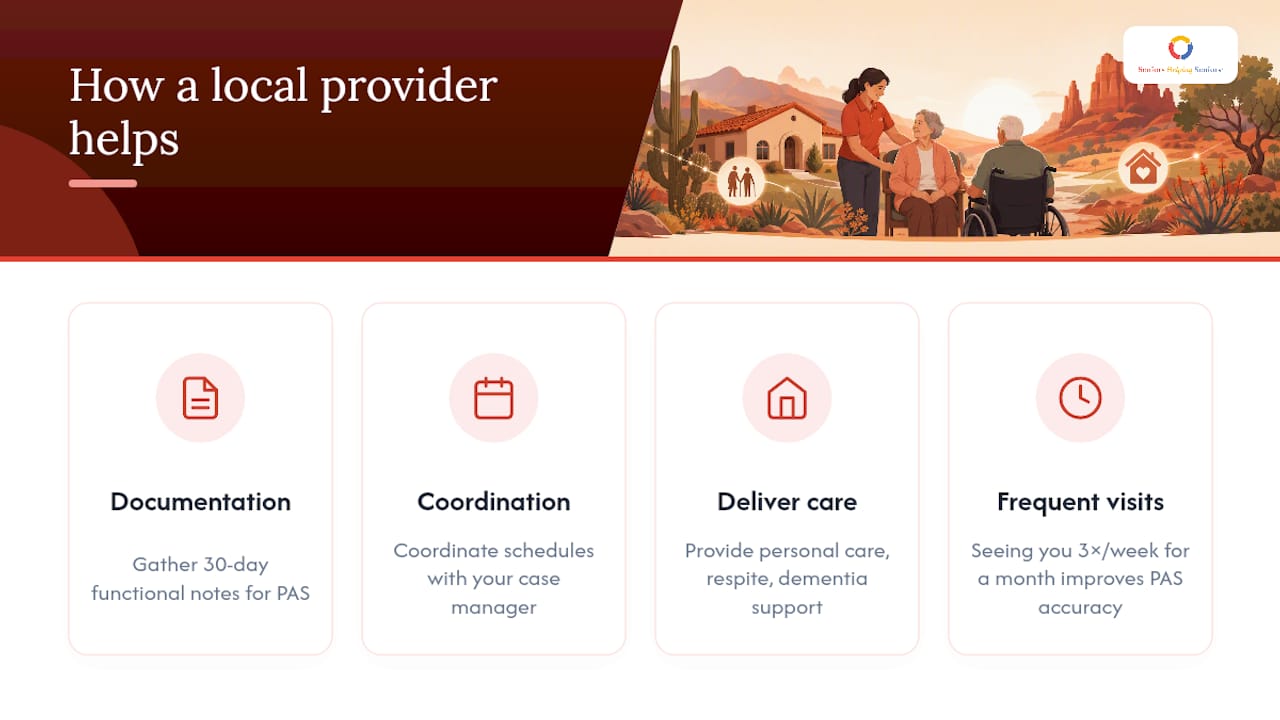
In practice, that means caregivers can help gather the 30-day functional notes assessors want, coordinate schedules with your case manager, and deliver the personal care, respite, or dementia support hours ALTCS authorizes once you're approved.
A caregiver who sees you three times a week for a month can describe your actual daily needs far more precisely than a single clinical visit ever could. That kind of documentation is often what separates an accurate PAS score from an undercounted one.
Always confirm current eligibility rules and numeric limits directly with AHCCCS before finalizing any care decision.
A Local Perspective on Avoiding ALTCS Mistakes
The most common mistake I see isn't financial. It's applicants showing up to their PAS assessment without any record of what daily help actually looked like over the past month, so the score comes in lower than the real need. Start a simple ADL log today, and request a PRP if you're genuinely unsure. Then call AHCCCS intake or a trusted local provider before you file anything.
— Cameron
How Tucson Seniors Helping Seniors Supports ALTCS Families
Tucsonshs offers exactly the kind of in-home services ALTCS home care is built around: personal care, companionship, respite for family caregivers, and dementia support delivered by caregivers matched for compatibility and life experience, not just availability. Unlike navigating this process alone, families working with Tucsonshs get help coordinating with case managers and organizing the documentation that shapes an accurate PAS score.
If you're preparing for an ALTCS assessment or already have authorized hours and need a provider who understands how the program works, contact Tucson In-Home Senior Care for a consultation. A short conversation now can save a stalled application later.
This article is general information, not a substitute for advice from a qualified doctor. Consult a qualified healthcare professional about your own circumstances before acting on anything here.
Sources
- EPM: Chapter 1000 Pre-admission Screening — AHCCCS
- Ariz. Admin. Code § R9-28-304 - Preadmission Screening Criteria (LII)