

Aid and Attendance is a VA pension enhancement (or, for service-connected veterans, an added Special Monthly Compensation payment) that gives eligible wartime veterans and surviving spouses tax-free monthly income to help cover long-term care. In 2026, a single veteran can receive up to $2,795 a month, a married veteran up to $3,314, and a surviving spouse up to $1,806, on top of the base pension. Qualifying comes down to one core question: does the applicant need regular help with daily living, or are they housebound?
TL;DR:
- Filing an Intent to File locks in benefits eligibility and can lead to substantial retroactive payments, so start with this step before gathering documents.
- Unreimbursed medical expenses above 5% of the MAPR can significantly reduce your income calculation, potentially qualifying you even if assets appear too high initially.
- Aid and Attendance payments are adjusted based on fixed MAPR amounts for pension-based benefits or are fixed amounts based on disability severity for SMC, with the latter not influenced by income.
- Gathering comprehensive medical documentation from any qualified physician and organizing financial records beforehand helps avoid delays and ensures accurate benefit calculations.
- Families should avoid paying for unaccredited help or making risky asset transfers, as improper asset restructuring or scams can result in penalties or delays of years.
Table of Contents
- What Is the Aid and Attendance Benefit, and How Does It Fit With VA Pension and SMC?
- What Are the Medical Eligibility Rules for Aid and Attendance?
- What Are the Financial Eligibility Rules: MAPR, Net Worth, and the Look-Back Period?
- How Much Does Aid and Attendance Pay in 2026?
- How Do You Apply for Aid and Attendance? Forms, Filing Methods, and Timeline
- What Documents Do You Need to Apply?
- What Can Aid and Attendance Pay for, and How Is It Taxed?
- Who Can Help You Apply, and What Scams Should You Watch For?
- Using Aid and Attendance to Pay for In-Home Care
- The Real Gap in How People Approach Aid and Attendance
- Sources
What Is the Aid and Attendance Benefit, and How Does It Fit With VA Pension and SMC?
Aid and Attendance isn't a program you apply for on its own. It's an add-on to an existing benefit, and there are two separate tracks that get confused constantly.
The first is pension-based A&A. This requires the veteran or surviving spouse to already qualify for the VA Improved Pension, which is means-tested and open to wartime veterans with limited income and net worth. The second track is Special Monthly Compensation, specifically SMC-L and above, reserved for veterans with service-connected disabilities. SMC A&A isn't means-tested at all. It's paid based on the severity of a connected condition, regardless of income.
One rule trips up a lot of applicants: you cannot receive both Aid and Attendance and Housebound at the same time. If you qualify for both, the VA simply pays whichever rate is higher.
What Are the Medical Eligibility Rules for Aid and Attendance?
The VA looks at functional need, not diagnosis. A veteran or surviving spouse can qualify by showing they need help with one or more activities of daily living, or that they meet another recognized threshold entirely.
Qualifying conditions include:
- Needing help bathing, dressing, eating, using the toilet, or transferring in and out of bed or a chair
- Requiring regular assistance to protect against the hazards of daily living, including cognitive supervision for dementia or similar conditions
- Being a patient in a nursing home due to mental or physical incapacity
- Being bedridden for a significant part of the day
- Having corrected vision of 5/200 or worse in both eyes, or a severely contracted visual field
A private or VA physician documents all of this on VA Form 21-2680, the standard medical certification. This form doesn't need to come from a VA doctor. A private physician or a nursing facility's medical director can complete it, which removes a common bottleneck for families juggling appointments.
What Are the Financial Eligibility Rules: MAPR, Net Worth, and the Look-Back Period?
Pension-based A&A runs on a formula: your VA pension payment equals the Maximum Annual Pension Rate (MAPR) minus your countable income. MAPR is the income ceiling the VA sets each year for your household category, and it doubles as the maximum benefit amount.
Two other numbers matter just as much:
- Net worth limit: For 2026, the ceiling is $163,699, combining assets and annual income. Your primary residence, one vehicle, and personal belongings don't count toward that figure.
- 36-month look-back: The VA reviews asset transfers made in the 36 months before you apply. Transfers made to get under the net worth limit, such as gifting savings to a family member, can trigger a penalty period during which you're ineligible for pension-based benefits.
Pro Tip: Unreimbursed medical expenses above 5% of the MAPR threshold get deducted from your countable income, dollar for dollar. In-home caregiver fees, assisted living costs, and even mileage to medical appointments count. This deduction is often the single biggest lever that turns an "ineligible" applicant into an approved one.
How Much Does Aid and Attendance Pay in 2026?
The VA adjusts MAPR figures annually for cost-of-living, and 2026 rates reflect that increase. Payments are federal tax-free, and the VA does not issue a 1099 or W-2 for them.
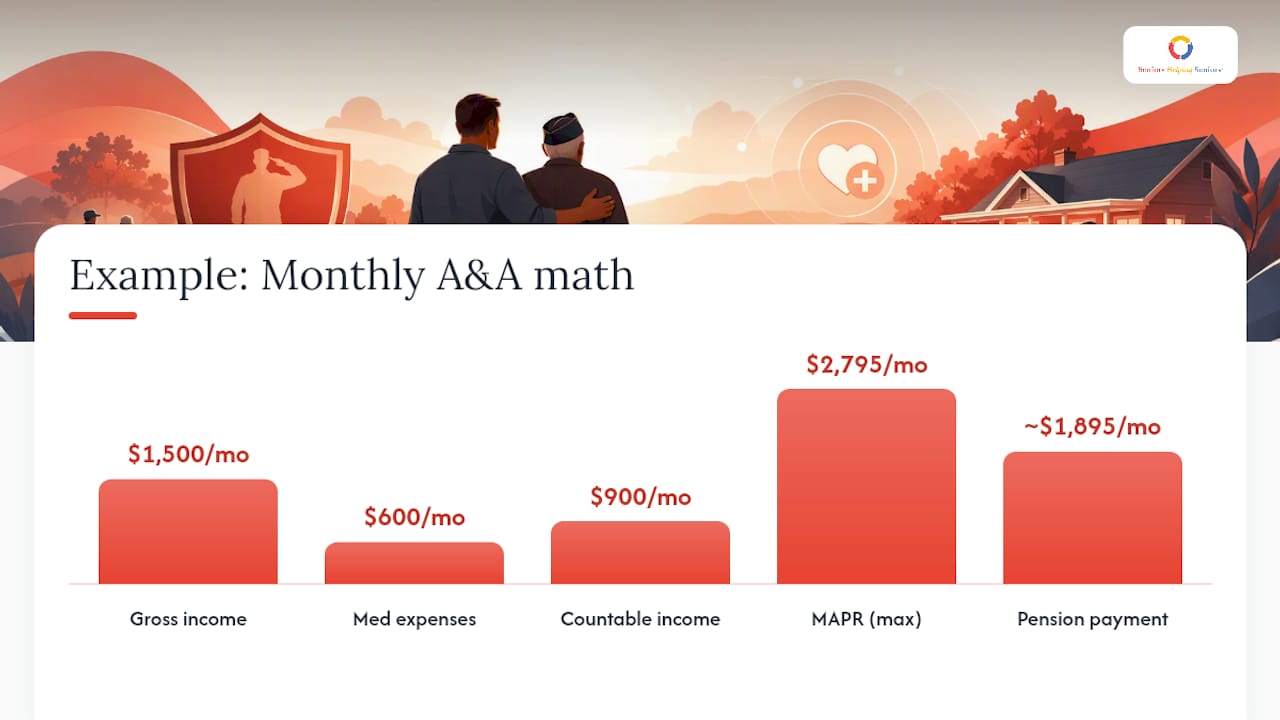
Here's how the math plays out. A single veteran with $1,500 in monthly income and $600 in unreimbursed monthly medical expenses (above the 5% threshold) has that $600 subtracted from countable income, bringing it down to $900. Subtract that from the $2,795 MAPR, and the monthly pension payment comes to roughly $1,895.
SMC-based A&A works differently. Those tiers pay a set amount tied to disability severity and aren't reduced by income at all, which is why service-connected veterans often see higher, more stable payments than pension-based recipients with similar care needs.
How Do You Apply for Aid and Attendance? Forms, Filing Methods, and Timeline
The application path depends on which track applies to you, but the sequence is largely the same for everyone.
- File an Intent to File first. Submitting VA Form 21-0966 locks in an effective date, so once your full claim is approved, the VA can pay you retroactively back to that filing date, even if it takes months to gather documents.
- Complete the correct pension or compensation form. Pension-based applicants file VA Form 21P-527EZ; surviving spouses file 21P-534EZ; veterans pursuing SMC file VA Form 21-526EZ.
- Attach VA Form 21-2680, completed by a physician, to document the specific ADL limitations or medical condition.
- Submit through your preferred channel: online via AccessVA/VA.gov, by mail to the Pension Management Center, or in person at a VA regional office.
- Track your claim status and respond quickly to any VA request for additional evidence.
Pro Tip: A "fully developed claim," meaning you submit all medical and financial evidence up front instead of letting the VA gather it, typically moves through review faster than a standard claim. Incomplete medical evidence is the single most common cause of processing delays.
What Documents Do You Need to Apply?
Gathering paperwork before you file saves weeks of back-and-forth. Build a folder with these items before submitting anything:
- DD-214 or equivalent discharge document proving character of discharge and dates of wartime service
- Bank statements, investment account summaries, and property deeds showing current net worth
- Completed VA Form 21-2680, signed by a physician or facility medical director
- Nursing home or assisted living agreements, if applicable
- Receipts or invoices for paid caregiver services, used to support medical-expense deductions
- Marriage certificate and veteran's death certificate, for surviving spouse claims
- Social Security numbers for the applicant and any dependents
Missing even one financial document is a common reason claims stall in review.
What Can Aid and Attendance Pay for, and How Is It Taxed?
A&A funds are flexible. They can pay for in-home caregivers, including a family member acting as a paid caregiver, assisted living fees, nursing home costs, adult day care, and durable medical equipment like hospital beds or wheelchairs.
At the federal level, the benefit is not taxable income. The VA does not report it on a 1099 or W-2, and the VA Office of General Counsel has confirmed this treatment under federal statute.
State Medicaid treatment is a different story. Some states count A&A as income when determining Medicaid eligibility for long-term care; others exclude it or treat it as a deductible medical expense. If you're weighing A&A alongside Medicaid home care coverage, check your state's specific rules or talk to an elder law professional before assuming the two benefits stack cleanly.
Who Can Help You Apply, and What Scams Should You Watch For?
VA regional offices and accredited Veterans Service Organizations, such as the DAV or VFW, provide free help preparing and filing claims. There's no legitimate reason to pay someone a fee just to fill out a pension application.
Before working with anyone claiming to specialize in VA benefits, verify their accreditation through the VA's own accreditation search. So-called "pension poachers" sometimes pressure elderly applicants into irrevocable trusts or annuities to artificially lower net worth, moves that can trigger the 36-month look-back penalty and cause real financial harm.
Pro Tip: If anyone suggests transferring assets to qualify faster, or charges an upfront fee to "guarantee approval," stop and consult an accredited attorney instead. Asset restructuring done wrong can delay your benefit by years.
Using Aid and Attendance to Pay for In-Home Care
Once approved, many families use A&A specifically to pay for help at home rather than moving a parent into a facility. Doing this cleanly for VA purposes, and for maximizing your medical-expense deduction, means keeping organized records.
- Keep dated invoices or receipts from your caregiver or agency every month
- Track hours worked and services provided, since generic "cash paid" notes invite scrutiny during VA review
- Confirm whether a family caregiver receiving payment needs to report that income separately
The service matches clients with mature, active caregivers, often seniors themselves, based on shared life experience rather than just scheduling availability. That model, built on the idea that companionship and practical help go together, pairs naturally with A&A funds earmarked for in-home senior care. Families in various communities use benefits like this to cover this kind of paid, documented support at home.
If you're ready to explore what in-home care actually costs and how A&A funds can offset it, Seniors Helping Seniors Tucson's home care services page walks through available service packages for local families.
The Real Gap in How People Approach Aid and Attendance
Most of the confusion around this benefit isn't about eligibility rules. It's about sequencing. Families spend weeks gathering financial documents before filing anything, not realizing that an Intent to File takes five minutes and locks in months of potential back pay. That single form is the most underused tool in the entire process.
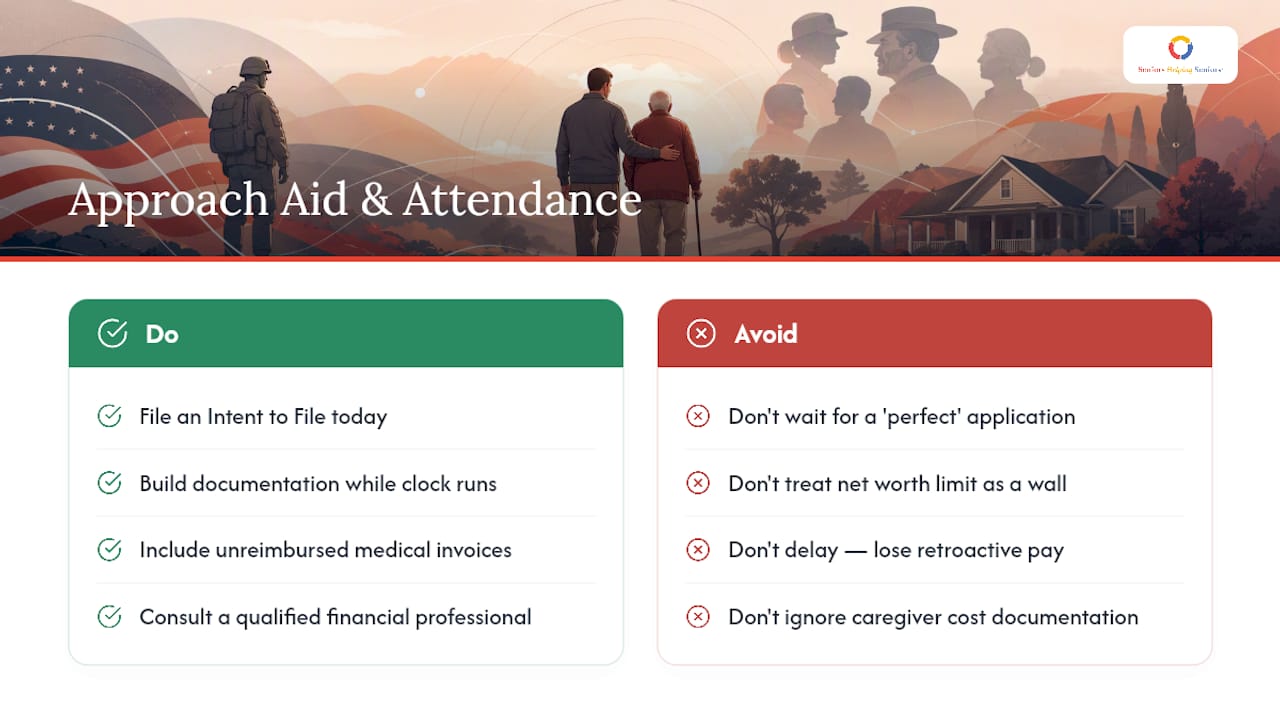
The second miscalculation is treating the net worth limit as a wall instead of a lever. Unreimbursed medical expenses, especially ongoing in-home care costs, pull countable income down fast. I've seen the math work the way it's supposed to: a veteran who looks "too well-off" on paper qualifies easily once real caregiver invoices enter the picture. That's not a loophole. It's the VA acknowledging that long-term care is expensive and income on paper doesn't reflect income after care costs.
If you take one thing from this, file the Intent to File today, then build your documentation. Waiting for a perfect application before starting the clock costs real money, sometimes thousands of dollars in retroactive payments you'll never recover.
— Cameron
This article is general information, not a substitute for advice from a qualified financial advisor. Consult a qualified financial professional about your own circumstances before acting on anything here.
Sources
- Pension rates (VA)
- Tax season guidance for veterans (VA News)
- How to apply for pension benefits (VA)