

Call your hospital discharge planner today, get written medication orders from the attending clinician, and contact a vetted non-medical in-home care provider such as Seniors Helping Seniors® Tucson and confirm they can begin services within 24–48 hours of discharge, following expert guidance that recommends in-home care should start within 48 hours when possible. That three-step sequence is the fastest way to get after-hospital home care moving before your loved one leaves the building.
Three actions to take right now:
- Get written orders. Ask the clinician for a printed medication list, dosing schedule, and any activity restrictions before discharge.
- Confirm payer basics. Speak with the hospital social worker about VA benefits, Medicaid HCBS waivers, long-term-care insurance, or private pay so cost doesn't stall the start.
- Call two providers who accept same-day starts. Confirm they serve your Tucson address, can begin within 48 hours, and offer a written service agreement. Hospital lists are a starting point, not a guarantee of current availability.
Key Takeaways
Early, consistent non-medical home care, starting within 48 hours of discharge, is thought to be an effective step a Tucson family can take to reduce readmission risk and support a safe recovery at home.
| Point | Details |
|---|---|
| Start planning at admission | Contact the discharge planner on day one; don't wait until the morning of discharge. |
| Get everything in writing | Collect a printed medication list, discharge instructions, and a signed agency care agreement before leaving the hospital. |
| Schedule within 24–48 hours | Guidance targets in-home care starting within 48 hours of discharge to reduce readmission risk. |
| Match the caregiver carefully | Shared life experience improves medication adherence, emotional support, and early detection of warning signs. |
| Tucsonshs is a local option | Seniors Helping Seniors® Tucson offers same-day or 48-hour post-discharge starts with matched, background-checked caregivers. |
Table of Contents
- What should you arrange before your loved one leaves the hospital?
- What does non-medical after-hospital home care actually include?
- How do you quickly vet an in-home care agency?
- What should the first 72 hours at home look like?
- How much does non-medical home care cost, and how do you pay for it?
- What does the evidence say, and when should you call for help?
- A note from a Tucson perspective
- Seniors Helping Seniors® Tucson is ready to start after your discharge
- Sources
What should you arrange before your loved one leaves the hospital?
AARP's caregiver transition guidance is clear: discharge planning starts on admission day, not the morning of discharge. Work through this checklist in order.
- Day 1 of the hospital stay: Introduce yourself to the discharge planner or social worker. Ask when discharge is expected and what written orders will be provided.
- 48 hours before discharge: Confirm the attending clinician has documented that non-medical in-home support is appropriate. Request a printed medication list with exact doses, timing, and any new prescriptions.
- 24 hours before discharge: Call your chosen agency. Confirm they serve the home address, can schedule a first visit within 24–48 hours, and have a caregiver available who matches language needs. Ask about equipment delivery timing if a hospital bed, commode, or mobility aid is needed. Selecting the right home recovery equipment before arrival prevents scrambling on day one.
- Day of discharge: Have a family point person present for the discharge briefing. Collect printed discharge instructions, follow-up appointment dates, and direct contact numbers for the hospital team. Sign the agency's written care agreement before leaving, if available.
- Right of choice: Hospitals must provide a provider list and disclose any financial interest in referred agencies. You are free to choose any provider regardless of that list.
Pro Tip: Call your preferred agency while still on the ward. Most can accept verbal orders and schedule the first visit immediately, which means a caregiver can be at the door within hours of arrival home.
What does non-medical after-hospital home care actually include?
The phrase "after hospital home care" covers two very different services. This article and Seniors Helping Seniors® Tucson address the non-medical side: companionship, personal care, and daily living support provided by mature caregivers. It does not mean skilled nursing, wound care, IV therapy, or physical therapy — those are clinical home health services arranged separately through a licensed home health agency.
| Included (non-medical) | Not included (requires clinical home health) |
|---|---|
| Companionship and conversation | Wound dressing changes |
| Bathing, dressing, toileting (ADLs) | IV medication administration |
| Meal preparation and grocery shopping | Injections or catheter care |
| Light housekeeping | Physical, occupational, or speech therapy |
| Transportation to follow-up appointments | Skilled nursing assessments |
| Medication reminders (not administration) | Physician-ordered medical monitoring |
If your loved one needs both, arrange the clinical home health referral through the discharge planner and the non-medical support separately. The two services run in parallel and do not overlap.
How do you quickly vet an in-home care agency?
UCI Health geriatricians advise starting the search early and prioritizing a consistent, compatible caregiver. "Stable" in the hospital does not mean independent at home. Use this screen on your first call.
Questions to ask every agency:
- Can you start within 24–48 hours at this Tucson address?
- What is your minimum visit length and scheduling flexibility?
- How do you match caregivers to clients? Do you consider shared life experiences or interests?
- What background checks do you run, and how often do caregivers receive ongoing training?
- Can you provide a written service agreement and a first-72-hour care plan before the initial visit?
- What is your escalation protocol if a caregiver notices a health change?
Red flags to watch for:
- No written service agreement offered
- Unable or unwilling to provide references
- No documented background check process
- Rigid scheduling with no after-hours or weekend coverage
- Vague or absent escalation protocol
The Family Caregiver Alliance recommends treating caregiver matching — shared experiences, interests, and temperament — as a quality signal, not a bonus. A caregiver who genuinely connects with your parent is more likely to notice subtle changes, encourage medication adherence, and provide the emotional support that keeps recovery on track.
Pro Tip: Favor agencies that document a first-72-hour response plan in writing. That document tells you the agency has thought through the highest-risk window of post-hospital recovery.
What should the first 72 hours at home look like?
The first three days carry the highest readmission risk. A clear schedule prevents the small oversights that send people back to the emergency department.
Arrival through hour 24:
- Caregiver arrives within the agreed window (ideally within 2–4 hours of the patient arriving home).
- Walk through the written medication list together. Confirm every medication is on hand and the timing is understood.
- Check hydration: offer fluids immediately and set a reminder every two hours.
- Complete a quick bathroom safety check: grab bars secure, path clear, nightlight working.
- Confirm any equipment (hospital bed, commode, walker) is set up and functional.
Hours 24–48:
- Conduct a medication reconciliation check: compare what was taken against the written list.
- Note any wound sites per discharge instructions and flag changes to the clinician, not the caregiver.
- Establish a toileting schedule, including overnight support if needed.
- Confirm the follow-up appointment is scheduled and transportation is arranged.
Hours 48–72:
- Assess appetite, sleep quality, and mood. Decline in any of these warrants a call to the clinician.
- Review the care plan with the caregiver and adjust the schedule if needed.
- Confirm the after-hours and weekend contact plan.
Hand this to the caregiver on the first visit:
- Printed medication list with times and doses
- Discharge instructions from the hospital
- Follow-up appointment date, time, and location
- Clinician's direct phone number
- Family emergency contact
- When to call 911 vs. when to call the clinician
How much does non-medical home care cost, and how do you pay for it?
Pricing for non-medical companionship and personal-care support varies by market and service intensity. The figures below are illustrative ranges for planning purposes.
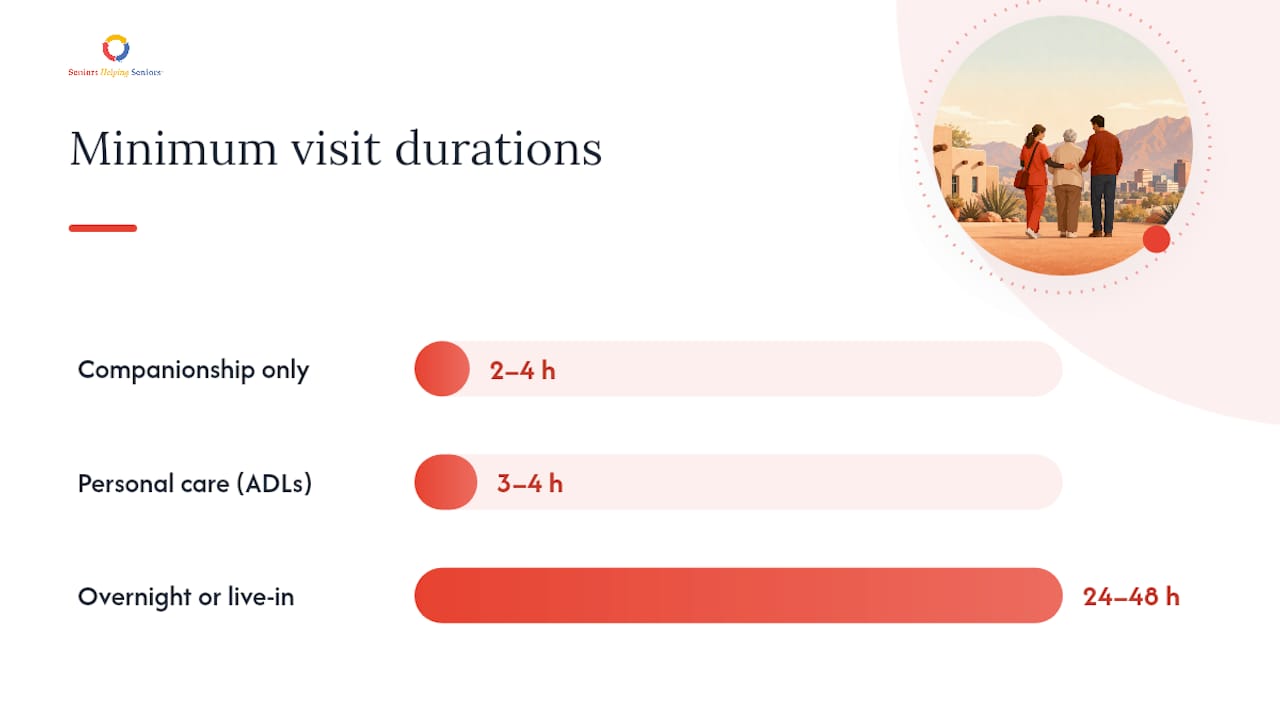
| Service type | Typical hourly range | Minimum visit |
|---|---|---|
| Companionship only | $25–30/hr (illustrative) | 2–4 hours |
| Personal care (ADLs) | $25–30/hr (illustrative) | 3–4 hours |
| Overnight or live-in | Higher flat rate; ask agency | 24–48 hours |
Payment options to explore:
- Private pay: Most non-medical care is self-funded. Ask for an itemized estimate, overtime rates, and cancellation policy upfront.
- VA benefits: Veterans and surviving spouses may qualify for Aid and Attendance or the Program of Comprehensive Assistance for Family Caregivers (PCAFC).
- Medicaid HCBS waivers: Arizona's ALTCS (Arizona Long Term Care System) may cover in-home support for eligible low-income seniors. Contact your Area Agency on Aging (AAA) for a referral.
- Long-term-care insurance: Review the policy's elimination period and covered services before assuming it applies.
- AAA respite grants: The Southern Arizona Area Agency on Aging administers limited respite funds for family caregivers. Call 211 to connect.
Pro Tip: Ask agencies about short-term trial packages or a guaranteed first-72-hour response rate. Limiting the initial financial commitment lets you assess fit before signing a longer arrangement.
What does the evidence say, and when should you call for help?
Key finding: A systematic review and network meta-analysis of 126 trials found that low-complexity transitional care interventions, including early follow-up and home-based support, reduced 30-day readmissions (OR 0.78). Medium-complexity interventions improved medication adherence and reduced 90-day readmissions.
A 2025 systematic review of 25 randomized controlled trials (17,542 participants) found that early follow-up and family involvement were the strongest predictors of short-term improvement in functional status and mood. Most benefits concentrated in the first one to three months, which is exactly the window non-medical home care covers best.
The practical mechanisms are straightforward: a caregiver who shows up consistently handles medication reminders, reduces fall risk, and notices early warning signs before they become emergencies.
Call the clinician (not 911) for:
- Fever above 101°F with redness or discharge at a wound site
- New confusion or unusual drowsiness
- Significant change in appetite or fluid intake
- Pain that is new or worsening
Call 911 immediately for:
- New chest pain or pressure
- Difficulty breathing
- Sudden severe weakness or inability to speak
- Uncontrolled bleeding
Escalation order: Contact the primary clinician first. If unavailable and the situation is urgent, go to urgent care. If the situation is life-threatening, call 911 and have the medication list and discharge paperwork ready to hand to paramedics.
A note from a Tucson perspective
What families often underestimate is how much the first 72 hours hinge on the caregiver's familiarity with the person, not just the task list. A caregiver who shares a similar background, speaks the same language, or has navigated a comparable health experience brings something a checklist cannot: genuine attentiveness. In Tucson, that often means Spanish-language availability, familiarity with the city's spread-out geography for transportation to Banner or TMC follow-up appointments, and an understanding of the close-knit family dynamics that shape how care decisions get made here.

The matching process matters more than most families realize at discharge. Families frequently request short-term, high-intensity support for the first week and then scale back as confidence grows. That flexibility, combined with a caregiver who actually knows the person, is what keeps people out of the emergency department.
Seniors Helping Seniors® Tucson is ready to start after your discharge
Seniors Helping Seniors® Tucson pairs older adults returning home from the hospital with mature, active caregivers who share similar life experiences. A caregiver who genuinely connects with your parent notices subtle changes that can help prevent emergency readmissions.

Services cover companionship, personal care and ADL assistance, medication reminders, meal preparation, light housekeeping, and transportation to follow-up appointments. For post-discharge starts, the team can schedule a first visit within 24–48 hours, provide a written care agreement before arrival, and document a first 72-hour response plan. Caregivers pass background checks and receive ongoing training. Every engagement starts with a matching conversation, not a random assignment.
To get started, contact Seniors Helping Seniors® Tucson with the patient's address, anticipated discharge date, and a copy of the written medication list. The team will confirm availability and schedule an expedited first visit.
Sources
Bring printed links or citations to discharge meetings so the hospital team can see you've done your homework.
- Transitional Care Interventions From Hospital Reduce Health Care Use and Improve Patient Outcomes: A Systematic Review and Network Meta-Analysis
- Systematic review of transitional care interventions for older adults
- Choosing an in-home caregiver
- Hospital Discharge Planning: A Guide for Families and Caregivers
- Managing Caregiving Transitions from Hospitals to Skilled Nursing, Rehab or Assisted Living and Back Home
- How to Find Post-Acute Care After a Hospital Discharge: A Family's Step-by-Step Guide