
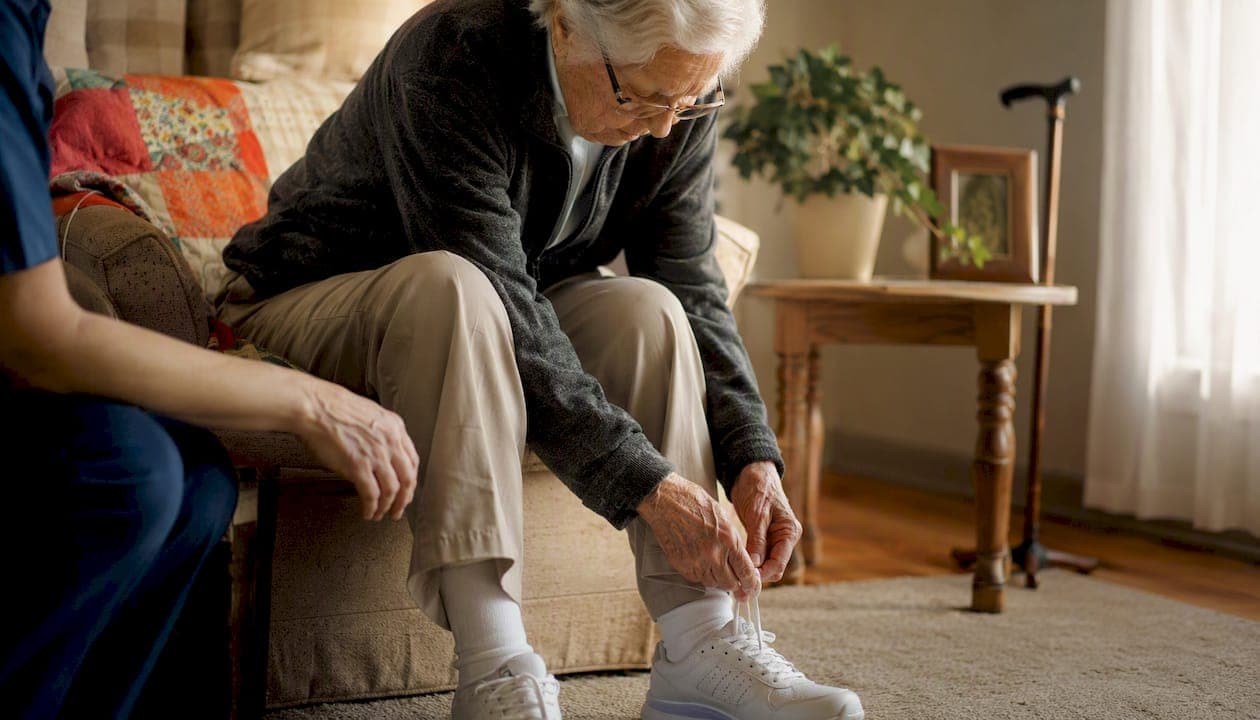
Activities of daily living (ADLs) are the basic self-care tasks clinicians use to measure a person's functional independence. Think bathing, dressing, eating, using the toilet, moving from a bed to a chair, and controlling bladder and bowel function. Lose the ability to do several of these safely, and the clinical picture changes fast: discharge planners start talking about rehab, home health agencies, or assisted living. The Cleveland Clinic and StatPearls/NCBI Bookshelf both treat ADL status as one of the strongest predictors of whether someone can safely return home after a hospitalization.
Basic ADLs (the physical six):
- Bathing and personal hygiene
- Dressing and undressing
- Eating and feeding
- Toileting (getting to and using the toilet)
- Transferring (moving between bed, chair, and standing)
- Continence (bladder and bowel control)
Instrumental ADLs (IADLs — the complex daily tasks):
- Managing finances and paying bills
- Managing medications
- Meal preparation
- Grocery shopping
- Housekeeping and laundry
- Transportation and driving
- Using the telephone or other communication devices
- Home maintenance
The two main tools clinicians reach for are the Katz Index of Independence in Activities of Daily Living/22%3A_Activity/22.03%3A_Activities_of_Daily_Living_(ADLs)) (which scores the six basic ADLs) and the Lawton Instrumental Activities of Daily Living Scale (which covers the eight IADL domains). ADL status directly shapes decisions about discharge planning, home care eligibility, and long-term care placement.
Key Takeaways
ADL status is one of the most reliable indicators of whether an older adult can safely live independently, and catching decline early gives families the most options.
| Point | Details |
|---|---|
| ADLs measure functional independence | Six basic ADLs (bathing, dressing, eating, toileting, transferring, continence) and eight IADLs determine care needs and eligibility. |
| IADL decline comes first | Missed medications, unpaid bills, and expired food often signal IADL loss months before basic ADL impairment appears. |
| Four main assessment tools | Katz Index, Lawton IADL Scale, Barthel Index, and Kohlman Evaluation each serve different settings and score ranges. |
| Scores drive coverage decisions | Insurers, Medicaid, VA, and long-term care policies use ADL scores as primary eligibility criteria for benefits. |
| Tucsonshs provides matched in-home support | Seniors Helping Seniors® Tucson offers personal care, companionship, and daily living assistance with caregiver-client compatibility matching in the Tucson area. |
Table of Contents
- What are activities of daily living, exactly?
- The six basic ADLs and what each one means
- What are instrumental ADLs, and why do they decline first?
- Why ADL status matters clinically
- Who assesses ADLs, and when does it happen?
- What assessment tools do clinicians use?
- How to interpret scores and plan next steps
- Interventions that restore or compensate for ADL impairments
- Red flags families should watch for
- How in-home care helps maintain ADLs
- Questions to bring to clinicians and care providers
- Authoritative resources and assessment tools
- Legal and ethical considerations in ADL assessments
- How ADL status affects insurance and healthcare coverage
- How technology supports ADL assessment and daily living
- What working with ADL changes actually looks like
- Tucsonshs supports ADLs in Tucson and surrounding communities
- Sources
What are activities of daily living, exactly?
The term was formalized in the 1960s by Dr. Sidney Katz, a geriatrician at the Benjamin Rose Hospital in Cleveland, who developed the Katz Index to track recovery in hip fracture patients. His insight was simple but powerful: functional independence in self-care tasks follows a predictable pattern, and losing that independence signals something clinically meaningful beyond the primary diagnosis.
The clinical definition goes a step further than just "can they do it." Clinicians ask whether someone can perform an ADL safely, consistently, and without prompting. A person with early dementia may technically be able to dress themselves on a good day but skip it entirely on a bad one, or put clothes on in the wrong order. That inconsistency counts as impairment in a formal assessment.
Clinicians measure ADLs at several key moments: hospital admission (to establish a baseline), at discharge (to determine safe placement), during rehab (to track progress), and at primary care visits or memory clinic evaluations (to catch gradual decline). Long-term care programs and insurers also use ADL scores to determine eligibility for benefits.
One nuance worth knowing: cultural and generational expectations shape what counts as "independent." In some households, meal preparation has always been shared; in others, a person who never cooked would not be flagged as impaired. Occupational therapists are trained to account for these variations, which is one reason their assessments tend to be more nuanced than a quick checklist.
The six basic ADLs and what each one means
The Wyoming Department of Health's item-by-item rating guide illustrates how each basic ADL is operationalized in practice. Here is the standard list with concrete examples of what mild versus severe dependence looks like:
- Bathing. Washing the body, including getting in and out of the tub or shower. Mild dependence: needs a grab bar and verbal reminders to wash hair. Severe dependence: requires full physical assistance for all washing.
- Dressing. Selecting and putting on clothing, including fasteners and footwear. Mild: can dress upper body but needs help with buttons, shoes, and socks. Severe: cannot initiate or complete any part of dressing without hands-on help.
- Eating/feeding. Getting food from the plate to the mouth. Mild: needs food cut up or adaptive utensils. Severe: requires someone to spoon-feed every meal.
- Toileting. Getting to the toilet, managing clothing, and cleaning afterward. Mild: needs help with clothing or cleanup. Severe: fully dependent on a caregiver for all steps.
- Transferring. Moving between surfaces: bed to chair, chair to standing, in and out of a car. Mild: needs standby assistance or a walker. Severe: requires a mechanical lift and two-person assist.
- Continence. Controlling bladder and bowel function. Mild: occasional accidents managed with protective garments. Severe: total incontinence requiring full management by a caregiver.
The distinction between independence, supervision, and hands-on assistance matters for scoring. Independence means doing the task without any help or prompting. Supervision means someone needs to be present for safety but does not touch the person. Hands-on assistance means physical contact is required.
Some tools split these categories further. The Barthel Index separates grooming from bathing and distinguishes bowel from bladder continence, giving a finer-grained picture. The Katz Index keeps it simpler, which is part of why it remains so widely used in quick clinical screenings.

What are instrumental ADLs, and why do they decline first?
IADLs require more cognitive organization than basic ADLs. Managing a medication schedule, balancing a checkbook, planning and cooking a meal — these tasks depend on executive function, memory, and sequencing. That is exactly why IADL decline tends to show up earlier than basic ADL loss, often by months or years.
Common IADLs assessed in clinical practice:
- Managing finances (paying bills, balancing accounts, avoiding scams)
- Medication management (filling prescriptions, taking correct doses at correct times)
- Meal preparation (planning, shopping, cooking, and storing food safely)
- Grocery shopping and errands
- Housekeeping (maintaining a reasonably clean and safe living environment)
- Laundry
- Transportation (driving or arranging rides independently)
- Using a telephone, computer, or other communication device
- Home maintenance and repairs
The early warning signs families often miss: a refrigerator full of expired food, a stack of unopened bills, a medication organizer that has not been touched in days, or a house that has become noticeably dirtier than usual. These are IADL failures, and catching them early matters. Lighter interventions, such as meal delivery, a medication management app, or a few hours of in-home companionship per week, can often stabilize the situation before a crisis forces a much bigger transition.
When IADL decline is identified, it commonly triggers a referral to occupational therapy for a full functional assessment, or to a care coordinator who can arrange in-home supports. The Cleveland Clinic notes that IADL decline often precedes basic ADL loss and that home supports can slow that progression meaningfully.
Why ADL status matters clinically
ADL impairment is not just a description of what someone cannot do. It is a predictor. Clinicians use ADL scores to anticipate falls, malnutrition, medication errors, poor hygiene leading to skin breakdown or infection, and the likelihood of hospitalization or nursing home admission. StatPearls/NCBI Bookshelf identifies inability to perform ADLs as a strong predictor of the need for paid care and nursing home placement.
According to a survey cited by WebMD, a significant portion of adults older than 85 require assistance with at least one ADL. That figure reflects the scale of the need, not an outlier situation.
One concept clinicians use that families rarely hear about is "ADL creep": the gradual, almost imperceptible loss of function across multiple ADLs over months or years. A person stops bathing daily, then starts skipping shaving or hair care, then begins eating less because cooking feels like too much effort. Each step alone seems minor. Together, they signal a trajectory that, without intervention, often ends in a preventable crisis.
Pro Tip: If you notice a loved one declining in two or more IADLs over a few months, request a formal ADL assessment from their primary care physician or an occupational therapist before the situation reaches a tipping point. Early assessment opens the door to lighter, less disruptive interventions.
ADL findings connect directly to care decisions. A person who scores poorly on transferring and continence but remains strong in IADLs may do well with a home health aide and physical therapy. Someone who has lost most basic ADLs and several IADLs is likely a candidate for assisted living or skilled nursing evaluation. ADL scores also factor into Medicare and Medicaid eligibility determinations, long-term care insurance claims, and Veterans Affairs benefit assessments.
Who assesses ADLs, and when does it happen?
ADL assessments happen across a wide range of settings, performed by different clinicians depending on the context:
- Registered nurses and licensed practical nurses conduct ADL screenings on hospital admission and before discharge.
- Occupational therapists (OTs) perform the most detailed functional assessments, often observing the person actually attempting tasks rather than relying on self-report.
- Physical therapists (PTs) focus particularly on mobility, transferring, and fall risk.
- Physicians and nurse practitioners incorporate ADL status into primary care visits, especially for older adults or those with chronic conditions.
- Social workers and discharge planners use ADL scores to match patients with appropriate post-acute care settings.
- Home health nurses and care coordinators reassess ADLs during home visits to track changes over time.
Assessment timing follows predictable triggers: hospital admission, pre-discharge planning, after a fall or acute illness, at a memory clinic or dementia evaluation, during a long-term care eligibility review, and at annual wellness visits for older adults.
The method varies by setting. Observation-based assessment (watching someone actually perform a task) is the most accurate but also the most time-intensive. Self-report works reasonably well for cognitively intact adults. Caregiver report is often used when the person being assessed has dementia or cannot reliably describe their own abilities — though caregivers sometimes overestimate or underestimate function, which is why trained clinicians triangulate across all three sources.
What assessment tools do clinicians use?
Four instruments dominate clinical practice for ADL and IADL measurement. Each has a different focus, scoring range, and ideal setting.
| Tool | What it measures | Score range | Typical setting | Key strength | Key limitation |
|---|---|---|---|---|---|
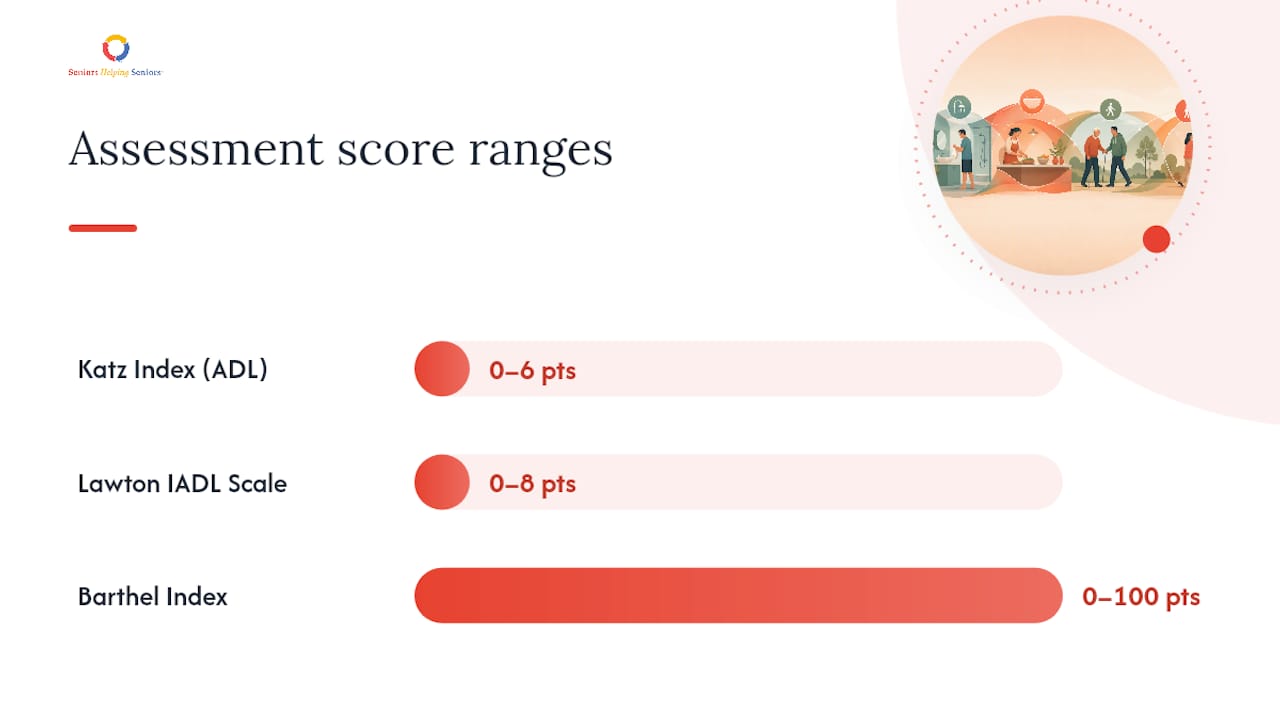
| Katz Index of ADL | 6 basic ADLs | 0–6 (6 = fully independent) | Hospital, primary care, long-term care | Simple, fast, widely validated | Insensitive to small changes; no IADLs |
| Lawton IADL Scale | 8 IADL domains | 0–8 (8 = fully independent) | Community, outpatient, primary care | Detects early cognitive decline via IADL loss | Self-report; historically gendered scoring |
| Barthel Index | 6 basic ADL items | 0–100 (100 = fully independent) | Rehab, acute hospital | Sensitive to gradual improvement; granular | Longer to administer; ceiling effect in high-functioning adults |
| Kohlman Evaluation of Living Skills (KELS) | Basic and instrumental living skills | Pass/Fail across multiple tasks | Psychiatric, cognitive impairment settings | Observational; good for cognitive decline | Requires trained OT; less used in general medical settings |
Scoring examples in plain language:
A Katz score of 6/6 means the person is fully independent in all six basic ADLs. A score of 4/6 typically means they need help with two tasks, often bathing and dressing, and signals a moderate level of dependence. A score of 2/6 or below indicates substantial dependence and usually triggers a conversation about supervised living or skilled nursing care.
The Lawton scale runs 0–8, where 8 means the person manages all eight IADL domains independently. A score of 4–5 often reflects early-to-moderate IADL impairment, common in mild cognitive impairment or early dementia. A score below 3 suggests significant functional loss in community living skills.
The Barthel Index scores 0–100 across ten items. Scores of 61–99 generally indicate modified independence or mild dependence; 21–60 suggests moderate dependence; 20 or below indicates severe dependence and high likelihood of needing institutional care.
As StatPearls/NCBI Bookshelf notes, the Katz is sensitive to large declines and works well for quick screening, while the Barthel provides gradations that make it more useful in rehab settings where tracking incremental progress matters. The Lawton, being self-report-based, can detect IADL changes earlier than tools that focus only on physical tasks.
The Lawton IADL Scale PDF is freely available and widely used; the Kohlman Evaluation of Living Skills requires a trained occupational therapist to administer and is most commonly used in psychiatric or cognitive impairment settings.
How to interpret scores and plan next steps
Understanding a score is one thing. Knowing what to do with it is another.
Full independence (Katz 6/6, Lawton 8/8, Barthel 91–100) means the person can manage their daily life without assistance. Monitoring continues, but no immediate intervention is indicated.
Partial dependence covers a wide range. Consider these scenarios:
- Needs help with bathing and dressing but manages all IADLs independently. This often responds well to a part-time in-home aide (two to three hours a day), grab bars and a shower chair, and a follow-up PT evaluation for fall risk. No facility placement is typically needed at this stage.
- Manages basic ADLs but struggles with medications, finances, and meal preparation. This IADL-dominant picture suggests early cognitive decline. Medication management tools (pill organizers, automated dispensers), meal delivery, and a weekly check-in from a care coordinator or in-home companion can stabilize the situation.
- Cannot transfer safely and has lost continence. This combination carries a high risk of falls, skin breakdown, and caregiver burnout. Without 24-hour supervision or skilled nursing support, home safety becomes difficult to maintain.
Full dependence (Katz 0–2/6, Barthel 0–20) almost always requires either a skilled nursing facility or a very high level of in-home support, including overnight coverage.
A checklist for families discussing scores with clinicians:
- Ask which specific ADL items were scored as dependent, not just the total score.
- Ask whether the assessment was observation-based or self-report, and whether a caregiver was also interviewed.
- Ask what the clinician expects the trajectory to be: stable, slowly declining, or rapidly worsening.
- Ask what interventions are realistic given the diagnosis (e.g., post-surgical recovery vs. progressive dementia).
- Ask what the next reassessment trigger will be and who will perform it.
Interventions that restore or compensate for ADL impairments
Recovery is possible for many people, but the realistic ceiling depends heavily on the underlying cause.
Rehabilitation approaches:
- Physical therapy targets mobility, strength, balance, and safe transferring. After hip replacement, most patients regain functional independence in basic ADLs within 6–12 weeks of consistent PT.
- Occupational therapy addresses the full ADL picture: adaptive techniques, assistive devices, home modification recommendations, and cognitive strategies for IADL tasks. OTs are the primary clinicians for ADL-specific intervention.
- Speech-language pathology addresses swallowing (relevant to the eating ADL) and cognitive-communication skills that affect IADLs.
Practical supports and assistive devices:
- Grab bars, shower chairs, and raised toilet seats for bathing and toileting
- Dressing aids (button hooks, long-handled shoehorns, elastic laces)
- Adaptive utensils and plate guards for eating
- Stair lifts, hospital beds, and transfer boards for mobility
- Automated pill dispensers and blister packs for medication management
- Meal delivery services (Meals on Wheels and similar programs) for nutrition
- Ride-share programs and medical transport for transportation IADLs
Caregiver roles in ADL support:
- Companionship and social engagement, which reduce isolation and support motivation to maintain routines
- Hands-on assistance with bathing, dressing, and personal care
- Supervision and coaching (standing by while someone attempts a task, prompting steps)
- Medication reminders and monitoring for missed doses
- Light housekeeping and meal preparation to maintain a safe, clean environment
Pro Tip: Before purchasing assistive devices, ask for an OT home visit. An occupational therapist can assess the actual layout of the home and recommend the right equipment for that specific space, preventing costly purchases that do not fit or get abandoned.
Some conditions will not fully restore ADL function. Advanced dementia, late-stage Parkinson's disease, ALS, and severe stroke with significant neurological damage often mean the goal shifts from recovery to compensation and safety. In these cases, the clinical conversation moves toward what level of support keeps the person safe and comfortable, rather than what might return them to independence.
Red flags families should watch for
Gradual ADL decline rarely announces itself clearly. These are the warning signs worth acting on:
- Missed medications or a pill organizer that is never empty
- Unexplained weight loss or a refrigerator full of expired food
- Noticeably poor hygiene: unwashed hair, body odor, unchanged clothing
- Repeated falls, even minor ones, or new bruises without a clear explanation
- Unpaid bills, collection notices, or confusion about finances
- Social withdrawal, missed appointments, or stopped hobbies
- A house that has become significantly messier or dirtier than usual
When to seek urgent care: A fall with injury, sudden confusion, signs of malnutrition or dehydration, or a medication error with health consequences all warrant a same-day call to a physician or an emergency room visit.
When to schedule an outpatient assessment: Two or more warning signs from the list above, a noticeable change over the past few months, or a family member's gut feeling that something is "off" are all sufficient reasons to request a formal ADL evaluation. Do not wait for a crisis.
Immediate action steps:
- Call the primary care physician and describe specific observations (not just "they seem worse").
- Request a referral to occupational therapy for a home safety and functional assessment.
- Contact a home health agency to discuss temporary support while the assessment is arranged.
- Remove obvious hazards from the home: loose rugs, poor lighting, clutter in walkways.
How in-home care helps maintain ADLs
In-home care does more than check tasks off a list. The structure of regular visits, a consistent caregiver, and the social engagement that comes with it can slow ADL decline in ways that task-only care cannot replicate.
Services that directly support daily living skills include:
- Personal care assistance (bathing, dressing, grooming, toileting)
- Meal preparation and monitoring of food intake
- Medication reminders and observation for missed doses
- Light housekeeping to maintain a safe environment
- Transportation to medical appointments and errands
- Companionship and social engagement throughout the day
The companionship component is often underestimated. Research cited by the Cleveland Clinic supports the view that matched caregivers who share similar life experiences with their clients improve emotional well-being and adherence to care plans. A person who looks forward to their caregiver's visit is more likely to eat, take medications, and engage in light activity than one who spends most of the day alone.
Questions to ask any in-home care provider:
- What specific ADL tasks are your caregivers trained and authorized to assist with?
- How do you match caregivers to clients, and what happens if the match is not working?
- Are all caregivers background-checked and insured?
- What is your backup plan when a regular caregiver is unavailable?
- How do you communicate changes in a client's condition to the family and to the client's medical team?
- What is the minimum number of hours per visit, and can scheduling be adjusted as needs change?
Red flags in care agreements: vague service descriptions ("general assistance"), no mention of background checks, no supervision structure for caregivers, and no process for reporting health changes to family or clinicians.
Pro Tip: Ask the agency whether caregivers receive specific training in dementia care and fall prevention, even if your loved one does not currently have a dementia diagnosis. These skills translate directly to safer ADL assistance for any older adult.
The Medicine LibreTexts resource on ADLs notes that families who catch early IADL warning signs and arrange lighter supports, such as meal delivery, medication management, and companionship, can often avoid or significantly delay the need for facility-level care.
Questions to bring to clinicians and care providers
Walking into a care planning meeting without a list of questions is one of the most common ways families leave without the information they need.
For clinicians:
- Which specific ADL and IADL items did you assess, and which ones showed deficits?
- Which assessment tool did you use, and what was the score?
- Was the assessment observation-based, self-report, or caregiver report?
- What is the likely trajectory: stable, slowly declining, or rapidly worsening?
- What rehabilitation outcomes are realistic given the diagnosis and current functional level?
- What level of care do you recommend, and what would change that recommendation?
- When should we reassess, and what would trigger an earlier evaluation?
For care providers:
- What is your caregiver-to-client ratio, and how are caregivers supervised?
- How do you handle a situation where a client's needs exceed what your caregivers are trained to provide?
- What is your process for communicating health changes to the family and the medical team?
- Can you provide references from families with similar care needs?
- What does your service agreement say about service limits and termination?
Red flags in care agreements: no written service description, no background check policy, no defined escalation process when a client's condition changes, and no clear statement of what the agency does not do.
Authoritative resources and assessment tools
These primary sources are worth bookmarking and bringing to clinical appointments:
- Cleveland Clinic — ADLs and IADLs: Clear lay definitions with clinical grounding; good for explaining ADLs to family members.
- StatPearls/NCBI Bookshelf — Activities of Daily Living: The clinical reference clinicians themselves use; detailed on assessment tools and scoring.
- WebMD — What Are ADLs and How They're Measured: Accessible overview with population statistics; good starting point for families new to the topic.
- Wyoming Department of Health — Descriptions of ADLs and IADLs: Item-by-item rating descriptions used in practical assessments; helpful for understanding exactly how each ADL is evaluated.
- Lawton IADL Scale PDF — University of Missouri Geriatric Toolkit: The actual instrument, freely downloadable; useful to review before a clinical appointment.
- LTCFeds Care Navigator — ADLs: Government resource explaining how ADL status connects to long-term care benefits planning.
A note on self-assessment: these tools are useful for understanding what clinicians measure and for tracking changes over time, but scores should always be interpreted by a trained clinician who knows the full clinical picture.
Legal and ethical considerations in ADL assessments
ADL assessments carry real legal weight in the United States, and families are often unaware of how much.
Guardianship and conservatorship. Courts in every U.S. state consider functional capacity, including ADL performance, when determining whether a person needs a legal guardian or conservator. A formal ADL assessment from a licensed clinician is typically required as part of that process. The standard is not just cognitive capacity but the ability to manage daily life safely.
Informed consent. A person's right to make their own care decisions does not disappear when ADL function declines. Clinicians are ethically and legally required to assess decision-making capacity separately from functional capacity. Someone who needs full assistance with bathing may still have complete legal capacity to refuse a care plan or choose their own living situation.
Mandatory reporting. In most U.S. states, clinicians who identify significant ADL impairment in a context suggesting neglect or self-neglect are required to report to Adult Protective Services. This is particularly relevant for older adults living alone who are found with severe hygiene deficits, malnutrition, or unsafe living conditions.
Advance directives and care preferences. ADL assessments often surface the need for advance care planning conversations. When a person's functional trajectory suggests increasing dependence, the time to document preferences about future care, living situation, and medical interventions is before a crisis, not during one. Documents like a healthcare proxy, durable power of attorney, and POLST (Physician Orders for Life-Sustaining Treatment) become practically important once ADL decline is identified.
Ethical tensions in assessment. Clinicians sometimes face pressure from families to document greater impairment than observed (to qualify for benefits) or less impairment (to avoid facility placement). Accurate, observation-based assessment is both an ethical obligation and a legal one. Falsifying ADL scores to influence insurance or government benefit decisions constitutes fraud.
This information is general in nature and does not constitute legal advice. Consult a licensed elder law attorney for guidance specific to your situation.
How ADL status affects insurance and healthcare coverage
ADL scores are not just clinical data. They are gatekeeping criteria for a significant amount of financial assistance in the U.S.
Medicare. Original Medicare (Parts A and B) does not cover custodial care, meaning ongoing help with ADLs in the home or a nursing facility. It does cover skilled care: physical therapy, occupational therapy, skilled nursing, and home health services ordered by a physician following a qualifying hospital stay. Once the skilled care need ends, Medicare coverage stops, even if the person still needs ADL assistance.
Medicaid. Medicaid is the primary payer for long-term custodial care in the U.S. Eligibility for home and community-based services (HCBS) waivers, which fund in-home ADL assistance, typically requires documented impairment in a defined number of ADLs (often two or more). The exact threshold varies by state. Nursing home Medicaid also uses ADL scores as part of the level-of-care determination.
Long-term care insurance. Most private long-term care insurance policies define a benefit trigger as needing substantial assistance with at least two of six ADLs, or having a severe cognitive impairment. The specific ADLs listed in the policy matter: some policies use a slightly different list than the standard Katz six. Understanding the policy's exact language before a claim is filed prevents disputes. For more on how ADL limitations interact with assisted living and Medicare decisions, the XactInsure Medicare and assisted living guide provides a practical breakdown.
Veterans Affairs (VA). The VA uses ADL assessments to determine eligibility for Aid and Attendance benefits, which provide financial assistance for veterans and surviving spouses who need help with daily living skills. A physician's statement documenting ADL impairment is required as part of the application.
Social Security Disability Insurance (SSDI) and Supplemental Security Income (SSI). ADL limitations are one component of the functional assessment the Social Security Administration uses when evaluating disability claims, particularly for older applicants.
The Cleveland Clinic notes that ADL assessment scores are commonly the primary factor insurers and government programs examine when determining eligibility for financial assistance or long-term care benefits. Getting the assessment right, and documented correctly, matters financially as much as it does clinically.
How technology supports ADL assessment and daily living
Remote monitoring and digital tools have moved from novelty to practical clinical infrastructure over the past decade, particularly for older adults aging in place.
Wearable sensors and motion monitoring. Devices worn on the wrist or placed around the home (door sensors, motion detectors, bed sensors) can track activity patterns over time. Changes in gait speed, sleep patterns, or daily movement routines can signal ADL decline before a family member or clinician notices it directly. Several health systems now use passive monitoring platforms to flag changes for care coordinators.
Automated medication dispensers. Devices like automated pill dispensers with alarms and locking compartments address one of the most common IADL failures: medication management. Some systems alert caregivers or family members when a dose is missed.
Telehealth and remote ADL assessment. Occupational therapists increasingly conduct virtual home assessments using video calls, guiding clients through tasks while observing performance. While not a full substitute for in-person observation, telehealth assessments can identify obvious hazards and functional changes between in-person visits.
Voice-activated assistants. Devices like Amazon Echo and Google Nest can serve as medication reminders, emergency call systems, and communication tools for older adults with limited mobility. For someone whose IADL decline includes difficulty using a telephone, a voice-activated device can restore that function without requiring fine motor skills.
Fall detection technology. Wearable fall detectors and smart home systems that detect falls and automatically alert emergency contacts or 911 address one of the most serious consequences of ADL impairment: undetected falls in a person living alone.
Technology supports ADLs best when it is introduced before a crisis and integrated into a broader care plan that includes human oversight. A sensor that flags a change in routine is only useful if someone is monitoring the data and knows what to do with it.
What working with ADL changes actually looks like
The clinical picture of ADL decline is rarely what families expect. Most people imagine a sudden, obvious change. What actually happens is slower and more ambiguous, which is part of why it goes unaddressed for so long.
The pattern that shows up repeatedly in in-home care: a person who was managing fine six months ago starts skipping breakfast, then stops opening mail, then begins wearing the same clothes for days at a time. Each step feels explainable in isolation. Taken together, they describe someone who has lost three or four IADLs and is beginning to slip in basic ADLs. By the time the family notices, the situation is already moderate.
What actually helps at that stage is not a facility placement or a dramatic intervention. It is consistency: a caregiver who shows up at the same time every day, prepares a real meal, sits down and talks, and notices when something is different. The assessment tools, the Katz score, the Lawton scale, are useful for documenting what is happening and communicating it to clinicians. But the daily reality of ADL support is much more human than a checklist.
Families sometimes resist in-home care because they worry their loved one will see it as an admission of failure. The framing that tends to work better: this is not about what someone cannot do anymore. It is about making sure the things they can still do, they keep doing.
Tucsonshs supports ADLs in Tucson and surrounding communities
When ADL decline reaches the point where a family needs real, consistent support, the caregiver model matters as much as the service list. Tucsonshs (Seniors Helping Seniors® Tucson) offers in-home care across Tucson, Green Valley, Sierra Vista, and surrounding communities, with a model built around matching mature caregivers, often seniors themselves, with older adults who share similar life experiences.

Services that directly support daily living skills include personal care and hygiene assistance, meal preparation, medication reminders, light housekeeping, transportation to appointments, and companionship throughout the day. The compatibility-matching approach means caregivers and clients tend to build genuine rapport, which research supports as a factor in better adherence to care routines and improved emotional well-being.
For families navigating a new ADL assessment or a recent discharge from the hospital, the practical next step is a conversation about what level of support fits the current situation and how that might need to change over time. Contact Tucsonshs to discuss services, scheduling, and caregiver matching for your family's specific needs.
Sources
- Activities of Daily Living (ADLs and IADLs) — Cleveland Clinic
- Activities of Daily Living - StatPearls - NCBI Bookshelf
- Descriptions of ADLs & IADLs — Wyoming Department of Health
This article is general information, not a substitute for advice from a qualified doctor. Consult a qualified healthcare professional about your own circumstances before acting on anything here.